
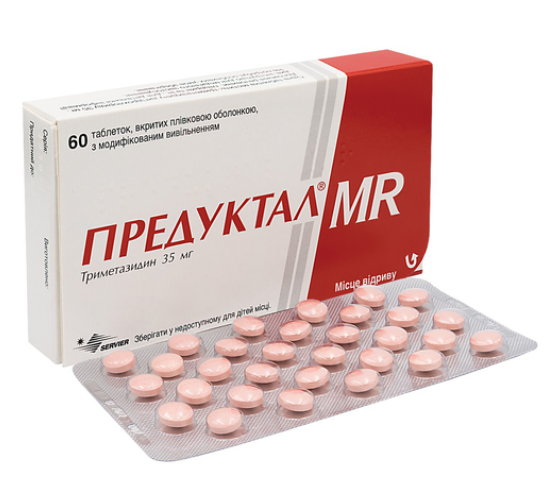
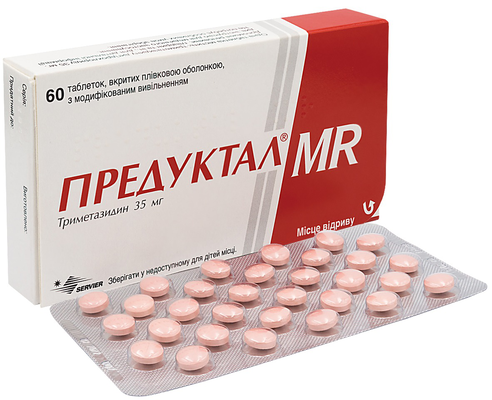
Preductal MR tablets, film-coated, with modified-release formulation, 35 mg each, No. 60 (30 x 2)
Ingredients
Active ingredient: trimetazidine;
1 tablet contains: 35 mg of trimetazidine dihydrochloride;
Inactive ingredients:
tablet: calcium hydrophosphate dihydrate, hypromellose 4000, magnesium stearate, povidone, colloidal anhydrous silicon dioxide;
coating: glycerin, macrogol 6000, magnesium stearate, hypromellose, red iron oxide (E 172), titanium dioxide (E 171).
Dosage Form
Film-coated tablets with modified-release formulation.
Main physical and chemical properties: pink, biconvex tablets, film-coated, with or without an imprint on one side.
Pharmacotherapeutic group
Cardiovascular agents. Trimetazidine. ATC code C01E B15.
Pharmacological properties
Pharmacodynamics.
Mechanism of action
By preserving energy metabolism in cells suffering from hypoxia or ischemia, trimetazidine prevents a decrease in intracellular ATP levels, thereby ensuring the proper functioning of ion pumps and transmembrane sodium-potassium flux while maintaining cellular homeostasis.
Trimetazidine inhibits β-oxidation of fatty acids by blocking long-chain 3-ketoacyl-CoA thiolase (3-KAT), which increases glucose oxidation. In ischemic cells, energy production via glucose oxidation requires less oxygen compared to energy production via β-oxidation of fatty acids. Enhancing glucose oxidation optimizes energy metabolism in cells and, consequently, maintains adequate energy metabolism under ischemic conditions.
Pharmacodynamic Effects
In patients with ischemic heart disease, trimetazidine acts as a metabolic agent, maintaining intracellular levels of high-energy phosphates in the myocardium. Anti-ischemic effects are achieved without concomitant hemodynamic effects.
Clinical Efficacy and Safety
Clinical studies have demonstrated the efficacy and safety of trimetazidine for the treatment of patients with stable angina, both as monotherapy and when added to other antianginal medications in cases of insufficient efficacy.
The TRIMPOL-II Study. A randomized, double-blind, placebo-controlled study involving 426 patients demonstrated that adding 60 mg of trimetazidine daily to 100 mg of metoprolol (50 mg twice daily) for 12 weeks resulted in a statistically significant improvement in exercise test parameters and clinical symptoms compared with placebo: total exercise duration—+20.1 s, p=0.023; total work performed: +0.54 MET-s, p=0.001; time to the onset of a 1-mm ST-segment depression: +33.4 s, p=0.003; time to onset of angina attack—+33.9 s, p<0.001; number of angina attacks per week: -0.73, p=0.014; use of short-acting nitrates per week: -0.63, p=0.032, with no change in hemodynamic parameters.
The SELLIER Study. A randomized, double-blind, placebo-controlled trial involving 223 patients demonstrated that in a subgroup of patients (n=173), who received trimetazidine modified-release tablets at 35 mg (twice daily) in addition to 50 mg of atenolol (once daily) for 8 weeks, there was a statistically significant increase (+34.4 s, p=0.03) in the time to a 1-mm ST-segment depression during exercise testing compared with placebo 12 hours after dosing. A statistically significant difference was also confirmed in the time to the onset of an angina attack (p=0.049). No statistically significant differences were found between the two patient groups for other secondary endpoints (total exercise duration, total work performed, and clinical endpoints).
The VASCO Study. In a randomized, double-blind study involving 1,962 patients that lasted 3 months, atenolol 50 mg daily was supplemented with trimetazidine 70 mg daily, 140 mg daily, or placebo. In the overall population, which included both symptomatic and asymptomatic patients, trimetazidine showed no benefits either in ergometric parameters (total exercise time, time to 1-mm ST-segment depression, and time to the onset of angina) or in terms of clinical endpoints. However, a post-hoc analysis of the subgroup of symptomatic patients (n = 1,574) showed that treatment with trimetazidine at a dose of 140 mg daily resulted in a statistically significant improvement in total exercise time (+23.8 s vs. +13.1 s for placebo; p=0.001) and time to onset of angina (+46.3 s vs. +32.5 s for placebo; p=0.005).
Pharmacokinetics.
The maximum concentration of trimetazidine in the blood is observed on average 5 hours after taking a tablet. Plasma concentration remains stable throughout the day: for 11 hours after taking the tablet, the plasma concentration of trimetazidine is equal to or higher than 75% of the maximum concentration. Steady-state concentrations are reached by the 60th hour at the latest. Food intake does not affect the pharmacokinetic characteristics of trimetazidine.
The volume of distribution is 4.8 L/kg; protein binding is low: 16% based on in vitro measurements.
Trimetazidine is excreted primarily in the urine, mostly in its unchanged form. The half-life averages 7 hours in healthy young volunteers and 12 hours in individuals aged 65 years and older. The complete elimination of trimetazidine results primarily from renal clearance, which correlates directly with creatinine clearance, and to a lesser extent from hepatic clearance, which decreases with age.
Special Patient Populations
Elderly patients.
A specific clinical study was conducted involving elderly patients receiving 35 mg of trimetazidine (1 tablet) twice daily. Analysis using a population pharmacokinetic model showed an increase in plasma concentrations. In elderly patients, trimetazidine concentrations may increase due to age-related decline in renal function. A dedicated pharmacokinetic study in patients aged 75–84 years or ≥ 85 years showed that in patients with moderate renal impairment (creatinine clearance 30–60 mL/min) trimetazidine concentrations were 1.0- and 1.3-fold higher, respectively, compared with younger patients (aged 30–65 years) with moderate renal impairment.
Renal impairment. The concentration of trimetazidine in the blood increases on average by a factor of 1.7 in patients with moderate renal impairment (creatinine clearance 30–60 mL/min) and by 3.1-fold in patients with severe renal impairment (creatinine clearance < 30 mL/min) compared with healthy volunteers with normal renal function. No additional safety concerns were observed in this population compared with the general population.
Indications
In adults, trimetazidine is indicated for the symptomatic treatment of stable angina when first-line antianginal medications are ineffective or not tolerated.
Contraindications
- Hypersensitivity to the active ingredient or to any excipient.
- Parkinson’s disease, symptoms of parkinsonism, tremor, restless legs syndrome, and other movement disorders related to the above.
- Severe renal insufficiency (creatinine clearance < 30 mL/min).
Drug Interactions and Other Interactions
No interactions with other medications have been reported.
Special considerations for use
This medication is not intended for the relief of angina attacks. It should not be prescribed for unstable angina or myocardial infarction as first-line therapy in the prehospital setting or during the first few days of hospitalization.
If an episode of unstable angina occurs during ongoing therapy, the patient’s condition must be reassessed and treatment adjusted (pharmacotherapy and consideration of revascularization).
Trimetazidine may cause or worsen symptoms of parkinsonism (tremor, akinesia, muscle rigidity), which should be monitored regularly, especially in elderly patients. In cases of uncertainty, patients should be referred to a neurologist for appropriate evaluation.
If motor disorders such as symptoms of parkinsonism, restless legs syndrome, tremor, or unsteadiness of gait occur, trimetazidine must be discontinued.
These cases are rare and usually resolve after discontinuation of treatment; in most patients, within 4 months after stopping trimetazidine. If symptoms of parkinsonism persist for more than 4 months after discontinuation of the drug, a neurologist should be consulted.
Falls associated with unsteadiness or hypotension may occur, especially in patients receiving antihypertensive therapy (see the “Adverse Reactions” section).
Trimetazidine should be prescribed with caution to patients at risk of elevated drug concentrations:
- patients with moderate renal impairment (see sections “Dosage and Administration” and “Pharmacokinetics”);
- elderly patients aged 75 years and older (see the “Dosage and Administration” section).
Athletes. This medication contains an active ingredient that may result in a positive anti-doping test.
Use During Pregnancy or Breastfeeding
Pregnancy
There are no data on the use of trimetazidine in pregnant women. Animal studies have not shown any direct or indirect harmful toxic effects on the reproductive system. To avoid any risk, the use of trimetazidine during pregnancy is not recommended.
Breastfeeding
It is unknown whether trimetazidine or its metabolites are excreted in breast milk. To avoid any risk to newborns or infants, the use of the medicinal product PREDUKTAL® MR is not recommended during breastfeeding.
Effect on reaction time when driving or operating machinery
According to clinical studies, trimetazidine does not affect hemodynamics; however, cases of dizziness and drowsiness have been reported during the postmarketing period (see the “Adverse Reactions” section), which may affect the ability to drive or operate machinery.
Dosage and Administration
For oral use.
1 tablet containing 35 mg of trimetazidine twice daily, in the morning and in the evening, with meals.
After 3 months of treatment, the results of treatment should be evaluated, and if no effect is observed, trimetazidine should be discontinued.
Special Patient Populations
Patients with renal impairment
For patients with moderate renal insufficiency (creatinine clearance 30–60 mL/min), the recommended dose is 1 tablet daily in the morning with breakfast (see the sections “Special Considerations for Use” and “Pharmacokinetics”).
Elderly patients
In elderly patients, blood concentrations of trimetazidine may be elevated due to age-related decline in renal function (see the “Pharmacokinetics” section). For patients with moderate renal impairment (creatinine clearance 30–60 mL/min), the recommended dose is 1 35-mg tablet in the morning with breakfast.
For elderly patients, the dose should be titrated with caution (see the “Special Considerations for Use” section).
Children
The safety and efficacy of trimetazidine in children (under 18 years of age) have not been studied. No data are available.
Overdose
Data on trimetazidine overdose are limited. Treatment is symptomatic.
Side Effects
Adverse reactions identified as side effects that may be associated with the use of trimetazidine are listed below according to their reported frequency: very common (≥ 1/10); common (≥ 1/100, < 1/10); uncommon (≥ 1/1,000, < 1/100); rare (≥ 1/10,000, < 1/1,000); very rare (< 1/10,000); frequency unknown (cannot be estimated from the available data).
| Classification by organ system | Frequency | Adverse reaction |
| Nervous system
|
Common | Dizziness, headache |
| Frequency unknown | Symptoms of parkinsonism (tremor, akinesia, muscle rigidity), unsteady gait, restless legs syndrome, and other movement disorders related to the above, which usually resolve after discontinuation of treatment | |
| Sleep disorders (insomnia, drowsiness) | ||
| Ear and vestibular system disorders | Frequency unknown | Vertigo |
| Cardiac disorders | Rare | Palpitations, extrasystoles, tachycardia |
| Vascular | Rare | Hypotension, orthostatic hypotension, which may be associated with malaise, dizziness, or falls, especially in patients taking antihypertensive medications; facial flushing |
| Gastrointestinal | Common | Abdominal pain, diarrhea, dyspepsia, nausea, and vomiting |
| Frequency unknown | Constipation | |
| Skin and subcutaneous tissue disorders | Common | Rash, itching, hives |
| Frequency unknown | Acute generalized exanthematous pustulosis, angioedema | |
| General disorders | Common | Asthenia |
| Blood and lymphatic system disorders | Frequency unknown | Agranulocytosis, thrombocytopenia, thrombocytopenic purpura |
| Hepatobiliary system | Frequency unknown | Hepatitis
|
Shelf life
3 years.
Storage conditions
No special storage conditions required. Keep out of reach of children.
Packaging
30 tablets per blister pack (PVC/aluminum); 2 blister packs per cardboard box.
Dispensing Category
By prescription only.







