
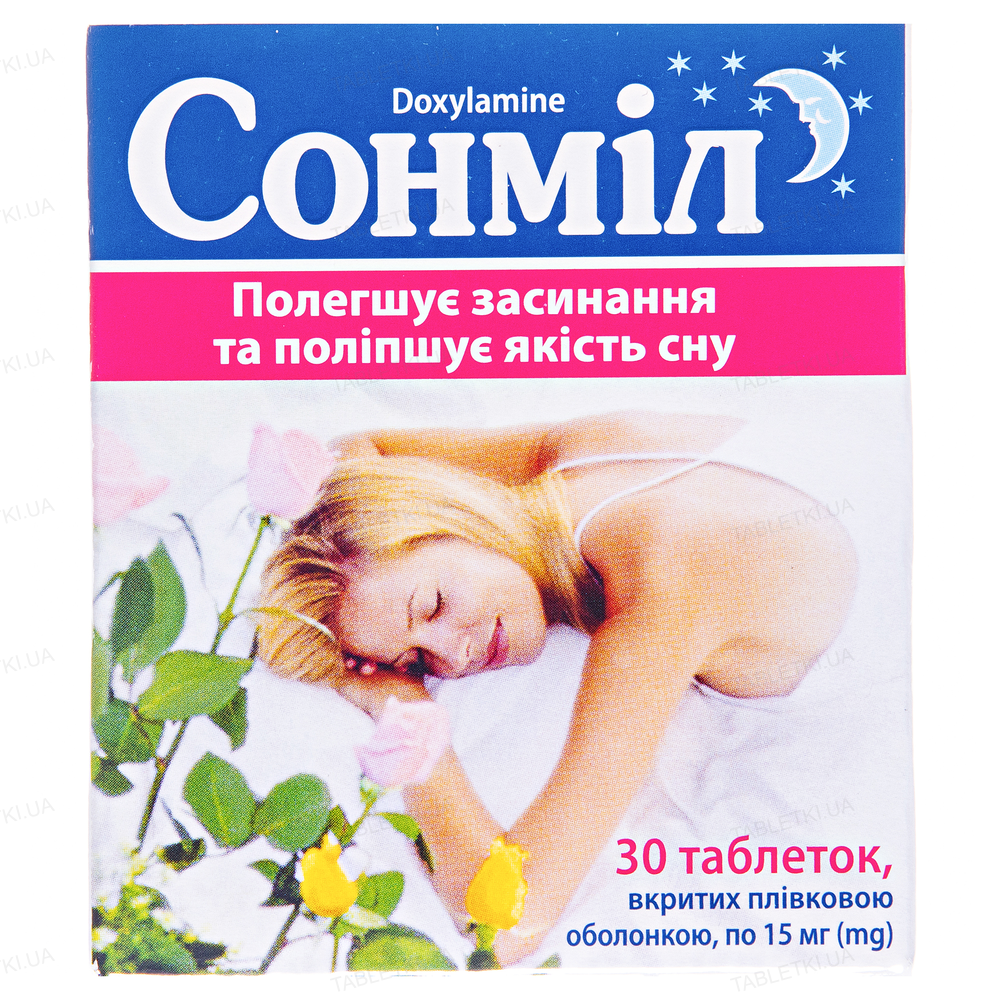
Sonmil tablets, film-coated, 15 mg, No. 30 (10 x 3)
Composition
Active ingredient: Each tablet contains 15 mg of doxylamine succinate;
excipients: lactose monohydrate; magnesium stearate; croscarmellose sodium; microcrystalline cellulose;
Coating: Opadry II White film-coating mixture: hypromellose (hydroxypropyl methylcellulose); lactose monohydrate; polyethylene glycol (macrogol); titanium dioxide (E 171); triacetin.
Dosage Form
Film-coated tablets.
Main physical and chemical properties: round tablets with a biconvex surface and a score line, coated with a white or almost white film coating.
Pharmacotherapeutic group
Antihistamines for systemic use.
ATC code R06A A09. Hypnotics and sedatives. ATC code N05C M.
Pharmacological properties
Pharmacodynamics.
Doxylamine succinate is an ethanolamine-class H1-histamine receptor blocker with sedative and atropine-like effects. It has been shown to reduce the time required to fall asleep and to improve the duration and quality of sleep.
Pharmacokinetics.
Maximum plasma concentration (Cmax) is reached on average 2 hours (Tmax) after administration of doxylamine succinate.
The average half-life in plasma (T½) is approximately 10 hours.
Doxylamine succinate is partially metabolized in the liver by demethylation and N-acetylation. The half-life may be significantly prolonged in the elderly or in patients with renal or hepatic impairment.
The various metabolites formed during the breakdown of the molecule are not quantitatively significant, as 60% of the administered dose is excreted in the urine as unchanged doxylamine.
Indications
Intermittent and transient insomnia in adults.
Contraindications
Hypersensitivity to doxylamine succinate, to excipients, or to other antihistamine medications.
History of angle-closure glaucoma in the patient or in the family.
Urethral or prostatic disorders associated with a risk of urinary retention.
Drug Interactions and Other Interactions
Alcohol potentiates the sedative effect of most H1-antihistamines. Consumption of alcoholic beverages and use of medications containing ethanol should be avoided.
Concomitant use with sodium oxybutyrate should be avoided due to increased central nervous system depression. Impaired reaction time may be hazardous when driving or operating machinery.
It should be noted that when this medication is used in combination with:
- atropine and atropine-like medications (imipramine antidepressants, anticholinergic antiparkinsonian medications, atropine-based antispasmodics, disopyramide, phenothiazine neuroleptics, as well as clozapine), side effects such as urinary retention, constipation, and dry mouth may occur;
- other antidepressants that affect the central nervous system (morphine derivatives [analgesics, medications used to treat coughs, and for substitution therapy], neuroleptics; barbiturates, benzodiazepines; anxiolytics other than benzodiazepines; sedative antidepressants (amitriptyline, doxepin, mianserin, mirtazapine, trimipramine); sedative H1-antihistamines; centrally acting antihypertensives; others: baclofen, pizotifen, thalidomide—may increase central nervous system depression.
Special Considerations for Use
Insomnia may have various causes that do not necessarily require medication; therefore, it is recommended to consult a doctor before starting treatment with this medication.
Since this medication contains lactose, it is contraindicated in cases of congenital galactosemia, glucose-galactose malabsorption syndrome, and lactase deficiency.
Like all hypnotics or sedatives, doxylamine succinate may exacerbate sleep apnea (increasing the number and duration of breathing pauses).
The risk of abuse and drug dependence is low. There have been reported cases of abuse leading to drug dependence. Patients should be closely monitored for early detection of signs of abuse or drug dependence. The duration of treatment should not exceed 5 days. This medication is not recommended for patients with a history of disorders caused by the use of psychoactive substances.
Doxylamine succinate remains in the body for approximately 5 half-lives.
The half-life may be significantly longer in the elderly and in individuals with renal or hepatic impairment. With repeated administration, the drug or its metabolites reach steady state much later and at higher levels. The efficacy and safety of the drug can only be assessed after steady state has been achieved.
A dose adjustment may be necessary (see the “Dosage and Administration” section).
H1-antihistamines should be used with caution in elderly patients due to the risk of dizziness, which increases the risk of falls (for example, when getting up at night), with consequences that are often serious for this patient population.
In elderly patients with renal or hepatic impairment, increased plasma concentrations of the drug and reduced plasma clearance are observed. A reduction in the drug dose is recommended.
To prevent daytime drowsiness, it is important to ensure that the duration of sleep following administration of the drug is at least 7 hours.
Use During Pregnancy or Breastfeeding.
Available data indicate that doxylamine may be used during pregnancy after consulting a doctor. If the drug was used late in pregnancy, the atropine-like and sedative properties of the active ingredient should be taken into account when monitoring the newborn.
It is unknown whether doxylamine passes into breast milk; therefore, use of the drug during breastfeeding is not recommended.
Effect on reaction time when driving or operating machinery.
When taking this medication, be aware of the risk of daytime drowsiness, especially for those who drive or operate machinery. The risk of impaired reaction time increases with insufficient sleep.
Dosage and Administration
For oral use. Take 15–30 minutes before bedtime.
The recommended dose is 7.5–15 mg per day (½–1 tablet per day). If necessary, the dose may be increased to 30 mg per day (2 tablets per day).
A reduced dose is recommended for elderly patients and patients with renal or hepatic impairment.
The duration of treatment is 2–5 days.
If insomnia persists for more than 5 days, consult a doctor regarding the advisability of continued use of the medication.
Children. Do not administer this medication to children (under 18 years of age).
Overdose
Symptoms. The first symptoms of acute poisoning are drowsiness and signs of anticholinergic effects: agitation, dilated pupils, accommodation paralysis, dry mouth, flushing of the face and neck, hyperthermia, and sinus tachycardia. Delirium, hallucinations, and athetotic movements are more commonly observed in children; sometimes they are precursors to seizures—rare complications of severe poisoning—or even coma. Even if seizures do not occur, acute doxylamine poisoning sometimes causes rhabdomyolysis, which can be complicated by acute renal failure. This muscle disorder is common and requires systematic screening by measuring creatine phosphokinase activity.
Treatment. Treatment is symptomatic. If treatment is initiated early, activated charcoal is recommended (50 g for adults, 1 g/kg for children).
Side Effects
Anticholinergic effects rarely occur: constipation, urinary retention, dry mouth, visual disturbances (accommodation disorders), palpitations, and confusion.
Daytime drowsiness: if this effect occurs, the dose should be reduced.
Allergic reactions are possible, including skin rashes and itching.
Cases of abuse and drug dependence have been reported.
In addition, H1-antihistamines are known to cause sedation, cognitive impairment, and psychomotor disturbances.
Shelf life
5 years.
Storage conditions
Store in the original packaging at a temperature not exceeding 25°C.
Keep out of reach of children.
Packaging
10 tablets per blister; 1 blister per pack.
10 tablets per blister; 3 blisters per pack.
Manufacturer
JSC “KYIV VITAMIN PLANT.”
Address
04073, Ukraine, Kyiv, 38 Kopylivska St.
Website: www.vitamin.com.ua







