
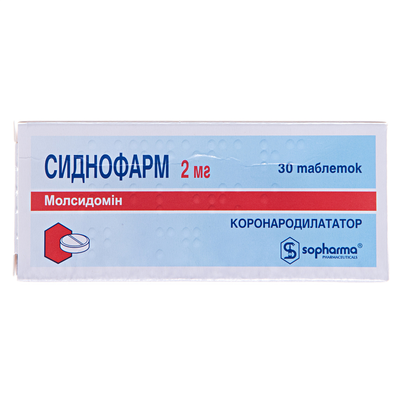
Sydnofarm 2 mg tablets, No. 30 (10 x 3)
Composition
Active ingredient: molsidomine;
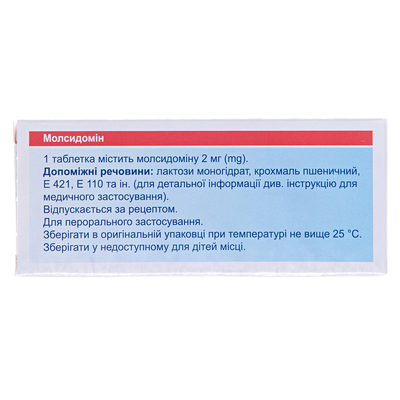
1 tablet contains 2 mg of molsidomine;
inactive ingredients: lactose monohydrate, mannitol (E 421), wheat starch, microcrystalline cellulose, hypromellose, colloidal anhydrous silicon dioxide, magnesium stearate, peppermint oil, Sunset Yellow FCF (E 110).
Dosage Form
Tablets.
Main physical and chemical properties: round, biconvex tablets with a score line on one side, 8 mm in diameter, pale pink in color with a minty odor.
Pharmacotherapeutic group
Vasodilators used in the treatment of heart disease. Molsidomine.
ATC code C01D X12.
Pharmacological properties
Pharmacodynamics.
Molsidomine exhibits venodilatory, antiplatelet, analgesic, and prolonged antianginal effects. Its venodilatory activity is due to the release, following a series of metabolic transformations, of nitric oxide (NO), which stimulates soluble guanylate cyclase; therefore, molsidomine is considered an NO donor. The accumulation of cyclic guanosine monophosphate (cGMP) causes relaxation of the smooth muscle cells of the vascular wall (primarily in veins). A reduction in preload—even without affecting myocardial contractility—restores the balance between oxygen demand and oxygen supply, which is disrupted in patients with coronary insufficiency. It dilates large epicardial coronary arteries affected by atherosclerosis but capable of dilation, and improves peripheral circulation.
It increases exercise tolerance and reduces the manifestations of angiospasm. It inhibits the early phase of platelet aggregation and reduces the synthesis and release of serotonin, thromboxane, and other proaggregants.
It reduces myocardial preload in patients with chronic heart failure, lowers pulmonary artery pressure, and reduces left ventricular filling, myocardial wall tension, and cardiac stroke volume. The effect begins 20 minutes after administration, reaches its peak in 0.5–1 hour, and lasts for 6 hours. Unlike nitrate therapy, the development of tolerance with a decrease in efficacy is not typically observed during long-term therapy with molsidomine.
Pharmacokinetics.
After oral administration, it is almost completely absorbed from the gastrointestinal tract. Bioavailability is 60–70%. Maximum concentration (4.4 μg/mL) is reached after 1 hour. When taken orally after a meal, absorption is slowed but not reduced (maximum plasma concentration is reached 30–60 minutes later than when taken on an empty stomach). The minimum effective concentration of molsidomine in plasma is 3–5 ng/mL. It is practically not bound to plasma proteins. It is metabolized in the liver to form the pharmacologically active compound SIN-1 (3-morpholino-sidnonimine), from which the highly unstable compound SIN-1a (N-morpholino-N-aminosynthonitrile), which releases NO to form the pharmacologically inactive compound SIN-1c. Other metabolites are also formed during metabolism. 90% is excreted by the kidneys (as metabolites), and 9% is excreted via the intestines. The half-life ranges from 1 to 3.5 hours. It does not accumulate (including in patients with renal insufficiency).
In severe hepatic insufficiency (an increase in the bromsulphalein test from 20% to 50%), a slowing of elimination and an increase in the plasma concentration of molsidomine have been observed.
Indications
Ischemic heart disease: prevention of episodes of stable and unstable angina (especially in elderly patients and in cases of individual intolerance to nitrates).
As part of combination therapy for chronic heart failure.
Contraindications
Hypersensitivity to the active ingredient or to any of the excipients; glaucoma (especially angle-closure glaucoma); acute angina attack; acute myocardial infarction; acute circulatory failure, including shock (including cardiogenic), vascular collapse, severe arterial hypotension (systolic blood pressure less than 100 mm Hg), concomitant use of phosphodiesterase type 5 (PDE-5) (sildenafil, vardenafil, tadalafil) due to the high risk of developing hypotension; toxic pulmonary edema; decreased central venous pressure; concomitant administration of nitric oxide donors in any form and soluble guanylate cyclase stimulators (e.g., riociguat) is contraindicated due to the risk of hypotension.
Drug Interactions and Other Interactions
When used concomitantly with peripheral vasodilators, “slow” calcium channel blockers (SCCBs), antihypertensive agents, and ethanol, the drug’s antihypertensive effect is enhanced. Sidnofarm may be used concomitantly with other antianginal drugs (for example, as part of a two- or three-component regimen—nitrates, CCBBs, and β-adrenergic receptor blockers). Alcohol consumption should be avoided during treatment with Sidnofarm.
When used concomitantly with acetylsalicylic acid, its antiplatelet activity is enhanced.
There is a high risk of developing hypotension when used concomitantly with PDE-5 inhibitors, such as sildenafil, vardenafil, and tadalafil. Concomitant use of Sidnofarm with PDE-5 inhibitors is contraindicated.
Ergot alkaloids. There is a possibility of a pharmacodynamic interaction between nitric oxide donors and ergot alkaloids, which may result in an antagonistic effect of the drugs. The concurrent use of nitric oxide donors and ergot alkaloids should be avoided.
Concomitant use of molsidomine and soluble guanylate cyclase stimulators (e.g., riociguat), which act on nitric oxide receptors, is contraindicated because the combination may lead to an increased risk of hypotension.
Special Considerations for Use
Do not use to treat acute angina attacks!
Molsidomine does not usually cause a significant decrease in blood pressure; however, caution is advised when used in patients with hypotension or an increased risk of hypotension, elderly patients with reduced circulating blood volume, and patients being treated with other vasodilators, caution is advised. Close monitoring is necessary, and the dose should be adjusted according to the patient’s condition.
During therapy with Sidnofarm, it is important to note that blood pressure (BP), particularly systolic BP, may decrease at rest. In this case, initial hypertensive blood pressure responds much more strongly than normotensive or hypotensive blood pressure.
Use with caution in patients with hypertrophic obstructive cardiomyopathy, constrictive (stenotic) pericarditis, pericardial tamponade, reduced intraventricular pressure, aortic stenosis or mitral stenosis, acute myocardial infarction, or impaired left ventricular function (left ventricular failure).
Since 90–95% of molsidomine’s metabolites are excreted by the kidneys, the dose may be reduced or the dosing intervals extended, depending on the patient’s individual response to the drug. Patients with hepatic or renal insufficiency should be started on lower doses, which should be gradually increased until the desired therapeutic effect is achieved. In cases of severe hepatic impairment (a 20–50% increase in the bromsulphalein test), the plasma concentration of molsidomine increases and its half-life is prolonged, requiring dose adjustment.
Special attention is required when treating the following patients: those who have had a hemorrhagic stroke, those with impaired cerebral circulation, and those with elevated intracranial pressure; patients who have recently suffered a myocardial infarction, patients with glaucoma and a predisposition to hypotensive reactions, or those with arterial hypotension. Sidnofarm should be used only under strict medical supervision with continuous monitoring of blood circulation.
During long-term use of nitrates, it is recommended to include molsidomine in the treatment regimen to prevent the development of nitrate tolerance.
For elderly patients with hepatic or renal impairment, the drug should be prescribed in lower doses.
The drug contains 0.06 g of lactose monohydrate. Patients with rare hereditary disorders of galactose intolerance, Lapp lactase deficiency, or glucose-galactose malabsorption should not use this medication.
Wheat starch may contain gluten, but only in trace amounts, and is therefore considered safe for people with celiac disease.
The colorant E 110 may cause allergic reactions.
Use during pregnancy or breastfeeding.
Use of this medication during pregnancy is contraindicated.
Do not use this medication while breastfeeding. If treatment is necessary, breastfeeding should be discontinued.
Effect on reaction time when driving or operating machinery.
Given the drug’s side effects (dizziness) and potential negative impact on concentration, this medication should be prescribed with caution to individuals who drive or operate machinery, following a thorough assessment of the potential risk.
Dosage and Administration
Take the medication orally during or after meals with a sufficient amount of liquid.
For the prevention of angina attacks, administer 1–2 mg (½–1 tablet) 4–6 times daily on the first and second days of therapy, then increase the dose to 2–4 mg 2–3 times daily as needed.
The dosing regimen is individualized and depends on the type and stage of the disease, as well as the severity of clinical symptoms. The usual daily dose is 2–4 mg (1–2 tablets), divided into 2 equal doses. In some cases, the dose may be increased to 6–8 mg (3–4 tablets), which should be divided into 3–4 doses.
The maximum daily dose is 12 mg.
The duration of treatment depends on the course of the disease and is determined by the doctor.
Children.
Use of this medication is contraindicated in children.
Overdose
Symptoms: bradycardia, weakness, drowsiness, severe headache, dizziness, and hypotension, as well as tachycardia accompanied by nausea and vomiting; in severe cases, collapse.
Treatment: Measures aimed at rapidly eliminating the drug from the body (gastric lavage, forced diuresis) and symptomatic therapy.
There are no data on the effectiveness of dialysis in cases of overdose.
Side Effects
Nervous system: headache (usually mild, resolves during further treatment), dizziness, increased fatigue, slowed psychomotor and motor reactions (in most cases at the start of treatment), weakness.
Gastrointestinal system: nausea, loss of appetite, diarrhea, vomiting.
Cardiovascular system: thrombocytopenia, circulatory failure, marked decrease in blood pressure, orthostatic hypotension, rarely—progressing to collapse or shock, tachycardia, facial flushing. In these cases, a dose reduction or discontinuation of the drug may be necessary.
Immune system: hypersensitivity reactions, including allergic reactions, itching, rashes, bronchospasm, asthma, anaphylactic shock.
Skin and subcutaneous tissue disorders: hives.
Shelf life
3 years.
Storage conditions
Keep out of reach of children.
Store in the original packaging at a temperature not exceeding 25 °C.
Packaging
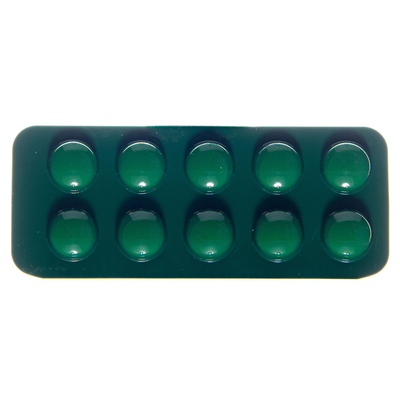
10 tablets per blister pack made of PVC film and aluminum foil. 3 blister packs per cardboard box.
Dispensing Category
By prescription only.







