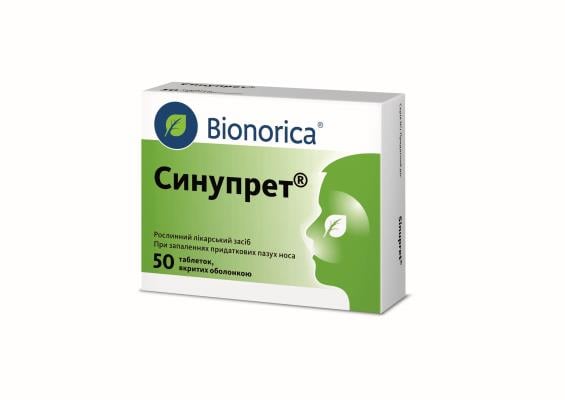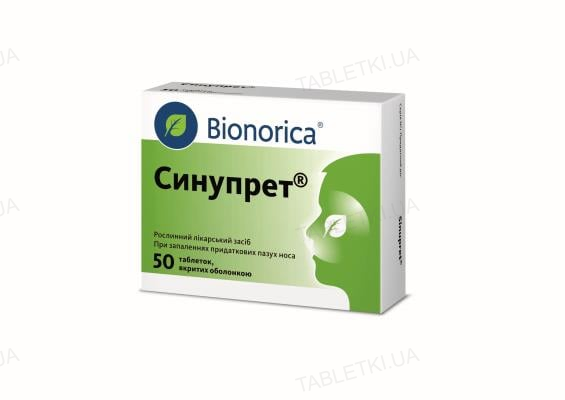
Sinupret Tablets, No. 50 (25 x 2)
Ingredients
Active Ingredients: 1 tablet contains dried medicinal plants in powder form:
- gentian root (Radix Gentianae) 6 mg,
- primrose flowers with calyx (Flores Primulae cum Calybus) 18 mg,
- sorrel herb (Nerba rumis) 18 mg,
- elderberry flowers (Flores Sambusi) 18 mg,
- verbena herb (Nerba verbenae) 18 mg;
excipients: calcium carbonate (E 170), castor oil, colloidal anhydrous silicon dioxide, acrylate copolymer, gelatin, glucose, lactose monohydrate, light magnesium oxide, aluminum hydroxide, copper chlorophyllin (E 141), riboflavin (E 101), corn starch, dextrin, gortanglycol wax, potato starch, purified water, shellac, sorbitol (E 420), stearic acid, sucrose, talc, titanium dioxide (E 171), indigo carmine (E 132).
Dosage Form
Film-coated tablets.
Main physical and chemical properties: round, biconvex tablets coated with a green film with a smooth surface.
Pharmacotherapeutic group
Medications used for coughs and colds. ATC code R05X.
Pharmacological properties
The components of this herbal preparation possess a complex range of activities, including secretolytic, anti-edematous, anti-inflammatory, immunostimulatory, and antiviral effects.
The active ingredients in Sinupret® inhibit the replication of various respiratory viruses, such as influenza A, parainfluenza, and RSV (respiratory syncytial viruses).
Under the influence of the medication, secretion is regulated and tissue swelling is reduced. Drainage and ventilation of the paranasal sinuses are restored, nasal congestion is relieved, and the protective function of the respiratory tract epithelium is normalized. The effectiveness of antibiotic therapy is enhanced.
Indications
Acute and chronic inflammation of the paranasal sinuses.
Contraindications
Hypersensitivity to any of the active or excipient ingredients of the drug, to other species of primrose, as well as peptic ulcer disease.
Interactions with Other Medications and Other Forms of Interaction
No interactions with other medications have been observed. Combination with antibiotics is possible and advisable.
Special Instructions for Use
It is recommended to consult a doctor if the patient has severe symptoms of rhinosinusitis, such as nosebleeds, fever, severe pain, purulent nasal discharge, visual disturbances, asymmetry of the midface or eyes, facial numbness, as emergency medical treatment may be required in such cases.
If symptoms persist for more than 7–14 days, worsen, or recur periodically, consult a doctor.
Special attention should be paid to the use of this medication in patients with gastritis or functional dyspepsia (a so-called “sensitive stomach”). The medication should be taken after meals with a sufficient amount of liquid (for example, a glass of water).
This medication contains glucose, lactose, sucrose, and sorbitol. Therefore, patients with hereditary fructose or galactose intolerance, lactase deficiency, glucose-galactose malabsorption, or sucrase-isomaltase deficiency should not take this medication.
Note for patients with diabetes mellitus: 1 film-coated tablet contains an average of 0.01 bread units.
Pregnancy and lactation. During pregnancy or lactation, this medication should be used with caution and only after a clear diagnosis has been made by a physician and the benefits to the mother have been weighed against the risks to the fetus (infant).
Effects on the ability to operate vehicles and machinery. No special precautions.
Dosage and Administration
Unless otherwise prescribed by a doctor, adults and children over 12 years of age should take 2 tablets 3 times a day; children aged 6 to 11 years should take 1 tablet 3 times a day.
The tablets should be swallowed whole with sufficient liquid.
The recommended course of treatment is usually 7 to 14 days.
Follow the recommendations outlined in the “Special Instructions and Precautions for Use” section of the package insert.
Children
Due to a lack of experience, use in children under 6 years of age is not recommended. For the treatment of preschool-aged children (under 6 years of age), who are prescribed lower doses, Sinupret should be administered in the form of drops or syrup.
Overdose
To date, no cases of overdose have been reported. If the dose is exceeded, the listed side effects may intensify; in such cases, consult a doctor.
If doses exceed the recommended amounts, the doctor should be informed so that a decision can be made regarding the necessary measures.
Side Effects
Gastrointestinal disorders, including abdominal pain, nausea, diarrhea, vomiting, and abdominal discomfort, are rare. Hypersensitivity reactions are possible, including rash, skin redness, itching, hives, angioedema, shortness of breath, and facial swelling.
If any side effects occur, stop taking the medication and consult a doctor.
Shelf life
3 years.
Do not use after the expiration date printed on the package.
The expiration date indicates that the medication may be used until the last day of the specified month.
Storage Conditions
Store in the original packaging at a temperature not exceeding 30 °C, out of the reach of children.
Packaging
50 tablets in blister packs, contained in a cardboard box.
Sales Conditions
Available without a prescription.
Manufacturer
Bionorica SE.
Address
Kerchensteiner Straße 11-15, 92318, Neumarkt, Germany/
Kerschenstеinerstrasse, 11-15, 92318 Neumarkt, Germany.
Contact information for the manufacturer’s representative in Ukraine, Bionorica LLC:
Phone: 044 521 86 00; Fax: 044 521 86 01, info@bionorica.ua