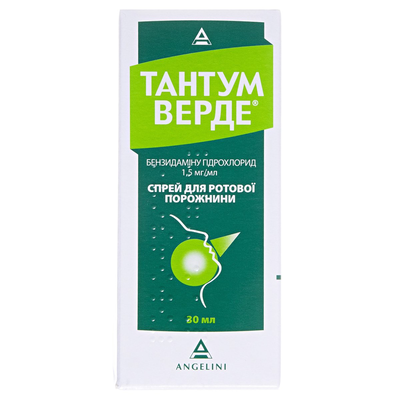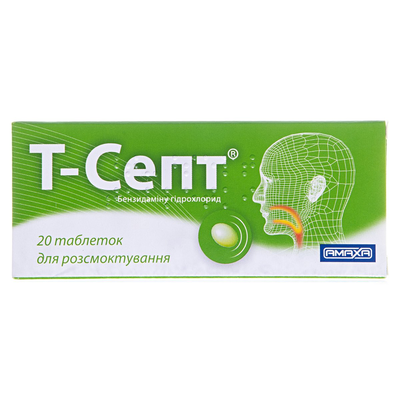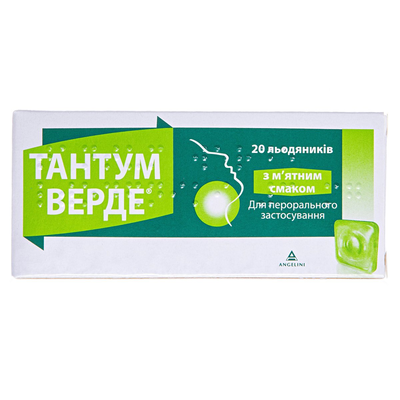
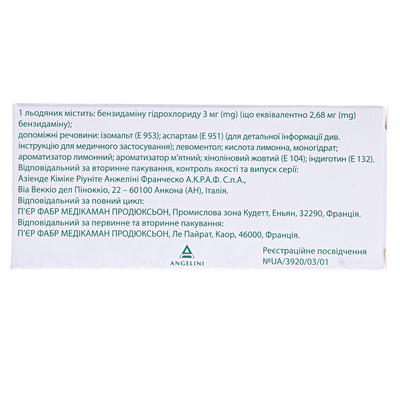
Tantum Verde mint-flavored lozenges, 3 mg each, No. 20 (10 x 2)
Ingredients
Active ingredient: benzidamine hydrochloride;
1 lozenge contains 3 mg of benzidamine hydrochloride (equivalent to 2.68 mg of benzidamine);
Excipients: isomalt (E 953); aspartame (E 951); levomenthol; citric acid monohydrate; lemon flavoring; mint flavoring; quinoline yellow (E 104); indigotine (E 132).
Dosage Form
Lozenges.
Main physical and chemical properties: within the shelf life: green, square-shaped lozenges with a depression in the center, with a characteristic mint-lemon flavor; the lozenges should not stick to waxed paper.
Pharmacotherapeutic group
Agents affecting the respiratory system. Agents used in throat disorders. Other preparations used in throat disorders. Benzidamine. ATC code R02A X03.
Pharmacological Properties
Pharmacodynamics.
Benzidamine is a nonsteroidal anti-inflammatory drug (NSAID) with analgesic and anti-exudative properties.
Clinical studies have shown that benzidamine is effective in relieving symptoms associated with localized irritative pathological processes in the oral cavity and pharynx. In addition, benzidamine exerts anti-inflammatory and local analgesic effects on the oral mucosa.
Pharmacokinetics.
Absorption through the mucous membranes of the oral cavity and pharynx has been demonstrated by the presence of measurable amounts of benzidamine in human blood plasma. Approximately 2 hours after taking a 3-mg lozenge, the maximum plasma concentration of benzidamine is 37.8 ng/mL, and the AUC is 367 ng/mL·h. However, these concentrations are too low to produce systemic pharmacological effects.
Excretion occurs primarily in the urine, mainly in the form of inactive metabolites or conjugated compounds.
It has been shown that, upon topical application, benzidamine accumulates in inflamed tissues, where effective concentrations are achieved due to its ability to penetrate the epithelial lining.
Indications
Symptomatic treatment of pain, irritation, and inflammation of the oropharynx.
Contraindications
Hypersensitivity to the active ingredient or to any other components of the drug.
Interactions with Other Medications and Other Types of Interactions
No interaction studies have been conducted.
Special considerations
Benzidamine is not recommended for patients with hypersensitivity to acetylsalicylic acid or other nonsteroidal anti-inflammatory drugs (NSAIDs).
In patients with bronchial asthma, including a history of the condition, the drug may trigger bronchospasm. The drug should be used with caution in such patients.
In some patients, ulcers of the oropharyngeal mucosa may be caused by serious pathological processes. Therefore, patients whose symptoms have worsened or have not improved within 3 days, or who have developed a fever or other symptoms, should consult a physician (dentist).
This medication contains aspartame, which is a source of phenylalanine. It may be dangerous for patients with phenylketonuria.
This medication contains isomalt and should not be used by patients with rare hereditary disorders associated with fructose intolerance.
Use During Pregnancy or Breastfeeding.
There are currently no adequate data available on the use of benzidamine in pregnant or breastfeeding women. The ability of this medication to pass into breast milk has not been studied. Animal study data are insufficient to draw conclusions regarding the effects of this medication on pregnancy and lactation. There are no data on potential risks during pregnancy or breastfeeding.
Tantum Verde® should not be used during pregnancy or while breastfeeding.
Effect on the ability to react while driving or operating machinery.
When used at the recommended doses, this medication has no effect on the ability to drive or operate machinery.
Directions for Use and Dosage
The lozenges should be slowly dissolved in the mouth.
Adults and children 6 years of age and older: one lozenge 3 times a day.
Do not swallow the lozenges. Do not chew the lozenges.
The course of treatment should not exceed 7 days.
Children. This dosage form is intended for children 6 years of age and older.
Children aged 6–11 years should use this medication under adult supervision.
Overdose
There have been no reports of benzidamine overdose when used topically.
However, it is known that when benzidamine is ingested in large doses (hundreds of times higher than the possible doses of this dosage form), especially in children, it can cause agitation, seizures, tremors, nausea, excessive sweating, ataxia, and vomiting. Such an acute overdose requires immediate gastric lavage, treatment of water-electrolyte imbalances, symptomatic treatment, and adequate hydration.
Side Effects
Adverse reactions are classified by frequency of occurrence as follows: very common (≥ 1/10); common (≥ 1/100 to < 1/10); uncommon (≥ 1/1,000 to < 1/100); rare (≥ 1/10,000 to < 1/1,000); very rare (< 1/10,000); frequency unknown (cannot be estimated from the available data).
Gastrointestinal system – rare: burning sensation in the mouth, dry mouth; frequency unknown: oral hypoesthesia.
Immune system disorders – rare: hypersensitivity reaction; frequency unknown: anaphylactic reaction.
Respiratory, thoracic, and mediastinal disorders—very rare: laryngospasm.
Skin and subcutaneous tissue disorders – uncommon: photosensitivity; very rare: angioedema.
Shelf life
4 years.
Storage conditions
Store the medication at a temperature not exceeding 25°C. The medication must be stored in its original packaging to protect it from moisture.
Packaging
Each lozenge is wrapped in waxed paper labeled “TANTUM VERDE®”; 10 lozenges form a stick, which is wrapped in a polyethylene/paper/aluminum foil wrapper. Two or three sticks are placed in a cardboard box along with the package insert.
Dispensing Category
Over-the-counter.