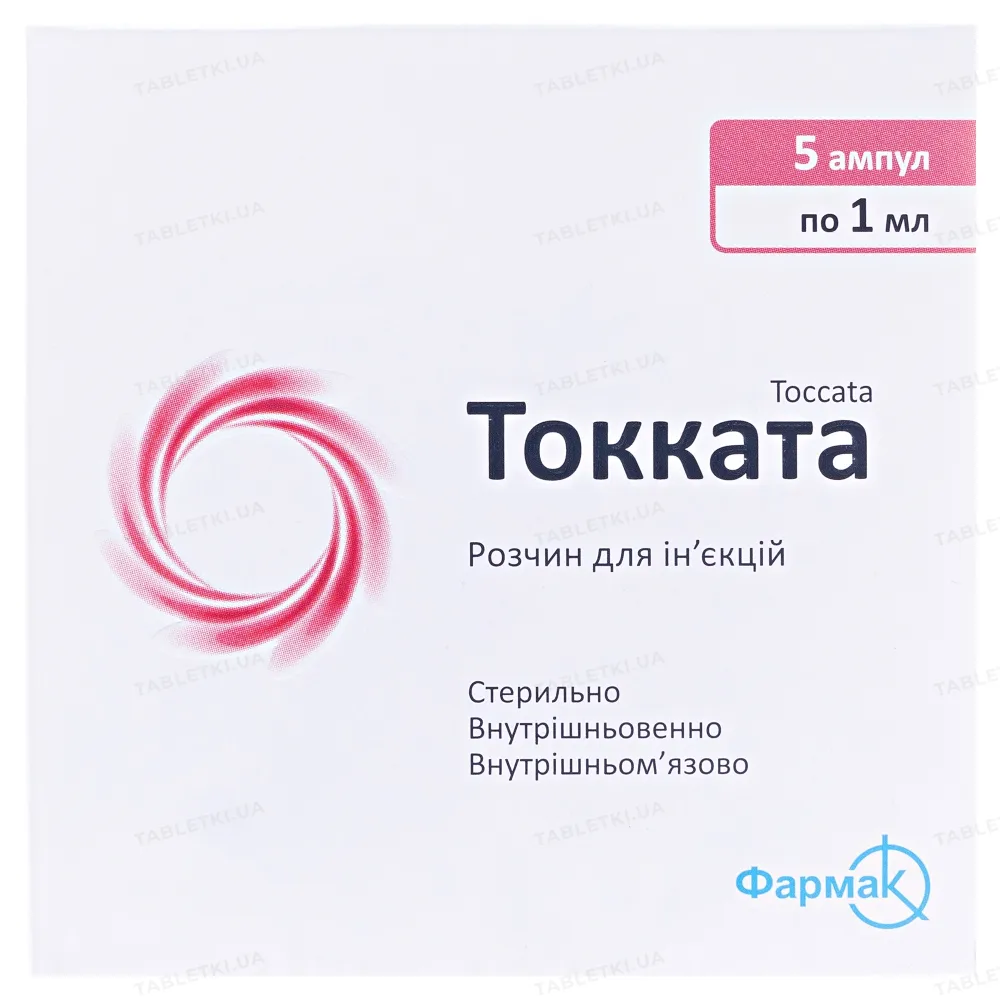
Toccata (Midokalm) solution for injection, 1 mL, No. 5 in ampoules
Ingredients
Active ingredients: tolperisone hydrochloride, lidocaine hydrochloride;
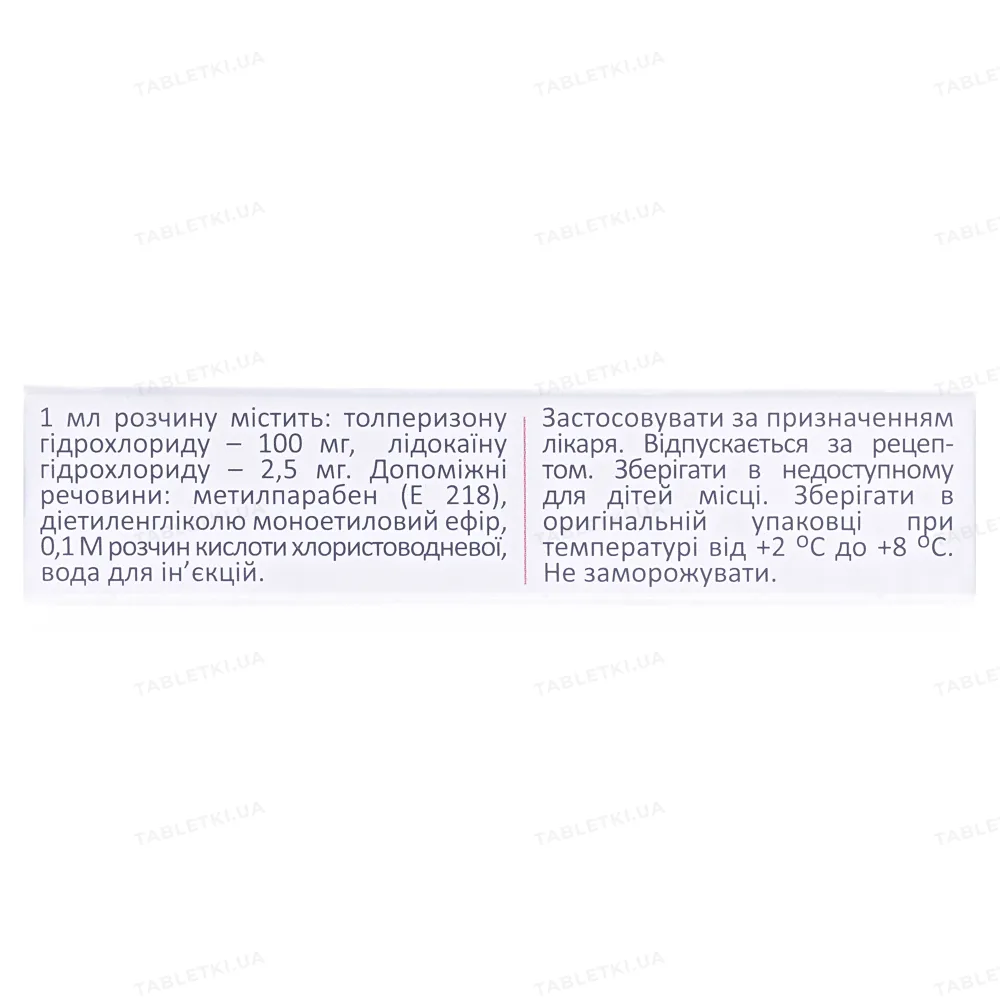
1 mL of solution contains: tolperisone hydrochloride—100 mg, lidocaine hydrochloride—2.5 mg;
Excipients: methylparaben (E 218), diethylene glycol monoethyl ether, 0.1 M solution
Hydrochloric acid, water for injection.
Dosage Form
Solution for injection.
Main physical and chemical properties: a clear, colorless or greenish liquid.
Pharmacotherapeutic group
Central-acting muscle relaxants.
ATX code M0ZV X04.
Pharmacological properties
Pharmacodynamics.
Tolperisone is a centrally acting muscle relaxant. The mechanism of action of tolperisone has not been fully elucidated.
It exhibits high affinity for nervous tissue, reaching the highest concentrations in the brainstem, spinal cord, and peripheral nervous system.
The most significant effect of tolperisone is its inhibitory action on the reflex pathway of the spinal reflex. Presumably, this effect, together with inhibition of the descending pathways, accounts for the therapeutic benefit of tolperisone.
The chemical structure of tolperisone is similar to that of lidocaine. Like lidocaine, it has a membrane-stabilizing effect and reduces the electrical excitability of motor neurons and primary afferent fibers. In a dose-dependent manner, tolperisone inhibits the activity of voltage-gated sodium channels. Consequently, the amplitude and frequency of action potentials are reduced.
An inhibitory effect on voltage-gated calcium channels has been demonstrated. It is hypothesized that, in addition to membrane stabilization, tolperisone may also inhibit the release of neurotransmitters.
Furthermore, tolperisone exhibits some weak alpha-adrenergic antagonist properties and has an antimuscarinic effect.
Clinical Efficacy and Safety
The efficacy of tolperisone in the treatment of muscle spasms following a stroke has been demonstrated.
In a randomized, double-blind, placebo-controlled study involving 120 patients with post-stroke muscle spasm, treatment with tolperisone resulted in a significant reduction in spasticity on the Ashworth scale, which was the primary endpoint. According to the overall efficacy assessment by physicians and investigators, tolperisone was superior to placebo (p < 0.001). The mean improvement on the Ashworth Scale was 32% in the overall intent-to-treat (ITT) patient population and 42% in the subgroup of patients receiving tolperisone at a dose of 300–450 mg/day. When assessing the efficacy of functional tests, tolperisone was also more effective than placebo, but the differences were not statistically significant.
In a randomized, double-blind, controlled trial involving 48 patients with brain injury, the efficacy of tolperisone as measured by the Barthel Index was comparable to that of baclofen. At the same time, tolperisone outperformed baclofen in improving the Rivermid Motor Assessment Scale (RMAS).
Data on the efficacy of tolperisone in reducing muscle tone in patients with musculoskeletal disorders other than muscle spasms following a stroke are inconsistent. Some studies have shown positive results on certain tests, while others have not demonstrated a benefit of tolperisone in such conditions.
The safety profile of tolperisone is based on data from clinical studies involving patients with increased muscle tone of various etiologies, as well as on data from spontaneous reports of adverse reactions.
Pharmacokinetics.
It undergoes extensive metabolism in the liver and kidneys. It is excreted by the kidneys, with more than 99% in the form of metabolites. The pharmacological activity of the metabolites is unknown. Following intravenous administration, the half-life is approximately 1.5 hours.
Preclinical Safety Data
Based on data from preclinical studies of pharmacological safety, repeated-dose toxicity, genotoxicity, and reproductive toxicity, no specific risk to humans has been identified.
Effects in preclinical studies were observed only at doses significantly exceeding the maximum tolerable doses for humans, indicating that these findings are of little relevance to clinical use.
Embryotoxic changes were observed in rats and rabbits following oral administration of the drug at doses of 500 mg/kg body weight and 250 mg/kg, respectively. However, these doses are many times higher than the recommended therapeutic doses for humans.
Indications
Muscle spasticity, including post-stroke spasticity, in cases where the injectable form is the preferred method of administration.
Contraindications
- Hypersensitivity to the active ingredients or to perizone, a chemical compound similar in structure to tolperisone, as well as to any of the excipients or other amide-type local anesthetics.
- Myasthenia gravis.
- Breastfeeding.
- Pediatric patients.
Interactions with Other Medications and Other Types of Interactions
Pharmacokinetic studies of drug interactions with dextromethorphan, a CYP2D6 substrate, have shown that concomitant administration of tolperisone increases the plasma concentrations of drugs that are primarily metabolized by CYP2D6, in particular thioridazine, tolterodine, venlafaxine, atomoxetine, desipramine, dextromethorphan, metoprolol, nebivolol, and perphenazine.
In vitro studies did not reveal significant inhibition or induction of other CYP isoenzymes (CYP2B6, CYP2C8, CYP2C9, CYP2C19, CYP1A2, CYP3A4) was observed in human liver microsomes and hepatocytes.
It is expected that when taken concomitantly with other CYP2D6 substrates and/or other medications, the effects of tolperisone will not be enhanced due to the diversity of its metabolic pathways.
Although tolperisone is a centrally acting drug, the likelihood of developing a sedative effect with its use is low. When administered concomitantly with other centrally acting muscle relaxants, consideration should be given to reducing the dose of tolperisone.
Tolperisone potentiates the effects of niflumic acid; therefore, when taken concomitantly with tolperisone, it is recommended to reduce the dose of niflumic acid as well as other NSAIDs.
Special Considerations
The injectable form of the drug should not be prescribed to children.
Hypersensitivity reactions.
In postmarketing surveillance of tolperisone, hypersensitivity reactions were the most frequently reported adverse events. Their severity ranges from mild skin reactions to severe systemic reactions, including anaphylactic shock. Symptoms of hypersensitivity reactions may include erythema, rash, urticaria, angioedema, tachycardia, hypotension, or shortness of breath.
Women who are hypersensitive to other medications or have a history of allergic diseases are at higher risk of hypersensitivity reactions when taking tolperisone.
Patients should be made aware of the possibility of an allergic reaction. If symptoms of an allergic reaction occur, tolperisone should be discontinued and medical attention sought immediately.
After an episode of hypersensitivity to tolperisone, the drug should not be administered again.
The drug contains lidocaine; therefore, in cases of known hypersensitivity to lidocaine or to other amide-type local anesthetics, Toccata for Injection should not be used due to the possibility of a cross-allergic reaction.
The drug contains methylparaben (E 218), which may cause allergic reactions (possibly delayed) and, in rare cases, bronchospasm.
Use during pregnancy or while breastfeeding.
According to animal studies, tolperisone has no teratogenic effects.
Due to the lack of meaningful clinical data on the use of this medication, Toccata should not be used during pregnancy.
Since it is unknown whether tolperisone passes into breast milk, the use of Toccata during breastfeeding is contraindicated.
Ability to affect reaction time when operating vehicles or other machinery.
Given the possibility of symptoms such as dizziness, drowsiness, impaired attention, seizures, and blurred vision, this medication should be used with caution when driving or operating machinery.
Route of Administration and Dosage
For parenteral administration only.
For use in adults only. The drug should be administered intramuscularly at a dose of 100 mg twice daily or by slow intravenous injection at a dose of 100 mg once daily.
The solution for injection should not be used in children.
The duration of treatment is determined by the physician based on the course of the disease and the effectiveness of treatment.
Patients with Impaired Renal Function
Experience with the use of this medication in patients with renal impairment is limited; a higher incidence of adverse effects has been observed in such patients. Therefore, in cases of moderate renal impairment, individualized dosing is recommended, with careful monitoring of the patient’s condition and renal function. In cases of severe renal impairment, tolperisone is not recommended.
Patients with Impaired Liver Function
Experience with the use of this medication in patients with liver impairment is limited; a higher incidence of adverse effects has been observed in such patients. Therefore, in cases of moderate liver impairment, individualized dose titration is recommended, with careful monitoring of the patient’s condition and liver function. In cases of severe liver impairment, tolperisone is not recommended.
Children. Tokkata injection solution should not be used in children.
Overdose
There is insufficient data on tolperisone overdose.
Symptoms of overdose may primarily include drowsiness, gastrointestinal symptoms (nausea, vomiting, epigastric pain), tachycardia, hypertension, bradykinesia, and dizziness. In severe cases, seizures and coma have been reported.
There is no specific antidote for tolperisone. Symptomatic treatment is recommended in case of overdose.
Side Effects
Adverse reactions are listed by organ system class according to the MedDRA Medical Dictionary for Regulatory Activities, using MedDRA frequency definitions: very common (≥ 1/10), common (≥ 1/100, <1/10), uncommon (≥ 1/1,000, <1/100), rare (≥ 1/1,000, < 1/100), very rare (< 1/1,000), frequency unknown (cannot be estimated from the available data).
According to postmarketing surveillance data, approximately 50–60% of adverse reactions associated with tolperisone are related to hypersensitivity. Most of these reactions were mild and resolved spontaneously. Life-threatening hypersensitivity reactions occur in rare cases.
| Organ system classes | Common (≥1/100, <1/10) | Uncommon
(≥1/1,000, <1/100) |
Rare
(≥1/10,000, <1/1,000) |
Very rare
(<1/10,000) |
| Diseases of the blood and lymphatic system | Anemia, lymphadenopathy | |||
| Immune system disorders | Hypersensitivity reaction
Anaphylactic reaction |
Anaphylactic shock | ||
| Nutritional and metabolic disorders | Anorexia | Excessive thirst | ||
| Mental disorders | Insomnia
Sleep disorders |
Decreased activity
Depression |
Confusion | |
| Nervous system disorders | Headache
Dizziness Drowsiness |
Attention disorders
Concussion Seizures Hypoesthesia Paresthesia Lethargy (excessive sleepiness) |
||
| Visual disturbances | Visual disturbances | |||
| Hearing and balance disorders | Ringing in the ears
Dizziness (vertigo) |
|||
| Heart disease | Angina
Tachycardia Heart palpitations Low blood pressure |
Bradycardia | ||
| Vascular disorders | Hypotension | Skin redness | ||
| Diseases of the respiratory tract, chest, and mediastinum | Difficulty breathing
Nosebleeds Shortness of breath |
|||
| Gastrointestinal disorders | Abdominal discomfort
Diarrhea Dry mouth Dyspepsia Nausea |
Epigastric pain
Constipation Flatulence Vomiting |
||
| Liver and biliary tract disorders | Mild liver damage | |||
| Skin and subcutaneous tissue disorders | Allergic dermatitis
Hyperhidrosis Itchy Hives Rash |
|||
| Diseases of the musculoskeletal system and connective tissue | Muscle weakness
Myalgia Pain in the limbs |
Discomfort in the limbs | Osteopenia | |
| Kidney and urinary tract disorders | Enuresis
Proteinuria |
|||
| General disorders and complications at the injection site | Redness at the injection site | Asthenia
Discomfort Increased fatigue |
Dizziness
Feeling hot Irritability Thirst |
Chest discomfort |
| Laboratory test results | Low blood pressure
Elevated bilirubin levels in the blood Changes in liver enzyme activity Decreased platelet count Leukocytosis |
Elevated blood creatinine levels |
Reporting Suspected Adverse Reactions
Reporting adverse reactions after a drug has been approved is extremely important. This allows for monitoring the benefit-risk profile of the drug. Healthcare and pharmaceutical professionals, as well as patients or their legal representatives, should report all suspected adverse reactions and instances of reduced efficacy of the drug through the Automated Pharmacovigilance Information System at: https://aisf.dec.gov.ua/.
Shelf Life
2 years.
Do not use this medication after the expiration date printed on the package.
Storage Conditions
Store in the original packaging at a temperature between +2 °C and +8 °C.
Do not freeze. Keep out of reach of children.
Incompatibility
There are no data on compatibility studies; therefore, Toccata should not be mixed with other medications in the same syringe. Administer it separately from other medications.
Packaging
1 mL in ampoules. 5 ampoules per blister pack; 1 or 2 blister packs per carton.
Manufacturer
Farmak JSC.
Manufacturer’s location, address, and place of business.
Ukraine, 04080, Kyiv, 74 Kyrylivska St.