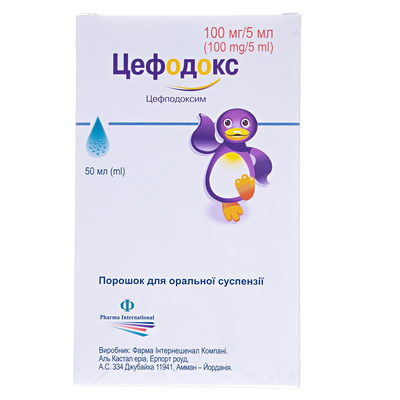
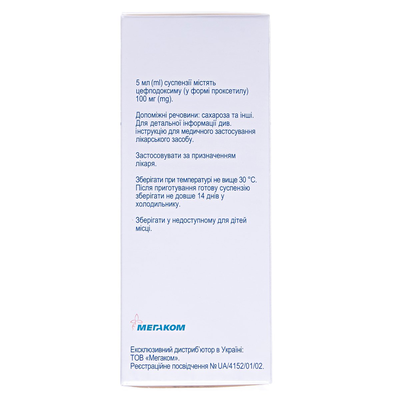
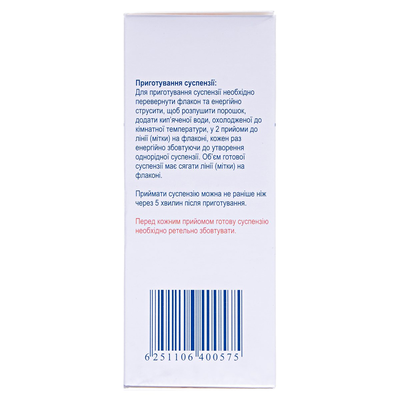
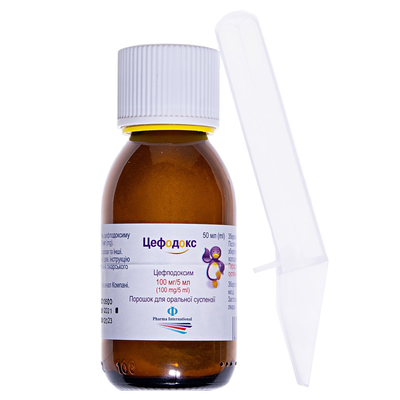
Cefodox powder for oral suspension, 100 mg/5 mL, 50 mL per bottle.
Composition
Active ingredient: cefpodoxime;
5 mL of suspension contains 50 mg or 100 mg of cefpodoxime (as proxetil);
excipients: hydroxypropyl cellulose; microcrystalline cellulose; corn starch; sucrose; citric acid monohydrate; colloidal anhydrous silicon dioxide; simethicone; sodium carboxymethylcellulose-microcrystalline cellulose; xanthan gum; sodium saccharin; lemon flavoring (powder); vanilla flavoring (powder).
Dosage Form
Powder for oral suspension.
Main physical and chemical properties: a creamy-white powder with a lemon scent.
Pharmacotherapeutic group
Antibacterial agents for systemic use. Other beta-lactam antibiotics. Third-generation cephalosporins. ATC code J01D D13.
Pharmacological properties
Pharmacodynamics.
Cefodox (cefpodoxime proxetil) is a third-generation beta-lactam antibiotic for oral administration. Its bactericidal effect is due to the inhibition of the synthesis of bacterial cell wall components. The drug is active against many Gram-positive, Gram-negative, aerobic, and anaerobic microorganisms.
The spectrum of activity of cefpodoxime includes the following microorganisms:
susceptible Gram-positive bacteria—Streptococcus pneumoniae, Group A streptococci (S. pyogenes), Group B streptococci (S. agalactiae), Groups C, F, and G, as well as S. mitis, S. sanguis, S. Salivarius, and Corynebacterium diphtheriae;
susceptible Gram-negative bacteria—Haemophilus influenzae, Haemophilus parainfluenzae, Moraxella (Branhamella) catarrhalis (both beta-lactamase-producing and non-producing strains), Neisseria meningitidis, Neisseria gonorrhoeae, Escherichia coli, Klebsiella spp. (K. pneumoniae; K. oxytoca), Proteus mirabilis;
moderately susceptible bacteria—methicillin-susceptible staphylococci, penicillinase-producing and non-penicillinase-producing strains (S. aureus and S. epidermidis).
The following bacteria are resistant to cefpodoxime, as they are to other cephalosporins: enterococci, methicillin-resistant staphylococci (S. aureus and S. epidermidis), Staphylococcus saprophyticus, Pseudomonas aeruginosa and Pseudomonas spp., Clostridium difficile, and Bacteroides fragilis.
Pharmacokinetics.
The active ingredient of the drug is absorbed in the small intestine and hydrolyzed to the active metabolite cefpodoxime. Peak plasma concentrations are reached within 2–4 hours after administration of a single dose. Cefpodoxime binds to plasma proteins (primarily albumin) via a non-saturating mechanism. The minimum inhibitory concentration (MIC) of cefpodoxime against most pathogens is observed in the lung parenchyma, the bronchial mucosa, pleural fluid, tonsils, interstitial fluid, and prostatic secretions.
It penetrates well into kidney tissue. Within 12 hours after administration of a single dose, MIC90 is achieved against most pathogens causing kidney and urinary tract infections. It is excreted primarily in the urine; the half-life is approximately 2.4 hours.
Indications
Infections caused by pathogens susceptible to cefpodoxime:
- ENT organs (including acute otitis media, sinusitis, tonsillitis, pharyngitis); Cefodox should be prescribed for the treatment of chronic or recurrent infections, as well as in cases of known or suspected resistance of the pathogen to commonly used antibiotics;
- respiratory tract infections (including pneumonia, acute bronchitis, or bronchiolitis complicated by bacterial superinfection);
- uncomplicated infections of the upper and lower urinary tract (including acute pyelonephritis and cystitis);
- skin and soft tissue infections (abscesses, cellulitis, infected wounds, boils, folliculitis, paronychia, carbuncles, and ulcers).
Contraindications
Hypersensitivity to cephalosporins, penicillins, or any component of the drug. A history of immediate-type or severe hypersensitivity reactions to penicillin or any other type of beta-lactam drug. Hereditary fructose intolerance or sucrase-isomaltase deficiency.
Drug Interactions and Other Interactions
Concomitant administration of high doses of antacids (sodium bicarbonate and aluminum hydroxide) or H2-histamine receptor blockers results in a 27–32% reduction in the extent of absorption, and Cmax by 24–42%. Oral anticholinesterase agents increase Tmax by 47% but do not affect the extent of absorption. If coadministration with ranitidine is necessary, the drug should be taken 2–3 hours after ranitidine administration.
Cephalosporins may potentiate the anticoagulant effect of coumarins and reduce the effect of estrogens.
The bioavailability of cefpodoxime increases when taken with food.
When determining glucose in urine using copper reduction methods (with Benedict’s or Fehling’s solutions), a false-positive result may occur; however, this does not affect the determination of glucose in urine using enzymatic methods.
Concomitant use of this drug with loop diuretics may increase nephrotoxicity. Close monitoring of renal function is recommended if Cefodox is prescribed concomitantly with drugs that have nephrotoxic effects. Plasma levels of cefpodoxime increase when the drug is administered with probenecid.
Special Considerations for Use
Hypersensitivity reactions.
Due to the risk of cross-hypersensitivity, it is important to determine before starting treatment whether the patient has a history of severe hypersensitivity reactions to cephalosporin or penicillin antibiotics. If an allergic reaction to cefpodoxime develops, the drug should be discontinued. Allergic reactions (particularly anaphylaxis) associated with the use of beta-lactam antibiotics can be severe, and in rare cases, may be fatal (see the “Adverse Reactions” section). If exudative polymorphic erythema, Stevens-Johnson syndrome, or Lyell’s syndrome occurs, administration of the drug must be discontinued.
Spectrum of Antibacterial Activity.
Cefodox is not the drug of choice for the treatment of staphylococcal pneumonia, nor should it be used to treat atypical pneumonia caused by bacteria such as Legionella, Mycoplasma, and Chlamydia.
Effect on renal function.
For patients with renal insufficiency, the dosing regimen should be adjusted based on creatinine clearance (recommended doses are listed in Table 1). Renal function may be impaired when Cefodox is used in combination with aminoglycosides or potent diuretics. It is recommended to monitor renal function parameters throughout treatment.
Colitis/overgrowth of non-susceptible microorganisms.
Gastrointestinal side effects (e.g., vomiting, nausea, abdominal pain) may occur. Antibiotics should always be prescribed with caution to patients with gastrointestinal disorders, especially those with colitis.
During treatment with cefpodoxime and other broad-spectrum antibiotics, an imbalance in the intestinal microflora may lead to diarrhea and colitis, including pseudomembranous colitis caused by Clostridium difficile toxin. These adverse reactions, which may occur most frequently in patients who have received high doses of cefpodoxime over a prolonged period, should be considered potentially serious.
Testing for Clostridium difficile should be performed. If colitis is suspected, the drug should be discontinued immediately, the diagnosis confirmed by sigmoidoscopy and rectoscopy, and, if clinically indicated, another antibiotic (vancomycin) should be prescribed. Avoid the use of medications that cause fecal retention.
Prolonged use of cefpodoxime may lead to overgrowth of non-susceptible microorganisms, including disruption of the normal intestinal microflora, which may lead to overgrowth of Candida and the development of oral candidiasis (see the “Adverse Reactions” section). If superinfections occur, the patient’s condition should be assessed and appropriate treatment prescribed.
Effects on the hematopoietic system.
Neutropenia and agranulocytosis may develop with the use of beta-lactam antibiotics, especially with prolonged use. If neutropenia develops, treatment with Cefodox must be discontinued.
Effect on serological test results.
When cefpodoxime is used, the Coombs test may yield false-positive results. A decrease in hemoglobin levels may also occur; cases of hemolytic anemia are very rare.
Use During Pregnancy or Breastfeeding.
This medication is intended for use in children.
Effect on reaction time when operating motor vehicles or other machinery.
This medication is intended for use in children.
Dosage and Administration
Cefodox suspension is intended for pediatric use. The prepared suspension should be taken orally with food to enhance absorption.
For children aged 5 months to 12 years, the drug should be administered at a dose of 10 mg/kg of body weight per day (maximum daily dose—400 mg), which should be administered in 2 divided doses 12 hours apart (maximum single dose—200 mg). The duration of treatment depends on the severity of the disease and is determined on an individual basis.
Liver dysfunction.
No dose adjustment is necessary for children with hepatic insufficiency.
Renal impairment.
There is no need to adjust the dose of Cefodox if creatinine clearance is > 40 mL/min.
If creatinine clearance is below 40 mL/min, pharmacokinetic studies indicate an increase in the half-life and maximum plasma concentration; therefore, the dose should be adjusted.
Table 1
| Creatinine Clearance (mL/min) | Recommended dose |
| > 40 | No dose adjustment is necessary |
| 39–10 | A single dose calculated based on body weight every 24 hours |
| < 10 | A single dose calculated based on body weight every 48 hours |
Patients undergoing hemodialysis are prescribed a single dose calculated based on body weight after each dialysis session.
Preparation of the Suspension
To prepare the suspension, turn the vial upside down and shake vigorously to disperse the powder, then add boiled water cooled to room temperature in two steps up to the line (mark) on the vial, shaking vigorously each time until a homogeneous suspension forms. The volume of the prepared suspension should reach the line (mark) on the vial. The suspension may be taken no earlier than 5 minutes after preparation. Shake the prepared suspension thoroughly before each dose. Once prepared, the suspension should be stored in the refrigerator for no longer than 14 days.
A measuring spoon is provided for dispensing the suspension.
Children.
This medication is prescribed for children aged 5 months to 12 years.
Overdose
Symptoms: nausea, vomiting, abdominal pain, diarrhea. In case of overdose, especially in patients with renal insufficiency, encephalopathy may occur. Cases of encephalopathy are generally reversible at low plasma levels of cefpodoxime.
Treatment: hemodialysis, peritoneal dialysis. Treatment is symptomatic.
Side Effects
The following classification of the frequency of adverse reactions is used: very common (≥ 1/10), common (≥ 1/100, < 1/10), uncommon (≥ 1/1,000, < 1/100), rarely (≥ 1/10,000, < 1/1,000), very rarely (< 1/10,000).
Infections and infestations: rare—superinfection caused by certain fungi of the genus Candida that are resistant to cefpodoxime; very rare—antibiotic-associated colitis.
Blood and lymphatic system disorders: rare—eosinophilia; very rare—leukopenia, hemorrhages, neutropenia, thrombocytopenia, thrombocytosis, agranulocytosis, serum sickness, decreased hematocrit, decreased hemoglobin concentration, hemolytic anemia, prolonged thrombin and prothrombin times, leukocytosis, lymphopenia, lymphocytosis.
Immune system disorders: rare—hypersensitivity, anaphylactic reactions, angioedema.
Metabolism and nutrition disorders: rare—dehydration, gout, peripheral edema, weight gain.
Musculoskeletal and connective tissue disorders: rare—myalgia, arthralgia.
Nervous system disorders: uncommon—cephalgia; rare—vertigo; very rare—dizziness, unsteadiness, headache, weakness, insomnia, drowsiness, sleep disturbances, neurosis, irritability, nervousness, anxiety, unusual dreams, blurred vision, confusion, nightmares, paresthesia.
Respiratory, thoracic, and mediastinal disorders: rare—asthma, bronchitis, cough, nosebleeds, sneezing, rhinitis, wheezing, shortness of breath, bronchospasm, sinusitis, pleural effusion, pneumonia.
Gastrointestinal system: uncommon—abdominal pain, nausea; rare—diarrhea, thirst, tenesmus, bloating, vomiting, dyspepsia, dry mouth, decreased appetite, sensation of pressure/fullness in the stomach, constipation, candidal stomatitis, toothache, anorexia, belching, gastritis, mouth ulcers, pseudomembranous colitis.
Hepatobiliary system: rarely—cholestatic liver damage, elevated levels of alanine aminotransferase, aspartate aminotransferase, alkaline phosphatase, and bilirubin.
Skin and subcutaneous tissue disorders: rare—rash, redness, itching, hives, increased sweating, macular rashes, fungal dermatitis, desquamation, dry skin, hair loss, vesicular rashes, sunburn, purpura, bullous reactions (including Stevens-Johnson syndrome), toxic epidermal necrolysis, erythema multiforme.
Urinary system: rarely—hematuria, urinary tract infections, metrorrhagia, dysuria, frequent urination, nocturia, male genital infections, proteinuria, vaginal pain, vaginal candidiasis. Renal dysfunction has been observed in isolated cases.
Cardiovascular system: rarely—congestive heart failure, palpitations, vasodilation, hematoma, migraine, hypertension, or hypotension.
Ocular system: eye irritation.
Ear and vestibular system disorders: tinnitus.
General disorders: rarely—discomfort, increased fatigue, asthenia, chills, drug-induced fever, chest pain (pain may radiate to the lower back), fever, generalized pain, localized swelling, localized pain, taste disturbances, abscess, allergic reaction, facial swelling, candidiasis, bacterial infections, parasitic infections.
Biochemical tests: hyper- or hypoglycemia, hypoalbuminemia, hypoproteinemia, hyperkalemia, hyponatremia.
Laboratory findings: elevated urea and creatinine levels, false-positive Coombs test.
Shelf life
2 years (unopened vial).
Once prepared, store the suspension for no longer than 14 days in the refrigerator.
Storage conditions
Store at a temperature not exceeding 30 °C.
Keep out of reach of children.
Packaging
Dry powder in a vial. 1 vial with a measuring spoon in a cardboard box.
Dispensing Category
By prescription.