
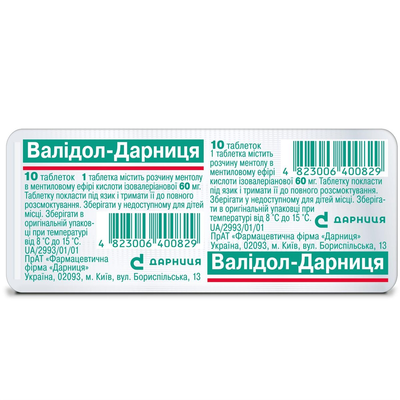
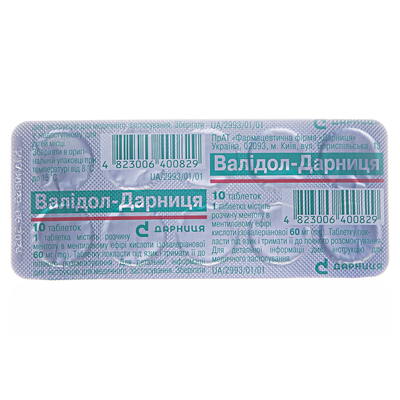
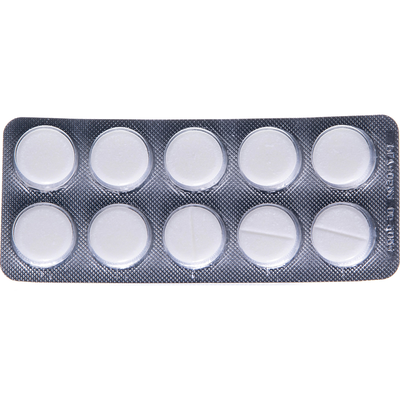
Validol-Darnitsa 60 mg tablets, No. 10, in blister packs, without a box
Composition
Active ingredient: menthol solution in menthyl isovalerate;
1 tablet contains 60 mg of menthol solution in menthyl isovalerate;
Excipients: crystalline sugar, calcium stearate.
Dosage Form
Tablets.
Main physical and chemical properties: white or white-with-a-yellowish-tint tablets, flat-cylindrical in shape, with a score line and a bevel, and a characteristic menthol odor. Grayish specks and a powdery coating on the surface of the tablets are permissible.
Pharmacotherapeutic group
Cardiovascular drugs. ATC code S01E X.
Pharmacological properties
Pharmacodynamics.
Validol is a complex substance formed by dissolving menthol in the menthyl ester of isovaleric acid. When administered sublingually, the drug’s effect is due to the action of menthol ester and isovaleric acid. The former—by irritating the sensitive nerve endings on the oral mucosa—exerts a reflex vasodilatory effect (including coronary vasodilation). The latter stimulates the formation and release of enkephalins, endorphins, dynorphins, and peptides in the central nervous system, which regulate pain sensations. As a result of using the drug, regional blood circulation improves, and the severity of pain is reduced. The drug has a calming effect.
Pharmacokinetics.
The drug is rapidly absorbed in the oral cavity and reaches its maximum concentration in the systemic circulation within a few minutes. When administered sublingually, the drug’s effect begins within 5 minutes.
It is partially metabolized in the liver. Metabolites are excreted from the body via the intestines with bile. The drug is excreted unchanged from the body in urine and in exhaled air.
Indications
Mild angina attacks.
Seasickness and airsickness.
Hysteria.
Neurosis.
Headache associated with nitrate use.
Contraindications
Hypersensitivity to the drug’s components, severe arterial hypotension, acute myocardial infarction.
Interactions with other medications and other forms of interaction
Nitrates—concomitant use of this medication with nitrates reduces the headache caused by the latter.
Validol-Darnitsa potentiates the effects of sedatives, psychotropic drugs, opioid analgesics, alcohol, and anesthetics when used concomitantly.
Antihypertensive drugs—the effects of antihypertensive drugs may be potentiated when used concurrently with Validol-Darnitsa.
Special Considerations
If chest pain persists after taking the medication, acute coronary syndrome must be ruled out. When using the medication as part of combination therapy for angina attacks, if there is no response within the first 5 minutes, nitrates should be administered.
This medication contains sugar; therefore, it should be prescribed with caution to patients with diabetes.
Pregnancy and lactation.
Use of the drug during pregnancy or lactation is permissible if, in the physician’s opinion, the expected benefit to the mother outweighs the potential risk to the fetus or infant.
Affects the ability to operate vehicles and machinery.
Caution is advised during the first few hours after taking the medication when driving or performing tasks that require increased attention, as dizziness, drowsiness, and slowed psychomotor reactions may occur.
Directions for Use and Dosage
Hold the tablets in your mouth (under the tongue) until they are completely absorbed.
The single dose for adults is 1–2 tablets; the daily dose is 2–4 tablets.
If necessary, the daily dose may be increased. The maximum daily dose is 600 mg. The duration of treatment is up to 7 days.
Children.
There is no experience with the use of this medication for the treatment of children.
Overdose
Symptoms: headache, nausea, agitation, cardiac disturbances, low blood pressure, central nervous system depression, hypersensitivity reactions to the drug’s components (angioedema, hives, itching, rash).
Treatment: In case of overdose, discontinue the drug and provide symptomatic treatment.
Side Effects
With long-term use, nausea, abdominal discomfort, tearing, dizziness, drowsiness, and transient hypotension may rarely occur; these symptoms resolve rapidly on their own.
Hypersensitivity reactions may develop, including angioedema, hives, itching, rash, erythema, and hypersensitivity reactions of the respiratory system.
Shelf life
2 years.
Storage conditions
Store in the original packaging at a temperature between 8 °C and 15 °C.
Keep out of reach of children.
Packaging
6 or 10 tablets per blister pack; 1 blister pack per package; 6 or 10 tablets per blister.
Sales Conditions
Available without a prescription.
Manufacturer
Darnitsa Pharmaceutical Company, PJSC.







