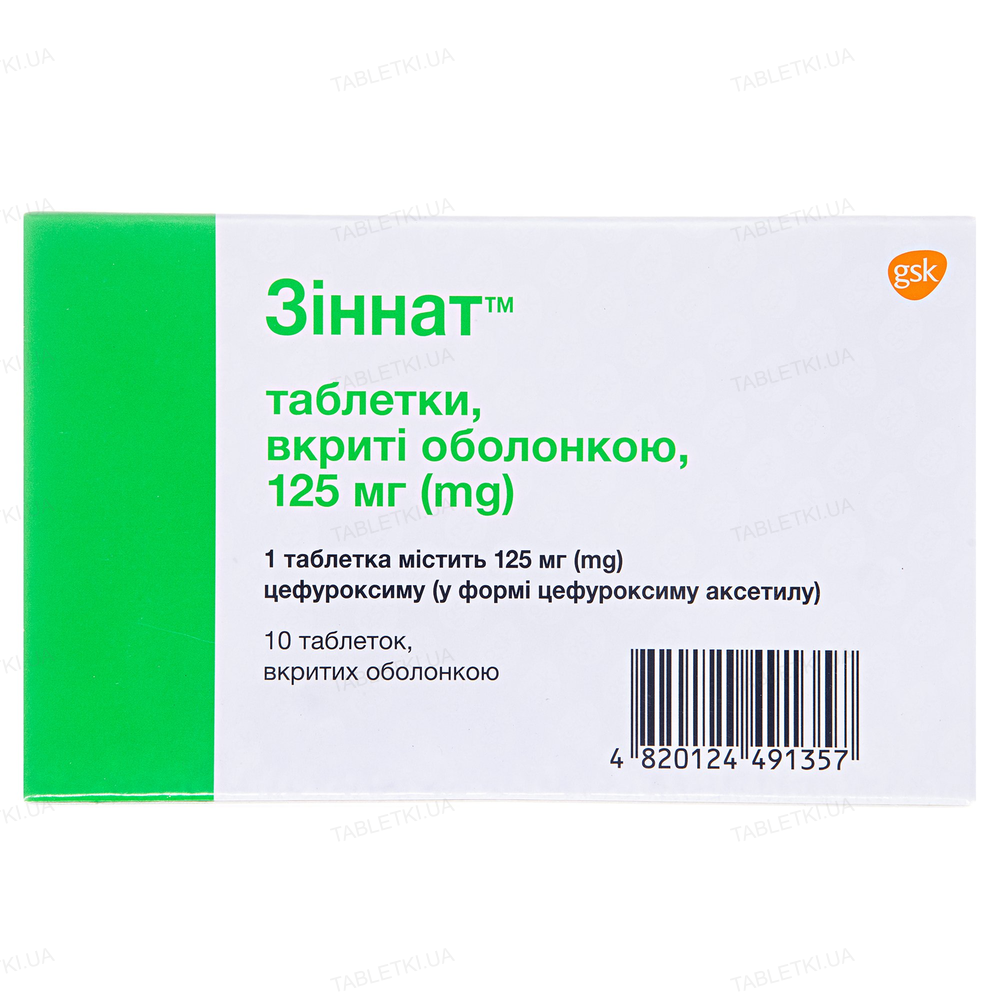
Zinnat tablets, coated, 125 mg each, No. 10
Composition
Active ingredient: cefuroxime;
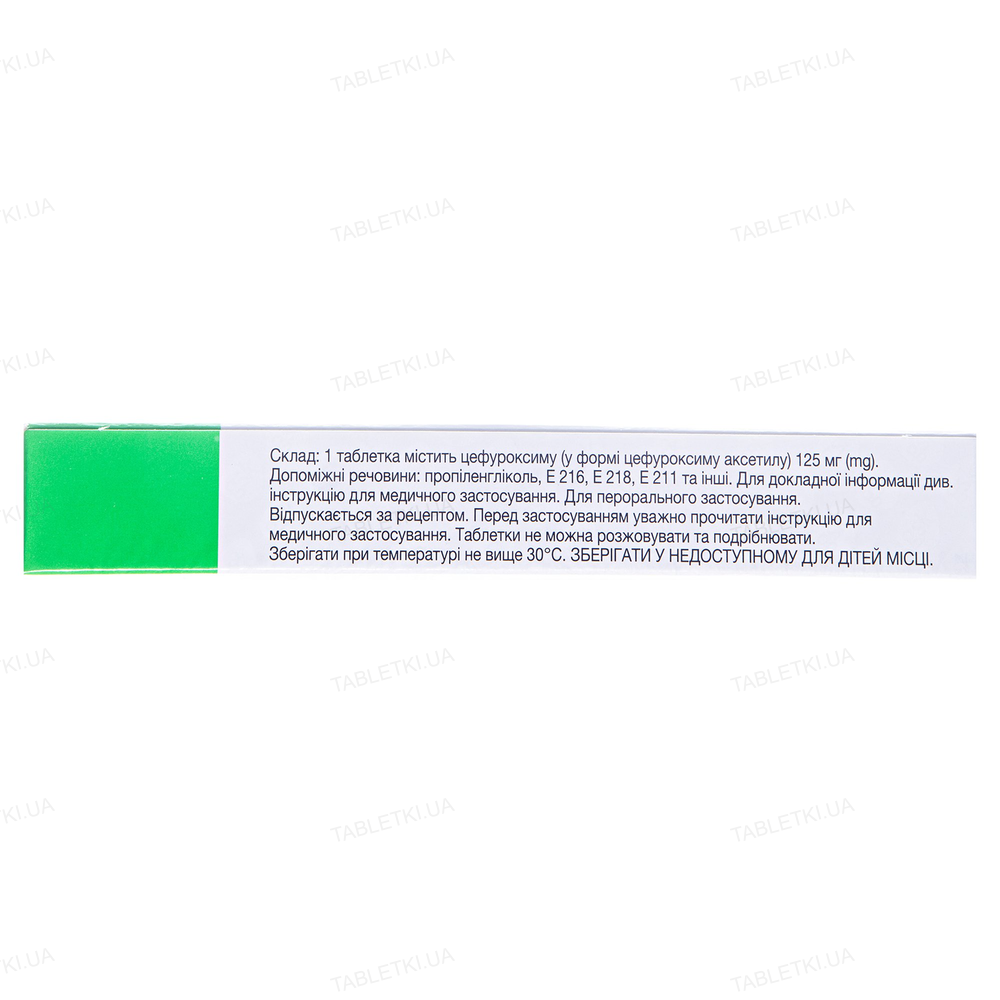
1 tablet contains 125 mg, 250 mg, or 500 mg of cefuroxime (as cefuroxime axetil);
inactive ingredients: microcrystalline cellulose, croscarmellose sodium (type A), sodium lauryl sulfate, hydrogenated vegetable oil, anhydrous colloidal silicon dioxide, hypromellose, propylene glycol, methyl parahydroxybenzoate (E 218), propyl parahydroxybenzoate (E 216), Opaspray White M-1-7120J (contains sodium benzoate (E 211)).
Dosage Form
Film-coated tablets.
Main physical and chemical properties: film-coated tablets, biconvex and capsule-shaped, white or almost white in color; marked “GX ES5” on one side for 125 mg tablets;
film-coated tablets, biconvex and capsule-shaped, white or almost white in color; marked “GX ES7” on one side for 250 mg tablets;
film-coated, biconvex, capsule-shaped tablets, white or almost white in color; marked “GX EG2” on one side for 500 mg tablets.
Pharmacotherapeutic group
Antimicrobials for systemic use. Beta-lactam antibiotics. ATC code J01D C02.
Pharmacological Properties
Pharmacodynamics.
Cefuroxime axetil is the oral form of the bactericidal cephalosporin antibiotic cefuroxime, which is resistant to most beta-lactamases and is active against a broad spectrum of Gram-positive and Gram-negative microorganisms.
The bactericidal action of cefuroxime results from the inhibition of microbial cell wall synthesis.
Acquired resistance to the antibiotic varies by region and may change over time; for certain strains, it may differ significantly. It is advisable, when available, to consult local data on antibiotic susceptibility, especially when treating severe infections.
Cefuroxime is generally active against the following microorganisms in vitro:
| Susceptible microorganisms: |
| Gram-positive aerobes:
Staphylococcus aureus (methicillin-susceptible)* Coagulase-negative staphylococci (methicillin-susceptible) Streptococcus pyogenes Streptococcus agalactiae |
| Gram-negative aerobes:
Haemophilus influenzae Haemophilus parainfluenzae Moraxella catarrhalis |
| Spirochetes:
Borrelia burgdorferi |
| Microorganisms for which acquired resistance may be a problem: |
| Gram-positive aerobes:
Streptococcus pneumoniae |
| Gram-negative aerobes:
Citrobacter freundii Enterobacter aerogenes Enterobacter cloacae Escherichia coli Klebsiella pneumoniae Proteus mirabilis Proteus strains (other than P. vulgaris) Providencia strains |
| Gram-positive anaerobes:
Peptostreptococcus strains Propionibacterium strains |
| Gram-negative anaerobes:
Fusobacterium strains Bacteroides strains |
| Resistant microorganisms: |
| Gram-positive aerobes:
Enterococcus faecalis Enterococcus faecium |
| Gram-negative aerobes:
Acinetobacter strains. Campylobacter strains Morganella morganii Proteus vulgaris Pseudomonas aeruginosa Serratia marcescens |
| Gram-negative anaerobes:
Bacteroides fragilis |
| Others:
Chlamydia strains Mycoplasma strains Legionella strains |
*All methicillin-resistant S. aureus strains are resistant to cefuroxime.
Pharmacokinetics.
After oral administration, cefuroxime axetil is absorbed in the intestine, hydrolyzed on the intestinal mucosa, and enters the bloodstream as cefuroxime.
Optimal absorption occurs immediately after a meal. Peak serum levels of cefuroxime are reached approximately 2–3 hours after administration. The half-life of the drug is approximately 1–1.5 hours. The protein binding rate is 33–55%, depending on the assay method. Cefuroxime is excreted by the kidneys in an unchanged form via tubular secretion and glomerular filtration.
Concomitant use of probenecid increases the area under the curve of the mean serum concentration by 50%.
Serum cefuroxime levels are reduced by dialysis.
Indications
Zinnat is indicated for the treatment of the infections listed below in adults and children aged 3 months and older.
- Acute streptococcal tonsillitis and pharyngitis.
- Acute bacterial sinusitis.
- Acute otitis media.
- Exacerbation of chronic bronchitis caused by pathogens susceptible to cefuroxime axetil.
- Cystitis.
- Pyelonephritis.
- Uncomplicated skin and soft tissue infections.
- Early manifestations of Lyme disease.
Contraindications
Hypersensitivity to cephalosporin antibiotics, cefuroxime, or any of the drug’s components. History of severe hypersensitivity reactions (e.g., anaphylactic reactions) to any other type of beta-lactam antibiotics (penicillins, monobactams, and carbapenems).
Drug Interactions and Other Interactions
Medications that reduce gastric acidity may decrease the bioavailability of Zinnat and tend to negate the effect of enhanced absorption following a meal.
Like other antibiotics, Zinnat may affect the intestinal flora, leading to reduced reabsorption of estrogens and decreased effectiveness of combined oral contraceptives.
Since a false-negative result may occur with the ferrocyanide test, it is recommended that patients being treated with cefuroxime axetil use the glucose oxidase or hexokinase methods to determine blood and plasma glucose levels. Cefuroxime does not affect the alkaline picrate assay for creatinine determination.
Concomitant use with probenecid results in a significant reduction in the maximum concentration, the area under the “serum concentration-time” curve, and the half-life of cefuroxime. Therefore, concomitant use with probenecid is not recommended.
Concomitant use with oral anticoagulants may lead to an increase in the INR (International Normalized Ratio).
Serum cefuroxime levels are reduced by dialysis.
There have been reports of a positive Coombs test during treatment with cephalosporins. This phenomenon may affect cross-matching tests.
Special Considerations for Use
Hypersensitivity Reactions
Particular caution is required in patients with a history of allergic reactions to penicillins or other beta-lactam antibiotics, as there is a risk of cross-sensitivity. As with all beta-lactam antimicrobial agents, serious and, in rare cases, fatal hypersensitivity reactions have been reported. If severe hypersensitivity reactions occur, treatment with cefuroxime should be discontinued immediately, and the patient should receive appropriate emergency medical care.
Before initiating therapy, it is necessary to determine whether the patient has a history of severe hypersensitivity reactions to cefuroxime, other cephalosporins, or other types of beta-lactam drugs. Cefuroxime should be prescribed with caution to patients with a history of mild hypersensitivity reactions to other beta-lactam drugs.
The use of cefuroxime axetil (as with other antibiotics) may lead to overgrowth of Candida. Prolonged treatment may also lead to overgrowth of other non-susceptible microorganisms (e.g., Enterococci, Clostridium difficile), which may, in turn, require discontinuation of treatment.
Pseudomembranous colitis may occur with antibiotic use, ranging from mild to life-threatening. Therefore, it is important to keep this in mind if patients develop severe diarrhea during or after antibiotic therapy. If prolonged or severe diarrhea occurs, or if the patient experiences sudden, cramping abdominal pain, treatment should be discontinued immediately, and the patient should undergo a thorough examination.
During treatment with Zinnat for Lyme disease, the Jarisch–Herxheimer reaction has been observed; this reaction occurs directly as a result of Zinnat’s bactericidal effect on the microorganism that causes Lyme disease—the spirochete Borrelia burgdorferi. Patients should be informed that this is a common consequence of antibiotic therapy for Lyme disease, which resolves without treatment.
When administering sequential therapy, the timing of the transition from parenteral to oral therapy is determined by the severity of the infection, the patient’s clinical condition, and the susceptibility of the pathogen. If there is no clinical improvement within 72 hours, parenteral therapy should be continued. Before initiating stepwise therapy, review the relevant Prescribing Information for cefuroxime sodium.
Zinnat tablets contain parabens, which may cause allergic reactions (possibly of a delayed type).
Use during pregnancy or breastfeeding.
Pregnancy
There are limited data on the use of cefuroxime in pregnant women. Animal studies have not shown any adverse effects of cefuroxime axetil on pregnancy, embryonic and fetal development, labor, or postnatal development of the child. Zinnat should be prescribed to pregnant women only when the benefits of the medication outweigh the potential risks.
Breastfeeding
Cefuroxime passes into breast milk in small amounts. When used at therapeutic doses, adverse reactions are not expected; however, the risk of diarrhea or fungal infection of the mucous membranes cannot be ruled out. Therefore, breastfeeding may need to be discontinued due to these reactions. The possibility of a sensitizing effect of the drug should also be considered. Cefuroxime should be prescribed during breastfeeding only after a physician has assessed the benefit-risk ratio of its use.
Fertility
There are no data on the effect of cefuroxime axetil on fertility in humans. In animal studies of reproductive function, no effect of this drug on fertility was observed.
Ability to affect reaction time when driving or operating machinery.
Since this medication may cause dizziness, patients should be advised to exercise caution when driving or operating machinery.
Dosage and Administration
Susceptibility to the antibiotic varies by region and may change over time. If necessary, consult local data on antibiotic susceptibility.
The usual duration of treatment is 7 days (may range from 5 to 10 days).
For better absorption, it is recommended to take the medication after meals.
The dosage for adults and children, depending on the infection, is shown in Tables 1 and 2.
Adults and children (≥ 40 kg) Table 1
| Indications for Use | Dose |
| Acute tonsillitis and pharyngitis, acute bacterial sinusitis | 250 mg twice daily |
| Acute otitis media | 500 mg twice daily |
| Exacerbation of chronic bronchitis | 500 mg twice daily |
| Cystitis | 250 mg twice daily |
| Pyelonephritis | 250 mg twice daily |
| Uncomplicated skin and soft tissue infections | 250 mg twice daily |
| Lyme disease | 500 mg twice daily for 14 days (treatment may last from 10 to 21 days) |
Children (< 40 kg) Table 2
| Indications for use | Dosage |
| Acute tonsillitis and pharyngitis, acute bacterial sinusitis | 10 mg/kg twice daily, maximum dose—125 mg twice daily |
| Children 2 years of age and older with otitis media or, if necessary, with more serious infections | 15 mg/kg twice daily; maximum dose—250 mg twice daily |
| Cystitis | 15 mg/kg twice daily; maximum dose: 250 mg twice daily |
| Pyelonephritis | 15 mg/kg twice daily, maximum dose—250 mg twice daily for 10–14 days |
| Uncomplicated skin and soft tissue infections | 15 mg/kg twice daily; maximum dose: 250 mg twice daily |
| Lyme disease | 15 mg/kg twice daily; maximum dose: 250 mg twice daily for 14 days (10 to 21 days) |
Zinnat tablets must not be broken; therefore, they are not prescribed to patients who cannot swallow them. It is recommended that children be prescribed the drug in suspension form.
Cefuroxime acetyl tablets and cefuroxime acetyl granules for suspension preparation are not bioequivalent; therefore, these dosage forms are not interchangeable when converted to milligrams.
Cefuroxime is also available as a sodium salt for parenteral administration. This allows for continuous therapy with a single antibiotic when transitioning from parenteral to oral administration, if clinically indicated.
Zinnat is effective for the sequential treatment of exacerbations of chronic bronchitis following prior parenteral administration of “Zinacef” (cefuroxime sodium).
Sequential Therapy
Exacerbations of chronic bronchitis: 750 mg of cefuroxime 2–3 times daily (intravenously or intramuscularly) for 48–72 hours, followed by Zinnat 500 mg twice daily orally for 5–10 days.
The duration of both parenteral and oral treatment should be determined based on the severity of the infection and the patient’s condition.
Patients with renal insufficiency
Cefuroxime is excreted primarily by the kidneys. In patients with severe renal impairment, it is recommended to reduce the dose of cefuroxime to compensate for its slower excretion (see table below).
| Creatinine clearance | T1/2 (hours) | Recommended dosage |
| ≥ 30 mL/min | 1.4–2.4 | No dose adjustment required (use the standard dose of 125 mg to 500 mg twice daily) |
| 10–29 mL/min | 4.6 | Standard individualized dose every 24 hours |
| <10 mL/min | 16.8 | Standard individualized dose every 48 hours |
| During hemodialysis | 2–4 | One additional standard dose should be administered after each dialysis session |
Patients with hepatic impairment
There are no data on the use of this medication in patients with impaired liver function. Cefuroxime is primarily excreted by the kidneys; therefore, existing liver dysfunction is not expected to affect the pharmacokinetics of cefuroxime.
Children.
There is no experience with the use of cefuroxime axetil for the treatment of children under 3 months of age.
Zinnat tablets must not be broken; therefore, they are not prescribed to patients who cannot swallow them. It is recommended that the drug be administered to children in the form of a suspension.
Overdose
In case of cephalosporin overdose, brain irritation and neurological complications, including encephalopathy, seizures, and coma, may occur. Symptoms of overdose may occur if the dose of the drug has not been appropriately adjusted for patients with impaired renal function (see the sections “Dosage and Administration” and “Special Considerations”).
Serum cefuroxime levels can be reduced by hemodialysis and peritoneal dialysis.
Side Effects
Adverse reactions associated with the use of cefuroxime axetil are mild and are generally reversible.
The adverse reactions listed below are classified by organ system and frequency of occurrence. They are categorized by frequency as follows:
very common ≥ 1 in 10, common ≥ 1 in 100 and < 1 in 10, uncommon ≥ 1 in 1,000 and < 1 in 100, rare ≥ 1 in 10,000 and < 1 in 1,000, very rare < 1 in 10,000.
Infections and infestations
Common: Candida overgrowth.
Unknown: overgrowth of Clostridium difficile.
Blood and lymphatic system disorders
Common: eosinophilia.
Uncommon: positive Coombs test, thrombocytopenia, leukopenia (sometimes severe).
Very rare: hemolytic anemia.
Cephalosporins, as a class, tend to be absorbed onto the surface of red blood cell membranes and interact there with antibodies, which may result in a positive Coombs test (affecting blood compatibility testing) and (very rarely) to hemolytic anemia.
Immune system disorders
Hypersensitivity reactions, including
Uncommon: skin rashes.
Rare: hives, itching.
Very rare: drug fever, serum sickness, anaphylaxis.
Frequency unknown: Jarisch–Herxheimer reaction.
Nervous system
Common: headache, dizziness.
Gastrointestinal system
Common: gastrointestinal disorders, including diarrhea, nausea, and abdominal pain.
Uncommon: vomiting.
Rare: pseudomembranous colitis (see the “Special Precautions for Use” section).
Hepatobiliary system
Common: transient elevation of liver enzymes (ALT, AST, LDH).
Very rare: jaundice (primarily cholestatic), hepatitis.
Skin and subcutaneous tissue disorders
Very rare: polymorphic erythema, Stevens–Johnson syndrome, toxic epidermal necrolysis (exanthematous necrolysis).
Frequency unknown: angioedema.
Children.
The safety profile of cefuroxime in children is consistent with that in adult patients.
Shelf life
3 years.
Storage conditions
Store at a temperature not exceeding 30 °C. Keep out of reach of children.
Packaging
Blister packs of 10 tablets in a cardboard box.
Dispensing Category
By prescription only.
Manufacturer
Glaxo Operations UK Limited (United Kingdom)/
Glaxo Operations UK Limited (United Kingdom).
Address
Glaxo Operations UK Limited, Harmire Road, Barnard Castle, Durham, DL12 8DT, United Kingdom/
Glaxo Operations UK Limited, Harmire Road, Barnard Castle, Durham, DL12 8DT, United Kingdom.