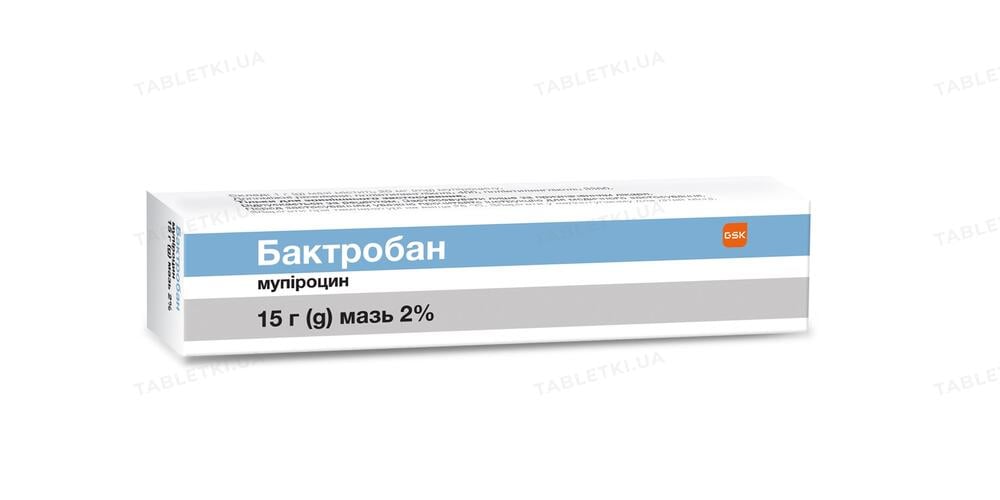
Bactroban 2% ointment, 15 g per tube
Ingredients
Active ingredient: mupirocin;
1 g of ointment contains 20 mg of mupirocin;
excipients: polyethylene glycol 400 and polyethylene glycol 3350.
Dosage Form
Ointment.
Main physical and chemical properties: the ointment is almost white in color.
Pharmacotherapeutic group
Dermatological agents. Antibiotics and chemotherapeutic agents for dermatological use. Topical antibiotics. Other topical antibiotics. Mupirocin. ATC code D06A X09.
Pharmacological properties
Pharmacodynamics.
Bactroban is an antibacterial agent for topical use that is active against organisms that cause most infectious skin diseases, including Staphylococcus aureus (including methicillin-resistant strains), other staphylococci and streptococci. It is also active against Gram-negative organisms, such as Escherichia coli and Haemophilus influenzae.
Bactroban (mupirocin) is a potent inhibitor of bacterial protein and RNA synthesis by inhibiting isoleucyl-tRNA synthetase.
Pharmacokinetics.
Following topical application of Bactroban ointment, mupirocin is minimally absorbed systemically, and the amount that is absorbed is rapidly metabolized to the microbiologically inactive metabolite monic acid. The penetration of mupirocin into the deeper epidermal and dermal layers of the skin is increased in damaged skin areas and under occlusive dressings.
Indications
Topical treatment of bacterial skin infections, such as impetigo, folliculitis, and furunculosis.
Contraindications
Hypersensitivity to mupirocin or to any other component of the drug.
Bactroban in this dosage form is not intended for ophthalmic or intranasal use.
Interactions with Other Medications and Other Types of Interactions
No reports.
Special Instructions for Use
If isolated hypersensitivity reactions or severe local irritation occur during use of the ointment, treatment should be discontinued, the affected skin area should be rinsed with water to remove any ointment residue, and an alternative medication should be prescribed to treat the lesion.
As with treatment using other antibacterial agents, prolonged use of the ointment may lead to overgrowth of non-susceptible microorganisms, including fungal flora.
There have been reports of pseudomembranous colitis associated with antibiotic use, which can range from mild to life-threatening. Therefore, it is important to consider this diagnosis in patients who develop diarrhea during or after antibiotic use, although it is less likely with topical application of mupirocin. If diarrhea is persistent or severe, or if the patient experiences abdominal pain, treatment should be discontinued immediately and the patient should be evaluated.
Renal insufficiency
Elderly patients: There are no restrictions on use, provided that conditions preventing the absorption of polyethylene glycol—a component of Bactroban ointment—do not arise during treatment and no signs of moderate or severe renal insufficiency appear.
Bactroban ointment must not be used:
- to treat eye conditions;
- intranasally;
- in combination with catheters;
- at the site of central venous catheterization.
Avoid getting the ointment in the eyes. If this occurs, rinse the eyes thoroughly with water until all traces of the ointment are removed.
Polyethylene glycol may be absorbed through a wound surface or otherwise damaged skin and excreted by the kidneys. Like other polyethylene glycol-based ointments, Bactroban should not be used in conditions of increased polyethylene glycol absorption, especially in cases of moderate to severe renal insufficiency.
Use during pregnancy or breastfeeding.
Fertility: There are no data on the ointment’s effect on human fertility. Animal studies have shown no effect on fertility.
Pregnancy: Reproductive studies of mupirocin in animals have not revealed any harmful effects on the fetus. There are insufficient clinical data on the use of the ointment during pregnancy. The ointment should be used during pregnancy only when the potential benefit to the woman outweighs the possible risk to the fetus.
Breastfeeding: There are insufficient data on the use of the ointment during breastfeeding. If necessary, the ointment may be used to treat cracked nipples, but the nipples should be thoroughly washed before feeding the baby.
Effect on reaction time when operating motor vehicles or other machinery.
No adverse effects on the ability to drive or operate machinery have been identified.
Dosage and Administration
Adults, children, and elderly patients
Apply a thin layer of the ointment to the affected areas of the skin 2–3 times a day for up to 10 days, depending on the course of the disease.
A bandage may be applied to the area of skin treated with the ointment.
Hepatic insufficiency
No dose adjustment is necessary.
Renal insufficiency
Polyethylene glycol may be absorbed through open wounds and damaged skin. Like other polyethylene glycol-based ointments, Bactroban should not be used in situations where large amounts of polyethylene glycol are absorbed, especially if there are signs of moderate or severe renal insufficiency.
This medication is intended for external use only.
Wash your hands thoroughly after applying the product to the skin.
Do not mix the ointment with other medications, as diluting the ointment reduces its antibacterial activity and may compromise the stability of the active ingredient.
Children.
It is used to treat children aged 2 months and older.
Overdose
Symptoms. Currently, experience with mupirocin overdose is limited.
Treatment. There is no specific treatment for mupirocin overdose. In case of overdose, symptomatic treatment is required.
The toxicity of Bactroban ointment is very low. In case of accidental ingestion of the ointment, symptomatic treatment should be administered.
If a large amount of the ointment is accidentally swallowed, renal function should be closely monitored in patients with renal insufficiency, taking into account the possible side effects of polyethylene glycol.
Side Effects
Adverse reactions are classified by organ system and frequency of occurrence. The frequency of adverse effects is defined as follows: very common (> 1/10), common (> 1/100, < 1/10), uncommon (> 1/1,000, < 1/100), rare (> 1/10,000, < 1/1,000), very rare (< 1/10,000, including isolated cases).
Immune system disorders:
very rare: systemic allergic reactions, including anaphylaxis, generalized rash, hives, and angioedema.
Skin and subcutaneous tissue disorders:
common: burning sensation at the site of ointment application, eczema;
Uncommon: itching, erythema, pain, and dry skin at the site of ointment application.
Hypersensitivity skin reactions: rash, increased exudation, swelling at the site of application, contact dermatitis.
Nervous system: headache, dizziness.
Gastrointestinal system: nausea, abdominal pain, ulcerative stomatitis.
Reporting of Suspected Adverse Reactions
Reporting suspected adverse drug reactions during the postmarketing period is of great importance. This ensures continuous monitoring of the risk-benefit ratio of this medication. Healthcare professionals and patients can report suspected adverse reactions to GlaxoSmithKline Pharmaceuticals Ukraine LLC via the 24-hour hotline (044) 585-51-85 or via email at oax70065@gsk.com.
Shelf life
2 years.
Storage Conditions
Store at a temperature not exceeding 25 °C. Keep out of reach of children.
Packaging
15 g of ointment in an aluminum tube with a polypropylene cap. One tube per cardboard box.
Manufacturer
Glaxo Operations UK Ltd, United Kingdom.
Manufacturer’s location and address of operations.
Harmire Road, Barnard Castle, DL12 8DT, United Kingdom/
Harmire Road, Barnard Castle, DL12 8DT, United Kingdom.