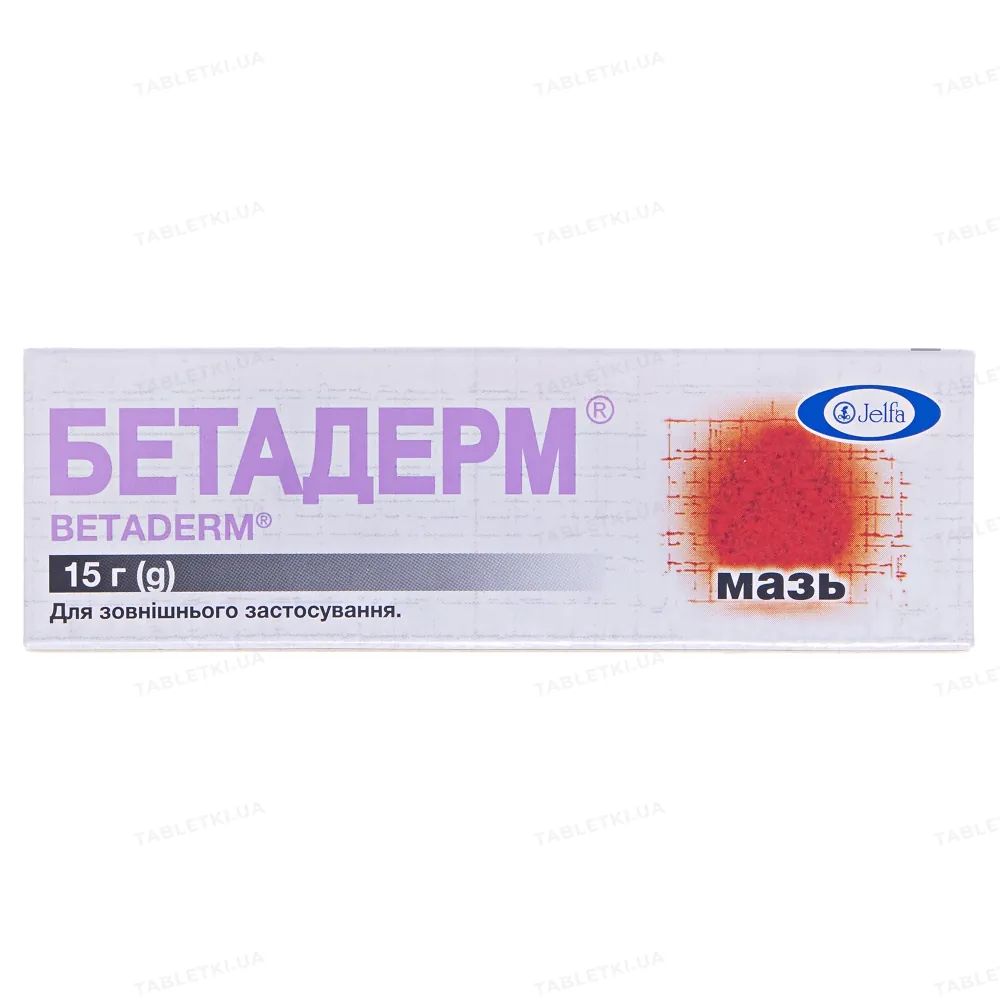
Betaderm ointment, 15 g tubes
Ingredients
Active ingredients: betamethasone, gentamicin;
1 g of ointment contains 0.5 mg of betamethasone (as betamethasone dipropionate) and 1 mg of gentamicin (as gentamicin sulfate);
Excipients: mineral oil, lanolin alcohol, cetostearyl alcohol, butylhydroxyanisole (E 320), butylhydroxytoluene (E 321), white soft paraffin.
Dosage Form
Ointment.
Main physical and chemical properties: a white or nearly white, translucent, greasy, soft paste.
Pharmacotherapeutic group
Corticosteroids for dermatological use. Corticosteroids in combination with antibiotics. Betamethasone and antibiotics.
ATC code D07C01.
Pharmacological properties
Pharmacodynamics.
Betaderm® combines the long-lasting anti-inflammatory, antipruritic, and vasoconstrictive effects of betamethasone dipropionate with the broad-spectrum antibacterial activity of gentamicin sulfate. It is active against Staphylococcus aureus (coagulase-positive, coagulase-negative, and some penicillinase-producing strains) and Gram-negative bacteria: Pseudomonas aeruginosa, Aerobacter aerogenes, Escherichia coli, Proteus vulgaris, and Klebsiella pneumoniae.
Pharmacokinetics.
No pharmacokinetic data are available for Betaderm®.
Indications
Dermatoses responsive to treatment with glucocorticosteroids, when complicated by or suspected of being complicated by a secondary infection caused by microorganisms susceptible to gentamicin: eczema (atopic, infantile, nummular), anogenital and senile pruritus, contact dermatitis, seborrheic dermatitis, neurodermatitis, intertriginous dermatitis, solar dermatitis, exfoliative dermatitis, stasis dermatitis, and psoriasis.
Contraindications
This medication is contraindicated in patients with hypersensitivity to corticosteroids, gentamicin, or any other component of the medication. It is also contraindicated in cases of cutaneous tuberculosis, cutaneous manifestations of syphilis, cutaneous reactions following vaccination, generalized plaque psoriasis, varicose veins, perioral dermatitis, viral skin infections (e.g., chickenpox, herpes), skin neoplasms, rosacea, adolescent (common) acne, and other bacterial and fungal skin infections without appropriate antibacterial and antifungal therapy. Do not apply to large areas of skin, especially in cases where the skin’s integrity is compromised, such as with burns.
Interactions with Other Medications and Other Types of Interactions
During treatment with this medication, it is not recommended to receive the smallpox vaccine or undergo other types of immunization (especially during prolonged use on large areas of skin) due to the possible absence of an adequate immune response in the form of antibody production.
This medication may enhance the effects of immunosuppressive drugs and weaken the effects of immunostimulants.
Due to the presence of white soft paraffin and mineral oil, the application of Betaderm® ointment to the anogenital area may damage the structure of latex condoms and reduce their safety when used during treatment.
Special Instructions for Use
This medication is not intended for ophthalmic use.
Since Betaderm® contains a potent glucocorticosteroid, it is recommended for use on small areas of skin.
Prolonged use of the product on large areas of skin increases the frequency of side effects and the risk of bacterial resistance to gentamicin sulfate.
Do not use continuously for more than 2 weeks.
If skin irritation, allergic reactions, or signs of hypersensitivity occur during treatment with Betaderm® ointment, discontinue use and select an appropriate alternative therapy for the patient.
Do not apply the ointment under an occlusive dressing, as this may lead to epidermal atrophy, the development of stretch marks, and superinfection.
Any side effects associated with the use of systemic corticosteroids, including suppression of adrenal cortex function, may also occur with the topical application of glucocorticosteroids, especially in children.
Vision problems may occur with the use of systemic and topical corticosteroids.
If symptoms such as blurred vision or other visual disturbances occur, consult an ophthalmologist to evaluate possible causes, which may include cataracts, glaucoma, or rare conditions such as central serous chorioretinopathy, which has been reported with the use of systemic and topical corticosteroids.
Avoid contact with the eyes and mucous membranes. Do not apply to the eyelid skin, as this may cause glaucoma or cataracts.
Do not apply the medication to the skin of the face due to the risk of side effects (telangiectasia, perioral dermatitis) even after short-term use.
If an infection is present, antifungal or antibacterial agents should be prescribed as appropriate.
Since corticosteroids and gentamicin can be absorbed through the skin, there is a risk of systemic side effects associated with glucocorticosteroids (including suppression of adrenal cortex function) and gentamicin (ototoxicity, nephrotoxicity, especially in patients with renal insufficiency).
This medication should be used with caution in patients with psoriasis, as topical application of glucocorticosteroids to psoriasis-affected areas may lead to a recurrence of the condition due to the development of tolerance, the risk of generalized pustular psoriasis, and systemic toxicity caused by a reduction in the skin’s protective function.
High-potency corticosteroids applied to large areas of skin should be used under careful and regular monitoring, as they may cause suppression of the hypothalamic-pituitary-adrenal (HPA) axis. If suppression occurs, the medication should be discontinued, the frequency of application reduced, or the patient switched to a less potent corticosteroid.
HPA axis function usually returns to normal after discontinuation of the drug.
In rare cases, withdrawal symptoms may develop, requiring the addition of a systemic corticosteroid.
It should be noted that prolonged topical therapy with gentamicin may lead to the development of microorganisms resistant to aminoglycosides.
Use on the skin of the armpits and in the groin area only when absolutely necessary, as absorption may increase and there is a high risk of side effects even after short-term use.
Use the drug with caution in patients with pre-existing atrophic conditions of the subcutaneous tissue, especially in the elderly.
Avoid using the drug on large areas of skin, on damaged skin, in high doses, in patients with renal or hepatic insufficiency, and in children.
Use During Pregnancy or Breastfeeding
Since the safety of topical corticosteroids in pregnant women has not been established, this medication should not be used during the first trimester of pregnancy. Prescription of this medication is possible only in later stages of pregnancy if the expected benefit to the expectant mother outweighs the potential risk to the fetus. Drugs in this class should not be used by pregnant women in high doses, for prolonged periods, or under occlusive dressings.
It is currently unknown whether corticosteroids, when applied topically, can enter breast milk as a result of systemic absorption; therefore, when deciding whether to discontinue breastfeeding or discontinue use of the drug, the importance of treatment for the mother must be taken into account.
Effect on the ability to drive or operate machinery
This medication generally does not affect reaction time when driving or operating machinery.
Dosage and Administration
Apply a thin layer of the ointment to the affected area of the skin twice daily—in the morning and in the evening.
The frequency of application is determined by the doctor on an individual basis, depending on the severity of the condition. In mild cases, apply once daily; in severe cases, more frequent application may be necessary.
The duration of treatment depends on the size and location of the lesion, as well as the patient’s response to treatment. However, if no clinical improvement is observed within 3–4 weeks, the doctor should reconsider the diagnosis.
Children
There are no clinical data on the use of this medication in children; therefore, its use in this age group is not recommended.
Since children have a higher surface area-to-body-weight ratio than adults, absorption of the drug is more rapid. Therefore, children are more prone to developing suppression of the hypothalamic-pituitary-adrenal (HPA) axis due to corticosteroid use and to experiencing exogenous effects of corticosteroids.
In children who received corticosteroids for topical use, adrenal suppression, Cushing’s syndrome, growth retardation, inadequate weight gain, and increased intracranial pressure have been observed.
Signs of adrenal cortex suppression include low plasma cortisol levels and an absence of response to an adrenal stimulation test using adrenocorticotropic hormone (ACTH). Increased intracranial pressure manifests as a bulging fontanelle, headache, and bilateral optic disc edema.
Overdose
With long-term use on large areas of skin, in high doses, or when an occlusive dressing is used, symptoms of overdose may occur, manifested by an increase in systemic side effects characteristic of corticosteroids (hyperglycemia, glucosuria, suppression of pituitary-adrenal function leading to secondary adrenal insufficiency and the onset of symptoms of hypercortisolism, including Cushing’s syndrome).
A reversible decrease in ACTH was observed following a single application of approximately 7 g of ointment.
Excessive or prolonged use of gentamicin may lead to overgrowth of microorganisms resistant to the antibiotic and may cause ototoxic and nephrotoxic effects, which can be particularly dangerous in patients with renal insufficiency.
Treatment. Administer appropriate symptomatic therapy. Symptoms of acute hypercortisolism are usually reversible. If necessary, correct electrolyte imbalances. In cases of chronic toxicity, gradual withdrawal of corticosteroids is recommended. In the event of excessive growth of resistant microorganisms, it is recommended to discontinue treatment with the drug and initiate appropriate therapy.
Side Effects
Skin and subcutaneous tissue disorders: acne, steroid purpura, suppression of epidermal growth, skin tingling, skin thickening, skin cracking, sensation of warmth, lamellar desquamation, focal desquamation, subcutaneous tissue atrophy, dry skin, skin hyperpigmentation, skin depigmentation, skin atrophy and striae, telangiectasia, folliculitis, allergic contact dermatitis, urticaria or maculopapular rash, prickly heat, itching, burning sensation, erythema, hypertrichosis, secondary infection, irritation, or exacerbation of existing lesions.
Application to the facial skin may cause perioral dermatitis.
Vascular system: If the product is used for longer than the recommended duration, dilation of small blood vessels (telangiectasia) may occur.
Ear-related side effects: Application to mucous membranes or large areas of skin, especially damaged skin, or under an occlusive dressing may cause ototoxicity due to the presence of gentamicin sulfate in the ointment.
Endocrine system: signs of hypercortisolism. Prolonged use of the ointment on large areas of skin, under an occlusive dressing, or in children—given the increased absorption of betamethasone dipropionate—may cause a strong systemic effect, characteristic of corticosteroids, manifested as edema, hypertension, immunosuppression, growth and developmental suppression in children, hyperglycemia, glucosuria, and the development of Cushing’s syndrome.
Ocular side effects: When applied topically to the eyelids, the drug may occasionally lead to the development of glaucoma or accelerate the development of cataracts.
Blurred vision may occur.
Immune system: Hypersensitivity to corticosteroids may occur; in such cases, use of the drug must be discontinued immediately.
Renal and urinary system: Application to large areas of skin, especially damaged skin, or under an occlusive dressing may cause nephrotoxicity due to the presence of gentamicin sulfate in the ointment.
The product contains cetostearyl alcohol, which may cause a local skin reaction (e.g., contact dermatitis).
The product contains butylhydroxytoluene and butylhydroxyanisole, which may cause a local skin reaction (e.g., contact dermatitis) or irritation of the eyes and mucous membranes.
Shelf life
3 years.
Storage conditions
Store at a temperature not exceeding 25 °C. Keep out of reach of children.
Packaging
15 g of ointment per tube.
Manufacturer
Yelpa Pharmaceutical Plant A.T.
Address
58-500 Jelenia Góra, 21 Wincenty Pola St., Poland.