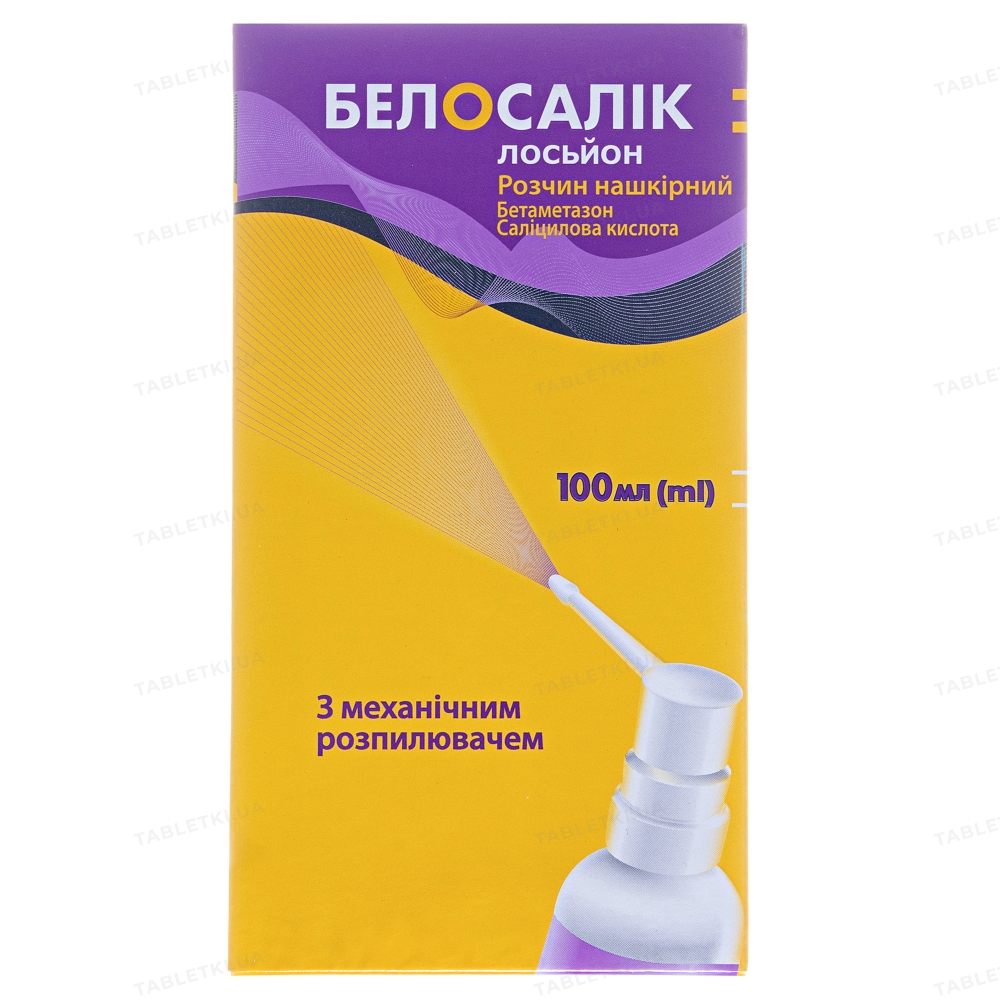
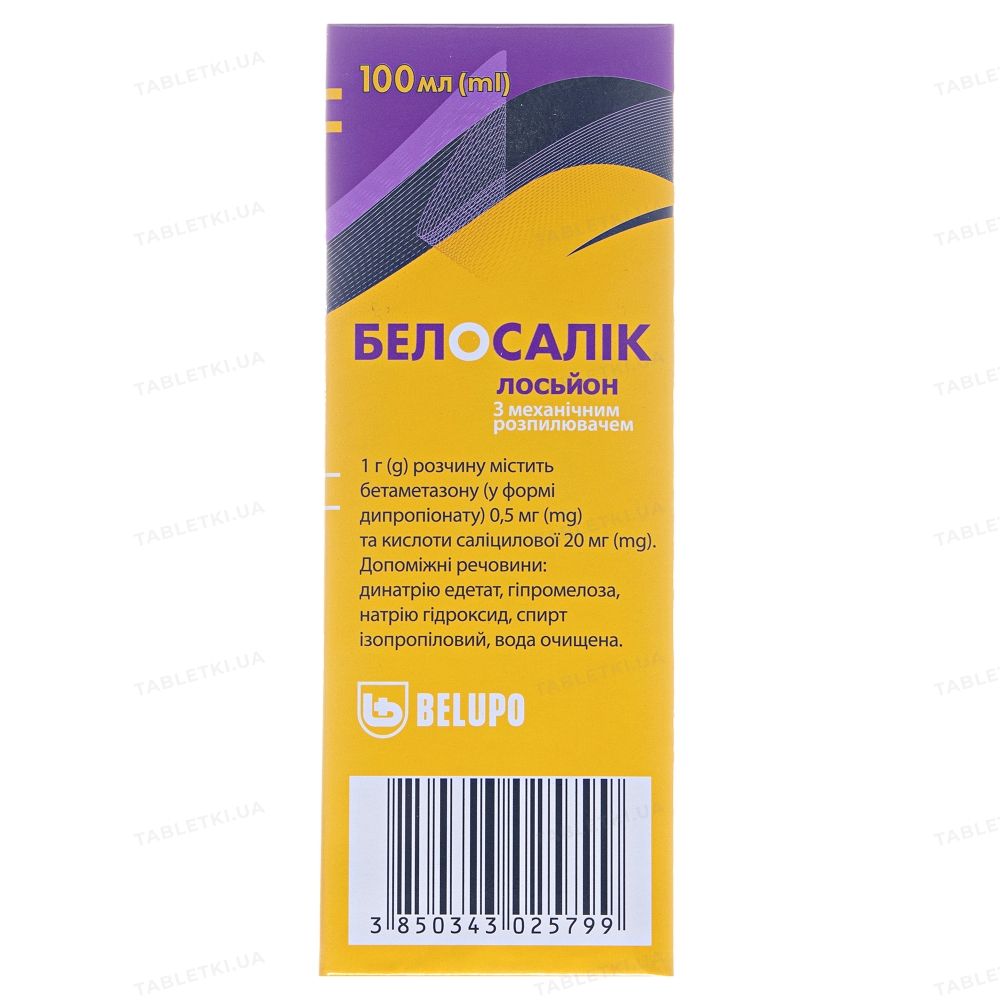
Belosalik Lotion, solution for external use, 100 ml per bottle with a spray nozzle.
Ingredients
Active ingredients: betamethasone, salicylic acid;
1 g of solution contains 0.5 mg of betamethasone (as dipropionate) and 20 mg of salicylic acid;
Excipients: disodium edetate, hypromellose, sodium hydroxide, isopropyl alcohol, purified water.
Dosage Form
Topical solution.
Main physical and chemical properties: a clear, colorless, viscous liquid with the odor of isopropanol.
Pharmacotherapeutic group
Topical corticosteroids in dermatology. Active corticosteroids in combination with other medicinal products. ATC code D07X C01.
Pharmacological properties
Pharmacodynamics.
The drug is a combination of the corticosteroid betamethasone and salicylic acid.
Betamethasone is a synthetic fluorinated adrenocorticosteroid for topical use with potent anti-inflammatory, immunosuppressive, and antiproliferative effects. It is a synthetic analog of prednisolone, exhibiting a high degree of corticosteroid activity with a negligible mineralocorticoid effect.
Corticosteroids reduce the formation, release, and activity of chemical mediators of inflammation (kinins, histamine, lysosomal enzymes, prostaglandins). Since the presence of leukocytes and macrophages is necessary to initiate the inflammatory process, corticosteroids inhibit cell migration to the damaged site and reduce vasodilation and increased vascular permeability at that site. This vasoconstrictive effect reduces extravasation and the development of edema.
Corticosteroids exert an immunosuppressive effect on Type III and IV hypersensitivity reactions by inhibiting the toxic action of the antigen-antibody complex deposited on the walls of blood vessels and causing cutaneous allergic vasculitis, as well as by inhibiting the action of lymphokines, target cells, and macrophages, which leads to a reaction in the form of allergic contact dermatitis. Corticosteroids also prevent sensitized T-lymphocytes and macrophages from accessing target cells.
Salicylic acid has a keratolytic effect when applied topically, which facilitates the penetration of corticosteroids into the skin.
Pharmacokinetics.
The absorption of betamethasone is influenced by many factors, including the presence of inflammation and the condition of the epidermis. When applied topically, corticosteroids may be absorbed to a lesser extent by normal, intact skin, while the presence of skin inflammation may increase absorption. Systemic absorption following topical application is 12–14%. The volume of distribution (Vd) is 1.4 L/kg. Approximately 64% of betamethasone is reversibly bound to plasma proteins. Betamethasone is metabolized in the liver; metabolites are excreted primarily in bile and, to a lesser extent, in urine (approximately 5% total).
When salicylic acid is applied to the skin under an occlusive dressing, it reaches its peak plasma concentration after 5 hours. Approximately 6% of the total absorbed amount of salicylic acid is excreted unchanged in the urine, while the majority is excreted as a metabolite.
Indications
To reduce the inflammatory symptoms of psoriasis and seborrhea of the scalp.
Contraindications
Hypersensitivity to betamethasone, salicylic acid, or any of the drug’s excipients. Also, rosacea, acne, widespread plaque psoriasis, perianal and genital pruritus, diaper rash, perioral dermatitis, rosacea, cutaneous manifestations of syphilis, cutaneous tuberculosis, other bacterial and fungal skin infections without appropriate antibacterial and antifungal therapy, molluscum contagiosum, dermatomycosis, skin reactions following vaccination, varicose veins, viral infections (e.g., herpes simplex, herpes zoster, chickenpox). Do not use under occlusive dressings.
Interactions with Other Medications and Other Forms of Interaction
Topical application of salicylic acid should not be combined with oral administration of medications containing acetylsalicylic acid or other nonsteroidal anti-inflammatory drugs. Do not use with benzoyl peroxide or topical retinoids.
Salicylic acid may increase the skin’s permeability to other topical medications and thereby increase their absorption into the body. In addition, salicylic acid may enhance the adverse effects of methotrexate and the hypoglycemic effects of oral sulfonylurea-based antidiabetic medications.
Special Considerations
This medication is not intended for ophthalmic use. It must not be used to treat the eyes or the skin around the eyes due to the risk of developing cataracts, glaucoma, fungal eye infections, and exacerbation of herpes.
Avoid contact with the eyes, mucous membranes, open wounds, and ulcers.
Prolonged topical application of the drug to the face is not recommended due to the potential for the development of rosacea-like dermatitis, perioral dermatitis, and acne.
When used on the face, the duration of treatment should be limited to 5 days.
If skin irritation or hypersensitivity occurs during use, treatment should be discontinued. If an infection is present, appropriate therapy should be prescribed.
Any side effects associated with the use of systemic corticosteroids, including adrenal suppression, may also occur with the use of topical glucocorticosteroids, especially in children.
Long-term therapy with this medication should be avoided in all patients, regardless of age.
This medication should not be used under occlusive dressings.
Systemic absorption of glucocorticosteroids or salicylic acid for topical use will be higher if treatment is applied to large areas of the body or when occlusive dressings are used. In such cases, appropriate precautions should be taken, especially when treating children.
Certain areas of the body where natural occlusion occurs (groin, armpits, perianal region) are more prone to the development of stretch marks during topical treatment with this medication; therefore, its use in these areas should be limited as much as possible.
If dandruff or scaling resolves, treatment should be continued with corticosteroids alone.
If excessive dryness or increased skin irritation develops, the medication should be discontinued.
Topical corticosteroids may induce psoriasis for several reasons, including recurrence of symptoms followed by tolerance, the risk of pustular psoriasis, and local systemic toxicity due to a reduction in the skin’s protective barrier. Patients with hepatic insufficiency are more susceptible to systemic effects. Such patients require careful monitoring.
Periodic monitoring of hypothalamic-pituitary-adrenal (HPA) axis function should be performed (measurement of free cortisol in urine and plasma, and an adrenocorticotropic hormone [ACTH] stimulation test). If suppression is detected, the drug should be discontinued, the frequency of administration reduced, or the drug replaced with a less potent corticosteroid.
Topical corticosteroids may distort the clinical picture.
Relapse is possible if treatment is interrupted. The infection may worsen, and healing may be delayed.
The medication should not be applied to mucous membranes or the areas around the eyes due to the keratolytic effect of salicylic acid.
It is contraindicated to apply the medication to areas with atrophic skin.
This medication should not be used to treat varicose veins.
Visual Disturbances
Vision disturbances may occur with the use of systemic and topical corticosteroids (including intranasal, inhaled, and intraocular administration). If symptoms such as blurred vision or other vision disturbances occur, the patient should be examined by an ophthalmologist to assess possible causes of the visual disturbances, which may include cataracts, glaucoma, or rare conditions such as central serous chorioretinopathy, which have been reported following the use of systemic and topical corticosteroids.
Pregnancy and lactation.
Pregnancy.
Since the safety of topical corticosteroids in pregnant women has not been established, the drug should not be used during the first trimester of pregnancy. These medications may be prescribed only in the later stages of pregnancy if the expected benefit to the mother clearly outweighs the potential risk to the fetus. Medications in this class are contraindicated in pregnant women at high doses and for prolonged periods.
Breastfeeding.
It is currently unclear whether topical corticosteroids can pass into breast milk due to systemic absorption; therefore, the need for the medication should be considered when deciding whether to discontinue breastfeeding or stop taking the medication.
Affects the ability to drive and operate machinery.
This medication does not affect reaction time when driving or operating machinery.
Directions for Use and Dosage
This medication is for external use only.
Bottle with a mechanical spray pump
The product should be sprayed twice daily onto the affected areas of the scalp using the extended spray nozzle.
Before spraying, shake the bottle, hold it upright, then place the spray nozzle against the affected area of the scalp and press the spray button with your index finger all the way down. Apply the required number of sprays to the affected areas of the scalp.
Dropper Bottle
Apply the product twice daily. Apply a few drops of the lotion evenly to the affected areas using a cotton swab or your fingers, and gently rub it into the skin or scalp.
A doctor may determine a frequency and duration of use different from the recommended ones, based on the severity of the condition. In mild cases, a single daily application may be sufficient for some patients.
Do not apply the product to or near the eyes. The maximum daily dose should be gradually reduced to the lowest effective dose necessary to control symptoms.
The duration of treatment is determined by the doctor on an individual basis.
Children.
There are no clinical data on the use of this medication in children; therefore, its use in this age group is not recommended.
Since the ratio of body surface area to body weight is higher in children than in adults, resulting in more active absorption of the medication, children are at greater risk of hypothalamic-pituitary-adrenal (HPA) axis suppression from corticosteroids and the development of exogenous corticosteroid effects.
In children receiving topical corticosteroids, adrenal suppression, Cushing’s syndrome, growth retardation, failure to thrive, and increased intracranial pressure have been reported.
Signs of adrenal suppression include low plasma cortisol levels and a lack of response to an adrenocorticotropic hormone (ACTH) stimulation test. Increased intracranial pressure manifests as bulging of the fontanelle, headache, and bilateral optic disc edema.
Overdose
Prolonged or excessive use of topical glucocorticosteroids may suppress pituitary-adrenal function, leading to the development of secondary adrenal insufficiency and the onset of symptoms of hypercortisolism, including Cushing’s disease. Excessive or prolonged use of topical preparations containing salicylic acid may cause symptoms associated with salicylic acid. Symptoms of salicylate overdose include pallor, rapid fatigue, drowsiness, nausea, vomiting, and hearing impairment.
Treatment. Appropriate symptomatic therapy is prescribed. Symptoms of acute hypercortisolism are generally reversible. If necessary, electrolyte balance is corrected. In cases of chronic toxicity, gradual withdrawal of corticosteroids is recommended.
Treatment for salicylism is symptomatic. Take measures to accelerate the elimination of salicylates from the body. In the event of excessive growth of resistant microorganisms, it is recommended to discontinue treatment with the drug and prescribe the necessary therapy. Administer sodium bicarbonate orally to alkalinize the urine and increase diuresis.
Side Effects
The following side effects may occur with the use of topical corticosteroids: burning sensation, itching, irritation, dry skin, tingling, skin thickening, skin cracking, sensation of heat, lamellar desquamation, focal desquamation, erythema, folliculitis, hypertrichosis, acne, hypopigmentation, perioral dermatitis, and allergic contact dermatitis.
When occlusive dressings are applied, the following adverse reactions may occur more frequently: skin maceration, secondary infection, skin atrophy, stretch marks, and heat rash.
Hypersensitivity reactions may occur in individuals with an individual intolerance to any component of the drug.
Stretch marks and dilation of blood vessels, primarily on the face, may result from prolonged, continuous use of the drug.
Blurred vision has been reported (see also Section 4.4) with the use of corticosteroids (frequency unknown).
Any side effects associated with systemic use of glucocorticoids, including adrenal suppression, may also occur with topical use.
The following skin changes may occur with topical application of salicylic acid: dryness, peeling, irritation, contact dermatitis, and manifestations of allergic reactions (hives, itching), which require discontinuation of the drug.
With prolonged use, the drug may be absorbed into the systemic circulation, leading to the development of side effects characteristic of salicylates: tinnitus, dizziness, epigastric pain, nausea, vomiting, acidosis, and rapid breathing.
Shelf life
2 years.
Storage conditions
Store at a temperature not exceeding 25 °C.
Keep out of reach of children.
Packaging
50 mL or 100 mL in a dropper bottle; 1 bottle in a cardboard box.
20 mL, 50 mL, or 100 mL in a bottle with a mechanical pump sprayer; 1 bottle per cardboard box.
Manufacturer
Belupo, Medicines & Cosmetics, d.d.
Address
5 Danica St., 48000 Koprivnica, Croatia.