
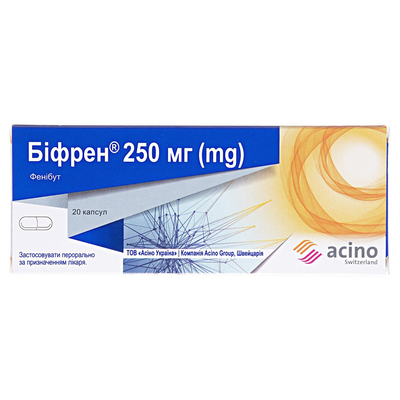
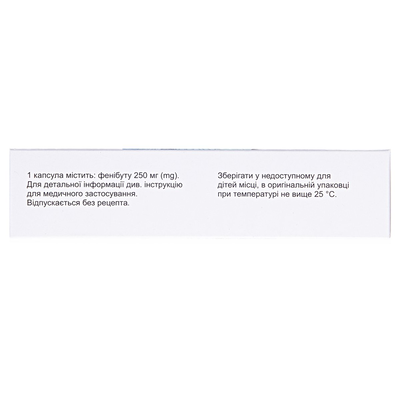
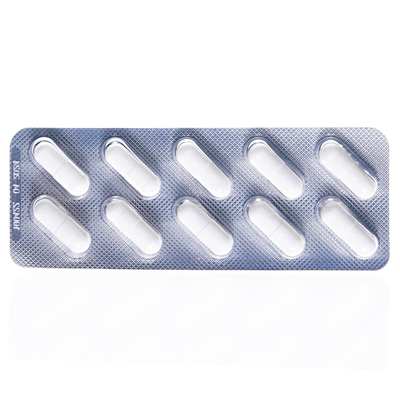
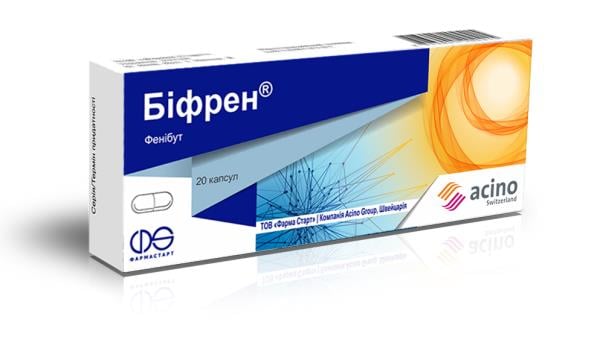
Bifren 250 mg capsules, No. 20 (10 x 2)
Ingredients
Active ingredient: phenibut;
1 capsule contains 250 mg of phenibut;
Excipients: microcrystalline cellulose, croscarmellose sodium, colloidal anhydrous silicon dioxide, magnesium stearate, talc; Capsule composition: gelatin, titanium dioxide (E 171).
Dosage Form
Capsules.
Main physical and chemical properties: white, hard gelatin capsules.
The capsule contents are a white or cream-white powder.
The presence of compressed columns or lumps is permitted; these disintegrate when pressed.
Pharmacotherapeutic group
Psychostimulants and nootropics. ATC code N06B X.
Pharmacological properties
Pharmacodynamics.
Bifren® is a derivative of γ-aminobutyric acid and phenylethylamine. Its antihypoxic and anti-amnesic effects are predominant. It has tranquilizing properties, stimulates memory and learning ability, and increases physical performance; relieves psychoemotional tension, anxiety, and fear, and improves sleep; it prolongs and enhances the effects of hypnotics, narcotics, neuroleptics, and anticonvulsants. It does not affect cholinergic or adrenergic receptors. The drug prolongs the latent period and reduces the duration and severity of nystagmus; it also has an antiepileptic effect. It significantly reduces the manifestations of asthenia and vasovegetative symptoms, including headache, a sensation of heaviness in the head, sleep disturbances, irritability, and emotional lability, and improves mental performance. Unlike tranquilizers, Bifren® improves psychological parameters (attention, memory, and the speed and accuracy of sensorimotor reactions). In patients with asthenia and in emotionally labile patients, well-being improves from the very first days of treatment with the drug; interest and initiative increase, and motivation for active engagement rises without causing sedation or agitation. It has been established that phenibut improves the brain’s bioenergetics.
Pharmacokinetics.
The drug is well absorbed after oral administration and penetrates well into all body tissues; it crosses the blood-brain barrier effectively. Distribution in the liver and kidneys is nearly uniform, while in the brain and blood it is less than uniform. After 3 hours, a noticeable amount of the administered phenibut is detected in the urine; however, the drug’s concentration in brain tissue does not decrease, and it remains detectable in the brain for another 6 hours.
The next day, phenibut can be detected only in the urine; it is detected in the urine as early as 2 days after administration, but the amount detected is only 5% of the administered dose.
The greatest binding of phenibut occurs in the liver (80%); this binding is nonspecific.
No accumulation is observed with repeated administration.
Indications
Asthenic and anxiety-neurotic conditions (emotional lability, memory impairment, decreased concentration), restlessness, fear, anxiety, and obsessive-compulsive neurosis;
in children—stuttering, enuresis, tics; in the elderly—insomnia, nighttime restlessness.
Prevention of stress-related conditions, prior to surgeries or painful diagnostic procedures.
As an adjunct in the treatment of alcohol withdrawal syndrome.
It is also prescribed for Meniere’s disease, dizziness associated with vestibular dysfunction, and to prevent motion sickness.
Contraindications
Hypersensitivity to any component of the medication. Acute renal failure. Children under 11 years of age.
Interactions with Other Medications and Other Forms of Interaction
Bifren can be combined with psychotropic drugs by reducing the doses of Bifren® and the drugs used in combination with it.
Bifren® enhances and prolongs the effects of hypnotics, narcotics, neuroleptics, and anticonvulsants.
Special Considerations
Caution should be exercised in patients with gastrointestinal disorders due to the irritating effect of Bifren®. Lower doses should be prescribed for such patients. During long-term use, blood cell counts and liver function test results should be monitored.
Pregnancy and lactation
The use of Bifren® during pregnancy or lactation is contraindicated, as there are insufficient data on the drug’s use during these periods.
Effects on the Ability to Drive and Operate Machinery
Patients experiencing drowsiness, dizziness, or other central nervous system disturbances during treatment with this drug should refrain from driving or operating machinery.
Dosage and Administration
Take orally before meals with water.
For asthenic and anxiety-neurotic conditions in adults: 250–500 mg three times daily. Maximum single doses: 750 mg for adults, 500 mg for elderly patients.
The course of treatment is 2–3 weeks. If necessary, the course of treatment may be extended to 4–6 weeks.
For children over 11 years of age: 250 mg three times daily; for children over 14 years of age: adult doses.
To treat dizziness associated with infectious vestibular dysfunction and Meniere’s disease during an acute episode: Bifren is prescribed at 750 mg three times daily for 5–7 days; and as the severity of vestibular disorders decreases—250–500 mg 3 times a day for 5–7 days, followed by 250 mg once daily for 5 days. For relatively mild cases of the disease, Bifren® is administered at a dose of 250 mg twice daily for 5–7 days, followed by 250 mg once daily for 7–10 days.
To treat dizziness caused by vestibular dysfunction of vascular or traumatic origin: Bifren® is prescribed at a dose of 250 mg three times a day for 12 days.
For motion sickness: Administer a dose of 250–500 mg once, 1 hour before the expected onset of motion sickness or upon the appearance of the first symptoms.
The effect of Bifren® increases with higher doses.
In the presence of severe symptoms (vomiting, nausea), the drug is largely ineffective even at a dose of 750–1,000 mg.
For the relief of alcohol withdrawal syndrome: Bifren® is prescribed at a dose of 250–500 mg three times daily and 750 mg at night during the first few days of treatment, with a gradual reduction of the daily dose to the usual adult dose.
If one or more doses are missed, continue taking the previously prescribed doses.
If necessary, or if the patient feels unwell, they should consult a doctor.
Children
This medication may be used in children over 11 years of age.
Overdose
Bifren® is a low-toxicity compound; however, at a daily dose of 7–14 g with prolonged use, it may be hepatotoxic (eosinophilia and fatty liver disease have been observed).
Symptoms: drowsiness, nausea, vomiting; hypotension and acute renal failure may develop.
Treatment: gastric lavage. Symptomatic therapy.
In case of complications (hypotension, renal failure), supportive and symptomatic measures are taken.
Side Effects
Nervous system: drowsiness (at the start of treatment), headache, and dizziness (at doses exceeding 2 g per day; the severity of side effects decreases when the dose is reduced).
Gastrointestinal disorders: nausea (at the start of treatment), vomiting, diarrhea, epigastric pain.
Liver and biliary tract: hepatotoxicity (with long-term use of high doses).
Immune system disorders: allergic reactions, including rash, itching, hives, and skin redness.
Psychiatric disorders: emotional lability, sleep disturbances (these adverse reactions may occur in children if the drug is not used in accordance with the instructions for use).
Shelf life
2 years.
Do not use after the expiration date printed on the package.
Storage conditions
Store out of the reach of children in the original packaging at a temperature not exceeding 25 °C.
Packaging
10 capsules per blister pack; 1 or 2 blister packs per cardboard box.
Sales Conditions
Available without a prescription.
Manufacturer
Pharma Start, LLC.







