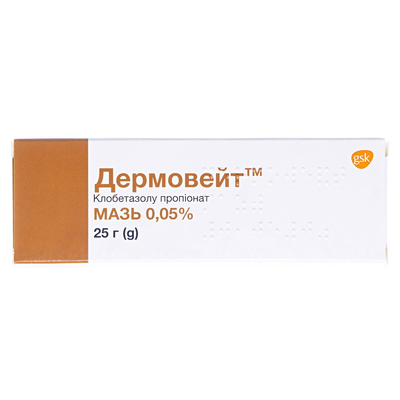
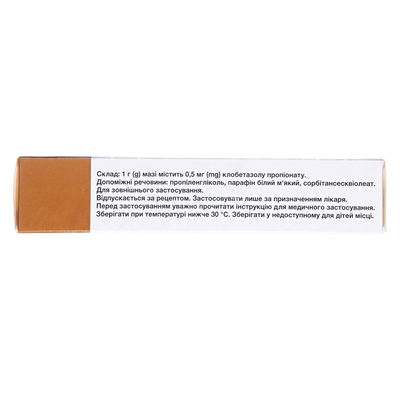
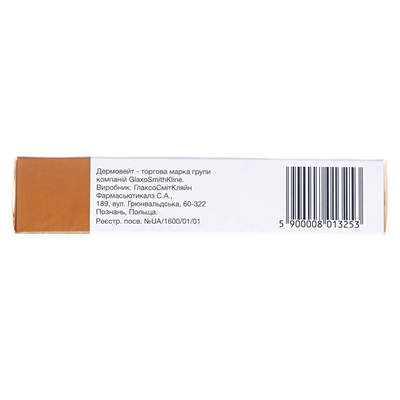
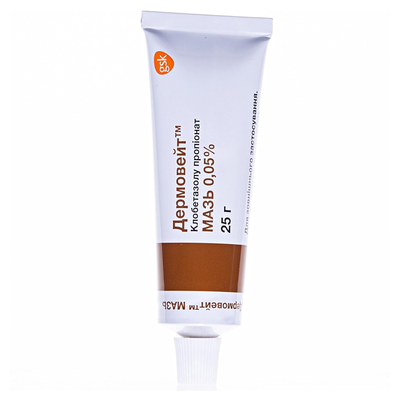
Dermoveit Ointment 0.05%, 25 g in tubes
Ingredients
Active ingredient: clobetasol propionate;
1 g of ointment contains 0.5 mg of clobetasol propionate;
excipients: propylene glycol, white soft paraffin, and sorbitan sesquioleate.
Dosage Form
Ointment.
Main physical and chemical properties: a homogeneous, white, translucent ointment free of undispersed particles and foreign matter.
Pharmacotherapeutic group
Corticosteroids for topical use. Highly active corticosteroids. ATC code D07A D01.
Pharmacological properties
Pharmacodynamics.
The primary effect of clobetasol propionate on the skin is a nonspecific anti-inflammatory action due to vasoconstriction and a reduction in collagen synthesis.
Pharmacokinetics.
The absorption of clobetasol propionate through the skin varies among individuals and may increase with the use of occlusive dressings or in cases of skin inflammation or damage. In individuals with healthy skin, the mean peak plasma concentration of clobetasol propionate was 0.63 ng/mL in one study, observed 8 hours after the second application (13 hours after the first application) of 30 g of 0.05% clobetasol propionate ointment. After application of a second dose of 30 g of 0.05% clobetasol propionate cream, the mean peak plasma concentration was slightly higher than that observed with the ointment and was observed 10 hours later. In another study, mean peak concentrations (approximately 2.3 ng/mL and 4.6 ng/mL) were observed in patients with psoriasis and eczema, respectively, 3 hours after a single application of 25 g of 0.05% clobetasol propionate ointment. After absorption through the skin, the drug most likely follows the same metabolic pathway as corticosteroids following systemic administration. However, the systemic metabolism of clobetasol has not been fully established.
Indications
Clobetasol is a highly active topical corticosteroid indicated for adults, the elderly, and children aged 1 year and older only for the short-term treatment of relatively persistent inflammatory and pruritic manifestations of steroid-responsive dermatoses that are unresponsive to less potent corticosteroids.
Such conditions include:
- psoriasis (with the exception of widespread plaque psoriasis);
- difficult-to-treat dermatoses;
- erythema multiforme;
- discoid lupus erythematosus;
- other skin conditions that do not respond to treatment with less potent corticosteroids.
Contraindications
- Hypersensitivity to any component of the drug.
- Untreated skin infections.
- Rosacea.
- Acne vulgaris.
- Itching without inflammation.
- Perianal and genital itching.
- Perioral dermatitis.
- Dermoveit is not intended for the treatment of dermatoses in children under 1 year of age, including dermatitis and diaper rash.
Interactions with Other Medications and Other Types of Interactions
It has been shown that concomitant use with drugs that may inhibit CYP3A4 (e.g., ritonavir, itraconazole) inhibits the metabolism of corticosteroids, which may increase systemic effects. The clinical significance of this interaction depends on the dose of the drug, the route of administration of the corticosteroid, and the potency of the CYP3A4 inhibitor.
Special Considerations for Use
Cases of serious osteonecrotic infections (including necrotizing fasciitis) and systemic immunosuppression (sometimes leading to reversible Kaposi’s sarcoma lesions) with long-term use of clobetasol propionate at doses exceeding the recommended ones (see the “Dosage and Administration” section). In some cases, patients were concurrently using other potent oral/topical corticosteroids or immunosuppressants (e.g., methotrexate, mycophenolate mofetil). If treatment with topical corticosteroids for more than 4 weeks is clinically justified, the use of a less potent corticosteroid should be considered.
The drug should be used with caution in patients with a history of local hypersensitivity reactions to corticosteroids or any of the excipients. Local hypersensitivity reactions (see the “Adverse Reactions” section) may resemble the symptoms of the condition being treated.
Manifestation of hypercortisolism (Cushing’s syndrome) and reverse suppression of the hypothalamic-pituitary-adrenal axis with adrenal suppression in some individuals may result from increased systemic absorption of topical steroids. If any of the above symptoms occur, use of the drug should be gradually discontinued by reducing the frequency of application or switching to a less potent corticosteroid. Abrupt discontinuation of treatment may lead to glucocorticoid insufficiency (see the “Adverse Reactions” section).
Risk factors for systemic effects include:
- the potency and composition of the topical steroid;
- duration of use;
- application to a large area of skin;
- application to skin surfaces that come into contact with each other, such as in areas of intertrigo or where an occlusive dressing is applied (in infants, diapers may act as an occlusive dressing);
- increased hydration of the stratum corneum;
- application to areas with thin skin, such as the face;
- application to areas of damaged skin or in other conditions where the skin barrier is compromised.
- Compared to adults, children may absorb a proportionally larger amount of topical corticosteroids and are therefore more susceptible to systemic side effects. This is because children have an underdeveloped skin barrier and a larger skin surface area relative to body weight compared to adults.
Children
Long-term use of topical corticosteroids in infants and children under 12 years of age should be avoided whenever possible, as they are at higher risk of adrenal suppression.
Children are more susceptible to developing atrophic changes with the use of topical corticosteroids. Treatment with Dermoveit in children should, if possible, last no longer than 5 days. The need to continue treatment should be reassessed weekly. Dermoveit should not be used under occlusive dressings in children.
Risk of infection when applying an occlusive dressing
The risk of developing bacterial infections increases in warm and moist conditions, particularly under occlusive dressings; therefore, the skin should be thoroughly cleaned each time before applying an occlusive dressing.
Treatment of psoriasis
Topical corticosteroids should be used with caution to treat psoriasis, as there have been reports of relapses, the development of tolerance, the risk of generalization of pustular psoriasis, and the development of symptoms of local or systemic toxicity caused by impairment of the skin’s barrier function. When used to treat psoriasis, the patient should be under close medical supervision.
Concomitant Infections
Appropriate antibacterial agents must be prescribed whenever treating inflammatory, infected lesions. If the infection spreads, topical corticosteroids should be discontinued and appropriate antibacterial therapy initiated.
Chronic leg ulcers
Topical corticosteroids are sometimes used to treat dermatitis occurring around chronic leg ulcers. However, this use is associated with an increased incidence of local hypersensitivity reactions and an increased risk of local infections.
Application of the ointment to the face
Applying the ointment to the facial skin is not recommended, as this area is more prone to atrophic changes. If use is necessary, it should be limited to 5 days.
Application to the eyelids
When applying the ointment to the eyelids, avoid getting the product in the eyes, as repeated exposure may cause cataracts and glaucoma.
Visual disturbances
Visual disturbances have been observed with both systemic and topical use of corticosteroids. If a patient experiences symptoms such as blurred vision or other visual disturbances, they should be referred to an ophthalmologist to evaluate possible causes, which may include cataracts, glaucoma, or rare conditions such as central serous chorioretinopathy, the occurrence of which has been reported following the use of systemic and topical corticosteroids.
Dermoveit ointment contains 475 mg of propylene glycol per 1 g of the product. Propylene glycol may cause skin irritation.
Dermoveit ointment contains paraffin. Patients should be warned not to smoke or be near open flames due to the risk of severe burns. If the product comes into contact with fabric (clothing, bedding, bandages, etc.), the material may ignite easily and cause a serious fire. Washing clothing and bedding reduces the accumulation of the product in the fabric but does not remove it completely.
Use during pregnancy or breastfeeding.
Pregnancy
Data on the use of Dermoveit in pregnant women are limited.
Topical application of corticosteroids to pregnant animals may cause fetal developmental abnormalities. The relevance of these findings to humans has not been established. Clobetasol should be used in pregnant women only when the expected benefit to the mother outweighs the risk to the fetus. The minimum amount of the drug should be used for the shortest possible duration of treatment.
Breastfeeding
The safety of clobetasol propionate during breastfeeding has not been established. It is unknown whether the use of topical corticosteroids can lead to systemic absorption resulting in measurable levels of the drug in breast milk. Dermoveit should be used during breastfeeding only if the expected benefit to the mother outweighs the risk to the infant. If prescribed during breastfeeding, the ointment should not be applied to the breasts to prevent accidental ingestion by the infant.
Effect on reaction time when driving or operating machinery.
No studies have been conducted to investigate this effect. Given the adverse reaction profile, no effect on reaction time while driving or operating machinery is expected.
Dosage and Administration
Clobetasol propionate belongs to the class of the most potent topical corticosteroids (Group IV), and its prolonged use may lead to serious adverse effects (see the “Special Precautions for Use” section). If treatment with a topical corticosteroid is clinically justified after 4 weeks of use, consideration should be given to switching to a less potent corticosteroid. Repeated but short courses of clobetasol propionate therapy may be used to control flare-ups (see details below).
The ointment is particularly suitable for treating skin lesions accompanied by dryness, lichenification, or scaling.
Apply a thin layer of the ointment gently to all affected areas of the skin, 1 or 2 times daily, until clinical improvement is observed (provided there is a good response to treatment, improvement is achieved within a few days), then reduce the frequency of application or switch to a less potent medication. After each application of the ointment, wait a short time for it to be fully absorbed before applying an emollient.
If symptoms worsen or there is no improvement within 2–4 weeks, the diagnosis and treatment should be reviewed.
To control flare-ups of the disease, repeated short courses of treatment with Dermoveit may be used. Treatment should not last longer than 4 weeks. If continuous long-term treatment is necessary, less potent medications should be used.
The maximum weekly dose should not exceed 50 g.
Once the condition is under control, clobetasol should be gradually discontinued, and an emollient should be continued as maintenance therapy.
Symptoms of previous skin conditions may recur if clobetasol is abruptly discontinued.
In cases of more persistent lesions, especially those with hyperkeratosis, the effect of Dermoveit can be enhanced by covering the affected skin area with an occlusive polyethylene dressing. Usually, applying the occlusive film only at night is sufficient to achieve a satisfactory result. The improvement achieved is usually maintained by applying the ointment without using an occlusive dressing.
For topical use.
Dermatoses that are difficult to treat. Patients with frequent exacerbations of the disease.
Once a response has been achieved during the acute phase of the disease through a continuous course of topical corticosteroid treatment, intermittent use should be considered (once daily, twice weekly, without an occlusive dressing). Such treatment has been shown to effectively reduce the frequency of flare-ups.
Continue to apply the medication to all previously affected areas of the skin or to known areas of potential flare-ups. This treatment regimen should be combined with consistent daily use of emollients. The clinical condition, as well as the benefits and risks of continuing treatment, should be regularly assessed.
Children.
The drug is contraindicated for the treatment of dermatoses, including dermatitis, in children under 1 year of age.
Overdose
Symptoms.
When used as directed, Dermoveit may be absorbed in amounts sufficient to produce a systemic effect. The likelihood of acute overdose is very low; however, signs of hypercortisolism may occur in cases of chronic overdose or improper use.
Treatment.
In the event of a Dermoveit overdose, the product should be gradually discontinued by reducing the frequency of application or by switching to a less potent corticosteroid, taking into account the risk of glucocorticoid insufficiency.
Further treatment should be based on the patient’s clinical condition or in accordance with national guidelines for the treatment of poisoning (if available).
Side Effects
Adverse reactions, as listed below, are classified by organ system and frequency of occurrence: very common ≥ 1/10, common ≥ 1/100 and < 1/10, uncommon ≥ 1/1,000 and < 1/100, rare ≥ 1/10,000 and < 1/1,000, very rare < 1/10,000, including isolated cases.
Infections and infestations
Very rare: opportunistic infections.
Immune system
Very rare: hypersensitivity, generalized rash.
Endocrine system
Very rare: suppression of the hypothalamic-pituitary-adrenal axis: Cushingoid signs (e.g., moon face, central obesity), delayed weight gain/growth in children, osteoporosis, hyperglycemia/glucosuria, hypertension, weight gain/obesity, decreased endogenous cortisol levels, alopecia, brittle hair.
Skin and Subcutaneous Tissues
Common: itching, local burning sensation/pain in the skin.
Uncommon: localized skin atrophy*, atrophic skin streaks*, telangiectasia*.
Very rare: skin thinning*, skin wrinkling*, skin dryness*, changes in pigmentation*, hypertrichosis, exacerbation of underlying symptoms, allergic contact dermatitis, pustular psoriasis, erythema, rash, urticaria, acne.
*Skin disorders secondary to local and/or systemic hypothalamic-pituitary-adrenal suppression.
General disorders and administration site conditions
Very rare: irritation/pain at the application site.
Eyes
Very rare: glaucoma, cataracts.
Frequency unknown: blurred vision.
Shelf life
2 years.
Storage Conditions
Store at a temperature below 30 °C. Keep out of reach of children.
Packaging
25 g of ointment in an aluminum tube with a polypropylene cap; 1 tube per cardboard package.
Dispensing Category
By prescription only.