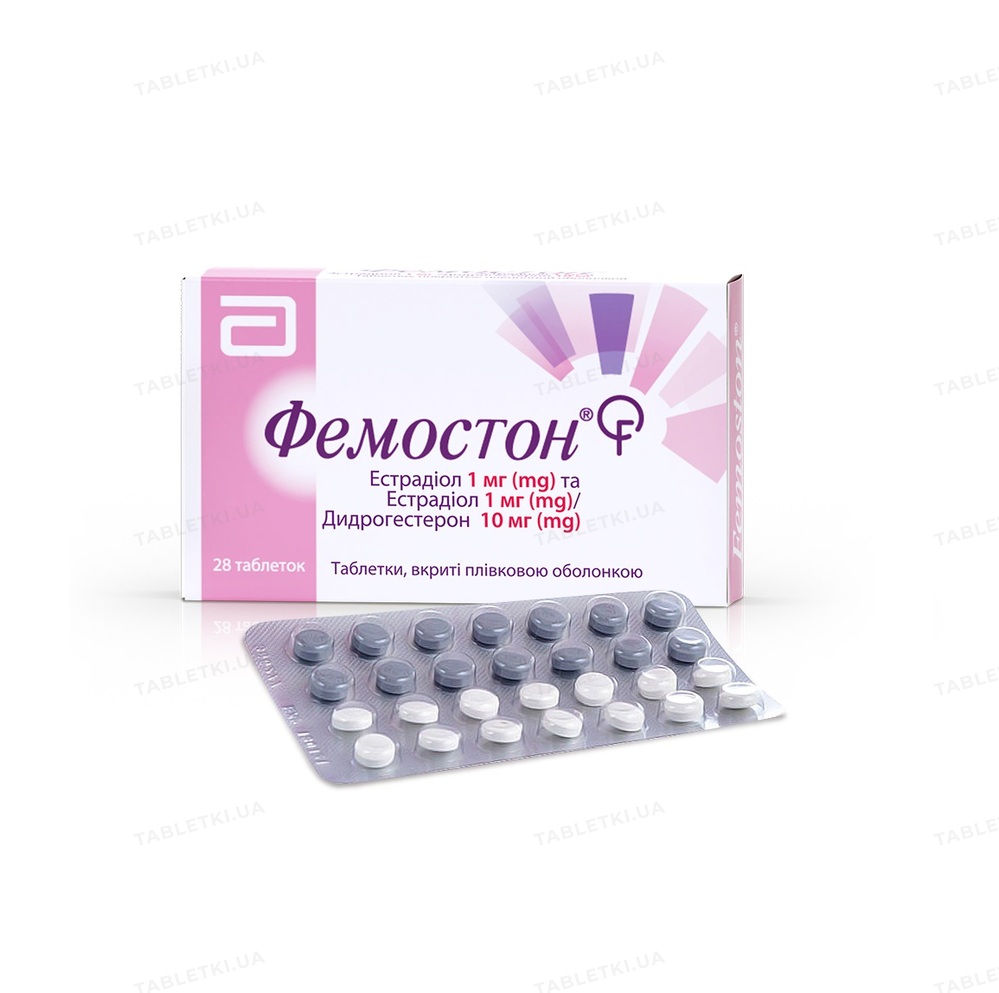
Femoston tablets, film-coated, 1 mg/10 mg, No. 28
Ingredients
estradiol tablet
Active ingredient: estradiol;
1 tablet contains micronized estradiol hemihydrate, equivalent to 1 mg or 2 mg of estradiol;
excipients: lactose monohydrate; hypromellose (HPMC 2910), corn starch, colloidal anhydrous silicon dioxide, magnesium stearate;
film coating: White I mixed film coating (hypromellose (HPMC 2910), polyethylene glycol 400, titanium dioxide (E 171))—for tablets containing 1 mg of estradiol;
Pink I mixed film coating (hypromellose (HPMC 2910), polyethylene glycol 400, talc, red iron oxide (E 172), black iron oxide (E 172), yellow iron oxide (E 172), titanium dioxide (E 171))—for tablets containing 2 mg of estradiol;
estradiol and dydrogesterone tablet
active ingredients: estradiol; dydrogesterone;
1 tablet contains micronized estradiol hemihydrate equivalent to 1 mg or 2 mg of estradiol; 10 mg of micronized dydrogesterone;
excipients: lactose monohydrate; hypromellose (HPMC 2910), corn starch, colloidal anhydrous silicon dioxide, magnesium stearate;
film coating: Grey I mixed film coating (polyethylene glycol 3350, talc (E 553b), polyvinyl alcohol, black iron oxide (E 172), titanium dioxide (E 171))—for tablets containing 1 mg of estradiol and 10 mg of dydrogesterone;
Yellow II mixed film coating (hypromellose (HPMC 2910), polyethylene glycol 400, talc, yellow iron oxide (E 172), titanium dioxide (E 171))—for tablets containing 2 mg of estradiol and 10 mg of dydrogesterone.
Dosage Form
Film-coated tablets.
Main physical and chemical properties:
tablet containing 1 mg of estradiol: round, biconvex, film-coated, white tablet marked “379” on one side; diameter 7 mm and tablet weight approximately 144 mg;
tablet containing 2 mg of estradiol: round, biconvex, film-coated, brick-red tablet marked “379” on one side; 7 mm in diameter and weighing approximately 144 mg;
tablet containing 1 mg of estradiol and 10 mg of dydrogesterone: round, biconvex, film-coated, gray tablet marked “379” on one side; 7 mm in diameter and weighing approximately 144 mg;
tablet containing 2 mg of estradiol and 10 mg of dydrogesterone: a round, biconvex, film-coated, yellow tablet marked “379” on one side; 7 mm in diameter and weighing approximately 144 mg.
Pharmacological group
Drugs for the treatment of diseases of the genitourinary system and sex hormones. Combination drugs containing progestin and estrogens for sequential use. ATX code G03F B08.
Pharmacological Properties
Pharmacodynamics.
Estradiol
The active ingredient, 17β-estradiol, is chemically and biologically similar to the natural female sex hormone estradiol. It replaces the loss of endogenous estrogen production in women during menopause and alleviates menopausal symptoms.
Estrogens prevent bone loss following menopause or oophorectomy.
Dydrogesterone
Dydrogesterone is an orally active progestin whose effect is comparable to that of parenterally administered progesterone.
Because estrogens stimulate endometrial growth, they increase the risk of endometrial hyperplasia and carcinoma if a progestin is not used. Adding a progestin to therapy significantly reduces the estrogen-induced risk of endometrial hyperplasia in women with an intact uterus.
Clinical trial data
Reduction in symptoms of estrogen deficiency and improvement in bleeding patterns.
A reduction in menopausal symptoms was observed during the first few weeks of treatment.
Regular withdrawal bleeding lasting an average of 5 days when using Femoston®, 2 mg estradiol + 2 mg estradiol/10 mg dydrogesterone, was observed in 89% of women. Withdrawal bleeding usually began on day 28 of the cycle. Breakthrough uterine bleeding or spotting was reported in 22% of women during the first 3 months of treatment and in 19% of women during 10–12 months of treatment. Amenorrhea (absence of bleeding or spotting) was observed in 12% of cycles during the first year of treatment.
Regular withdrawal bleeding lasting an average of 5 days when using Femoston®, 1 mg estradiol + 1 mg estradiol/10 mg dydrogesterone, was observed in 76% of women. Withdrawal bleeding usually began on the last day of the progestin phase (on average, on day 28 of the cycle). Breakthrough uterine bleeding or spotting was reported in approximately 23% of women during the first 3 months of treatment and in 15% of women during 10–12 months of treatment. Amenorrhea (absence of bleeding or spotting) was observed in 21% of cycles during the first year of treatment.
Prevention of Osteoporosis
Estrogen deficiency following the onset of menopause is associated with increased bone resorption and a decrease in bone mass. The effect of estrogens on bone density is dose-dependent. The protective effect is present only while they are being used. After discontinuation of hormone replacement therapy (HRT), the rate of bone mass loss is the same as in women who did not receive this therapy.
Data from the Women’s Health Initiative (WHI) and a meta-analysis of other studies indicate that the use of HRT—primarily in healthy women—as estrogen monotherapy or in combination with progestin reduces the risk of hip fractures, vertebral fractures, and other types of fractures resulting from osteoporosis. HRT may also prevent fractures in women with low bone density and/or diagnosed osteoporosis, but data on this are limited.
After two years of treatment with Femoston®, 2 mg estradiol + 2 mg estradiol/10 mg dydrogesterone, bone mineral density (BMD) in the lumbar spine increased by 6.7 ± 3.9% (mean ± standard deviation). Bone mineral density in the lumbar spine increased or remained unchanged in 94.5% of women.
In women taking Femoston®, 1 mg estradiol + 1 mg estradiol/10 mg dydrogesterone, bone mineral density in the lumbar spine increased by 5.2 ± 3.8% (mean ± standard deviation). Bone mineral density in the lumbar spine increased or remained unchanged in 93% of women.
Femoston® also affected BMD in the femur.
After two years of treatment with Femoston®, estradiol 2 mg + estradiol/dydrogesterone 2 mg/10 mg, BMD increased by 2.6 ± 5.0% (mean ± standard deviation) in the femoral neck, by 3.5 ± 5.0% (mean ± standard deviation) in the trochanteric region, and by 4.1 ± 7.4% (mean ± standard deviation) in the Ward’s triangle region. Bone mineral density in the three zones of the femur increased or remained unchanged after treatment with Femoston®, 2 mg estradiol + 2 mg estradiol/10 mg dydrogesterone, in 71–88% of women.
After two years of therapy with Femoston®, 1 mg estradiol + 1 mg estradiol/10 mg dydrogesterone, BMD in the femoral neck increased by 2.7 ± 4.2% (mean ± standard deviation), by 3.5 ± 5.0% (mean ± standard deviation) in the trochanteric region, and by 2.7 ± 6.7% (mean ± standard deviation) in Ward’s triangle. BBM in the three zones of the femur increased or remained unchanged after treatment with Femoston®, 1 mg estradiol + 1 mg estradiol/10 mg dydrogesterone, in 67–78% of women.
Pharmacokinetics.
Estradiol
Absorption
The absorption of estradiol depends on particle size: micronized estradiol is rapidly absorbed from the gastrointestinal tract.
Table 1 presents the mean steady-state pharmacokinetic parameters for estradiol (E2), estrone (E1), and estrone sulfate (E1S) for each dose of micronized estradiol.
Data are presented as means (SD).
Table 1
Estradiol 1 mg
| Parameters | E2 | E1 | Parameters | E1S |
| Cmax (pg/mL) | 71 (36) | 310 (99) | Cmax (ng/mL) | 9.3 (3.9) |
| Cmin (pg/mL) | 18.6 (9.4) | 114 (50) | Cmin (ng/mL) | 2.099 (1.340) |
| Cav (pg/mL) | 30.1 (11.0) | 194 (72) | Cav (ng/mL) | 4,695 (2,350) |
| AUC0-24
(pg*h/mL) |
725 (270) | 4,767 (1,857) | AUC0-24 (ng*h/mL) | 112.7 (55.1) |
Estradiol 2 mg
| Parameters | E2 | E1 | Parameters | E1S |
| Cmax (pg/mL) | 103.7 (48.2) | 622.2 (263.6) | Cmax (ng/mL) | 25.9 (16.4) |
| Cmin (pg/mL) | 48 (30) | 270 (138) | Cmin (ng/mL) | 5.7 (5.9) |
| Cav (pg/mL) | 68 (31) | 429 (191) | Cav (ng/mL) | 13.1 (9.4) |
| AUC0-24 (pg·h/mL) | 1,619 (733) | 10,209 (4,561) | AUC0-24 (ng*h/mL) | 307.3 (224.1) |
Distribution
Estrogens are measured in their unbound or bound forms. Approximately 98–99% of the estradiol dose is bound to plasma proteins, of which 30–52% is bound to albumin and approximately 46–69% to sex hormone-binding globulin (SHBG).
Biotransformation
After oral administration, estradiol is actively metabolized. The major unconjugated and conjugated metabolites are estrone and estrone sulfate. These metabolites may contribute to estrogenic activity either directly or after conversion to estradiol. Estrone sulfate may undergo enterohepatic circulation.
Excretion
The major compounds excreted in the urine are the glucuronides of estrone and estradiol. The half-life ranges from 10 to 16 hours. Estrogens are secreted into breast milk.
Dose- and Time-Dependence
With daily oral administration of Femoston®, estradiol concentrations reach steady state in approximately five days. In most cases, steady-state concentrations are achieved between the 8th and 11th day of treatment.
Dydrogesterone
Absorption
After oral administration, dydrogesterone is rapidly absorbed, with a Tmax of 0.5–1.5 hours.
Table 2 presents the mean steady-state pharmacokinetic parameters for dydrogesterone (D) and dihydrodydrogesterone (DHD).
Data are presented as means (SD).
Table 2
Dydrogesterone 10 mg
| Parameters | D | DHD |
| Cmax (ng/mL) | 2.54 (1.80) | 62.50 (33.10) |
| Cmin (ng/mL) | 0.13 (0.07) | 3.70 (1.67) |
| Cav (ng/mL) | 0.42 (0.25) | 13.04 (4.77) |
| AUCτ (ng·h/mL) | 10.17 (5.96) | 312.90 (114.54) |
After a single dose, food delays the attainment of peak plasma concentrations of dydrogesterone by approximately 1 hour, resulting in a reduction in peak plasma concentrations of dydrogesterone by approximately 20%, without affecting the extent of exposure to dydrogesterone and DGD.
Distribution
After oral administration of dydrogesterone, the apparent volume of distribution is substantial and amounts to approximately 22,000 L. Dydrogesterone and DGD are bound to plasma proteins by more than 90%.
Biotransformation
After oral administration, dydrogesterone is rapidly metabolized to form DGD. Levels of the major active metabolite, 20-dihydrodydrogesterone (DGD), reach their peak at the same time as dydrogesterone. Plasma levels of DGD are significantly higher than those of the parent compound. The AUC and Cmax ratios of DGD to dydrogesterone are approximately 25 and 20, respectively. The mean half-life of dydrogesterone and DGD is approximately 15 hours. A common feature of all metabolites is the preservation of the 4,6-diene-3-one configuration of the parent compound and the absence of 17-hydroxylation. This explains the absence of the estrogenic and androgenic effects of dydrogesterone.
Excretion
After administration of labeled dydrogesterone, an average of 63% of the dose is excreted in the urine. The apparent total plasma clearance of dydrogesterone in the body is high, at approximately 20 L/min. Complete elimination occurs within 72 hours. Dydrogesterone is present in the urine primarily as a glucuronic acid conjugate.
Dose- and Time-Dependency
The pharmacokinetics following single and multiple doses are linear within the oral dose range of 2.5 to 20 mg. A comparison of the kinetics of single and multiple doses shows that the pharmacokinetics of dydrogesterone and DGD do not change with repeated administration. Steady-state conditions are usually reached after 3 days of treatment.
Indications
Hormone replacement therapy (HRT) to alleviate symptoms caused by estrogen deficiency in postmenopausal women, no earlier than 6 months after the last menstrual period.
Prevention of osteoporosis in postmenopausal women at high risk of fractures. Femoston® should be used only in patients who are intolerant to or have contraindications for other medications used to prevent osteoporosis (see the “Special Considerations” section).
Experience with treating women over 65 years of age is limited.
Contraindications
- A history of, current, or suspected breast cancer;
- Confirmed or suspected estrogen-sensitive tumors (e.g., endometrial cancer);
- confirmed or suspected progestin-sensitive tumors;
- meningioma or a history of meningioma;
- vaginal bleeding of unknown origin;
- untreated endometrial hyperplasia;
- current or history of venous thromboembolism (deep vein thrombosis, pulmonary embolism);
- presence of thrombophilic disorders (e.g., protein C, protein S, or antithrombin deficiency; see the “Special Considerations for Use” section);
- acute or recent thromboembolic arterial disease (e.g., angina pectoris, myocardial infarction);
- acute liver disease or a history of liver disease, if liver function tests have not returned to normal;
- known hypersensitivity to the active ingredients or to any of the drug’s excipients;
- porphyria.
Interactions with Other Medications and Other Types of Interactions
No drug interaction studies have been conducted.
The efficacy of estrogens and progestins may be impaired
- The metabolism of estrogens (and progestins) may be enhanced when used concomitantly with substances capable of inducing enzymes involved in drug metabolism. This applies, in particular, to the CYP2B6, CYP4A4, CYP4A5, and CYP4A7 enzymes. Such substances include anticonvulsants (phenobarbital, carbamazepine, phenytoin) and antibacterial/antiviral agents (e.g., rifampin, rifabutin, nevirapine, efavirenz).
- Although ritonavir and nelfinavir are known as potent inhibitors of CYP450 3A4, A5, and A7, they actually have an inducing effect when used concomitantly with steroid hormones.
- Herbal preparations containing St. John’s wort (Hypericum perforatum) may also enhance the metabolism of estrogens (and progestogens) as they pass through CYP450 3A4.
- Clinically, increased metabolism of estrogens and progestins may manifest as reduced efficacy and changes in the bleeding profile.
Interactions of Hormone Replacement Therapy (HRT) Containing Estrogens with Other Medications
It has been shown that hormonal contraceptives containing estrogens, when used concomitantly with lamotrigine, significantly reduced its plasma concentrations due to the stimulation of lamotrigine glucuronidation. This may reduce seizure control. Although the potential interaction between hormone replacement therapy and lamotrigine has not been studied, it is expected that a similar interaction exists, which may lead to reduced seizure control in women taking both medications concurrently.
Pharmacodynamic Interactions
During clinical trials of hepatitis C virus (HCV) treatment with the combination of ombitasvir/paritaprevir/ritonavir, with or without dasabuvir, elevations in alanine aminotransferase (ALT) levels more than 5 times the upper limit of normal were observed significantly more frequently in women taking medications containing ethinyl estradiol, such as combined hormonal contraceptives (CHCs). In women taking medications containing estrogens other than ethinyl estradiol, such as estradiol, the degree of ALT elevation was similar to that in women not receiving any estrogens; however, given the limited number of women who took other estrogens, caution is advised when this drug is used concomitantly with ombitasvir/paritaprevir/ritonavir combination therapy, with or without dasabuvir, as well as with glecaprevir/pibrentasvir therapy (see the “Special Considerations” section).
Estrogens may interfere with the metabolism of other medications.
Estrogens may inhibit CYP450 enzymes involved in drug metabolism through competitive inhibition. This should be taken into account particularly with regard to drugs with a narrow therapeutic index, such as:
- tacrolimus and cyclosporine A (CYP450 3A4, 3A3);
- fentanyl (CYP450 3A4);
- theophylline (CYP450 1A2).
Clinically, this may lead to an increase in plasma levels of these substances to toxic concentrations. Therefore, careful monitoring of drug levels over an extended period may be required, as well as a reduction in the dose of tacrolimus, fentanyl, cyclosporine A, and theophylline.
Special Considerations for Use
For the treatment of estrogen deficiency symptoms in postmenopausal women, HRT should be initiated only if these symptoms significantly impair quality of life. A thorough assessment of the benefits and risks of HRT should be conducted regularly, at least annually, and treatment should be continued only if the benefits outweigh the risks.
Data on the risks associated with HRT for the treatment of premature menopause are limited. However, due to the low absolute risk in younger women, the benefit-risk ratio in these women is more favorable than in older women.
Medical Examination/Follow-up
Before starting HRT or when resuming HRT after a break, a complete medical history (including family history) must be obtained. A physical examination (including a gynecological examination and a breast examination) must be performed, taking into account the medical history, contraindications, and precautions for use. During treatment, regular examinations are recommended, with the frequency and scope determined on an individual basis. Women should be informed about any changes in their breasts that they should report to their doctor or nurse (see the “Breast Cancer” section). Examinations, including appropriate imaging methods such as mammography, should be performed in accordance with current screening practices, modified as needed to meet individual clinical needs.
Conditions Requiring Monitoring of Patients’ Condition
If any of the conditions listed below are present at this time, have occurred in the past, and/or have worsened during pregnancy or prior hormone therapy, patients should be closely monitored. It should be noted that these conditions may recur or worsen during treatment with Femoston®. These include:
- leiomyoma (uterine fibroids) or endometriosis;
- risk factors for thromboembolic diseases (see below);
- risk factors for estrogen-sensitive tumors, such as a first-degree hereditary predisposition to breast cancer;
- hypertension;
- liver disease (liver adenoma);
- diabetes mellitus with or without vascular symptoms;
- gallstone disease;
- migraine or (severe) headache;
- systemic lupus erythematosus;
- history of endometrial hyperplasia (see below);
- epilepsy;
- bronchial asthma;
- otosclerosis;
Meningioma
Cases of meningiomas (single and multiple) have been reported with the use of Femoston®. Patients should be monitored for signs and symptoms of meningiomas in accordance with clinical practice. If a patient is diagnosed with a meningioma, all treatment with Femoston® must be discontinued (see the “Contraindications” section). Tumor shrinkage has been observed following discontinuation of treatment.
Reasons for Immediate Discontinuation of Therapy
Hormone replacement therapy must be discontinued immediately if a contraindication is identified, as well as in the following situations:
- the onset of jaundice or impaired liver function;
- a significant increase in blood pressure;
- the first occurrence of a migraine-like headache;
- pregnancy.
Endometrial Hyperplasia and Carcinoma
In women with an intact uterus, the risk of endometrial hyperplasia and carcinoma increases with long-term estrogen-only HRT. The observed increase in the risk of endometrial cancer among women taking estrogen-only medications ranges from 2 to 12 times that of women who do not take them, depending on the duration of treatment and the estrogen dose (see the “Adverse Reactions” section). After discontinuation of treatment, the risk may remain elevated for at least 10 years.
Cyclic combination therapy with estrogen and progestin for at least 12 days per month (per 28-day cycle) or continuous combined estrogen-progestin therapy in women with an intact uterus prevents the increased risk associated with the use of estrogen-only preparations.
Breakthrough uterine bleeding or spotting may occur during the first few months of treatment. If these occur some time after treatment begins or persist after treatment is discontinued, the cause must be determined—including through an endometrial biopsy—to rule out malignant tumors.
Breast Cancer
All available data indicate an increased risk of breast cancer in women taking combined estrogen-progestin HRT or estrogen-only HRT. This risk depends on the duration of use.
Combined estrogen-progestin therapy
Both the randomized, placebo-controlled Women’s Health Initiative (WHI) study — WHI) and a meta-analysis of prospective epidemiological studies have consistently shown an increased risk of breast cancer in women using combined estrogen-progestin therapy. The increased risk becomes apparent after approximately 3 (1–4) years (see the “Adverse Reactions” section).
Estrogen-only therapy
The WHI study did not find an increased risk of breast cancer in post-hysterectomy women taking HRT with estrogen-only preparations. In clinical trials, a slight increase in the risk of breast cancer diagnosis was predominantly reported, which is significantly lower than in patients taking estrogen-progestin combinations (see the “Adverse Reactions” section).
The results of a large-scale meta-analysis showed that after discontinuation of treatment, the increased risk will decrease over time, and the time required to return to baseline depends on the duration of prior HRT use. In cases where HRT was used for more than 5 years, the risk may persist for 10 years or longer.
Ovarian Cancer
Ovarian cancer occurs much less frequently than breast cancer. Epidemiological data from a large meta-analysis showed a slightly increased risk in women using estrogen monotherapy or a combination of estrogen and progestin as hormone replacement therapy; this risk manifests within 5 years and decreases over time after discontinuation of therapy. Some other studies, notably the WHI studies, suggest that the use of combined HRT may be associated with the same or a slightly lower risk (see the “Adverse Reactions” section).
Venous Thromboembolism
HRT is associated with a 1.3- to 3-fold increase in the risk of venous thromboembolism (VTE), i.e., deep vein thrombosis or pulmonary embolism. This condition is most likely to occur during the first year of HRT (see the “Adverse Reactions” section).
Patients with known thrombophilic conditions are at increased risk for VTE, and HRT may further increase this risk. Therefore, hormone replacement therapy is contraindicated in this group of patients (see the “Contraindications” section).
Generally recognized risk factors for VTE include: estrogen use, advanced age, major surgery, prolonged immobilization, obesity (BMI > 30 kg/m²), pregnancy/postpartum period, systemic lupus erythematosus (SLE), and cancer. There is no consensus on the role of varicose veins in the development of VTE.
As with all postoperative patients, measures must be taken to prevent VTE following surgery. If prolonged immobility is expected following elective surgery, it is recommended to discontinue HRT 4–6 weeks before the procedure. Treatment may be resumed only once the woman has fully regained her mobility.
Women with no history of VTE but with first-degree relatives who have experienced thrombosis at a young age may be offered screening after a thorough discussion of its limitations (screening detects only a subset of thrombophilic disorders).
If a congenital thrombophilic disorder is identified, accompanied by a family history of thrombosis, or if the disorder is severe (e.g., antithrombin deficiency, protein S, or protein C deficiency, or a combination of these disorders), HRT is contraindicated.
In women already receiving long-term anticoagulant therapy, the benefits and risks of using ZGT should be carefully weighed.
If VTE develops after the start of therapy, the medication should be discontinued immediately. Patients should be advised to seek immediate medical attention if they experience potential symptoms of thromboembolism (e.g., painful leg swelling, sudden chest pain, shortness of breath).
Coronary Artery Disease (CAD)
There is no evidence from randomized controlled trials of protection against myocardial infarction in women with or without CHD who received combined estrogen-progestin HRT or estrogen-only HRT.
Combined estrogen-progestin therapy
The relative risk of developing CHD while using combined estrogen-progestin HRT is slightly increased. Since the baseline absolute risk of coronary heart disease depends largely on age, the number of additional cases of coronary heart disease attributable to the use of estrogens and progestogens is very low in healthy women approaching menopause but will increase with advancing age.
Estrogen Monotherapy
Data from randomized controlled trials have not shown an increased risk of CHD in women who have undergone hysterectomy and are receiving estrogen monotherapy.
Ischemic stroke
Combined estrogen-progestin therapy and estrogen monotherapy are associated with a 1.5-fold increase in the risk of ischemic stroke. The relative risk does not change with age or the time elapsed since the onset of menopause. However, since the baseline absolute risk of stroke depends largely on age, the overall risk of stroke in women taking HRT will increase with age (see the “Adverse Reactions” section).
Other Conditions
§ Estrogens may cause fluid retention; therefore, patients with impaired heart or kidney function should be closely monitored.
§ Women with pre-existing hypertriglyceridemia should be closely monitored during estrogen replacement therapy or hormone replacement therapy, as in rare cases, women with this condition have experienced a significant increase in plasma triglyceride levels during estrogen therapy, leading to pancreatitis.
§ Exogenous estrogens may cause or exacerbate symptoms of hereditary and acquired angioedema.
§ Estrogens increase thyroxine-binding globulin (TBG) levels, leading to an increase in circulating thyroid hormones, which are measured by protein-bound iodine (PBI) levels, T4 levels (when measured by column chromatography or radioimmunoassay), or T3 levels (by radioimmunoassay). Triiodothyronine (T3) uptake is reduced as a result of elevated TSH levels. Concentrations of free triiodothyronine (T3) and thyroxine (T4) remain unchanged. Levels of other serum binding proteins—corticoid-binding globulin (CBG) and sex hormone-binding globulin (SHBG)— sex hormone-binding globulin (SHBG), may increase, leading to elevated concentrations of corticosteroids and sex hormones in the blood. Concentrations of free and/or biologically active hormones remain unchanged. Concentrations of other plasma proteins (angiotensin-renin substrate, alpha-1-antitrypsin, ceruloplasmin) may increase.
§ HRT does not improve cognitive function. Some data suggest an increased risk of possible dementia in women who begin long-term combined or estrogen-only HRT at age 65 or older.
- Patients with rare hereditary disorders, such as galactose intolerance, total lactase deficiency, or glucose-galactose malabsorption syndrome, should not take this medication.
- Femoston® is not a contraceptive.
Elevated ALT Levels
During clinical trials involving patients treated for hepatitis C virus (HCV) infection with a combination of ombitasvir/paritaprevir/ritonavir with or without dasabuvir, elevations in ALT levels exceeding 5 times the upper limit of normal were observed significantly more frequently in women taking medications containing ethinyl estradiol, such as combined hormonal contraceptives (CHCs). In addition, among patients receiving glecaprevir/pibrentasvir, elevated ALT levels were also observed in women taking ethinyl estradiol-containing medications, such as CHCs. In women taking medications containing estrogens other than ethinyl estradiol, such as estradiol, the degree of ALT elevation was similar to that in women who did not receive any estrogens; however, given the limited number of women taking other estrogens, caution is advised when this drug is used concomitantly with ombitasvir/paritaprevir/ritonavir combination therapy, with or without dasabuvir, as well as with glecaprevir/pibrentasvir therapy (see the “Interactions with Other Medications and Other Interactions” section).
Use During Pregnancy or Breastfeeding.
Pregnancy
Femoston® is not indicated for use during pregnancy. If pregnancy occurs during treatment with Femoston®, the drug should be discontinued immediately.
There are insufficient data on the use of estradiol/dydrogesterone in women during pregnancy.
The scientific literature has reported that the use of certain progestogens is associated with an increased risk of hypospadias. However, due to confounding factors during pregnancy, it is not possible to definitively determine the role of progestogens in the development of hypospadias.
Currently, the results of most epidemiological studies regarding the incidental effects of estrogen-progestin combinations on the fetus indicate no teratogenic or toxic risk to the fetus.
Breastfeeding
Femoston® is not indicated for use during breastfeeding.
Effect on Fertility
Femoston® is not indicated for use in women of childbearing age.
Effects on reaction time when driving or operating machinery.
Femoston® has no or negligible effect on the ability to drive or operate machinery.
Dosage and Administration
Femoston® is taken orally every day according to a continuous, sequential regimen as described below.
Treatment begins with one tablet containing 1 mg or 2 mg of estradiol, taken once daily for the first 14 days of a 28-day cycle.
Thereafter, for the next 14 days, take one tablet containing 1 mg or 2 mg of estradiol and 10 mg of dydrogesterone once daily, as indicated on the 28-day calendar pack.
After completing the 28-day cycle, on the 29th day, a new 28-day cycle should be started immediately.
Treatment cycles follow one after another and are continuous.
For the treatment of estrogen deficiency in postmenopausal women, the lowest effective dose should be used as the initial and maintenance dose, and the duration of treatment should be as short as possible (see also the “Special Considerations for Use” section).
In general, sequential combination therapy should be initiated with Femoston®, 1 mg estradiol + 1 mg estradiol/10 mg dydrogesterone.
The dose should be adjusted individually based on the clinical response.
In women not currently receiving hormone replacement therapy, or in women switching from continuous combined hormone replacement therapy, treatment may be started on any convenient day. For women switching from cyclic or continuous sequential hormone replacement therapy, treatment should begin immediately on the day following the completion of the previous cycle.
If a tablet is missed, it is recommended to continue with the next tablet without taking the missed one. While taking the tablets, the likelihood of breakthrough bleeding or spotting may increase.
Femoston® can be taken with or without food.
Children.
There is no indication for the use of Femoston® in this patient population.
Overdose
Both estradiol and dydrogesterone are substances with low toxicity. In case of overdose, symptoms such as nausea, vomiting, breast tenderness, dizziness, abdominal pain, drowsiness/fatigue, and withdrawal bleeding may occur. It is unlikely that any specific or symptomatic treatment will be required in the event of an overdose.
The information described above also applies to overdose in children.
Side Effects
The most common adverse reactions in patients treated with estradiol/dydrogesterone during clinical trials were headache, abdominal pain, breast pain/tenderness, and lower back pain.
During clinical trials (n=5,108), the adverse reactions listed in Table 3 were observed with the following frequencies:
Table 3
| MedDRA System Organ Classes | Very common
(≥ 1/10) |
Common
(≥ 1/100, <1/10) |
Uncommon
(≥ 1/1,000, < 1/100) |
Rare
(≥ 1/10,000 to < 1/1,000) |
| Infections and parasitic diseases | Vaginal candidiasis
|
Cystitis-like syndrome | ||
| Benign, malignant, and unspecified neoplasms | Enlargement of a myoma
|
|||
| Blood and Lymphatic System | Hemolytic anemia* | |||
| Immune system disorders | Hypersensitivity | |||
| Psychiatric
|
Depression, nervousness | Effects on libido | ||
| Central Nervous System | Headache | Migraine, dizziness | Meningioma* | |
| Effects on the eyes | Increased corneal curvature*. Intolerance to contact lenses* | |||
| Cardiac | Myocardial infarction | |||
| Vascular disorders
|
Venous thromboembolism**, hypertension, peripheral vascular disease, varicose veins | Stroke* | ||
| Gastrointestinal
|
Abdominal pain | Nausea, vomiting,
flatulence |
Dyspepsia | |
| Hepatobiliary system | Liver dysfunction (in some cases with jaundice, asthenia, or malaise and abdominal pain), gallbladder disorders | |||
| Skin and subcutaneous tissue disorders
|
Allergic skin reactions (e.g., rash, hives, itching)
|
Angioedema, erythema nodosum*, vascular purpura; chloasma or melasma, which may persist after discontinuation of treatment* | ||
| Musculoskeletal and connective tissue disorders | Back pain
|
Cramps in the lower extremities* | ||
| Reproductive system and breast disorders
|
Breast pain/tenderness | Menstrual cycle disorders (including postmenopausal bleeding, metrorrhagia, menorrhagia, oligo-/amenorrhea, irregular menstruation, dysmenorrhea); pelvic pain, cervical discharge | Breast enlargement, premenstrual syndrome (PMS)
|
|
| General disorders and administration site conditions | Asthenic conditions (asthenia, fatigue, malaise), peripheral edema | |||
| Abnormal findings detected during examination | Weight gain | Weight loss |
*Adverse reactions reported in spontaneous reports that were not observed during clinical trials have been classified as “rare.”
** See below for more details.
Risk of breast cancer
An up to twofold increased risk of breast cancer has been reported in women taking combined estrogen-progestin therapy for more than 5 years.
The increased risk in women taking estrogen monotherapy is lower than in women taking combined estrogen-progestin therapy.
The level of risk depends on the duration of use (see the “Special Considerations for Use” section).
The following table presents an estimate of the absolute risk based on the results of the largest randomized, placebo-controlled study, the Women’s Health Initiative (WHI), and the largest meta-analysis of prospective epidemiological studies.
Table 4
The largest meta-analysis of prospective epidemiological studies
Calculated additional risk of breast cancer after 5 years of use in women with a body mass index of 27 (kg/m²)
| Age at the start of HRT (years) | Number of cases per 1,000 women who have never used HRT over a 5-year period (ages 50–54)¹ | Risk ratio | Number of additional cases per 1,000 women who used HRT after 5 years |
| Estrogen-only HRT | |||
| 50 | 13.3 | 1.2 | 2.7 |
| HRT using a combination of estrogen and progestin | |||
| 50 | 13.3 | 1.6 | 8.0 |
| Note: Since breast cancer incidence varies across EU countries, the number of additional breast cancer cases will also change proportionally.
1 Based on baseline incidence rates in England in 2015 for women with a body mass index of 27 (kg/m²). |
|||
Table 5
Estimated additional risk of breast cancer after 10 years of use in women with a body mass index of 27 (kg/m²)
| Age at the start of HRT (years) | Number of cases per 1,000 women who have never used HRT over a 10-year period (ages 50–59)¹ | Risk ratio | Number of additional cases per 1,000 women who used HRT after 10 years |
| Estrogen-only HRT | |||
| 50 | 26.6 | 1.3 | 7.1 |
| HRT using a combination of estrogen and progestin | |||
| 50 | 26.6 | 1.8 | 20.8 |
| 1Based on baseline incidence rates in England in 2015 among women with a body mass index of 27 (kg/m²).
Note: Since breast cancer incidence varies across EU countries, the number of additional breast cancer cases will also change proportionally. |
|||
Table 6
The WHI Study in the U.S.: Additional Risk of Breast Cancer After 5 Years of Use
| Age range (years) | Number of cases per 1,000 women in the placebo group over 5 years | Risk ratio and 95% confidence interval (CI) | Number of additional cases per 1,000 women who used HRT for 5 years (95% CI) |
| Estrogen-only hormone replacement therapy (EHRT) | |||
| 50–79 | 21 | 0.8 (0.7–1.0) |
|
| CCE + MPA combined estrogen-progestin HRT ‡ | |||
| 50–79 | 17 | 1.2 (1.0–1.5) | +4 (0–9) |
| ‡ In a limited analysis of women who had not used HRT prior to the start of the study, no clear risk was observed during the first 5 years of treatment; after 5 years, the risk was higher than in those who did not use HRT.
2 WHI studies involving women without a uterus showed no increased risk of breast cancer. CEE – conjugated equine estrogen, MPA – medroxyprogesterone acetate |
|||
Risk of endometrial cancer
Postmenopausal women with an intact uterus
The risk of endometrial cancer is approximately 5 cases per 1,000 women with an intact uterus who are not taking HRT.
Estrogen-only HRT is not recommended for women with an intact uterus, as it increases the risk of endometrial cancer (see the “Special Considerations” section). Depending on the duration of estrogen monotherapy and the estrogen dose, the increased risk of endometrial cancer reported in epidemiological studies ranged from 5 to 55 additional cases diagnosed per 1,000 women aged 50 to 65.
Adding progestin to estrogen monotherapy for at least 12 days per cycle may prevent this increased risk. In the Million Women Study, five years of combined (sequential or continuous) HRT did not increase the risk of endometrial cancer (risk ratio 1.0 [0.8–1.2]).
Ovarian Cancer
The use of estrogen-only HRT or combined estrogen-progestin HRT was associated with a slightly increased risk of ovarian cancer (see the “Special Considerations” section).
Data from a meta-analysis of 52 epidemiological studies reported an increased risk of ovarian cancer in women who used HRT, compared with women who had never used HRT (risk ratio 1.43, 95% confidence interval (CI) 1.31–1.56). Among women aged 50 to 54 who used HRT for 5 years, this resulted in 1 additional case per 2,000 women. Among women aged 50 to 54 who did not use HRT, ovarian cancer is diagnosed in approximately 2 out of 2,000 women over a 5-year period.
Risk of Venous Thromboembolism
HRT is associated with a 1.3- to 3-fold increase in the relative risk of venous thromboembolism (VTE), that is, deep vein thrombosis or pulmonary embolism. This condition is more likely to occur during the first year of HRT use (see the “Special Considerations for Use” section). The results of the WHI studies are presented below.
Table 7
WHI Study: Additional Risk of VTE Over 5 Years of Use
| Age range (years) | Number of cases per 1,000 women in the placebo group over 5 years | Risk ratio and
95% CI |
Number of additional cases per 1,000 women taking HRT over 5 years (95% CI) |
| Oral estrogen-only hormone replacement therapy³ | |||
| 50–59 | 7 | 1.2 (0.6–2.4) | 1 (–3–10) |
| Oral combination therapy with estrogen and progestin | |||
| 50–59 | 4 | 2.3 (1.2–4.3) | 5 (1–13) |
3 A study involving women without a uterus.
Risk of ischemic heart disease
The risk of ischemic heart disease is slightly increased in women over 60 years of age taking combined estrogen-progestin HRT (see the “Special Considerations” section).
Risk of ischemic stroke
The use of estrogen monotherapy and combined estrogen-progestin HRT is associated with a 1.5-fold increase in the relative risk of ischemic stroke. The risk of hemorrhagic stroke does not increase with HRT use.
The relative risk does not depend on age or duration of use; however, since the baseline risk depends largely on age, the overall risk of stroke in women taking HRT will increase with age (see the “Special Considerations” section).
Table 8
Pooled data from the WHI studies: additional risk of ischemic stroke⁴ over 5 years of use
| Age range (years) | Number of cases per 1,000 women in the placebo group over 5 years | Risk ratio and 95% CI | Number of additional cases
per 1,000 women taking HRT over 5 years (95% CI) |
| 50–59 | 8 | 1.3 (1.1–1.6) | 3 (1–5) |
4 There was no difference between ischemic and hemorrhagic stroke.
Other adverse reactions reported in association with estrogen/progestin therapy (including estradiol/dydrogesterone):
- neoplasms—benign, malignant, and of unknown etiology: estrogen-dependent neoplasms, both benign and malignant, such as endometrial cancer and ovarian cancer; enlargement of progestin-dependent neoplasms (e.g., meningiomas);
- Immune system disorders: systemic lupus erythematosus (SLE);
- Metabolic and nutritional disorders: hypertriglyceridemia;
- Central nervous system disorders: possible dementia, chorea, exacerbation of epilepsy;
- vascular disorders: arterial thromboembolism;
- gastrointestinal disorders: pancreatitis (in women with pre-existing hypertriglyceridemia);
- skin and subcutaneous tissue disorders: erythema multiforme;
- Renal and urinary tract disorders: urinary incontinence;
- disorders of the reproductive system and mammary glands: fibrocystic changes in the mammary glands, cervical erosion;
- Congenital and hereditary genetic disorders: worsening of porphyria;
- Abnormalities detected during examination: elevated total thyroid hormone levels.
Reporting adverse reactions after a drug’s marketing authorization is of great importance. This allows for monitoring the benefit-risk ratio when using this drug. Healthcare and pharmaceutical professionals, as well as patients or their legal representatives, should report all cases of suspected adverse reactions and lack of efficacy of the drug through the Automated Pharmacovigilance Information System at: https://aisf. dec.gov.ua.
Shelf life
3 years.
Storage conditions
Store in the original packaging at a temperature not exceeding 30 °C. Keep out of reach of children.
Packaging
Combination package: 28 tablets per blister (14 white film-coated tablets, 1 mg each, plus 14 gray film-coated tablets, 1 mg/10 mg each, per blister). 1, 2, or 3 blisters per box.
Combination package: 28 tablets per blister pack (14 brick-red film-coated tablets, 2 mg each + 14 yellow film-coated tablets, 2 mg/10 mg each, per blister pack). 1, 2, or 3 blister packs per box.
Manufacturer
Abbott Biologicals B.V.
Address
Veerweg 12, 8121 AA Olst, The Netherlands.