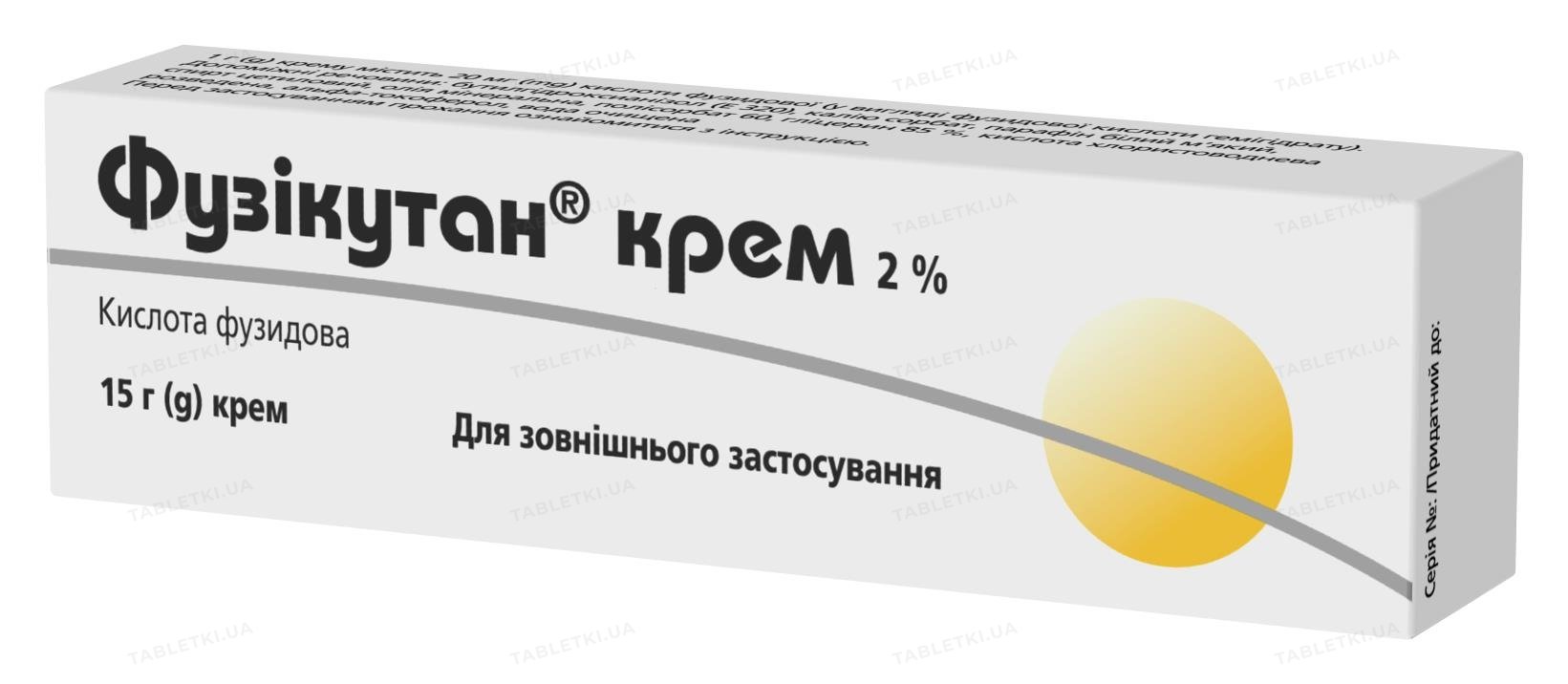
Fuzikutan 2% cream, 15 g per tube
Composition
: active ingredient: fusidic acid;
1 g of cream contains 20 mg of fusidic acid (as fusidic acid hemihydrate);
Excipients: butylhydroxyanisole (E 320), potassium sorbate, white soft paraffin, cetyl alcohol, mineral oil, polysorbate 60, glycerin 85%, diluted hydrochloric acid, alpha-tocopherol, purified water.
Dosage form
: Cream.
Main physical and chemical properties: a white, shiny, homogeneous, soft cream with a faint characteristic odor.
Pharmacotherapeutic group
: Other antibiotics for topical use.
ATX code: D06A X01.
Pharmacological properties
: Pharmacodynamics.
Fusidic acid is an antibiotic produced during the growth of Fusidium coccineum. It disrupts protein synthesis in microbial cells and, depending on the dose, acts bacteriostatically or bactericidally. The drug has a potent antibacterial effect against a wide range of Gram-positive microorganisms—Staphylococcus spp., Streptococcus spp., Corynebacterium minutissimum, and Propionibacterium acnes—including staphylococci resistant to penicillin, streptomycin, levomycetin, erythromycin, and other antibiotics. Fuzikutan® is capable of acting through intact skin. When applied topically, fusidic acid is active against Corynebacteria spp., Neisseria spp., Clostridia spp., and Bacteroides spp.
Pharmacokinetics.
Systemic absorption is negligible following topical application.
Indications
Fusikutan® cream is indicated for the topical treatment of infectious skin diseases caused by bacteria sensitive to fusidic acid (see the “Pharmacodynamics” section). Use the cream to treat weeping skin conditions.
Contraindications
: Hypersensitivity to fusidic acid or to any other components of the product. Do not apply Fusikutan® cream to the area around the eyes.
Interactions with Other Medications and Other Interactions
No interaction studies have been conducted. Interactions with medications for systemic use are considered minimal, due to the negligible systemic absorption of fusidic acid.
Special Considerations for Use
The development of resistance in Staphylococcus aureus bacteria has been reported with topical application of fusidic acid. As with the use of any antibiotics, prolonged or regular use of fusidic acid may increase the risk of antibiotic resistance.
Butylhydroxyanisole may cause local skin reactions (e.g., contact dermatitis) or irritation of the eyes and mucous membranes. Cetyl alcohol and potassium sorbate may cause local skin reactions (e.g., contact dermatitis).
If latex condoms are used during treatment with Fusicutan® cream on the anal or genital area, the condoms’ resistance to tearing may be reduced due to the action of the excipients white soft paraffin and liquid paraffin, which negatively affects the reliability of this method of contraception.
Use during pregnancy or breastfeeding.
The use of Fusikutan® cream during pregnancy or breastfeeding is recommended only in cases where the expected benefit to the mother outweighs the potential risk to the fetus or infant. When using the product during breastfeeding, avoid contact with the skin of the breasts.
Effect on reaction time when driving or operating machinery.
Fusidic acid has no or negligible effect on reaction time when driving or operating machinery.
Dosage
and Administration For adults and children 2 years of age and older, apply the cream to the affected areas of the skin 2–3 times daily for 7 days. If necrotic tissue is present, it must be removed before applying the medication.
Children.
There is no experience with the use of Fusicutan® cream in clinical practice in patients under 2 years of age.
Overdose
None reported.
Side Effects
The frequency of adverse reactions was assessed based on the results of a pooled analysis of clinical trial data and spontaneous reports.
The most commonly reported adverse reactions during treatment included various skin reactions, such as itching and rashes; reactions at the application site, such as pain and irritation, were reported less frequently and occurred in fewer than 1% of patients.
Cases of hypersensitivity and angioedema have been reported.
Adverse reactions are listed by organ system class according to MedDRA, with individual adverse reactions listed starting with the most common. Within each frequency group, adverse reactions are listed in descending order of frequency.
The frequency categories for adverse reactions are defined based on the following criteria:
Very common (≥1/10)
Common (≥1/100 and <1/10)
Uncommon (≥1/1,000 and <1/100)
Rare (≥1/10,000 and <1/1,000)
Very rare (<1/10,000)
Frequency unknown (frequency cannot be estimated from the available data)
Immune system disorders
Rare: Hypersensitivity.
Eye disorders
Rare: Conjunctivitis.
Skin and subcutaneous tissue disorders
Uncommon: Dermatitis (including contact dermatitis, eczema), rash*, pruritus, erythema.
*Various types of rashes have been reported, such as erythematous, pustular, vesicular, maculopapular, and papular. Cases of generalized rashes have also been reported.
Rare: Angioedema, urticaria, blisters.
General disorders and administration site conditions
Uncommon: Pain at the injection site (including a burning sensation on the skin), irritation at the injection site.
Children
The frequency, type, and severity of adverse reactions in children are not expected to differ from those in adults.
Reporting of Suspected Adverse Reactions
Reporting suspected adverse reactions after the drug’s approval is important. It allows for continuous monitoring of the benefit-risk profile of the drug. Healthcare professionals should report any suspected adverse reactions through the national reporting system.
Shelf
life: 2 years.
Once the tube is opened, the shelf life is 6 months.
Storage
conditions: Store out of the reach of children at a temperature not exceeding 30 °C.
Packaging
: 5 g, 10 g, 15 g, or 30 g in a tube inside a cardboard box.
Manufacturer
: Mibe GmbH Arzneimittel.
Manufacturer’s location and address of its place of business.
Münchener Straße 15, Brenna, Saxony-Anhalt, 06796, Germany.