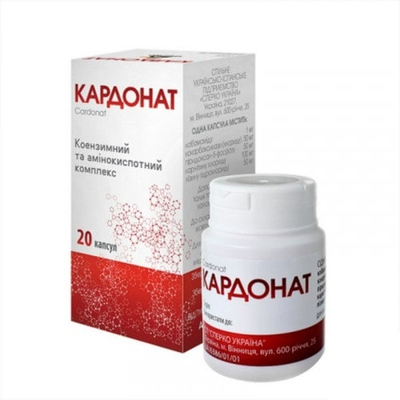
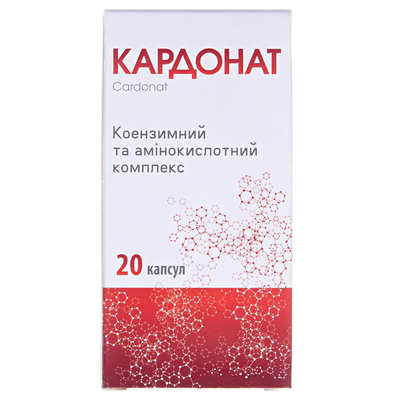
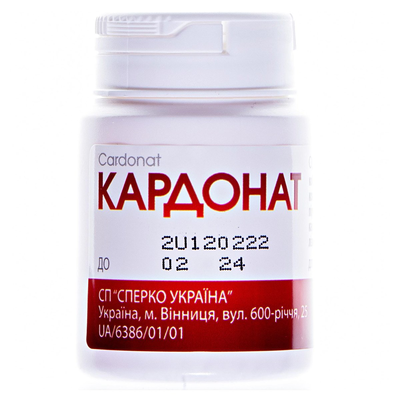
Cardonat Capsules No. 20 in a container.
Composition
Active ingredients: cobamamide (dibenkoside, coenzyme B12), cocarboxylase (chloride) (coenzyme B1), pyridoxal-5-phosphate (coenzyme B6), carnitine chloride, lysine hydrochloride;
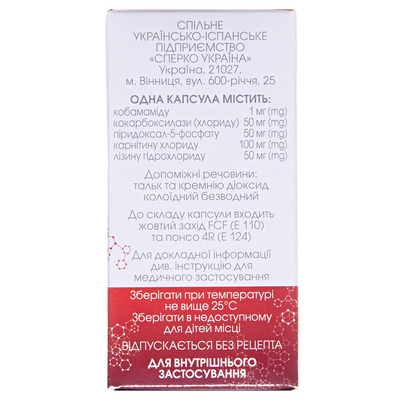
1 capsule contains cobamamide (dibencoside, coenzyme B12) – 1 mg, cocarboxylase (chloride) (coenzyme B1) – 50 mg, pyridoxal-5-phosphate (coenzyme B6) – 50 mg; carnitine chloride – 100 mg, lysine hydrochloride – 50 mg;
excipients: talc, colloidal anhydrous silicon dioxide;
capsule composition:
- cap: gelatin, titanium dioxide (E 171), Ponceau 4R (E 124), Sunset Yellow FCF (E 110);
- body: gelatin, titanium dioxide (E 171).
Dosage form
Capsules.
Main physical and chemical properties: hard gelatin capsules No. 1 or No. 2 with a white or orange body and an orange or red cap. Capsule contents: a powder ranging in color from whitish-yellow to light orange with dark and/or white specks.
Pharmacotherapeutic group
Vitamins in combination with various substances.
ATC code A11J C.
Pharmacological Properties
Pharmacodynamics.
Cardonat is a combination drug whose action is due to the synergistic effects of its constituent components. L-carnitine—a trimethylammonium (betaine) derivative of γ-amino-β-hydroxybutyric acid—belongs to the class of anabolic agents. It is synthesized in the liver, kidneys, and central nervous system from the amino acids lysine and methionine with the participation of iron and ascorbic acid; and is present in blood plasma in its free form and as acylcarnitine esters. Carnitine is the primary cofactor and regulator of fatty acid metabolism in the myocardium, liver, and skeletal muscles, and is the sole transporter of long-chain fatty acids into the mitochondria, where their beta-oxidation to acetyl-CoA occurs; acetyl-CoA serves as a substrate for ATP production in the Krebs cycle. It promotes the removal of metabolites and toxic substances from the cytoplasm and improves metabolic processes. Under normal oxygen supply conditions, it shifts cellular metabolism toward the oxidation of fatty acids as the most energy-rich substrate, and under hypoxic conditions, L-carnitine removes toxic fatty acid metabolites from the mitochondria, shifting cellular metabolism toward glucose oxidation, thereby exerting an antihypoxic effect. It increases physical performance, accelerates growth, promotes an increase in muscle mass and a reduction in adipose tissue mass due to its lipolytic effect, reduces the peripheral effects of thyroid hormones, and helps normalize basal metabolism in hyperthyroidism. It reduces symptoms of physical and mental fatigue, exhibits neuroprotective, hepatoprotective, and cardioprotective effects, exerts an anti-ischemic effect, and helps limit the infarct zone; improves nerve impulse transmission in synapses and axons by increasing the synthesis of choline, acetylcholine, and glutamic acid; reduces ammonia concentration in nervous tissue; and stimulates cellular immunity. It eliminates functional disorders of the nervous system in patients with chronic intoxications, including those of alcoholic origin; alleviates the course of withdrawal syndrome; and inhibits dystrophic changes in the retina. Carnitine exhibits an antiketogenic effect by reducing the production of ketone bodies from higher fatty acids.
Lysine is an essential amino acid that participates in all processes of assimilation and growth, promotes ossification and bone tissue growth, stimulates cell mitosis, improves oogenesis and spermatogenesis, and exerts a direct antiviral effect against herpes simplex viruses.
Vitamin B12 coenzyme (cobamamide) has anabolic activity, activates the metabolism of carbohydrates, proteins, and lipids, participates in the synthesis of labile methyl groups, in the formation of choline, methionine, nucleic acids, and creatine, and promotes the accumulation of compounds with sulfhydryl groups in red blood cells. As a growth factor, it stimulates bone marrow function, which is necessary for normoblastic erythropoiesis. Cobamamide helps normalize liver and nervous system dysfunction, has an antiketogenic effect, activates the blood coagulation system, and, in high doses, increases the activity of thromboplastin and prothrombin.
The coenzyme of vitamin B1 (cocarboxylase) exerts a regulatory effect on metabolic processes in the body. It plays a particularly important role in carbohydrate and fat metabolism, primarily in the oxidative decarboxylation of keto acids (pyruvic, α-ketoglutaric), as well as in the pentose phosphate pathway of glucose breakdown. It reduces the levels of lactic and pyruvic acid in the body, improves glucose utilization and the trophism of nervous tissue, and exerts a cardioprotective effect.
Vitamin B6 coenzyme (pyridoxal-5-phosphate) plays an important role in metabolism and is essential for the normal functioning of the central and peripheral nervous systems. It acts as a coenzyme for a large number of enzymes involved in the non-oxidative metabolism of amino acids (decarboxylation and transamination processes). It participates in the metabolism of tryptophan, methionine, cysteine, glutamine, and other amino acids. It plays a significant role in histamine metabolism as a coenzyme of histaminase, helps normalize lipid metabolism, increases glycogen levels in the liver, and enhances its detoxifying properties. It catabolizes neuromuscular processes, which are particularly important in childhood in cases of delayed mental and physical development, chronic fatigue, and asthenia.
Pharmacokinetics.
Not studied.
Indications
In adults and children: physical and mental overexertion, including in athletes; decreased performance; asthenic syndrome; vegetative-vascular dystonia; during the convalescence period following somatic and infectious diseases, as well as surgical interventions; acetonemic syndromes of various origins; liver diseases (hepatitis, cirrhosis); metabolic cardiopathies, chronic heart failure (as part of complex therapy), to improve ossification in the complex treatment of osteoporosis and bone fractures.
In children: delays in mental and physical development (hypotrophy, anorexia, growth retardation).
In adults: peripheral neuritis, neuralgia, radiculopathy; as part of complex therapy for acute and chronic disorders of cerebral circulation (cerebral strokes and chronic cerebral ischemia); as part of complex therapy for ischemic heart disease (angina pectoris, myocardial infarction), hyperhomocysteinemia, as part of complex therapy for alcohol dependence syndrome, including during withdrawal, and hyperthyroidism.
In obstetric and gynecological practice: gestosis in pregnant women, fetoplacental insufficiency, and intrauterine growth restriction.
Contraindications
Hypersensitivity to the drug’s components, malignant neoplasms, active peptic ulcer of the stomach or duodenum.
Interactions with Other Medications and Other Types of Interactions
When used concomitantly with levodopa, its therapeutic activity may be reduced due to interaction with pyridoxal. Cardonat may potentiate the effects of antihypertensives, cardiac glycosides, peripheral vasodilators, insulin, and other hypoglycemic agents.
Special considerations for use
Do not exceed the recommended doses of the drug.
Use During Pregnancy or Breastfeeding
This medication should be used by pregnant women only as prescribed and under close medical supervision. It is unknown whether the active ingredients of the drug pass into breast milk; therefore, during breastfeeding, Cardonat may be used only when the benefit to the mother outweighs the potential risk of side effects in the infant.
Effect on reaction time when driving or operating machinery
No effect.
Dosage and Administration
For adults and children 15 years of age and older, Cardonat should be taken 1–2 capsules 3 times daily after meals. For children aged 5–15 years, administer 1 capsule twice daily. For children aged 1 to 5 years, it is recommended to administer the contents of 1 capsule once daily. When administering to children aged 1 to 5 years, the contents of the capsule should first be dissolved in 50–100 mL of any fruit juice or sweetened water.
No dose adjustment is necessary for pregnant women.
In cases of anorexia, take the medication 15–20 minutes before a meal.
If swallowing the capsule is difficult (for children, postoperative patients, or individuals who have suffered a stroke), the capsule contents may be dissolved in juice or sweetened water before administration.
The average duration of treatment ranges from 3 weeks to 3 months.
Children
Use in children aged 1 year and older.
Overdose
Tachycardia, dyspeptic disorders, agitation, and increases or decreases in blood pressure may occur; these symptoms resolve after discontinuation of the medication and do not require treatment.
Side Effects
The drug is generally well tolerated, but in rare cases, usually in patients with individual hypersensitivity, allergic reactions may occur, including various skin rashes, itching, hives, and angioedema. In such cases, treatment should be discontinued and a doctor consulted.
Gastrointestinal system: bloating, epigastric pain, heartburn, nausea, vomiting, and changes in bowel habits may occur.
Cardiovascular system: possible symptoms include rapid heartbeat and changes in blood pressure.
Central nervous system: Agitation occurs very rarely.
The capsule shell contains Sunset Yellow FCF (E 110) and Ponceau 4R (E 124), which may cause allergic reactions.
Shelf life
2 years.
Do not use this medication after the expiration date printed on the package.
Storage conditions
Store at a temperature not exceeding 25 °C. Keep out of reach of children.
Packaging
20, 30, or 60 capsules in a plastic container and a cardboard box.
10 capsules per blister pack. 2, 3, or 6 blister packs per cardboard box.
Dispensing Category
Over-the-counter.
Manufacturer
Sperko Ukraine, a Ukrainian-Spanish joint venture.