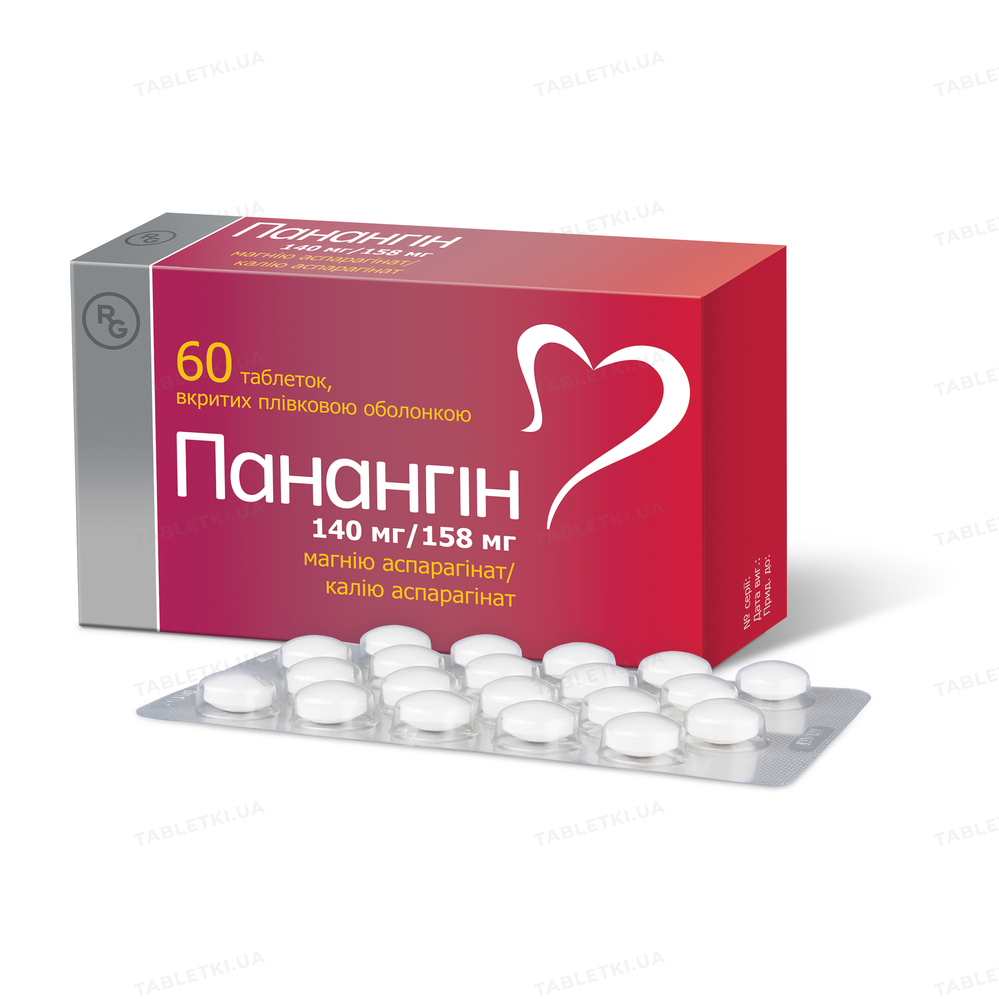
Panangin tablets, film-coated, No. 60 (20 x 3)
Ingredients
Active ingredients: magnesium aspartate, potassium aspartate;
1 film-coated tablet contains 140 mg of magnesium aspartate (as 175 mg of magnesium aspartate tetrahydrate), equivalent to 11.8 mg of Mg2+;
158 mg of potassium aspartate (as 166.3 mg of potassium aspartate hemihydrate), equivalent to 36.2 mg of K+;
excipients: colloidal anhydrous silicon dioxide; potato starch; povidone; magnesium stearate; talc; corn starch; polyethylene glycol 6000; titanium dioxide, E 171; methacrylate base copolymer (Eudragit E 100).
Dosage Form
Film-coated tablets.
Main physical and chemical properties: round, biconvex film-coated tablets, almost white in color, with a slightly shiny and slightly uneven surface, almost odorless.
Pharmacotherapeutic group
Mineral substances. Preparations of other mineral substances. ATC code A12C X.
Pharmacological Properties
Pharmacodynamics. Potassium and magnesium ions, as important intracellular cations, are involved in the activity of a number of enzymes, in the binding of macromolecules to subcellular components, and in the mechanism of muscle contraction at the molecular level. The ratio of extracellular to intracellular concentrations of potassium, calcium, sodium, and magnesium ions affects the contractile capacity of the myocardium. Aspartate, as an endogenous substance, acts as a transporter of potassium and magnesium ions; it has a high affinity for cells, and its salts dissociate only to a small extent. As a result, the ions enter the intracellular space in the form of complex compounds. Magnesium aspartate and sodium aspartate improve myocardial metabolism. Insufficient levels of potassium and magnesium in the body increase the risk of developing hypertension, atherosclerotic lesions of the coronary arteries, cardiac arrhythmias, and myocardial pathology.
Pharmacokinetics.
Magnesium
The total magnesium stores in a 70-kg human body average 24 g (1,000 mmol); more than 60% of magnesium is found in bone tissue, and about 40% is found in skeletal muscle and other tissues. About 1% of the total magnesium stores in the body are found in extracellular fluid, primarily in blood serum. In healthy adults, serum magnesium levels range from 0.7 to 1.10 mmol/L.
The recommended dietary intake of magnesium is 350 mg per day for men and 280 mg per day for women. Magnesium requirements increase during pregnancy and breastfeeding.
Magnesium is absorbed from the gastrointestinal tract via active transport. The kidneys are the primary regulators of magnesium balance in the body. 3–5% of ionized magnesium is excreted by the kidneys.
An increase in urine volume (for example, during therapy with highly effective loop diuretics) leads to increased excretion of ionized magnesium. If magnesium absorption in the small intestine is reduced, the resulting hypomagnesemia leads to a decrease in its excretion (< 0.5 mmol/day).
Potassium
The total potassium stores in a 70-kg human body average 140 g (3,570 mmol). Total potassium stores are slightly lower in women than in men and decrease slightly with age. 2% of the total potassium stores in the body are located outside the cells, while the remaining 98% are inside the cells.
The optimal dietary intake of potassium is 3–4 g (75–100 mmol) per day. The primary route of potassium excretion is renal (approximately 90% of potassium is excreted by the kidneys daily). The remaining 10% is excreted through the gastrointestinal tract. Thus, the kidneys are responsible for long-term potassium homeostasis as well as for serum potassium levels. In the short term, blood potassium levels are also regulated by potassium exchange between the intracellular and extracellular spaces.
Indications
Adjunctive therapy for chronic heart disease (in heart failure, during the post-infarction period), cardiac arrhythmias—particularly ventricular arrhythmias—as recommended by a physician.
Adjunctive therapy during treatment with digitalis preparations, as recommended by a physician.
As a dietary supplement to increase magnesium and potassium levels in the body.
Contraindications
Hypersensitivity to the active ingredients or to any of the drug’s excipients.
Acute and chronic renal failure, Addison’s disease, third-degree atrioventricular block, cardiogenic shock (blood pressure < 90 mm Hg).
Drug Interactions and Other Interactions
Oral tetracyclines, iron salts, and sodium fluoride inhibit the absorption of the drug from the gastrointestinal tract. When used in combination therapy with the aforementioned medications, an interval of at least 3 hours between doses is required. Concomitant use of this drug with potassium-sparing diuretics and/or angiotensin-converting enzyme inhibitors, beta-blockers, cyclosporine, heparin, or nonsteroidal anti-inflammatory drugs increases the risk of hyperkalemia.
Special Considerations for Use
Panangin, as a medication containing potassium and magnesium, should be used with caution in patients with myasthenia gravis; in conditions that may lead to hyperkalemia, such as impaired renal function, acute dehydration, or extensive tissue damage, particularly in cases of severe burns. In this patient population, regular monitoring of serum electrolyte levels is recommended.
Panangin film-coated tablets should not be prescribed to patients with gastroduodenal ulcers or obstruction.
Use During Pregnancy or Breastfeeding.
To date, no adverse effects have been reported with the use of this medication in this patient population.
Effect on reaction time when driving or operating machinery.
This medication does not affect the ability to drive or operate machinery.
Dosage and Administration
The usual daily dose for adults is 1–2 tablets 3 times a day. The dose may be increased to 3 tablets 3 times a day. Stomach acid may reduce the drug’s effectiveness, so it is recommended to take the tablets after meals.
The duration of treatment is determined by the doctor.
Children. Use of this medication in children is not recommended due to insufficient experience with its use.
Overdose
There are no known cases of overdose.
Given the kidneys’ ability to excrete large amounts of potassium from the body, increasing the dose of the drug may lead to hyperkalemia only if associated with acute or severe impairment of potassium excretion.
Magnesium has a wide therapeutic index, and in the absence of renal insufficiency, serious side effects are extremely rare.
According to scientific data, oral administration of magnesium preparations may cause minor side effects, such as diarrhea.
High doses of Panangin film-coated tablets may cause an increase in bowel movements due to their magnesium content.
Rapid intravenous administration may lead to symptoms of hyperkalemia/hypermagnesemia.
Symptoms of hyperkalemia: general weakness, paresthesia, bradycardia, paralysis. Extremely high plasma potassium concentrations can lead to death due to cardiac depression, arrhythmia, or cardiac arrest.
Symptoms of hypermagnesemia: nausea, vomiting, drowsiness, hypotension, bradycardia, weakness, slurred speech, double vision. At very high plasma magnesium concentrations, hyporeflexia, muscle paralysis, respiratory arrest, and cardiac arrest may develop.
In case of overdose, K+-, Mg2+-aspartate should be discontinued, and symptomatic treatment is recommended (calcium chloride 100 mg/min intravenously, dialysis if necessary).
Side Effects
Gastrointestinal: An increase in the frequency of bowel movements may occur with high doses of the drug.
According to some reports, nausea, vomiting, and abdominal pain may occur.
Shelf life
5 years.
Storage Conditions
Store at a temperature not exceeding 25 °C.
Keep this medication out of the reach of children.
Packaging
50 tablets in a polypropylene bottle with a tamper-evident seal, 1 bottle per cardboard package;
or
20 tablets per blister; 3 (20×3) or 5 (20×5) blisters per cardboard box.
Dispensing Category
Over-the-counter.
Manufacturer
Gedeon Richter JSC.
Address
19-21 Demreyi Street, Budapest, H-1103, Hungary.