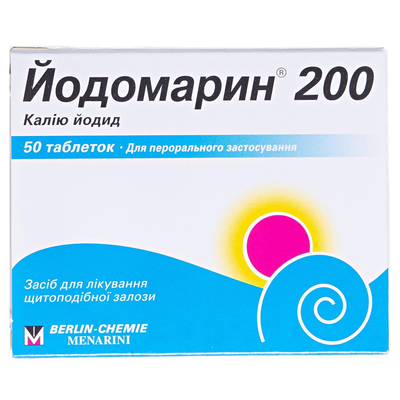
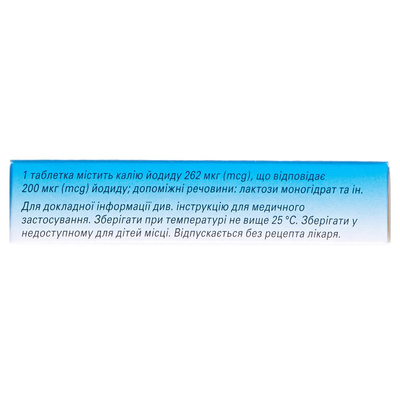
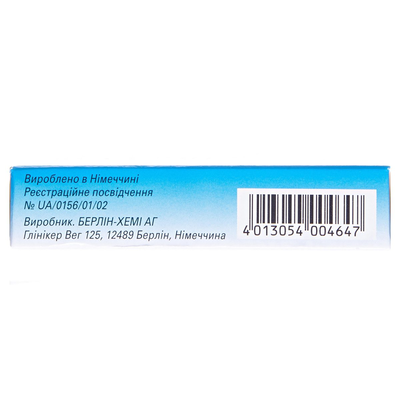
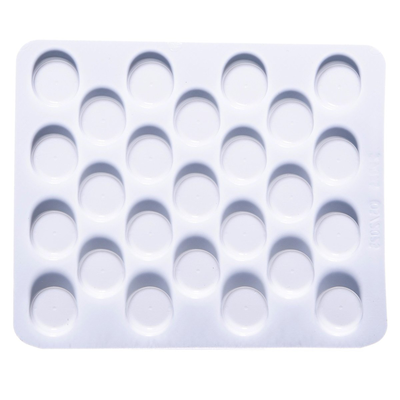
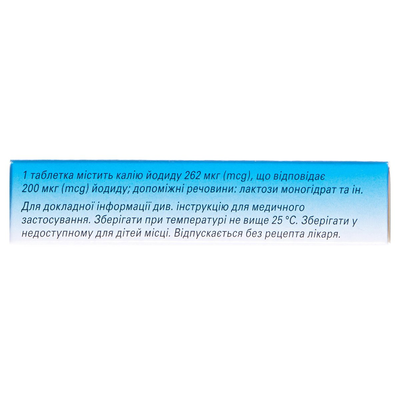
Iodomarin 200 tablets, 200 mcg each, No. 50 (25 x 2)
Ingredients
Active ingredient: potassium iodide;
1 tablet contains 262 mcg of potassium iodide, equivalent to 200 mcg of iodide;
inactive ingredients: lactose monohydrate, light magnesium carbonate, gelatin, sodium starch glycolate (type A), colloidal anhydrous silicon dioxide, magnesium stearate.
Dosage Form
Tablets.
Main physical and chemical properties: tablets with flat, parallel surfaces, white or almost white in color, with beveled edges and a score line on one side.
Pharmacotherapeutic group
Drugs for the treatment of thyroid disorders. Thyroid drugs. Iodine-containing drugs. ATC code H0ZS A.
Pharmacological properties
Pharmacodynamics.
Iodomarin® 200 is a medicinal product containing inorganic iodine. Iodine is an essential trace element that is a component of the thyroid hormones thyroxine (T4) and triiodothyronine (T3), ensuring the thyroid gland’s normal functioning.
When iodides enter the epithelial cells of the thyroid follicles, the enzyme iodide peroxidase catalyzes the oxidation of iodine to form elemental iodine. The substance undergoes a substitution reaction with the aromatic ring of tyrosine, resulting in the formation of tyronines: a 3,5-iodo derivative (the hormone thyroxine—T4) and a 3-iodo derivative (the hormone triiodothyronine—T3). Thyronines form a complex with the protein thyroglobulin, which is deposited in the colloid of the thyroid follicle and remains in this state for several days to weeks. This process is disrupted in the event of iodine deficiency. Iodine, when ingested in physiological amounts, prevents the development of endemic goiter associated with a deficiency of this element in the diet; normalizes thyroid gland size in newborns, children, and young adults; and affects the T3/T4 ratio and thyrotropin (TSH) levels.
Pharmacokinetics.
After oral administration, iodine is almost completely absorbed in the small intestine. Within 2 hours after absorption, it is distributed into the extracellular space; it accumulates in the thyroid gland, kidneys, stomach, mammary glands, and salivary glands. The volume of distribution in a healthy person averages 23 liters (38% of body weight). The concentration in blood plasma after administration of a standard dose is 10–50 ng/mL, while the iodine content in breast milk, saliva, and gastric juice is 30 times higher than the concentration in blood plasma. The thyroid gland contains three-quarters (10–20 mg) of the total iodine in the body. Iodine is excreted primarily in urine and, to a lesser extent, in feces and exhaled air. Once an equilibrium concentration is reached, the amount of iodine excreted is proportional to the daily intake of iodine from food.
Indications
Prevention of iodine deficiency, including during pregnancy or breastfeeding.
Prevention of recurrence of iodine-deficient goiter after surgical treatment, as well as after completion of comprehensive treatment with thyroid hormone medications.
Treatment of diffuse euthyroid goiter in children, including newborns, and young adults.
Contraindications
A history of hypersensitivity to the active ingredient or to any of the drug’s excipients. Severe hyperthyroidism. In cases of latent hyperthyroidism, it is contraindicated to use the drug in doses exceeding 150 mcg of iodine per day. In cases of autonomous adenoma, as well as focal and diffuse autonomous lesions of the thyroid gland, it is contraindicated to use the drug at a dose of 300 to 1,000 μg of iodine per day (with the exception of preoperative iodine therapy for thyroid blockade according to Plummer). Pulmonary tuberculosis. Hemorrhagic diathesis. Dühring’s herpetiform dermatitis (Dühring–Broca syndrome).
Interactions with Other Medications and Other Types of Interactions
Iodine deficiency enhances the response to thyrostatic therapy, whereas an excess of iodine reduces it; therefore, iodine intake should be avoided whenever possible before or during treatment for hyperthyroidism. Thyrostatic drugs, in turn, inhibit the conversion of iodine into organic compounds in the thyroid gland and, as a result, may cause goiter.
Substances absorbed by the thyroid gland via the same uptake mechanism as iodine can inhibit iodine uptake by the thyroid gland through a competitive mechanism (for example, perchlorate, which also inhibits the recirculation of iodide within the thyroid gland). Inhibition is also possible by drugs that are not themselves absorbed, such as thiocyanate at concentrations exceeding 5 mg/dL.
Iodine uptake by the thyroid gland and iodine metabolism within the gland are stimulated by endogenous and exogenous thyroid-stimulating hormone (TSH).
Concomitant treatment with high doses of iodine, which suppress thyroid hormone secretion, and lithium salts may contribute to the development of goiter and hypothyroidism.
High doses of potassium iodide in combination with potassium-sparing diuretics may cause hyperkalemia.
When used concomitantly, the effect of quinidine on the heart is enhanced due to an increase in plasma potassium concentration.
Concomitant use with plant alkaloids and heavy metal salts may lead to the formation of an insoluble precipitate and inhibition of iodine absorption.
Special Considerations for Use
This medication should not be used in cases of hypothyroidism, except when hypothyroidism is caused by iodine deficiency. Iodine administration should be avoided during radioactive iodine therapy or in cases of confirmed or suspected thyroid cancer. It should be noted that hyperkalemia may develop during treatment with this medication in patients with renal insufficiency.
The drug Iodomarin® 200 contains lactose. Patients with a rare hereditary form of galactose intolerance, severe lactase deficiency, or glucose-galactose malabsorption syndrome should not take Iodomarin® 200.
Use During Pregnancy or Breastfeeding
During pregnancy or breastfeeding, the need for iodine is increased, so an adequate intake of iodine (200 mcg per day) is particularly important. Due to iodine’s ability to cross the placenta and the fetus’s sensitivity to pharmacologically active doses of iodine, it should be used only in the recommended doses. This also applies to the breastfeeding period, as the concentration of iodine in breast milk is 30 times higher than in blood serum. An exception is high-dose iodine prophylaxis, which is administered following nuclear accidents.
Effect on the ability to drive or operate machinery
No effect.
Dosage and Administration
Prevention of iodine deficiency and endemic goiter in cases where an adult’s iodine intake is less than 150–200 mcg/day—the following additional amounts should be taken:
- infants and children under 12 years of age: 50–100 μg of iodine per day (100 μg of iodine is equivalent to ½ tablet of Iodomarin® 200. To achieve a dose of 50 μg of iodine, use medications with the appropriate active ingredient content);
- children 12 years of age and older and adults: 100–200 mcg of iodine per day (½ to 1 tablet of Iodomarin® 200);
- during pregnancy or breastfeeding: 200 μg of iodine per day (1 tablet of Iodomarin® 200).
Prevention of recurrence of iodine-deficient goiter following surgical treatment, as well as after completion of comprehensive treatment with thyroid hormone medications.
Children and adults: 100–200 mcg of iodine per day (½ to 1 tablet of Iodomarin® 200).
Treatment of euthyroid goiter.
Newborns and children: 100–200 μg of iodine per day (½ to 1 tablet of Iodomarin® 200).
Young adults: 300–500 μg of iodine per day (1½ to 2½ tablets of Iodomarin® 200).
Directions for Use.
Take the tablets after meals with a sufficient amount of liquid, such as a glass of water. For infants and children under 3 years of age, the medication may be administered in crushed form. Prophylactic use of the medication is typically carried out over several months or years, and more often—for life. For the treatment of goiter in newborns, 2–4 weeks is usually sufficient; in children and adults, 6–12 months or longer is required. In general, the doctor determines the dosage and duration of treatment for preventive measures or for the treatment of thyroid disorders on a case-by-case basis.
Children
The drug may be used in children of any age when indicated.
Overdose
Symptoms of intoxication: brown discoloration of the mucous membranes, reflex vomiting (blue discoloration if starch is present in the diet), abdominal pain, diarrhea (possible presence of blood in the stool), dehydration, and shock. In rare cases, esophageal strictures have been observed. Fatalities have been reported only after ingestion of large amounts of iodine (30–250 mL of iodine tincture). In some cases, chronic overdose leads to the development of so-called iodism, i.e., iodine intoxication: a metallic taste in the mouth, swelling and inflammation of the mucous membranes (rhinitis, conjunctivitis, gastroenteritis, bronchitis). Iodide can activate latent inflammatory processes, such as tuberculosis. Edema, erythema, acne-like and bullous rashes, hemorrhages, fever, and nervous agitation may develop.
Treatment.
Treatment for acute poisoning: gastric lavage with a solution of starch, albumin, or a 5% sodium thiosulfate solution until all traces of iodine are removed. Administer symptomatic therapy to correct water and electrolyte imbalances, and, if necessary, anti-shock therapy.
Treatment for chronic poisoning: discontinuation of iodine.
Hypothyroidism caused by iodine intake: discontinue iodine and prescribe thyroid hormones to normalize metabolism.
Hyperthyroidism caused by iodine intake: this is not an overdose in the literal sense, since hyperthyroidism can also result from an amount of iodine that is considered physiological in other countries.
Treatment depends on the severity: mild cases usually do not require treatment, while severe cases require thyrostatic therapy (the effectiveness of which is delayed). In the most severe cases (thyrotoxic crisis), intensive care, plasmapheresis, or thyroidectomy is required.
Side Effects
When iodide is used prophylactically in patients of any age, as well as therapeutically in newborns and children, adverse effects are generally not observed. However, in the presence of extensive areas of thyroid autonomy and when iodine is administered in daily doses exceeding 150 μg, the occurrence of severe hyperthyroidism cannot be completely ruled out.
The following adverse reactions occurred with the following frequencies: very common (≥1/10); common (≥1/100 to <1/10); uncommon (≥1/1,000 to <1/100); rarely (≥1/10,000 to <1/1,000); very rarely (<1/10,000); unknown (cannot be estimated from the available data).
Immune system disorders.
Very rare: hypersensitivity reactions (such as iodine-induced rhinitis, bullous or tuberous iododerma, exfoliative dermatitis, angioedema, fever, acne, and swelling of the salivary glands).
Endocrine system.
Very rare: during treatment of goiter in adults (daily dose of 300 to 1,000 μg of iodine), iodine-induced hyperthyroidism may develop. In the vast majority of cases, this is preceded by the presence of diffuse or localized areas of thyroid autonomy. This primarily applies to elderly patients who have suffered from goiter for a long time.
The following are also possible: manifestations of iodism (including symptoms such as swelling of the nasal mucosa, hives, angioedema, skin rashes, itching, and, in rare cases, anaphylactic shock), eosinophilia, tachycardia, tremor, irritability, sleep disturbances, increased sweating, epigastric discomfort, and diarrhea. When the drug is used in high doses, goiter and hypothyroidism may develop in isolated cases.
Reporting of Suspected Adverse Reactions.
Reporting suspected adverse reactions after the drug’s approval plays an important role. This allows for continued monitoring of the drug’s benefit-risk profile. Healthcare professionals should report any suspected adverse reactions.
Shelf Life
For packaging containing a PVC/aluminum blister pack—3 years.
For packages containing an aluminum/aluminum blister pack—5 years.
Do not use this medication after the expiration date printed on the package.
Storage Conditions
Store packages containing a PVC/aluminum blister at a temperature not exceeding 25 °C.
No special storage conditions are required for packaging containing aluminum/aluminum blister packs.
Keep out of the reach of children.
Packaging
A cardboard box containing 5 blisters of 10 tablets each or 2 blisters of 25 tablets each.
Dispensing Category
Over-the-counter.
Manufacturer
BERLIN-CHEMIE AG.