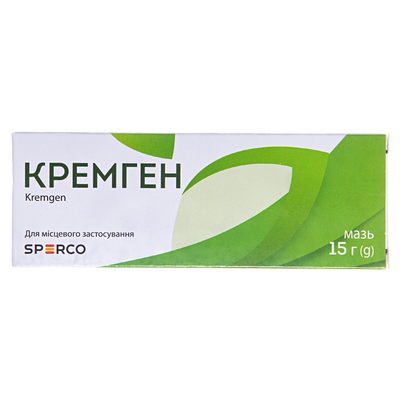
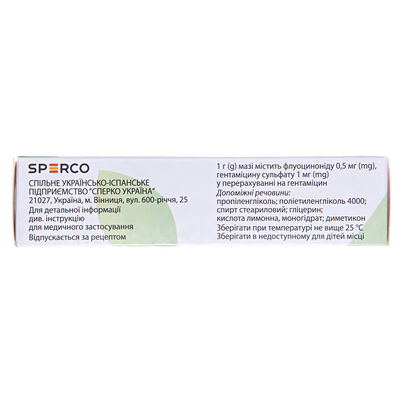
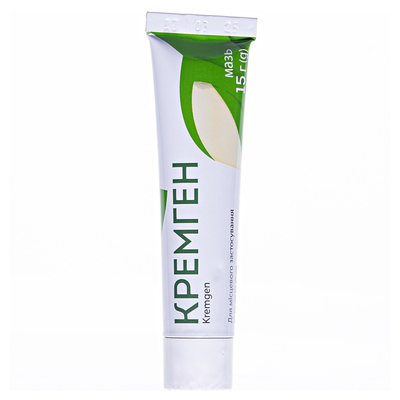
Kremgen ointment, 15 g tubes
Composition
Active ingredients: fluocinolide, gentamicin;
1 g of ointment contains 0.5 mg of fluocinolide and 1 mg of gentamicin sulfate (equivalent to gentamicin);
Excipients: propylene glycol; polyethylene glycol 4000; stearyl alcohol; glycerin; citric acid monohydrate; dimethicone.
Dosage Form
Ointment.
Main physical and chemical properties: a white ointment with a pearlescent or pearlescent yellowish tint.
Pharmacotherapeutic group
Dermatological products. Corticosteroids in combination with antibiotics.
ATC code D07C C05.
Pharmacological properties
Pharmacodynamics.
A combination topical preparation containing the glucocorticosteroid fluocinolide and the aminoglycoside antibiotic gentamicin. The drug’s action is due to the synergistic effects of its components.
Fluocinolide is a synthetic, highly effective third-generation glucocorticosteroid. It has pronounced and long-lasting anti-inflammatory, antiallergic, anti-edematous, and antipruritic effects. It stabilizes lysosomal membranes and inhibits lysosomal phospholipase A2, which leads to a reduction in the formation of inflammatory mediators such as eicosanoids and cytokines (IL-1 and 2, γ-interferon, TNF-α), blocks the conversion of arachidonic acid into prostaglandins, and prevents cell lysis during the inflammatory process. Stimulation of steroid receptors leads to the formation of a special class of proteins—lipocortins—which have a pronounced anti-edematous effect.
Gentamicin, a second-generation aminoglycoside antibiotic, has a pronounced bactericidal effect. The mechanism of its antimicrobial activity involves binding to the 30S subunit of microbial ribosomes, which causes irreversible inhibition of protein synthesis. Gentamicin binds to the cytoplasmic membranes of bacteria, disrupts their permeability, and leads to the loss of potassium ions, amino acids, and nucleotides from the cells. Gentamicin has a bactericidal effect against Streptococcus spp., Staphylococcus spp. (including MRSA), Pseudomonas spp., Escherichia coli, Proteus spp., Klebsiella spp., Shigella spp., Salmonella spp., Enterobacter spp., Acinetobacter spp., and other bacteria.
Pharmacokinetics.
When applied topically, the drug’s components easily penetrate all layers of the skin, including areas with inflammatory, erosive, and burn lesions, exerting a therapeutic effect. Upon contact with the dermis, fluocinolide is deethylated, releasing fluocinolone, which also has a pronounced glucocorticoid effect. Due to this deethylation effect, fluocinolonide practically does not enter the systemic circulation when applied topically. The gentamicin molecule is characterized by highly hydrophilic properties; therefore, it does not penetrate biological membranes, such as the skin or the intestinal wall, and does not enter the systemic circulation when applied topically.
Indications
Inflammatory and allergic skin conditions, including those complicated by secondary bacterial infection: various forms and locations of eczema, dermatitis (atopic, contact, allergic, seborrheic, radiation-induced, diaper rash, exfoliative, and solar), psoriasis, senile pruritus, lichen planus, discoid lupus erythematosus, trophic ulcers (except for leg ulcers associated with varicose veins), first-degree burns and frostbite, and insect and arthropod bites.
Contraindications
Infectious skin diseases (viral, bacterial, fungal), including cutaneous manifestations of syphilis, cutaneous tuberculosis, pyoderma, chickenpox, herpes, actinomycosis, blastomycosis, and sporotrichosis; acne rosacea and acne vulgaris; diaper dermatitis, perioral dermatitis; anogenital pruritus; skin neoplasms, skin tumors; nevi, atheromas, hemangiomas, xanthomas; wounds at the application sites; numerous psoriatic plaques, trophic ulcers of the lower legs associated with varicose veins, ulcerative skin lesions; erosive and ulcerative lesions of the gastrointestinal tract; hypersensitivity to the active ingredients or to other components of the drug. Kremgen is contraindicated in ophthalmic practice. Do not use the drug after preventive vaccinations.
Interactions with Other Medications and Other Forms of Interaction
This medication may enhance the effects of immunosuppressants and may inhibit the effects of immunostimulants, antihypertensives, diuretics, antiarrhythmics, and potassium supplements.
The drug may be used with other topical and systemic antimicrobial agents. Concomitant use with systemic corticosteroids increases the drug’s efficacy but also raises the likelihood of systemic and local side effects.
Concomitant use with nonsteroidal anti-inflammatory drugs increases the risk of systemic and local side effects.
Concomitant use with diuretics (except potassium-sparing diuretics) increases the likelihood of developing hypokalemia.
Minimal absorption during topical application does not lead to interactions with other medications.
During treatment with this drug, vaccination against smallpox and other types of immunization are not recommended (especially during long-term use on large areas of skin) due to the possible lack of an adequate immunological response in the form of the production of corresponding antibodies.
Long-term use does not rule out the possibility of gentamicin absorption and increased ototoxicity associated with other aminoglycoside antibiotics, polymyxin B, colistin, cephaloridine, ethacrynic acid, and furosemide.
Special Considerations for Use
Treatment must be conducted under a physician’s supervision. It is advisable to use the drug in short courses (no longer than 10 days) on small areas of skin. Prolonged use on large areas of skin increases the incidence of side effects associated with iatrogenic hypercortisolism: edema, hypertension, hyperglycemia, and impaired glucose tolerance. Before each subsequent application of the medication, any remaining ointment from the previous application should be washed off with warm soapy water or an antiseptic solution. It is recommended to wear loose-fitting clothing during treatment. Do not use the medication under an occlusive dressing, or on lesions of the mucous membranes of the mouth, nose, or eyes. Use with caution on areas of the body with thin skin (face, groin, and inguinal regions), as absorption may increase and local side effects (telangiectasia, perioral dermatitis) may develop even after short-term use. Do not apply to the skin of the breasts. Avoid applying the medication to the eyelids or the skin around the eyes in patients with cataracts, angle-closure and open-angle glaucoma due to the potential for exacerbation of disease symptoms. Avoid contact with the eyes. If local irritation, fungal skin infections, or hypersensitivity reactions occur during treatment, discontinue use of the medication. If a gentamicin-resistant infection develops, appropriate antibacterial or antifungal treatment should be administered at the site of ointment application.
With topical use of the medication, the following may occur: decreased production of adrenocorticotropic hormone by the pituitary gland due to suppression of the hypothalamic-pituitary-adrenal axis, a decrease in blood cortisol levels, and the development of iatrogenic Cushing’s syndrome, which resolves after discontinuation of the drug.
If long-term use is necessary, periodic monitoring of adrenal cortex function should be performed by measuring cortisol levels in blood and urine following adrenocorticotropic hormone stimulation.
The drug should be used under close medical supervision in patients with psoriasis, as topical application of glucocorticosteroids to areas affected by psoriasis may lead to the spread of a relapse caused by the development of tolerance to generalized pustular psoriasis and systemic toxicity caused by skin dysfunction.
The drug should be used with caution in the presence of subcutaneous tissue atrophy, especially in elderly patients.
During treatment, it is not recommended to receive smallpox vaccinations or undergo other types of immunization.
Gentamicin, a component of the drug, may cause cross-allergic reactions with other aminoglycoside antibiotics. Systemic absorption of gentamicin following topical application may be higher when treating large areas of the body, especially with prolonged use or in the presence of skin lesions. In such cases, adverse effects associated with systemic absorption of gentamicin may occur. In such cases, appropriate precautions are recommended, especially when treating infants and children.
Prolonged topical use of antibiotics may sometimes lead to the growth of resistant microorganisms, including fungi. In this case, therapy should be discontinued and appropriate treatment prescribed.
With prolonged use (more than 14 days) on large areas of skin, especially in patients with chronic renal failure, the possibility of systemic effects of gentamicin must be considered: ototoxicity (dizziness, nausea, tinnitus), nephrotoxicity (increased blood urea and creatinine levels, decreased urine output), and increased levels of bilirubin and transaminases in serum.
This medication contains propylene glycol, which may cause skin irritation.
This medication contains stearyl alcohol, which may cause local skin reactions (e.g., contact dermatitis).
Pregnancy and lactation.
This medication is contraindicated during pregnancy. Breastfeeding should be discontinued for the duration of treatment with this medication.
Effects on the ability to drive and operate machinery.
This medication does not affect psychomotor reaction time.
Directions for Use and Dosage
Apply a thin layer of the medication to the affected areas of the skin 2–3 times a day. The duration of treatment is determined by the doctor on an individual basis and depends on the nature of the disease.
Children.
This medication should be prescribed to children over 2 years of age. It should be used with caution, under a doctor’s supervision, only once daily, on a small area of skin. Do not apply the ointment to a child’s face. Use of this medication is permissible only if the expected benefit outweighs the potential risk of adverse reactions. When using this medication in children, consider the possibility of signs of hypothalamic-pituitary-adrenal axis suppression, which occur more frequently in children than in adult patients due to greater absorption of the medication in children resultinga higher skin-to-body-weight ratio. In children receiving topical corticosteroids, adrenal suppression, Itsenko–Cushing syndrome, growth retardation, inadequate weight gain, and increased intracranial pressure have been reported. Signs of adrenal cortex suppression include low plasma cortisol levels and a lack of response to an adrenocorticotropic hormone (ACTH) stimulation test. Increased intracranial pressure manifests as bulging of the fontanelle, headache, and bilateral optic disc edema.
Overdose
With prolonged or excessive use of topical glucocorticosteroids, including fluocinolide, especially in children, there is a risk of developing systemic effects (secondary adrenal insufficiency and the onset of symptoms of hypercortisolism). Symptoms of hypercorticism are generally reversible. Prolonged topical use of gentamicin may lead to the growth of resistant fungal or bacterial flora. In this case, it is recommended to discontinue use of the medication and provide symptomatic treatment. With prolonged use on large areas of skin, symptoms of overdose may occur, manifesting as an intensification of side effects.
Side Effects
Skin and subcutaneous tissue disorders: burning sensation, irritation, erythema, itching, dry skin, folliculitis, hypertrichosis, stretch marks, acne, perioral dermatitis, allergic contact dermatitis, urticaria, maculopapular rash, skin maceration at the application site, skin integrity impairment, hyperkeratosis, furunculosis, fungal skin infections. With prolonged use, skin atrophy, localized hirsutism, telangiectasia, purpura, pigmentation disorders, hypertrichosis, and alopecia may occur, especially in women; secondary infectious skin lesions may also develop.
Gastrointestinal disorders: When applied to large areas of skin, especially with prolonged use, gastritis and steroid-induced gastric ulcers may occur.
Endocrine disorders: hyperglycemia. When applied to large areas of skin, systemic manifestations may occur: adrenal insufficiency, Cushing’s syndrome, and steroid-induced diabetes mellitus.
Immune system: decreased immune resistance. With prolonged use, the following may occur: development of secondary immunodeficiency (exacerbation of chronic infectious diseases, generalization of the infectious process, development of opportunistic infections), slowing of reparative processes, and development of local and generalized manifestations of allergic reactions.
Cardiovascular disorders: hypertension; edema may develop.
Shelf life
3 years.
Do not use the drug after the expiration date indicated on the package.
Storage conditions
Store at a temperature not exceeding 25 °C. Keep out of reach of children.
Packaging
15 g or 30 g in a tube; 1 tube per pack.