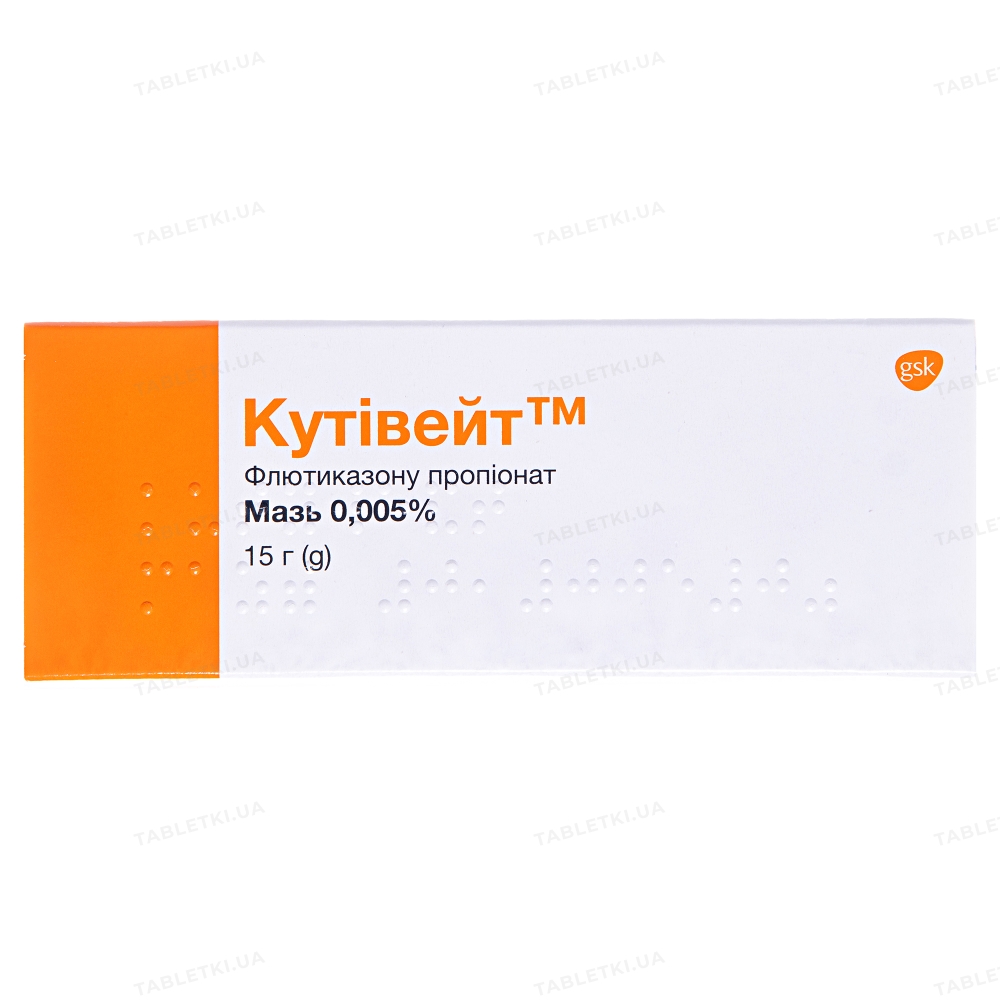
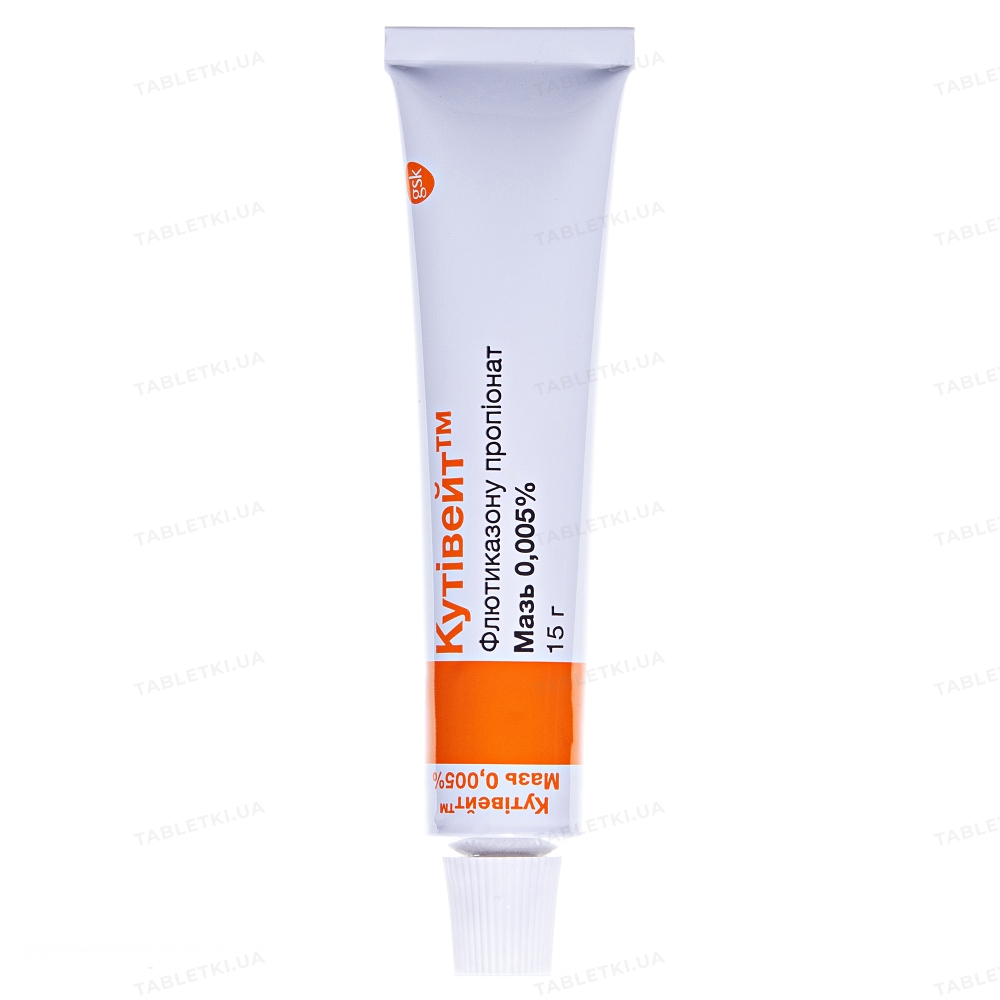
Kutivite ointment, 0.005%, 15 g in tubes
Composition
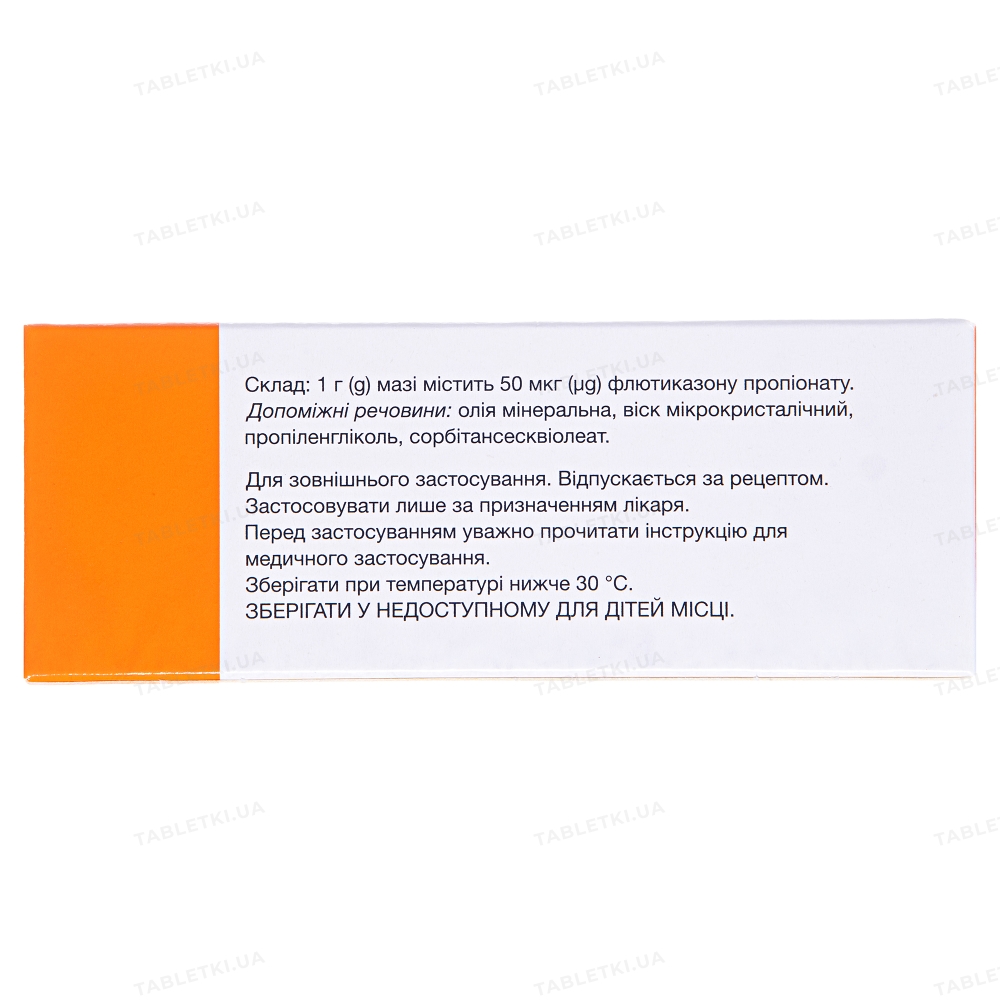
Active ingredient: fluticasone propionate;
1 g of ointment contains 50 μg of fluticasone propionate;
inactive ingredients: mineral oil, propylene glycol, sorbitan sesquioleate, microcrystalline wax.
Dosage Form
Ointment.
Main physical and chemical properties: a homogeneous, translucent ointment that is white or nearly white in color.
Pharmacotherapeutic group
Corticosteroids for dermatological use. Active corticosteroids (Group III). ATC code D07A C17.
Pharmacological properties
Pharmacodynamics.
Fluticasone propionate is a glucocorticoid with high anti-inflammatory activity and very low suppression of the hypothalamic-pituitary-adrenal axis when applied topically; therefore its therapeutic index is one of the widest among all currently available topical steroids.
Fluticasone propionate has high systemic activity following subcutaneous administration but very low activity when administered orally, possibly due to metabolic inactivation. In vitro studies have demonstrated its high affinity for human glucocorticoid receptors.
Fluticasone propionate does not exhibit unpredictable hormonal effects or significant effects on the central and peripheral nervous systems, the gastrointestinal, cardiovascular, or respiratory systems.
Pharmacokinetics.
Absorption. With topical and oral administration, bioavailability is very low due to limited absorption of the drug through the skin or from the gastrointestinal tract and due to extensive first-pass metabolism. Oral bioavailability is close to zero; therefore, the systemic effect of fluticasone propionate will be low regardless of the route of administration of the ointment.
Distribution.
Studies have shown that only a very small amount of orally administered fluticasone propionate enters the systemic circulation; this amount is rapidly cleared via the bile and excreted in the feces. Fluticasone propionate is not retained in any tissues and does not bind to melanin.
Metabolism.
According to pharmacokinetic studies in animals, fluticasone propionate is rapidly eliminated and undergoes extensive metabolic clearance. In humans, metabolic clearance is high and, consequently, elimination is rapid. When the drug enters the systemic circulation through the skin, it is rapidly inactivated. The primary mechanism of metabolism is hydrolysis to a carboxylic acid, which has very low glucocorticoid and anti-inflammatory activity.
Elimination.
According to animal studies, the route of excretion does not depend on the route of administration of fluticasone propionate. It is excreted primarily in the feces, and this process is complete within 48 hours.
Indications
Adults.
Dermatoses responsive to corticosteroid treatment, such as:
- atopic dermatitis;
- numular dermatitis (discoid eczema);
- nodular prurigo;
- psoriasis (except for widespread plaque psoriasis);
- simple chronic lichen (neurodermatitis), lichen planus;
- seborrheic dermatitis;
- irritant or allergic contact dermatitis;
- discoid lupus erythematosus;
- generalized erythroderma (as an adjunctive treatment);
- reaction to insect bites;
- heat rash.
Children.
Treatment of atopic dermatitis in children aged 3 months and older when treatment with less potent corticosteroids has been ineffective.
Contraindications
Hypersensitivity to the active ingredient or to any component of the medication.
Untreated skin infections.
Rosacea.
Acne vulgaris.
Perioral dermatitis.
Perianal and genital itching.
Itching without inflammation.
Skin conditions in infants under 3 months of age, including dermatitis and diaper rash.
Drug Interactions and Other Interactions
It has been shown that concomitant use with drugs that may inhibit CYP3A4 (e.g., ritonavir, itraconazole) inhibits the metabolism of corticosteroids, which may result in increased systemic effects. The clinical significance of this interaction depends on the dose of the drug, the route of administration of the corticosteroid, and the potency of the CYP3A4 inhibitor.
Special Considerations for Use
Use this medication with caution in patients with a history of local hypersensitivity reactions to corticosteroids or any of the excipients. Local hypersensitivity reactions (see the “Adverse Reactions” section) may resemble the symptoms of the condition being treated.
Manifestation of hypercortisolism (Cushing’s syndrome) and reverse suppression of the hypothalamic-pituitary-adrenal axis with adrenal suppression in some individuals may result from increased systemic absorption of topical steroids. If any of the above symptoms occur, use of the drug should be gradually discontinued by reducing the frequency of application or switching to a less potent corticosteroid. Abrupt discontinuation of treatment may cause glucocorticoid insufficiency (see the “Adverse Reactions” section).
Risk factors for systemic effects include:
- the potency and composition of the topical steroid;
- duration of use;
- application to a large area of skin;
- application to skin surfaces that come into contact with each other, such as in areas of intertrigo or where an occlusive dressing is applied (in infants, diapers may act as an occlusive dressing);
- increased hydration of the stratum corneum;
- application to areas with thin skin, such as the face;
- application to areas of damaged skin or in other conditions where the skin barrier is compromised.
Compared to adults, children and adolescents may absorb a proportionally larger amount of topical corticosteroids and are therefore more susceptible to systemic side effects. This is because children have an underdeveloped skin barrier and a larger skin surface area relative to body weight compared to adults.
Children.
Long-term daily use of topical corticosteroids in infants and children under 12 years of age should be avoided whenever possible, as they are at higher risk of adrenal suppression.
Treatment of psoriasis.
Topical corticosteroids should be used with caution for the treatment of psoriasis, as there have been reports of relapses, the development of tolerance, the risk of generalization of pustular psoriasis, and the development of symptoms of local or systemic toxicity caused by impairment of the skin’s barrier function. When used to treat psoriasis, the patient must be under close medical supervision.
Application of the ointment to the face.
Prolonged application of the ointment to the facial skin is not recommended, as this area is more susceptible to atrophic changes.
Application to the eyelids.
When applying the ointment to the eyelids, avoid getting the product in the eyes, as repeated exposure may cause cataracts and glaucoma.
Visual disturbances
Vision problems may occur with both systemic and topical use of corticosteroids. If a patient experiences symptoms such as blurred vision or other vision problems, they should be referred to an ophthalmologist to evaluate possible causes, which may include cataracts, glaucoma, or rare conditions such as central serous chorioretinopathy, which have been reported following the use of systemic and topical corticosteroids.
Concomitant infections.
Whenever treating infected inflammatory lesions, appropriate antibacterial agents must be prescribed. If the infection spreads, topical corticosteroids should be discontinued and appropriate antibacterial therapy initiated.
Risk of infection when applying an occlusive dressing
The risk of developing bacterial infections increases in warm and moist conditions in skin folds or under occlusive dressings; therefore, the skin should be thoroughly cleaned each time before applying a new dressing.
Chronic leg ulcers.
Topical corticosteroids are sometimes used to treat dermatitis occurring around chronic leg ulcers. However, such use is associated with an increased incidence of local hypersensitivity reactions and an increased risk of local infections.
Overt suppression of adrenal cortex function (morning plasma cortisol level less than 5 μg/dL) is unlikely with the use of Kutiveit ointment at therapeutic doses, provided that no more than 50% of the body surface area is treated in adults and no more than 20 g of the product is applied per day.
Cutiveit ointment contains mineral oil. Patients must be warned not to smoke or be near open flames while applying the ointment due to the risk of severe burns. If the product comes into contact with fabric (clothing, bedding, bandages, etc.), the material may easily ignite and cause a serious fire. Washing clothing and bedding reduces the accumulation of the product in the fabric but does not remove it completely.
Kutivite ointment contains propylene glycol (50 mg per 1 g of the product) as an excipient, which may cause local skin reactions.
Topical Steroid Withdrawal Syndrome
After prolonged use of topical steroids, discontinuation of treatment may lead to recurrent flare-ups (topical steroid withdrawal syndrome). Severe recurrent flare-ups may develop in the form of dermatitis with pronounced redness, tingling, and burning, spreading beyond the originally treated area. The likelihood of such a reaction increases when treating more sensitive areas of the skin, such as the face or the inner surfaces of joint creases. If the condition recurs within a few days or weeks after successful completion of treatment, this may indicate withdrawal syndrome. The drug should be re-administered with extreme caution. It is recommended to consult a specialist and consider the appropriateness of alternative treatments.
Use during pregnancy or breastfeeding.
Pregnancy.
Data on the use of fluticasone propionate in pregnant women are limited.
Topical application of corticosteroids in pregnant animals may lead to fetal developmental abnormalities, although the relevance of these findings to pregnant women has not been established. However, fluticasone propionate should be prescribed to pregnant women only when the expected benefit to the mother outweighs the potential risk to the fetus and infant. Use the lowest effective dose for the shortest possible duration.
Breastfeeding.
The safety of topical corticosteroids during breastfeeding has not been established. It is unknown whether the use of topical corticosteroids can lead to systemic absorption resulting in measurable levels of the drug in breast milk. In a study conducted on laboratory rats, signs of the presence of fluticasone propionate in breast milk were detected when a certain level of the drug was reached in the blood plasma following subcutaneous administration.
Fluticasone propionate ointment should be prescribed during breastfeeding only if the expected benefit to the mother outweighs the potential risk to the infant. If prescribed during breastfeeding, the ointment should not be applied to the breasts to prevent accidental ingestion by the infant.
Fertility.
There are no data available to assess the effect of topical corticosteroids on human fertility.
Effect on reaction time when driving or operating machinery.
No studies on this effect have been conducted. Given the adverse reaction profile, an effect on reaction time while driving or operating machinery is not expected.
Dosage and Administration
Adults and children 3 months of age and older.
The ointment is particularly suitable for treating dry skin surfaces, as well as skin with lichen or scaly lesions.
Apply a thin layer of the ointment to the affected skin areas once or twice daily. The duration of treatment with daily application is up to 4 weeks until improvement is seen; thereafter, reduce the frequency of application or switch to a less potent medication. After applying the ointment, allow sufficient time for absorption before applying an emollient.
Once the condition is under control, the frequency of topical corticosteroid use should be gradually reduced until discontinued entirely, and emollients should be used as maintenance therapy.
Symptoms of the underlying condition may recur if topical corticosteroids, especially potent ones, are abruptly discontinued.
Duration of treatment in adults and elderly patients.
If the condition worsens or there is no improvement within 2–4 weeks, the diagnosis and treatment should be reviewed.
Children aged 3 months and older.
Children are more likely to experience local or systemic adverse reactions when using topical corticosteroids; therefore, they are generally prescribed shorter courses of treatment and less potent medications than adults.
Use Kutiveit ointment with caution to ensure that the minimum effective amount of the medication is applied.
Duration of treatment in children.
If no improvement is observed after 7–14 days of using the ointment in children, treatment should be discontinued and the child should undergo further evaluation. If the condition is brought under control within 7–14 days of treatment, the minimum effective doses should then be used for the shortest possible time. The duration of treatment with daily application should not exceed 4 weeks.
Elderly patients.
Clinical studies have shown no difference in response to treatment between elderly and younger patients. Since elderly patients are more likely to have impaired renal or hepatic function, which may result in delayed drug elimination following systemic absorption, the lowest effective doses should be used for the shortest possible duration of treatment to achieve the desired result.
Hepatic/renal insufficiency.
In cases of systemic absorption (when applied to large areas of the skin or for prolonged periods), the metabolism and elimination of the drug may be slowed, increasing the risk of systemic toxicity. Therefore, to achieve the desired result, the minimum effective doses should be used for the shortest possible duration.
Children. Use for the treatment of children aged 3 months and older.
Overdose
Symptoms.
When applied topically, fluticasone propionate may be absorbed in amounts sufficient to produce systemic effects. Acute overdose is unlikely. In cases of chronic overdose or abuse, signs of hypercortisolism may occur (see the “Adverse Reactions” section).
Treatment.
In case of overdose, use of the ointment should be gradually discontinued by reducing the frequency of application or switching to a less potent topical corticosteroid, given the risk of developing glucocorticoid insufficiency. Further treatment should be based on the patient’s clinical condition.
Side Effects
Adverse reactions are classified by organ system and frequency of occurrence: very common (>1/10), common (>1/100, <1/10), uncommon (>1/1,000, <1/100), rare (>1/10,000, <1/1,000), very rare (<1/10,000), including isolated cases, unknown (frequency cannot be estimated from the available data).
Infections and infestations.
Very rare: opportunistic infections.
Immune system disorders.
Very rare: hypersensitivity.
Endocrine system disorders.
Very rare: suppression of the hypothalamic-pituitary-adrenal axis:
- weight gain/obesity;
- delayed weight gain/growth retardation in children;
- Cushingoid features (e.g., moon face, central obesity);
- decreased endogenous cortisol levels;
- hyperglycemia/glucosuria;
- hypertension;
- osteoporosis;
- cataracts;
- glaucoma.
Skin and subcutaneous tissue disorders.
Common: itching.
Uncommon: local burning sensation in the skin.
Very rare: skin thinning, skin atrophy, striae, telangiectasia, changes in pigmentation, hypertrichosis, allergic contact dermatitis, exacerbation of underlying symptoms, pustular psoriasis, erythema, rash, urticaria.
Frequency unknown: withdrawal syndrome—skin redness that may extend beyond the initially treated area, a tingling or burning sensation, itching, skin peeling, pustules with oozing contents (see the “Special Considerations for Use” section).
Ocular side effects
Unknown: blurred vision (see the “Special Precautions for Use” section).
Shelf life
2 years.
Storage conditions
Store at a temperature below 30 °C. Keep out of reach of children.
Packaging
15 g of ointment in an aluminum tube with a protective membrane and a polypropylene cap, packaged in a cardboard box.
Dispensing Category
By prescription only.
Manufacturer
Delpharm Poznan S.A., Poland.
Address
189 Grunwaldzka St., 60-322 Poznan, Poland/
189 Grunwaldzka St., 60-322 Poznan, Poland.