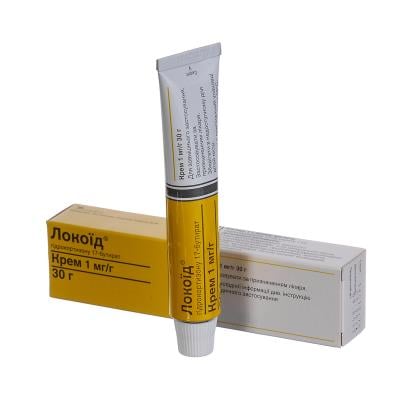
Locoid cream, 1 mg/g, 30 g in tubes
Ingredients
Active ingredient: hydrocortisone 17-butyrate;
1 g of cream contains 1 mg of hydrocortisone 17-butyrate;
Excipients: cetostearyl alcohol, cetostearyl macrogol ether, light mineral oil, white soft paraffin, propyl parahydroxybenzoate (E 216), butyl parahydroxybenzoate, anhydrous citric acid, sodium citrate, purified water.
Dosage Form
Cream.
Main physical and chemical properties: a white cream that is easy to apply.
Pharmacotherapeutic group
Corticosteroids for dermatological use.
ATC code D07A B02.
Pharmacological properties
Pharmacodynamics.
Hydrocortisone 17-butyrate is an active synthetic nonhalogenated corticosteroid for topical use. It has anti-inflammatory, anti-edematous, and antipruritic effects. Its efficacy is comparable to that of halogenated steroids. Use at recommended doses does not cause suppression of the hypothalamic-pituitary-adrenal axis. Although long-term use of high doses of the drug, especially when used with occlusive dressings, may lead to an increase in plasma cortisol levels, the responsiveness of the hypothalamic-pituitary-adrenal axis is not reduced, and cortisol production returns to normal after discontinuation of the drug.
Pharmacokinetics.
Absorption. Following application, the active ingredient accumulates in the epidermis, primarily in the granular layer.
Metabolism. Hydrocortisone 17-butyrate, absorbed through the skin, is metabolized to hydrocortisone and other metabolites directly in the epidermis and then in the liver.
Excretion. Metabolites and a small portion of unchanged hydrocortisone 17-butyrate are excreted in the urine and feces.
Indications
Conditions that respond to treatment with topical corticosteroids (eczema, dermatitis, psoriasis). Topical corticosteroids are generally not indicated for the treatment of psoriasis, but may be acceptable—with the exception of widespread plaque psoriasis—provided that precautions are followed (see the “Special Precautions for Use” section).
Contraindications
Except when used in combination with appropriate chemotherapeutic agents:
- Skin lesions (wounds) caused by bacterial infections (e.g., pyoderma, syphilitic or tuberculous lesions) or viral infections (e.g., chickenpox, herpes simplex, herpes zoster, common warts, flat warts, genital warts, molluscum contagiosum); infections caused by fungi and yeasts; parasitic infections (e.g., scabies);
- ulcerative skin lesions;
- adverse reactions caused by corticosteroids (e.g., perioral dermatitis, striae);
- ichthyosis, juvenile plantar dermatosis, acne vulgaris, rosacea, fragile capillaries, skin atrophy;
- allergic hypersensitivity reactions to the drug’s components or to corticosteroids (the latter are rare);
- skin neoplasms.
Interactions with Other Medications and Other Types of Interactions
No interaction studies have been conducted.
Special Considerations for Use
Systemic adverse reactions following topical application of corticosteroids in adults are extremely rare but can be serious. This is particularly true for adrenocortical suppression with prolonged use of the drug.
The risk of systemic effects increases in the following cases:
- application to large areas of skin, especially with occlusive dressings or application to skin folds;
- long-term treatment;
- use in children (due to thin skin and a relatively large skin surface area);
- the presence of components or excipients that enhance penetration through the stratum corneum and/or potentiate the effect of the active ingredient (e.g., propylene glycol).
The risk of developing local adverse reactions increases with the potency of the drug and the duration of treatment. Use with occlusive dressings or application to skin folds increases this risk. The skin of the face, scalp, and genital area is particularly susceptible to adverse reactions. If used improperly, or in the presence of bacterial, parasitic, fungal, or viral infections, the symptoms of these conditions may be masked and/or exacerbated.
The ointment should not be applied to the eyelids due to the possibility of contact with the conjunctiva and an increased risk of developing primary open-angle glaucoma or subcapsular cataracts.
Topical corticosteroids may be dangerous for patients with psoriasis for a variety of reasons, including rebound syndrome due to the development of tolerance, the risk of generalized pustular psoriasis, or local and systemic toxic effects resulting from impairment of the skin’s barrier function. Steroids may be used for scalp psoriasis or chronic plaque psoriasis of the hands and feet. It is important to monitor patients closely.
Children, including infants.
Side effects may occur in infants with excessive use. Particular caution should be exercised in cases of dermatoses in infants, particularly diaper dermatitis. In such patients, the course of treatment should generally not exceed 7 days.
Adrenal suppression (Cushing’s syndrome) can develop rapidly in children. Growth hormone production may also be suppressed, and intracranial hypertension may occur. Signs of intracranial hypertension have included: bulging fontanelle, headache, and bilateral optic disc edema. If long-term treatment is necessary, it is advisable to regularly monitor the child’s height and body weight, as well as measure plasma cortisol levels.
In comparative studies, no significant differences in adrenocortical function were observed in children who were treated for 4 weeks with Locoid® cream or 1% hydrocortisone at a dose of 30–60 grams per week.
Excipients contained in the product.
Cetostearyl alcohol may cause local skin reactions (e.g., contact dermatitis).
Propyl and butyl parahydroxybenzoate may cause delayed allergic reactions.
Use during pregnancy or breastfeeding.
Pregnancy. Data on the use of hydrocortisone butyrate in pregnant women are lacking or limited. Results from studies in laboratory animals indicate reproductive toxicity of the drug. Corticosteroids cross the placenta. With systemic administration of high doses of corticosteroids, adverse effects on the fetus or newborn have been reported (fetal growth retardation, adrenocortical suppression).
Although there is limited information on the topical use of corticosteroids in pregnant women, given the limited systemic absorption of drugs in this class, mild- and moderate-potency corticosteroids (Class 1 and Class 2), such as hydrocortisone, may be used for short periods of time and on limited areas of the skin. The aforementioned effects cannot be ruled out with long-term use or when applied to large areas of the skin. This should be done only when there are specific indications.
Breastfeeding. Hydrocortisone butyrate and its metabolites pass into breast milk; however, when Locoid® is used at therapeutic doses, no effects on breastfed newborns or infants are expected. Locoid® may be used by women who are breastfeeding only for short-term treatment and when applied to small areas of skin. Breastfeeding should be discontinued during long-term treatment or when the medication is applied to large areas of affected skin.
Effect on reaction time when driving or operating machinery.
There are no data on the effect of Locoid® cream on the ability to drive or operate machinery; no such effect is expected.
Directions for Use and Dosage
For topical use.
Apply a small amount of the medication in a thin, even layer to the affected areas no more than twice daily.
It may be applied under an occlusive dressing in cases of more persistent lesions, such as thickened psoriatic plaques on the elbows and knees (excluding weeping lesions).
Dosage
The total dose per treatment course should not exceed 30–60 g of cream per week.
Adults and Elderly Patients
Adults and elderly patients receive the same doses, as there is no clinical evidence to suggest that elderly patients require a special dosing regimen.
Children
If possible, long-term treatment should be avoided.
Ages 6 months to 1 year
If possible, the treatment period should last no longer than 7 days.
Overdose
Excessive use under an occlusive dressing may lead to adrenal suppression. There are no specific treatment procedures or antidotes. If any side effects occur, treatment should be discontinued and symptomatic treatment administered.
Side Effects
Rare (>1/10,000, <1/1,000)
Skin and subcutaneous tissue disorders:
- dermatitis, eczema, striae, contact dermatitis;
- contact allergy, pustular acne;
- skin atrophy, often irreversible, accompanied by thinning of the epidermis, telangiectasias, purpura, and striae;
- depigmentation, hypertrichosis;
- rosacea-like and perioral dermatitis, with or without skin atrophy;
- rebound effect, which may lead to steroid dependence;
- delayed wound healing;
- skin infection, redness, irritation, burning sensation, rashes, itching, dry skin, folliculitis, heat rash, acne, maceration.
Endocrine disorders: adrenocortical suppression, Cushing’s syndrome, hyperglycemia, glucosuria, growth retardation, and intracranial hypertension.
Very rare (<1/10,000, including isolated reports)
Ocular disorders: increased intraocular pressure and risk of cataracts (with repeated contact of the drug with the conjunctiva).
Immune system disorders: hypersensitivity reactions.
Reporting of Suspected Adverse Reactions
It is important to report possible adverse reactions after the drug has been approved. This allows for ongoing monitoring of the drug’s benefit-risk balance. Healthcare professionals should report any suspected adverse reactions through the national reporting system.
Shelf life
3 years.
Storage conditions
Store in the original packaging at a temperature not exceeding 25 °C.
Do not refrigerate.
Keep out of reach of children.
Packaging
30 g per tube; 1 tube per cardboard box.
Dispensing Category
By prescription.