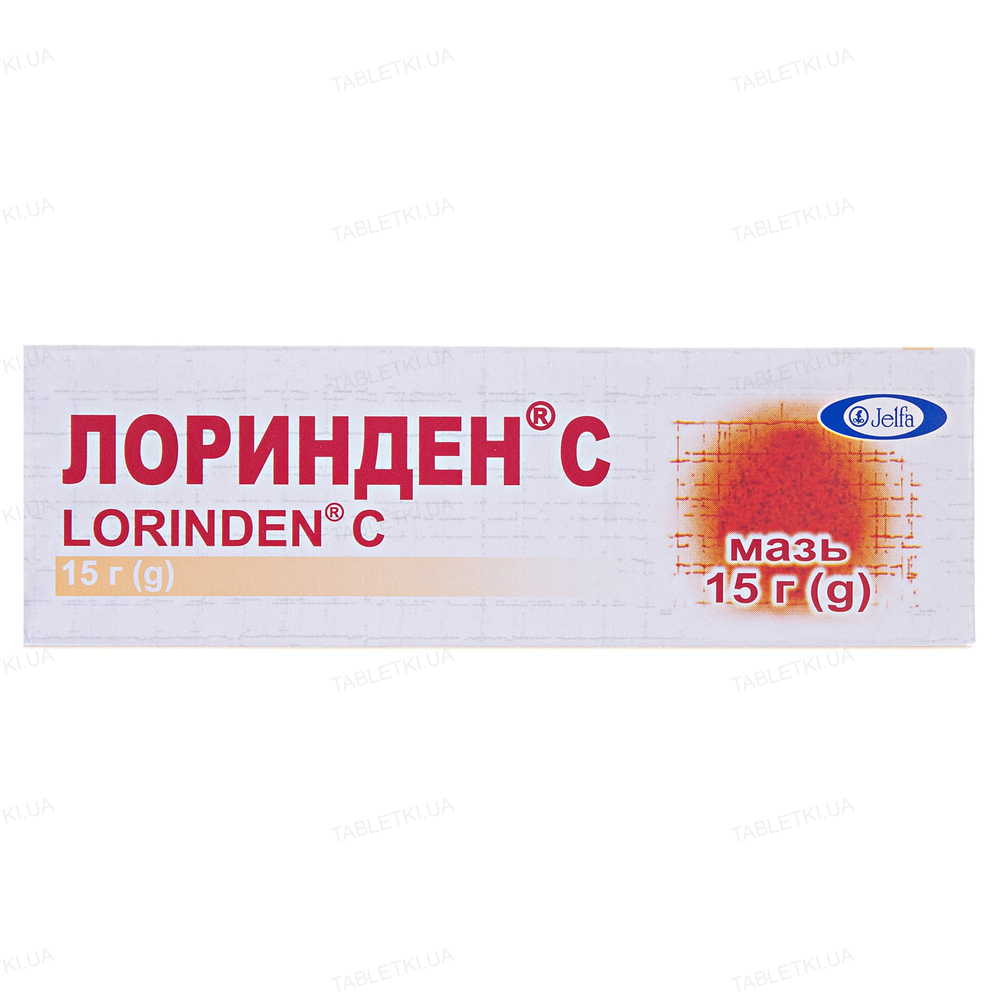

Laurinden C ointment, 15 g tubes
Composition
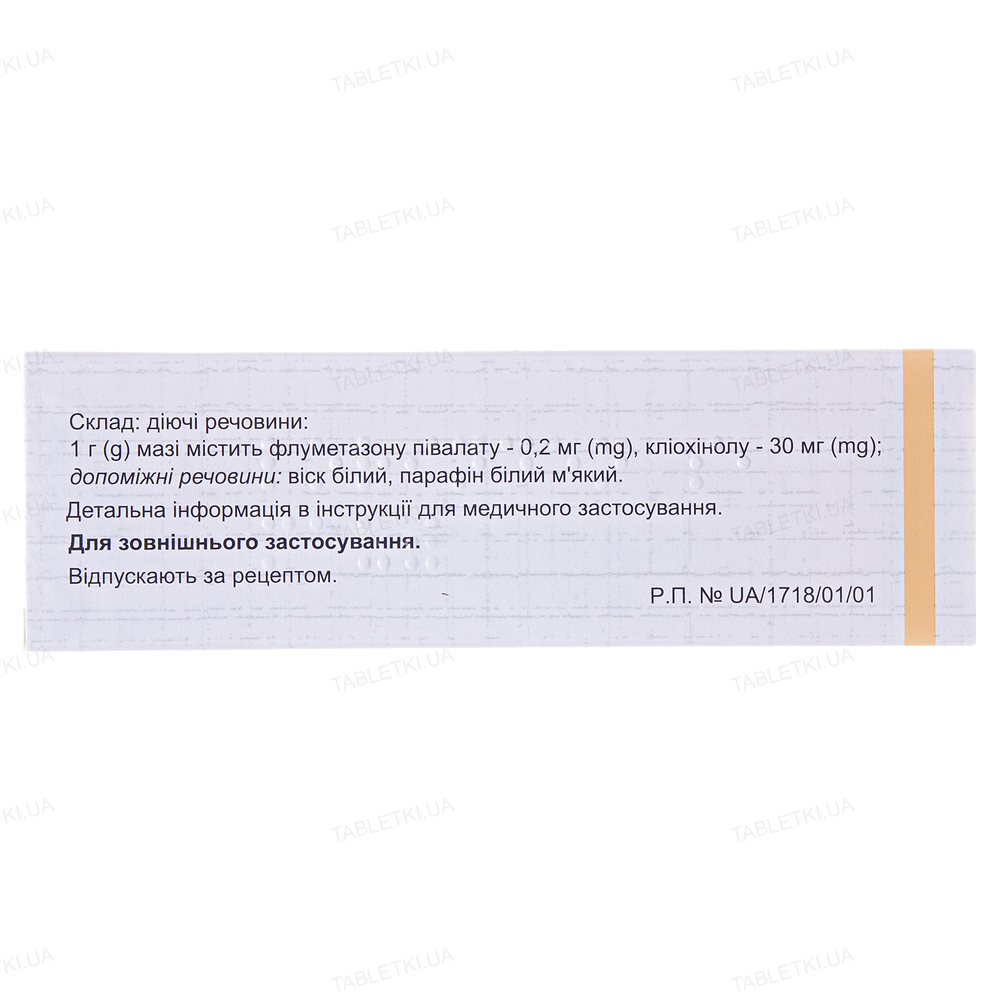
Active ingredients: flumethasone pivalate, clioquinol:
1 g of ointment contains 0.2 mg of flumethasone pivalate and 30 mg of clioquinol;
Excipients: white wax, white soft paraffin.
Dosage Form
Ointment.
Main physical and chemical properties: a white, greasy mass with a yellow or gray tint.
Pharmacotherapeutic group
Corticosteroids in combination with antiseptics for dermatological use. ATC code D07B B01.
Pharmacological properties
Pharmacodynamics.
The properties of Lorinden® C ointment are due to the combined action of flumethasone pivalate and clioquinol.
Flumethasone pivalate is a synthetic glucocorticosteroid with moderate anti-inflammatory activity. When applied as an ointment, it exerts a moderate local effect. It has lipophilic properties, easily penetrates the stratum corneum, and provides a prolonged anti-inflammatory, antipruritic, and antiallergic effect. When applied topically, flumethasone pivalate inhibits the formation of prostaglandins and leukotrienes in the skin by suppressing phospholipase A2 activity and reducing the release of arachidonic acid from phospholipidcell membranes. It inhibits phagocytosis and the release of interleukins and other cytokines that cause inflammatory processes. It inhibits the release of histamine and the occurrence of local allergic reactions, and attenuates proliferative processes. Due to its local vasoconstrictive effect, it reduces exudative reactions. It reduces protein synthesis and collagen deposition.
Clioquinol exerts antibacterial activity against Gram-positive and Gram-negative bacteria, as well as mild antifungal activity.
Pharmacokinetics.
Flumethasone pivalate easily penetrates the stratum corneum, where it accumulates. It is not metabolized in the skin. A small amount may penetrate the body upon topical application and, in such cases, exert a systemic effect. After penetrating the skin, the drug is metabolized primarily in the liver and excreted in the urine and, in small amounts, in the bile as glucuronide conjugates and in its unchanged form. The absorption of flumethasone pivalate increases when applied to delicate skin in skin folds or on the face, or to skin with a damaged epidermis or affected by inflammation. The use of an occlusive dressing, which increases skin temperature and humidity, also increases the absorption of flumethasone pivalate. In addition, absorption increases with frequent application of the medication or when applied to large areas of skin. Absorption through the skin is more intense in younger individuals than in older patients.
Clioquinol has a local effect and is practically not absorbed into the bloodstream.
Indications
For the topical treatment of skin lesions without exudation, complicated by bacterial infection, and accompanied by itching and hyperkeratosis: seborrheic dermatitis, atopic dermatitis, allergic contact dermatitis, erythema multiforme, lupus erythematosus, psoriasis, lichen planus.
Contraindications
Hypersensitivity to flumethasone pivalate, other corticosteroids, clioquinol, or any other components of the ointment.
Viral (e.g., chickenpox, herpes simplex), fungal, or bacterial (such as tuberculosis) skin infections, skin neoplasms, common acne and rosacea, perioral and diaper dermatitis, anal itching, vulvar itching, inflammation, or ulcers of varicose veins.
Do not apply to large areas of skin, especially if the skin is broken, such as in the case of burns.
Interactions with Other Medications and Other Types of Interactions
No interactions with other medications have been identified with the topical use of glucocorticosteroids.
During treatment, it is not recommended to receive the smallpox vaccine or undergo other types of immunization, especially with prolonged use on large areas of skin, given the possibility of an inadequate immune response.
“Lorinden® S” ointment may enhance the effects of immunosuppressive medications and inhibit the effects of immunostimulatory medications.
Special Instructions for Use
Do not use continuously for more than 2 weeks. With long-term use on large areas of skin, the frequency of side effects increases. Use of the medication should be discontinued immediately if it causes itching, dryness, or allergic skin reactions.
During topical application of flumethasone pivalate, pituitary secretion of adrenocorticotropic hormone (ACTH) may decrease due to suppression of the hypothalamic-pituitary-adrenal axis, blood cortisol levels may decrease, and iatrogenic Cushing’s syndrome may develop, which resolves after discontinuation of treatment. If an infection worsens at the application site, additional use of antibacterial or antifungal medications is necessary. If symptoms of infection persist, use of the medication should be discontinued.
Patients with narrow- or wide-angle glaucoma, as well as those with cataracts, should avoid applying the medication to the eyelids or the skin around the eyes, given the possibility of exacerbating the symptoms of the disease.
Vision disturbances may occur with the use of systemic and topical corticosteroids.
If symptoms such as blurred vision or other visual disturbances occur, consult an ophthalmologist to evaluate possible causes, which may include cataracts, glaucoma, or rare conditions such as central serous chorioretinopathy, which has been reported with the use of systemic and topical corticosteroids.
Avoid contact of the medication with the eyes and mucous membranes.
Use on the skin of the face, armpits, and groin area only when absolutely necessary, as increased absorption and the development of side effects (telangiectasia, perioral dermatitis) are possible, even after short-term use.
The use of the ointment under an occlusive dressing should be limited to exceptional situations due to the potential for atrophy and epidermal defects, as well as superinfection.
Use the medication with caution in patients with subcutaneous tissue atrophy, particularly in the elderly.
During treatment of chronic conditions, such as psoriasis or chronic eczema, the medication should not be abruptly discontinued. Use with caution in patients with psoriasis, as topical application of glucocorticosteroids in this case may lead to disease relapses caused by the development of tolerance, the spread of pustular psoriasis, and systemic toxicity resulting from skin dysfunction.
Use During Pregnancy and Breastfeeding.
Animal studies have confirmed that glucocorticosteroids have teratogenic effects when administered orally, even at low doses. Teratogenic effects have also been confirmed with topical application of glucocorticosteroids. No controlled studies have been conducted on the potential teratogenic effects of topical application of flumethasone pivalate in pregnant women.
Lorinden® C ointment may be used by pregnant women only for a short period of time, on small areas of skin, and only if, in the physician’s opinion, the benefit outweighs the potential risk of use. Use of the drug during the first trimester of pregnancy is contraindicated.
The extent to which flumethasone pivalate is excreted into breast milk following topical application is unknown. When glucocorticosteroids are taken orally, no significant amounts of these hormones—which could affect a newborn—have been detected in breast milk. However, it is recommended to use Lorinden® C ointment with caution in women who are breastfeeding. In isolated cases, the product may be used for a short period on small areas of skin. Do not apply Lorinden® C ointment to the skin of the breasts.
Effect on reaction time when operating motor vehicles or other machinery.
This medication does not impair mental or motor functions, nor does it affect the ability to operate vehicles or other machinery.
Directions for Use and Dosage
This medication is intended for topical use. Apply a thin layer of the ointment to the affected skin 1–2 times daily. Treatment should not be continued for more than 2 weeks. Do not apply to the facial skin for more than 1 week. It is recommended to use no more than 1 tube per week.
In cases of severe lichenification or excessive hyperkeratosis, an occlusive dressing may be used; it should be changed every 24 hours.
Children
Do not use this medication in children under 12 years of age. Use with caution in children 12 years of age and older. The ointment may be used in isolated cases on small areas of skin. Do not apply the medication to the face.
Children may absorb a proportionally larger amount of the topical corticosteroid and are therefore more susceptible to systemic side effects. This is because children have an underdeveloped skin barrier and a larger skin surface area relative to body weight compared to adults.
Overdose
With prolonged use on large areas of skin, symptoms of overdose may occur, manifested by an increase in side effects, including swelling, a burning sensation, irritation, itching, hypertension, hyperglycemia, increased susceptibility to infections, and, in severe cases, the development of Cushing’s syndrome. Treatment should be discontinued gradually and in a timely manner, or low-potency glucocorticosteroids should be administered. Treatment is symptomatic.
Side Effects
Skin and subcutaneous tissue disorders: acne, post-steroid purpura, inhibition of epidermal growth, subcutaneous tissue atrophy, dry skin, burning sensation, irritation, itching, excessive body hair growth or alopecia, skin depigmentation or hyperpigmentation, skin atrophy and disruption of skin integrity, telangiectasia, perioral dermatitis, inflammation of hair follicles, secondary infections. In rare cases, the following may occur: hives, maculopapular rash, or exacerbation of existing symptoms.
Ocular side effects: When applied topically to the eyelids, cataracts or glaucoma may occasionally develop.
Blurred vision may occur.
Other: Absorption of the active ingredient into the bloodstream may cause systemic side effects characteristic of flumethasone pivalate. These occur primarily with prolonged use of the medication, when applied to large areas of skin, under an occlusive dressing, or in children.
Systemic side effects of flumethasone pivalate, typical of corticosteroids, may occur, including dysfunction of the hypothalamic-pituitary-adrenal axis, Cushing’s syndrome, growth and developmental suppression in children, hyperglycemia, glucosuria, edema, hypertension, increased susceptibility to infections, and immunosuppression; possible neurotoxic effects with topical application of clioquinol, especially in cases of prolonged use or use under an occlusive dressing.
Hypersensitivity reactions may occur in individuals with an individual intolerance to any component of the drug.
Shelf life
3 years.
Storage Conditions
Store at a temperature not exceeding 25 °C. Keep out of the reach of children.
Packaging
15 g per tube; 1 tube per box.
Manufacturer
Yelfa Pharmaceutical Plant A.T.
Address
58-500 Jelenia Góra, 21 Wincenty Pola St., Poland.