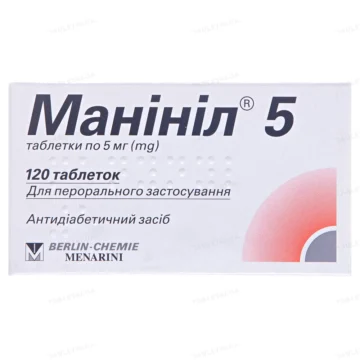
Maninil, 5 tablets, 5 mg each, No. 120 per bottle.
Ingredients
Active ingredient: glibenclamide;
1 tablet contains 5 mg of glibenclamide;
excipients: lactose monohydrate, potato starch, gelatin, magnesium stearate, talc, Ponceau 4R (E 124).
Dosage Form
Tablets.
Main physical and chemical properties: flat, parallel-sided, pink tablets with beveled edges and a score line on one side. The tablet can be divided into equal doses.
Pharmacotherapeutic group
Digestive system and metabolism. Medicinal products used in diabetes. Hypoglycemic agents, excluding insulins. Sulfonylureas. Glibenclamide. ATC code A10B B01.
Pharmacological Properties
Pharmacodynamics.
Mechanism of action
Maninil® 5 exerts a hypoglycemic effect due to increased insulin secretion by β-cells of the pancreatic islets, both in individuals with normal metabolism and in patients with non-insulin-dependent diabetes mellitus (type 2, NIDDM). This effect depends on the concentration of glucose in the environment surrounding the pancreatic islet β-cells.
At very high blood glucose concentrations, at which glucose-stimulated secretion is maximal, no additional release of insulin in large quantities is expected in response to glibenclamide administration. The clinical significance of this observation, made in healthy volunteers, for patients with diabetes mellitus taking glibenclamide has not been established.
Inhibition of glucagon release by pancreatic α-cells has been described, as well as extrapancreatic effects (insulin receptor replication, increased insulin sensitivity in peripheral tissues); however, their clinical significance has not been established.
Pharmacokinetics.
Absorption
Maninil® 5 is rapidly and almost completely absorbed after oral administration. Concomitant food intake does not significantly affect the absorption of glibenclamide.
Distribution
The plasma albumin binding of Maninil® 5 is greater than 98%.
Maximum serum concentration is reached after 2.5 hours and is 100 ng/mL. After 8–10 hours, the serum concentration decreases by 10–20 ng/mL, depending on the dose administered. The serum half-life following intravenous administration is approximately 2 hours, and 7 hours following oral administration. However, some studies indicate that in patients with diabetes mellitus, it may be prolonged to 8–10 hours.
Metabolism
Glibenclamide is completely metabolized in the liver. The major metabolite is 4-trans-hydroxyglibenclamide; the minor metabolite is 3-cis-hydroxyglibenclamide. The metabolites do not contribute significantly to the hypoglycemic effect of glibenclamide.
Excretion.
Metabolites are excreted in approximately equal amounts in urine and bile, with excretion complete within 45–72 hours.
In patients with impaired liver function, the elimination of the active substance from plasma is delayed.
In patients with renal insufficiency, depending on the degree of renal impairment, the excretion of metabolites in bile is compensatorily increased. In moderate renal insufficiency (creatinine clearance ≥ 30 mL/min), total elimination remains unchanged; in severe renal insufficiency, accumulation is possible.
Preclinical safety data.
There are no data from chronic toxicity studies that would suggest the possibility of previously unknown adverse reactions in humans.
Furthermore, in vitro studies revealed no evidence of mutagenic potential.
No regular long-term carcinogenicity studies have been conducted.
In studies conducted on rats, mice, and rabbits, there were no indications of teratogenic effects.
Indications
Non-insulin-dependent diabetes mellitus in adults (NIDDM, type 2), if other measures, such as strict adherence to a diabetic diet, weight loss, and adequate physical activity, have not led to satisfactory control of blood glucose levels.
Contraindications
- Hypersensitivity to the active ingredient, Ponso 4R, or to any of the excipients listed in the “Composition” section;
- hypersensitivity to other sulfonylurea drugs, sulfonamides, sulfonamide diuretics, and probenecid, as cross-reactions are possible;
- in the following cases of diabetes mellitus where insulin is required: type 1 insulin-dependent diabetes mellitus; complete secondary failure of glibenclamide therapy in type 2 diabetes mellitus; metabolic acidosis; diabetic precoma or coma; post-pancreatectomy;
- severe liver dysfunction;
- severe renal impairment;
- pregnancy and breastfeeding (see also the section “Use During Pregnancy or Breastfeeding”);
- Patients being treated with bosentan should not take Maninil® 5.
Interactions with Other Medications and Other Types of Interactions
Concomitant use of other medications may enhance or reduce the effects of Maninil® 5. Therefore, other medications should only be taken with the approval of the treating physician.
Glibenclamide is metabolized primarily by CYP 2C9 and, to a lesser extent, by CYP 3A4. This should be taken into account when glibenclamide is taken concomitantly with CYP 2C9 inducers or inhibitors.
Hypoglycemic reactions, as a manifestation of the drug’s enhanced effect, are possible when used concomitantly with: oral antidiabetic agents and insulin, ACE inhibitors, anabolic steroids, and male sex hormones; antidepressants (such as fluoxetine and MAO inhibitors); quinolone derivatives, chloramphenicol, clarithromycin, clofibrate and its analogs, coumarin derivatives, disopyramide, fenfluramine, miconazole, fluconazole, para-aminosalicylic acid, pentoxifylline (when administered parenterally in high doses), perhexiline, pyrazolone derivatives, probenecid, salicylates, sulfinpyrazone, sulfonamides, sympatholytics (such as β-adrenergic receptor blockers), tetracyclines, tritoqualine, and cytostatics such as cyclophosphamide.
The perception of warning signs of low blood glucose may be impaired when taking β-adrenergic receptor blockers, clonidine, guanethidine, and reserpine.
Hyperglycemic reactions, as a manifestation of reduced drug efficacy, are possible when used concomitantly with: acetazolamide, β-adrenergic receptor blockers, barbiturates, diazoxide, diuretics, glucagon, isoniazid, corticosteroids, laxatives (with chronic abuse; see the “Special Considerations for Use” section), nicotinates, phenothiazine derivatives, phenytoin, rifampicin, thyroid hormones, female sex hormones (progesterone, estrogens), and sympathomimetics.
H2-receptor antagonists, clonidine, and reserpine may cause either a reduction or an increase in the hypoglycemic effect in the blood.
In isolated cases, pentamidine may lead to severe hypoglycemia or hyperglycemia. The effects of coumarin derivatives may be enhanced or attenuated.
In patients taking glibenclamide concomitantly with bosentan, an increased incidence of elevated liver enzyme levels has been observed. Both glibenclamide and bosentan inhibit the bile acid transport protein, leading to intracellular accumulation of cytotoxic bile acids. Therefore, this combination should not be used (see the “Contraindications” section).
Glibenclamide may lead to increased plasma concentrations of cyclosporine and, consequently, likely to an increase in its toxicity. Therefore, when both substances are used concomitantly, it is recommended to monitor and adjust the cyclosporine dose.
Colesvelam binds to glibenclamide and thereby reduces its absorption from the gastrointestinal tract. Glibenclamide should be taken at least 4 hours before colesvelam, as no interaction has been observed under these conditions.
Other types of interactions. Acute or chronic alcohol consumption may unpredictably enhance or attenuate the hypoglycemic effect of Maninil® 5.
Special Considerations for Use
The patient should be informed that if other symptoms occur during treatment with Maninil® 5, they should immediately consult their treating physician, and if they change physicians, they should inform the new physician of their diabetes (for example, upon hospitalization, after an accident, or if they become ill while on vacation).
Hypoglycemia.
Patients should be made aware of the risk of hypoglycemia when taking medications that lower blood glucose levels.
Prolonged fasting, insufficient carbohydrate intake, unusual physical exertion, diarrhea, or vomiting are circumstances that indicate a high risk of low blood glucose (see the “Adverse Reactions” section).
In patients with severe signs of cerebral sclerosis and in patients who do not follow their doctor’s recommendations, the risk of hypoglycemia is generally higher.
Medications that affect the central nervous system, beta-adrenergic receptor blockers, and autonomic neuropathies may mask the warning signs of hypoglycemia.
Despite initial success in treating hypoglycemia, recurrence is possible. Therefore, patients should remain under medical supervision. Severe hypoglycemia or prolonged episodes that can only be controlled for a short time with normal amounts of sugar require immediate treatment (see the “Overdose” section).
Hyperglycemia.
If the treatment regimen is not followed, if the hypoglycemic effect of Maninil® 5 is insufficient, or in particularly stressful situations, blood glucose levels may rise.
Symptoms of hyperglycemia may include intense thirst, dry mouth, frequent urination, itchy and/or dry skin, fungal or infectious skin diseases, and reduced performance.
In extreme stressful situations (for example, in cases of trauma, surgery, or infectious diseases accompanied by a fever), metabolism may be impaired, which can result in hyperglycemia and may require temporary treatment with insulin.
Laxatives.
Chronic abuse of laxatives can lead to impaired metabolism.
Alcohol.
Acute or chronic alcohol abuse may unpredictably enhance or weaken the hypoglycemic effect of Maninil® 5.
Liver and kidney dysfunction and endocrine disorders.
Patients with impaired liver or kidney function or reduced function of the thyroid gland, pituitary gland, or adrenal cortex should use this medication with extreme caution.
Glucose-6-phosphate dehydrogenase deficiency (G6PD deficiency).
In patients with glucose-6-phosphate dehydrogenase deficiency (G6PD deficiency), treatment with sulfonylurea drugs may cause hemolytic anemia. Since glibenclamide belongs to the sulfonylurea class of drugs, patients with G6PD deficiency should use it only with caution and consider switching to alternatives to sulfonylurea derivatives.
Elderly patients.
Age 65 years and older has been identified as a risk factor for hypoglycemia in patients receiving sulfonylurea therapy. It may be difficult to recognize hypoglycemia in elderly patients. The initial and maintenance doses of glibenclamide should be carefully adjusted to reduce the risk of hypoglycemia (see the “Dosage and Administration” section). For patients in this age group, sulfonylurea drugs with a shorter duration of action should be preferred.
Maninil® 5 contains lactose.
If you have been diagnosed with an intolerance to certain sugars, consult your doctor before taking this medication.
Patients with rare hereditary galactose intolerance, lactase deficiency, or glucose-galactose malabsorption should not take this medication.
Use During Pregnancy or Breastfeeding
Pregnancy.
Maninil® 5 is contraindicated during pregnancy. Since oral antidiabetic medications do not regulate blood glucose levels as reliably as insulin, they are completely unsuitable for treating diabetes during pregnancy.
Insulin therapy is the treatment of choice for diabetes during pregnancy. If possible, oral antidiabetic medications should be discontinued and replaced with insulin before a planned pregnancy.
Breastfeeding.
Since it is unknown whether Maninil® 5 passes into breast milk, it is contraindicated during breastfeeding.
Breastfeeding patients should be treated with insulin to control diabetes or should discontinue breastfeeding.
Fertility.
There are no data on the effect of the active ingredient glibenclamide on human fertility.
Effect on reaction time when driving or operating machinery.
During episodes of hypo- or hyperglycemia, alertness and reaction time may be impaired, especially at the start of or following a change in treatment, or if glibenclamide is taken irregularly. In situations where these abilities are particularly important (e.g., driving or operating machinery), this may pose a risk. Therefore, patients should be advised to take precautions to avoid hypoglycemia while operating vehicles. This is particularly important for patients with frequent episodes of hypoglycemia or a reduced or absent ability to recognize the warning signs of hypoglycemia. In such cases, the appropriateness of driving should be reconsidered.
Directions for Use and Dosage
Dosage.
Dose adjustments for Maninil® 5 should be made only by a physician in conjunction with dietary adjustments. Dosage depends on the results of the patient’s metabolic testing (blood and urine glucose levels).
It is recommended to start therapy with the lowest possible dose. This applies primarily to patients with a particular predisposition to hypoglycemia or a body weight of less than 50 kg. It is important to note that the glibenclamide in Maninil® 5 is in a non-micronized form. Therefore, the recommended doses of Maninil® 5 differ from those of medications in which glibenclamide is present in micronized form.
Initiation of treatment.
The dosage should be increased gradually, starting with the lowest possible dose:
- ½ (up to 1) Maninil® 5 tablet (corresponding to 2.5–5 mg of glibenclamide) per day.
If metabolic status remains unsatisfactory, the dose should be increased gradually, at intervals ranging from several days to approximately one week, until the therapeutically necessary daily dose is reached, which is:
- a maximum of 3 Maninil® 5 tablets (equivalent to 15 mg of glibenclamide) per day.
Switching from other medications used to lower blood glucose levels.
Switching from another oral antidiabetic medication to Maninil® 5 should be done with caution and started with:
- ½ (up to 1) Maninil® 5 tablet (equivalent to 2.5–5 mg of glibenclamide) per day.
Dose adjustment.
For elderly, debilitated, or malnourished patients, as well as those with impaired renal or hepatic function, the initial and maintenance doses should be reduced due to the risk of hypoglycemia. In addition, dose adjustment should be considered in the event of changes in the patient’s body weight or lifestyle.
Combination with Other Antidiabetic Medications.
In justified cases, patients with metformin intolerance may be prescribed thiazolidinediones (e.g., pioglitazone) as an adjunct.
Maninil® 5 may also be combined with oral antidiabetic agents that do not stimulate insulin release (guar gum or acarbose).
At the onset of secondary failure of glibenclamide therapy, combination therapy with insulin may be attempted. In cases of complete cessation of endogenous insulin secretion, insulin monotherapy is indicated.
Elderly patients.
Patients aged 65 years and older: The initial and maintenance doses of glibenclamide should be carefully adjusted to reduce the risk of hypoglycemia. Treatment should be initiated at the lowest possible dose and gradually increased as needed (see the “Special Considerations for Use” section).
Directions for Use.
Tablets should be taken before meals, swallowed whole, and washed down with a sufficient amount of liquid (preferably a glass of water).
If the daily dose exceeds 2 Maninil® 5 tablets, it is recommended to divide the total amount into morning and evening doses in a 2:1 ratio.
It is important to take the medication at the same time each day. Missed doses—for example, if the patient forgets to take the tablets—should never be compensated for by taking a larger number of tablets.
The duration of treatment depends on the course of the disease. Metabolic status should be monitored at the recommended regular intervals.
In particular, blood and urine glucose levels must be checked regularly; it is also recommended to monitor HbA1c and/or fructosamine levels, as well as other parameters (such as blood lipid levels).
Children
The safety and efficacy of Maninil® 5 in children have not been established. Therefore, this medication should not be used to treat children.
Overdose
Acute, severe overdose with Maninil® 5—such as the use of slightly elevated doses over a prolonged period—can lead to severe, prolonged hypoglycemia, which is life-threatening. Once an overdose is confirmed, close monitoring is required until it is determined that the patient is no longer at risk. It is important to note that hypoglycemia and its clinical manifestations may recur after the patient’s temporary recovery. Significant overdose and severe reactions, such as loss of consciousness and other serious neurological disorders, should be considered medical emergencies requiring immediate treatment and hospitalization.
Symptoms of overdose.
In cases of intentional overdose, there is a risk of prolonged hypoglycemia, which tends to recur after several days of successful initial treatment. In patients with impaired consciousness, a hypoglycemic coma may develop rapidly, manifested by loss of consciousness, tachycardia, clammy skin, hyperthermia, motor agitation, hyperreflexia, paresis with a positive Babinski sign.
Therapeutic measures in case of overdose.
See the “Adverse Reactions” section for treatment of mild hypoglycemia.
In cases of accidental poisoning and when treating more vulnerable patients who are not prone to seizures, in addition to intravenous administration of glucose, vomiting should first be induced or gastric lavage performed.
For patients who are unconscious, intravenous glucose administration should be initiated immediately (40–80 mL of a 40% glucose solution as an injection, followed by an infusion of a 5–10% glucose solution).
Afterward, 1 mg of glucagon may be administered intramuscularly or intravenously. If the patient does not regain consciousness after this, the procedure may be repeated, and intensive care may subsequently be required.
Particularly in children who have accidentally ingested Maninil® 5, the glucose solution must be administered with caution to avoid dangerous hyperglycemia; close monitoring of blood glucose levels is required thereafter.
Patients who have ingested Maninil® 5 in life-threatening quantities require detoxification through gastric lavage and administration of activated charcoal, provided the medication was ingested recently.
In cases of prolonged hypoglycemia, the patient must be monitored for several days with regular monitoring of blood glucose levels and infusion therapy as needed.
Side Effects
Adverse reactions were classified by frequency:
Very common (≥ 1/10)
Common (≥ 1/100, < 1/10)
Uncommon (≥ 1/1,000, < 1/100)
Rare (≥ 1/10,000, < 1/1,000)
Very rare (< 1/10,000)
Frequency unknown (cannot be estimated from the available data).
Hypoglycemia.
Hypoglycemia is the most common adverse reaction associated with glibenclamide therapy.
It may become chronic during glibenclamide therapy and lead to severe hypoglycemia with coma, which is life-threatening. In cases of very masked hypoglycemia, autonomic neuropathy, or concomitant therapy with sympatholytic agents (see the section “Interactions with Other Medications and Other Types of Interactions”), the typical warning signs of hypoglycemia may be attenuated or absent. The clinical presentation of a severe hypoglycemic episode may resemble a stroke.
Possible causes of hypoglycemia are described in the “Special Considerations for Use” section.
Hypoglycemia is defined as a drop in blood glucose levels below approximately 50 mg/dL. For the patient or those around them, the following warning signs may indicate an excessive drop in blood glucose levels: sudden sweating, rapid heartbeat, tremors, hunger, anxiety, a tingling sensation in the mouth, pale skin, headache, drowsiness, sleep disturbances, anxiety, unsteadiness, and reversible neurological symptoms (such as speech and vision disturbances, signs of paralysis, or sensory disturbances).
If hypoglycemia progresses, the patient may lose self-control and consciousness. Such patients usually have cold, clammy skin and are prone to seizures.
People with diabetes can manage mild hypoglycemia by consuming sugar or foods and beverages high in sugar. Therefore, they should always carry 20 grams of glucose with them.
If hypoglycemia cannot be corrected immediately, a doctor must be called right away.
Other side effects.
Disorders of the blood and lymphatic system.
Rare: thrombocytopenia.
Very rare: leukopenia, erythrocytopenia, granulocytopenia up to the development of agranulocytosis, pancytopenia, hemolytic anemia.
These changes in blood counts are usually reversible after discontinuation of the drug, but may very rarely be life-threatening.
Immune system disorders.
Very rare: cross-allergy with sulfonamides, sulfonamide derivatives, and probenecid is possible.
Metabolic and nutritional disorders.
Common: weight gain.
Very rare: hyponatremia, disulfiram-like reaction.
Eye disorders.
Very rare: due to changes in blood glucose levels, transient visual disturbances and accommodation problems may occur, especially at the start of treatment.
Gastrointestinal disorders.
Uncommon: nausea, feeling of fullness/bloating, vomiting, abdominal pain, diarrhea, belching, metallic taste.
These symptoms are often transient and generally do not require discontinuation of the medication.
Liver and gallbladder disorders.
Very rare: transient elevations in AST, ALT, and alkaline phosphatase; drug-induced hepatitis; intrahepatic cholestasis, possibly caused by a hypersensitivity-type allergic reaction in liver tissue.
Such liver function abnormalities are reversible after discontinuation of Maninil® 5, but may also lead to life-threatening liver failure.
Skin and subcutaneous tissue disorders.
Uncommon: pruritus, urticaria, erythema nodosum, erythema nodosum or maculopapular rash, increased photosensitivity, purpura.
These symptoms are hypersensitivity reactions that are reversible, but very rarely they may progress to life-threatening conditions accompanied by shortness of breath and a drop in blood pressure, potentially leading to shock.
Very rare: life-threatening allergic vasculitis; generalized hypersensitivity reactions, including skin rash, arthralgia, fever, proteinuria, and jaundice.
Report any skin reactions to your doctor immediately.
Renal and urinary system disorders.
Very rare: mild diuretic effect, reversible proteinuria.
Other adverse reactions.
Unknown: Pons 4R may cause allergic reactions.
Reporting of suspected adverse reactions.
Reporting suspected adverse reactions after a drug’s approval plays an important role. This allows for continued monitoring of the benefit-risk profile of the drug. Healthcare professionals are asked to report any suspected adverse reactions through the national reporting system.
Shelf life
3 years.
Do not use this medication after the expiration date printed on the package.
Storage Conditions
Store at a temperature not exceeding 25 °C. Store in the original packaging in a place protected from light and moisture!
Packaging
120 tablets per bottle; 1 bottle per cardboard box.
Manufacturer
BERLIN-CHEMIE AG.
Manufacturer’s location and business address.
Glinicker Weg 125, 12489 Berlin, Germany.
Applicant
BERLIN-CHEMI AG.
Location of the applicant.
Gliniker Weg 125, 12489 Berlin, Germany