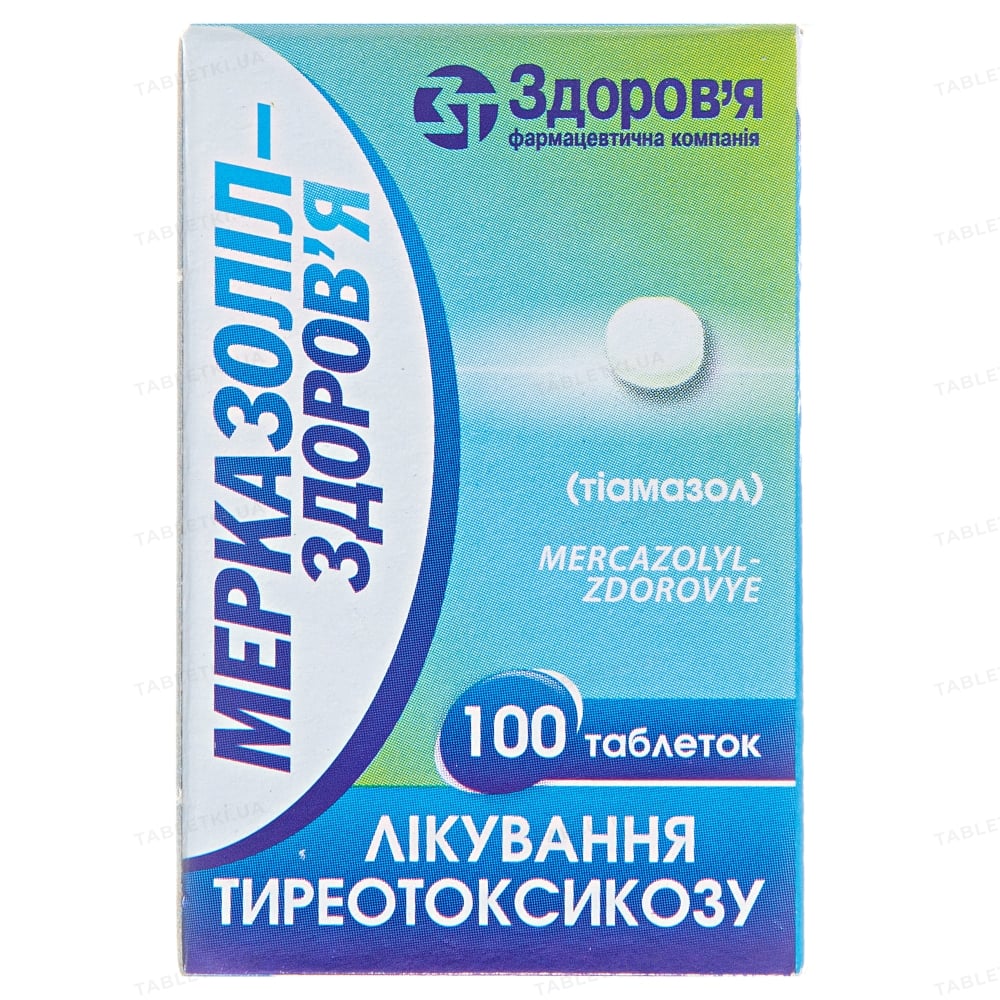
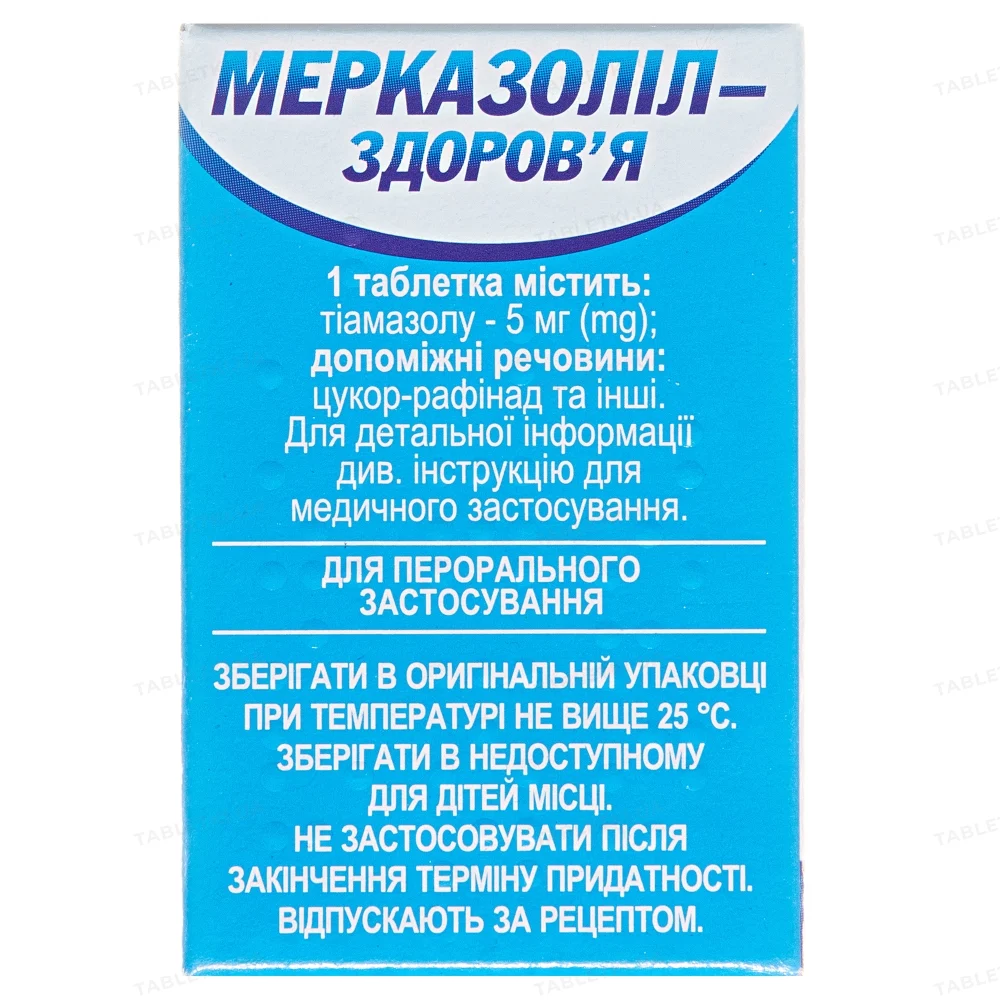
Mercazolil-Zdorovye 5 mg tablets, No. 100, in a container.
Ingredients
Active ingredient: thiamazole;
1 tablet contains 5 mg of thiamazole;
inactive ingredients: potato starch, calcium stearate, refined sugar, talc.
Dosage Form
Tablets.
Main physical and chemical properties: white or white with a yellowish tint tablets, with a flat surface and a beveled edge.
Pharmacotherapeutic group
Antithyroid agents. ATC code H03B B02.
Pharmacological properties
Pharmacodynamics.
Antithyroid agent. The mechanism of its thyrostatic action is due to the inhibition of the enzyme peroxidase, which is involved in the iodination of thyroid hormones by the thyroid gland, leading to impaired synthesis of thyroxine and triiodothyronine. This property allows for the symptomatic treatment of thyrotoxicosis regardless of its etiology. Thiamazole does not affect the secretion of previously synthesized thyroid hormones, which explains the duration of the latent period before serum thyroxine and triiodothyronine concentrations normalize, thereby improving the clinical picture of the disease. It has no effect on thyrotoxicosis that has developed as a result of hormone release following the destruction of thyroid cells (after treatment with radioactive iodine or in cases of thyroiditis).
Pharmacokinetics.
After oral administration, thiamazole is rapidly and completely absorbed from the gastrointestinal tract. Cmax in plasma is reached within 40–80 minutes. It binds to plasma proteins to a negligible extent. Thiamazole accumulates in the thyroid gland and is metabolized very slowly; consequently, a concentration plateau forms on the kinetic curve, which persists for 24 hours after administration of a single dose of the drug. Metabolic kinetics are independent of thyroid function. The half-life (T½) is 3 hours; it is longer in patients with hepatic insufficiency. It is excreted in urine and bile, and to a minor extent, in feces. It is excreted in urine as metabolites (70% within 24 hours) and as the unchanged drug.
Indications
Treatment of thyrotoxicosis.
- Conservative treatment of thyrotoxicosis, especially in cases with no goiter or a small goiter.
- Preparation for surgical treatment of all forms of thyrotoxicosis.
- Preparation for treatment of thyrotoxicosis with radioactive iodine.
- Therapy during the latent phase of radioactive iodine treatment.
- Prevention of thyrotoxicosis when prescribing iodine-containing medications in cases of latent thyrotoxicosis, autonomous adenomas, or a history of thyrotoxicosis.
Contraindications
- Hypersensitivity to any component of the drug or other thionamide derivatives;
- moderate to severe abnormalities in blood cell counts (granulocytopenia);
- cholestasis prior to the start of treatment, not caused by thyrotoxicosis;
- bone marrow damage resulting from previous therapy with thiamazole or carbimazole;
- a history of acute pancreatitis following the use of thiamazole or carbimazole.
Concomitant therapy with thiamazole and thyroid hormones during pregnancy is contraindicated (see the section “Use During Pregnancy or Breastfeeding”).
Interactions with Other Medications and Other Types of Interactions
Iodine deficiency increases the thyroid gland’s sensitivity to thiamazole, while an excess of iodine decreases it. No other direct interactions with other medications are known. It should be noted that the metabolism and excretion of other medications may be increased in hyperthyroidism. These parameters return to normal as thyroid function is restored. If necessary, the dosage of the medication should be adjusted.
In addition, correction of hyperthyroidism may normalize the increased activity of anticoagulants in patients with hyperthyroidism.
No drug interaction studies have been conducted in children.
Special Considerations for Use
This medication is not recommended for patients with a history of moderate hypersensitivity reactions (allergic rashes, itching).
Patients with very large goiters and tracheal stenosis should use this medication with caution: for as short a period as possible and under close medical supervision due to the risk of goiter enlargement.
Myelotoxicity.
Agranulocytosis has been reported in 0.3–0.6% of cases. Before starting treatment, special attention should be paid to symptoms of agranulocytosis (stomatitis, pharyngitis, high body temperature). Symptoms usually occur at the start of treatment, but they may also appear several months later or during a repeat course of treatment. It is recommended to monitor blood counts before and after the start of therapy, especially in patients with moderate granulocytopenia. If any of the above symptoms develop, especially during the first few weeks of treatment, consult a doctor immediately for a blood test. If agranulocytosis is confirmed, further treatment with this medication must be discontinued.
When the drug is used at the recommended doses, adverse reactions caused by bone marrow toxicity have occurred rarely. Such reactions have frequently been reported when very high doses of thiamazole (approximately 120 mg per day) were administered. Such doses are prescribed for specific indications (severe forms of the disease, thyrotoxic crisis). If symptoms of bone marrow toxicity appear during treatment with thiamazole, further use of the drug must be discontinued and, if necessary, treatment should be switched to an antithyroid drug from another class.
Acute pancreatitis.
There are reports of acute pancreatitis in patients taking thiamazole or carbimazole. If acute pancreatitis occurs, thiamazole therapy must be discontinued immediately. Thiamazole should not be prescribed to patients who have previously developed acute pancreatitis after taking thiamazole or carbimazole. Repeated use of these medications may cause a recurrence of acute pancreatitis, with a shorter time to onset of the attack.
Women of childbearing age and pregnant women.
Women of childbearing age are advised to use effective methods of contraception during thiamazole therapy. Thiamazole should be prescribed to pregnant women only after a careful benefit-risk assessment and only at the lowest effective doses without additional administration of thyroid hormones. If prescribed during pregnancy, the condition of the woman, the fetus, and the newborn should be closely monitored (see the section “Use During Pregnancy or Breastfeeding”).
Management of Hyperthyroidism.
An excess of the drug in the body following very high doses may lead to the development of subclinical or clinical hypothyroidism or goiter enlargement due to increased secretion of thyroid-stimulating hormone. Therefore, the dose of the drug should be reduced immediately after the thyroid gland returns to normal function; if necessary, levothyroxine should be prescribed. It is not recommended to discontinue treatment with this drug entirely and use only levothyroxine.
Enlargement of the goiter during thiamazole therapy, despite suppression of thyroid-stimulating hormone secretion, results from the underlying disease itself and cannot be prevented by additional levothyroxine administration.
Maintaining normal levels of thyroid-stimulating hormone secretion is important for minimizing the risk of the onset or worsening of endocrine ophthalmopathy. However, this condition is often independent of the course of thyroid disease. Such complications are not a reason to change the treatment regimen and do not constitute an adverse reaction when the course of treatment is properly administered.
In rare cases, late-onset hypothyroidism has been observed following a course of antithyroid therapy without surgical intervention. This is not an adverse reaction to the medication but rather the result of inflammatory and destructive processes in the thyroid parenchyma caused by the underlying disease.
Due to a reduction in the pathologically elevated energy expenditure associated with hyperthyroidism, body weight may increase during treatment with thiamazole. An improvement in the clinical picture indicates that energy metabolism has normalized.
This medication contains refined sugar. If a patient has been diagnosed with an intolerance to certain sugars, they should consult a doctor before taking this medication.
Use during pregnancy or breastfeeding.
Women of childbearing age.
Women of childbearing age should use effective methods of contraception during treatment.
Pregnancy.
Adequate treatment of hyperthyroidism in pregnant women is necessary to prevent serious complications in both the mother and the fetus. Thiamazole crosses the placental barrier.
There are data from clinical studies, as well as isolated reports, of congenital anomalies following the use of thiamazole in high doses during the first trimester of pregnancy. In particular, cases have been reported of congenital skin aplasia (the defect healed spontaneously after several weeks), maxillofacial malformations (choanal atresia, facial dysmorphism), exomphalos, esophageal atresia, omphalomesenteric duct anomaly, and interventricular septal defect.
Thiamazole may be prescribed during pregnancy only after a careful assessment of the benefit-risk ratio and at the lowest effective dose without the additional administration of thyroid hormones. If thiamazole is used during pregnancy, close medical monitoring of the mother, fetus, and newborn is required.
Breastfeeding.
Thiamazole passes into breast milk, where its concentration reaches the level found in the mother’s blood serum, which poses a risk of hypothyroidism in the infant.
During breastfeeding, the drug should be prescribed in the minimum effective doses, not exceeding 10 mg per day, without additional hormone therapy.
Thyroid function in newborns should be monitored regularly.
Effect on reaction time when driving or operating machinery.
This medication does not affect the ability to drive or operate machinery.
Dosage and Administration
Thiamazole is an active metabolite of carbimazole; however, 1 mg of thiamazole is not equivalent to 1 mg of carbimazole. This must be taken into account at the start of treatment with thiamazole or when switching from carbimazole to thiamazole. The dosage recommendations provided should be followed.
Administer the daily dose as a single dose or divide it into several doses throughout the day. At the start of treatment, single doses should be taken at regular intervals throughout the day. The maintenance dose should be taken as a single dose, either during or after breakfast.
Swallow the tablets whole with sufficient liquid.
If a dose is missed, do not increase the dose at the next administration.
General Dosage Recommendations.
Adults.
Depending on the severity of the condition and iodine intake, the recommended dose for adults is 10–40 mg per day. In many cases, suppression of thyroid hormone production is achieved with a daily dose of 20–30 mg. In cases of mild disease, prescribe the drug at a lower dosage; in cases of severe disease, the initial dose should be 40 mg per day.
Dose adjustments should be made on an individual basis, taking into account the activity of metabolic processes determined by the level of thyroid hormone production.
The following dosages are recommended for maintenance therapy:
– a maintenance dose of 5–20 mg per day in combination with levothyroxine, for the prevention of hypothyroidism;
– for monotherapy, 2.5–10 mg of the drug per day.
In cases of thyrotoxicosis caused by elevated iodine levels, higher doses of the drug may be used.
Conservative treatment of thyrotoxicosis.
The goal of therapy is to achieve a euthyroid state of the gland and long-term remission after a limited duration of treatment. According to studies, remission can be achieved in up to 50% of patients one year after therapy. It has been found that the time to achieve remission varies significantly depending on baseline parameters. Significant influencing factors include the type of hyperthyroidism (immunogenic or non-immunogenic), the duration of treatment, the thiamazole dosage, and the source of iodine intake: dietary or iatrogenic.
The duration of therapy with this drug ranges from 6 months to 2 years (on average, 1 year). The possibility of prolonging the remission period depends on the duration of therapy. In cases where remission cannot be achieved and other therapeutic measures are not feasible, the drug may be used for long-term therapy at the lowest effective doses, either alone or in combination with a low dose of levothyroxine.
In patients with tracheal stenosis and very large goiters, the drug should be used for a short period. Long-term therapy may lead to goiter enlargement.
Preparation for surgical treatment in all forms of thyrotoxicosis.
Short-term preparatory therapy (for 3–4 weeks; in some cases, the drug may be used for a longer period) helps restore a euthyroid state, thereby reducing the risks associated with surgical intervention.
Surgery is performed immediately after euthyroid status is achieved. If surgery is not performed, levothyroxine must be administered. Treatment with the drug may be discontinued one day before surgery.
During the 10 days leading up to surgery, the surgeon may additionally prescribe high-dose iodine preparations to strengthen thyroid tissue (Plummer’s iodine therapy).
Preparation for radioactive iodine therapy.
The medication should be used to achieve a euthyroid state before starting therapy with radioactive iodine. Preliminary therapy with this medication is especially necessary for patients with severe thyrotoxicosis, as there have been isolated cases of thyrotoxic crisis following iodine treatment without prior therapy with thiamazole.
It should be noted that thiourea derivatives may reduce the sensitivity of thyroid tissue to radiation therapy. When conducting planned therapy with radioactive iodine for autonomous adenomas, preliminary therapy with this drug is necessary to prevent activation of paranodular tissue.
Treatment during the latent period of radioactive iodine action.
The duration and dose of the medication are selected on an individual basis depending on the severity of the disease, as well as taking into account the period before the onset of radioactive iodine action (approximately 4–6 months).
Prophylactic treatment of patients at risk of developing hyperthyroidism when iodine-containing drugs are prescribed for diagnostic purposes.
The usual recommended dose is 10–20 mg of thiamazole per day and/or 1 g of perchlorate daily for 10 days (for example, when it is necessary to administer a radiopaque agent that is excreted by the kidneys). The duration of prophylactic treatment is determined based on the length of time the iodine-containing drugs remain in the body.
Special Patient Populations.
Patients with impaired liver function.
In patients with impaired liver function, the rate of thiamazole elimination is reduced. Therefore, the drug should be administered at the minimum effective dose, and the patient’s condition should be monitored throughout the course of therapy.
Patients with renal impairment.
Individual dose adjustment and continuous monitoring are recommended for patients with renal insufficiency, as there is insufficient data on the pharmacokinetic properties of the drug in this patient group.
Elderly patients.
Individual dose adjustment and continuous monitoring are recommended for elderly patients; there are no data on drug accumulation in the body. The drug should be used at the minimum effective doses.
Children.
Children and adolescents (3–17 years)
The initial dose for treating children and adolescents (3–17 years) is calculated based on the patient’s body weight.
Typically, treatment begins with 0.5 mg/kg, divided into two or three equal doses per day.
The maintenance dose may be reduced depending on the patient’s individual response to therapy and administered once daily. To avoid hypothyroidism, supplemental levothyroxine may be required. The total daily dose should not exceed 40 mg of thiamazole.
Children under 2 years of age.
The safety and efficacy of thiamazole in children under 2 years of age have not been studied.
The use of thiamazole in children under 2 years of age is not recommended.
Overdose
Overdose may lead to the development of hypothyroidism with corresponding symptoms of a slowed metabolism and, as a result of hormone deficiency, to activation of the anterior pituitary gland with subsequent enlargement of the goiter.
This can be avoided by reducing the dose of the drug until a euthyroid state is achieved. If necessary, levothyroxine preparations should be prescribed additionally. The adverse effects of accidental ingestion of high doses of thiamazole are unknown.
Side Effects
Adverse effects are classified by frequency of occurrence into the following categories: very common (> 1/10), common (> 1/100, < 1/10), uncommon (> 1/1,000, < 1/100), rare (> 1/10,000, < 1/1,000), very rare (1/10,000), frequency unknown (cannot be estimated from the available data).
Blood and lymphatic system disorders: uncommon: agranulocytosis (occurs in approximately 0.3–0.6% of cases; may manifest several weeks or months after the start of treatment, requiring discontinuation of the drug, after which, in most cases, the condition resolves spontaneously); very rare: thrombocytopenia, pancytopenia, generalized lymphadenopathy.
Endocrine system: very rare: insulin-dependent autoimmune syndrome with a sharp decrease in blood glucose levels.
Nervous system disorders: rare: taste disturbances (dysgeusia, ageusia), which resolve after discontinuation of the drug (sometimes taste sensation returns several weeks after the end of treatment); very rare: neuritis, polyneuropathy.
Gastrointestinal system: very rare: acute inflammation of the salivary glands; frequency unknown: acute pancreatitis.
Hepatobiliary system: very rare: cholestatic jaundice or toxic hepatitis. Symptoms usually resolve after discontinuation of the drug. Subclinical symptoms of bile stasis during treatment should be distinguished from dysfunctions caused by hyperthyroidism, such as elevated levels of γ-glutamyltransferase and alkaline phosphatase levels, or elevated levels of the specific bone isoenzyme of alkaline phosphatase.
Skin and subcutaneous tissue disorders: very common: allergic skin reactions of varying severity (itching, rash, hives), usually of moderate severity, which resolve with continued therapy; very rare: severe forms of allergic skin reactions, including generalized dermatitis, alopecia, and drug-induced lupus erythematosus.
Musculoskeletal and connective tissue disorders: common: arthralgia, which develops gradually and may occur even several months into therapy.
General disorders: rare: drug fever.
Children. The frequency, type, and severity of adverse reactions in children are expected to be similar to those observed in adult patients.
Very rare cases of serious hypersensitivity skin reactions, such as generalized dermatitis, including Stevens-Johnson syndrome, have been reported in adult patients and children.
Shelf life
5 years.
Storage conditions
Store in the original packaging at a temperature not exceeding 25 °C.
Keep out of reach of children.
Packaging
Tablets No. 50 and No. 100 in a container inside a box; No. 50 (10×5) and No. 100 (10×10) in blister packs.
Manufacturer
Limited Liability Company “Pharmaceutical Company ‘Zdorov’ya’”.
Address
Ukraine, 61013, Kharkiv Oblast, city of Kharkiv, Shevchenko Street, Building 22.