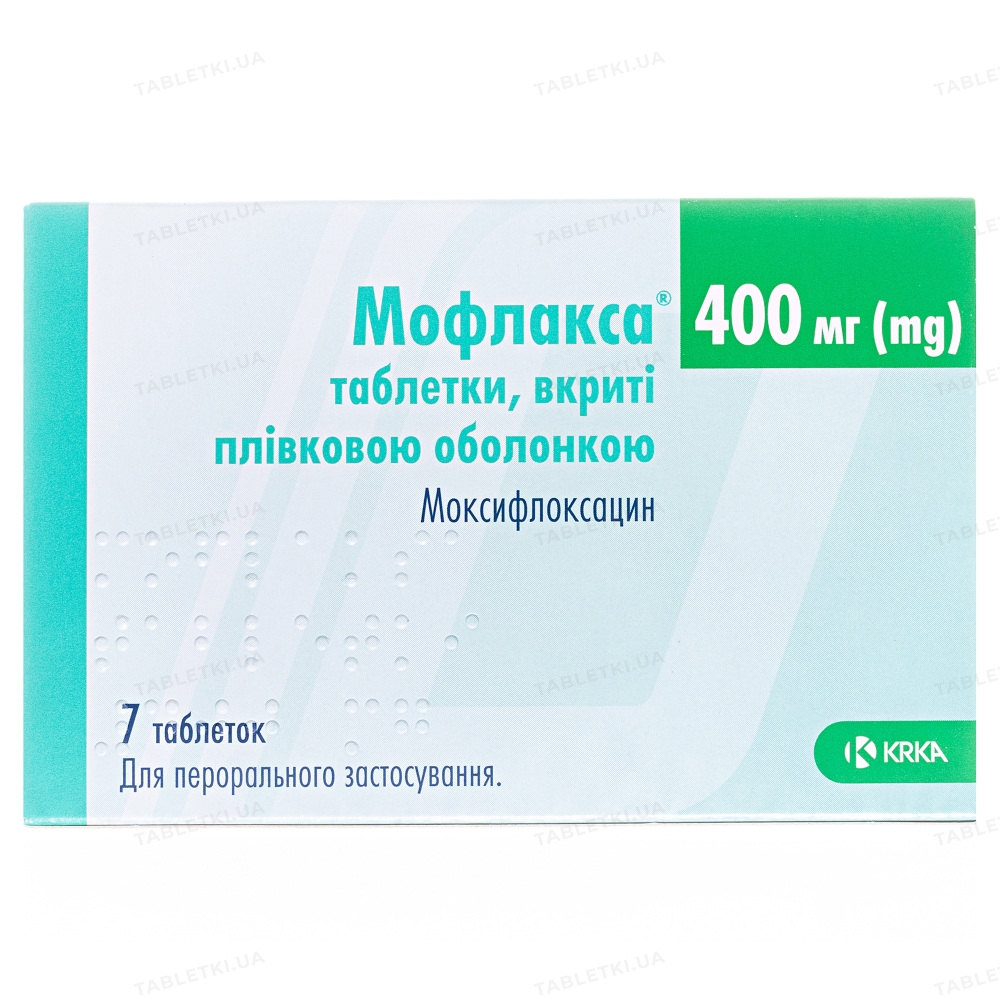
Moflaxa tablets, film-coated, 400 mg, No. 7
Active ingredient: moxifloxacin;
1 tablet contains 400 mg of moxifloxacin as moxifloxacin hydrochloride;
Excipients: microcrystalline cellulose, croscarmellose sodium, magnesium stearate;
Coating: hypromellose, polyethylene glycol, titanium dioxide (E 171), red iron oxide (E 172).
Dosage Form
Film-coated tablets.
Main physical and chemical properties: dark pink, film-coated, biconvex, capsule-shaped tablets.
Pharmacotherapeutic group
Antimicrobial agents for systemic use. Antibacterial agents of the quinolone group.
ATC code J01M A14.
Pharmacological properties
Pharmacodynamics.
Mechanism of Action
Moxifloxacin is an 8-methoxyfluoroquinolone with a broad spectrum of bactericidal activity. In vitro, moxifloxacin is effective against many Gram-positive and Gram-negative microorganisms.
Moxifloxacin has been found to be effective against bacteria resistant to β-lactam and macrolide antibiotics.
The bactericidal action of moxifloxacin is due to the inhibition of both types of topoisomerase II (DNA gyrase and topoisomerase IV), which are essential for replication, transcription, and repair of bacterial DNA.
It is believed that the C8-methoxy group enhances activity and reduces the selection of resistant mutants in Gram-positive bacteria compared to the C8-H group. The presence of a large dicyclamine residue at the C-7 position prevents active efflux associated with the norA or pmrA genes found in some Gram-positive bacteria.
Moxifloxacin exhibits concentration-dependent bactericidal activity. Minimum bactericidal concentrations (MBC) generally correspond to minimum inhibitory concentrations (MIC).
Effects on the Human Gut Flora
In two studies in volunteers, the following changes in the intestinal flora were observed following oral administration of moxifloxacin. There was a decrease in the number of E. coli, Bacillus spp., Enterococcus, and Klebsiella spp., as well as the anaerobes Bacteroides vulgatus, Bifidobacterium spp., Eubacterium, and Peptostreptococcus. An increase in the abundance of Bacteroides fragilis was observed. The levels of the microorganisms listed above returned to normal within two weeks.
Resistance
Resistance mechanisms that inactivate penicillins, cephalosporins, aminoglycosides, macrolides, and tetracyclines do not affect the antibacterial efficacy of moxifloxacin. Other resistance mechanisms, such as entry barriers (common in Pseudomonas aeruginosa) and efflux mechanisms, may affect susceptibility to moxifloxacin.
The development of resistance to moxifloxacin in vitro has been observed as a gradual process involving point mutations in both types of topoisomerase II: DNA gyrase and topoisomerase IV. Moxifloxacin is a weak substrate for active efflux mechanisms in Gram-positive microorganisms.
Cross-resistance with other fluoroquinolones has been observed. However, since moxifloxacin inhibits both topoisomerases II and IV with similar activity in certain Gram-positive bacteria, these bacteria may be resistant to other quinolones but susceptible to moxifloxacin.
Control Points
Table 1
Clinical breakpoints for MIC and disk diffusion for moxifloxacin (January 1, 2012) according to EUCAST (European Committee on Antimicrobial Susceptibility Testing)
| Microorganism | Susceptible | Resistant |
| Staphylococcus spp. | ≤ 0.5 mg/L
≥ 24 mm |
> 1 mg/L
< 21 mm |
| S. pneumoniae | ≤ 0.5 mg/L
≥ 22 mm |
> 0.5 mg/L
< 22 mm |
| Streptococcus, groups A, B, C, D | ≤ 0.5 mg/L
≥ 18 mm |
> 1 mg/L
< 15 mm |
| Helicobacter identification (H. influenzae) | ≤ 0.5 mg/L
≥ 25 mm |
> 0.5 mg/L
< 25 mm |
| M. catarrhalis | ≤ 0.5 mg/L
≥ 23 mm |
> 0.5 mg/L
< 23 mm |
| Enterobacteria (Enterobacteriaceae) | ≤ 0.5 mg/L
≥ 20 mm |
> 1 mg/L
< 17 mm |
| Monitoring points not included in the review* | ≤ 0.5 mg/L | > 1 mg/L |
* Non-species-specific reference points were determined primarily based on pharmacokinetic/pharmacodynamic data and are independent of the distribution of species-specific CMMs. These data are used only for species for which no specific cut-off values have been assigned and are not used for species for which interpretive criteria need to be established.
Microbiological Susceptibility
The prevalence of acquired resistance may vary depending on the geographic location of the region and the time period specified for individual microbial species. It is advisable to have access to local information on microbial resistance, especially when treating severe infections.
If necessary, consult an antibiotic resistance specialist when local resistance is so prevalent that the efficacy of a particular drug against at least some species of infectious agents is in question.
Susceptible Species
Aerobic Gram-positive microorganisms
Gardnerella vaginalis
Staphylococcus aureus* (methicillin-susceptible)
Streptococcus agalactiae (Group B)
Streptococcus milleri group* (S. anginosus, S. constellatus, and S. intermedius)
Streptococcus pneumoniae*
Streptococcus pyogenes* (Group A)
Streptococcus viridans group (S. viridans, S. mutans, S. mitis, S. sanguinis, S. salivarius, S. thermophilus)
Aerobic Gram-negative microorganisms
Acinetobacter baumannii (Acinetobacter baumannii)
Haemophilus influenzae*
Haemophilus parainfluenzae*
Legionella pneumophila
Branhamella catarrhalis*
Anaerobic microorganisms
Fusobacterium spp.
Prevotella spp.
Other microorganisms
Chlamydophila (Chlamydia) pneumoniae*
Chlamydia trachomatis*
Coxiella burnetii
Mycoplasma genitalium
Mycoplasma hominis
Mycoplasma pneumoniae*
Species with possible acquired resistance
Aerobic Gram-positive microorganisms
Enterococcus faecalis*
Enterococcus faecium*
Staphylococcus aureus (methicillin-resistant)+
Aerobic Gram-negative microorganisms
Enterobacter cloacae*
Escherichia coli* #
Klebsiella pneumoniae* #
Klebsiella oxytoca
Neisseria gonorrhoeae*+
Proteus mirabilis*
Anaerobic microorganisms
Bacteroides fragilis*
Peptostreptococcus spp.*
Resistant species
Aerobic Gram-negative microorganisms
Pseudomonas aeruginosa
* Demonstrated satisfactory activity against susceptible strains in clinical studies within the approved clinical indications.
#ESBL-producing strains are typically resistant to fluoroquinolones.
+Resistance rate > 50% in one or more countries.
Pharmacokinetics.
Absorption and Bioavailability
When taken orally, moxifloxacin is rapidly and almost completely absorbed. Absolute bioavailability reaches nearly 91%.
Pharmacokinetics are linear in the dose range of 50–800 mg as a single dose and at a dose of 600 mg daily for 10 days. Steady state is reached within three days. After oral administration of a 400-mg dose, peak blood concentration is reached within 0.5–4 hours and is 3.1 mg/L. The maximum and minimum steady-state plasma concentrations (400 mg once daily) are 3.2 and 0.6 mg/L, respectively.
Distribution
Moxifloxacin is rapidly distributed into the extravascular space; after a 400-mg dose, the AUC is 35 μg/L. The volume of distribution at steady state is 2 L/kg. In in vitro and ex vivo experiments, protein binding is approximately 40–42% and is independent of moxifloxacin concentration.
Table 2
Peak concentration (geometric mean) following a single oral dose of 400 mg of moxifloxacin
| Tissue | Concentration | Local concentration – plasma concentration |
| Plasma | 3.1 mg/L | - |
| Saliva | 3.6 mg/L | 0.75–1.3 |
| Blister pack contents | 1.61 mg/L | 1.71 |
| Bronchial mucosa | 5.4 mg/kg | 1.7–2.1 |
| Alveolar macrophages | 56.7 mg/kg | 18.6–70.0 |
| Epithelial layer fluid | 20.7 mg/L | 5–7 |
| Maxillary sinus | 7.5 mg/kg | 2.0 |
| Ethmoid sinuses | 8.2 mg/kg | 2.1 |
| Nasal polyps | 9.1 mg/kg | 2.6 |
| Interstitial fluid | 1.02 mg/L | 0.8–1.4, 2.3 |
| Female reproductive organs* | 10.24 mg/kg | 1.724 |
* Intravenous administration of a single 400 mg dose.
1 10 hours after administration.
2 Free concentration.
3 From 3 hours to 36 hours after administration.
4 At the end of the infusion.
Metabolism
Moxifloxacin undergoes Phase II biotransformation and is excreted by the kidneys, as well as in feces and bile, both in its unchanged form and as inactive sulfates (M1) and glucuronides (M2). M1 and M2 are the only metabolites relevant to humans, both of which are microbiologically inactive. In in vitro studies and Phase I clinical trials, no metabolic or pharmacokinetic interactions were observed with other drugs involved in Phase I biotransformation mediated by cytochrome P450 enzymes. There is no evidence of oxidative metabolism.
Elimination
The half-life of moxifloxacin is approximately 12 hours. The mean total clearance following administration of 400 mg ranges from 179 to 246 mL/min. Renal clearance is approximately 24–53 mL/min, indicating partial tubular reabsorption of moxifloxacin by the kidneys. Following a 400-mg dose, excretion in urine (approximately 19% as unchanged drug, approximately 2.5% as M1, and approximately 14% as M2) and in feces (approximately 25% as unchanged drug, about 36% as M1, and no excretion as M2) totaled about 96% overall. Concomitant use of ranitidine and probenecid does not alter the renal clearance of moxifloxacin.
Pharmacokinetics in Different Patient Groups.
Elderly patients and underweight patients
Higher plasma concentrations of moxifloxacin have been reported in healthy, underweight volunteers (especially women) and healthy elderly volunteers.
Renal impairment.
No clinically significant changes in the pharmacokinetics of moxifloxacin have been observed in patients with impaired renal function (including patients with a creatinine clearance ˃ 20 mL/min/1.73 m²). With reduced renal function, the concentration of metabolite M2 (glucuronide) increases up to 2.5-fold (in patients with creatinine clearance <30 mL/min/1.73 m²).
Hepatic dysfunction.
Based on data from pharmacokinetic studies conducted in patients with hepatic impairment (Child-Pugh classes A–C), it is not possible to determine whether there is a difference compared to healthy volunteers. Hepatic insufficiency was associated with higher plasma exposure to M1, while the effect of the parent drug was comparable to that in healthy volunteers. There is insufficient clinical experience with moxifloxacin for the treatment of patients with hepatic impairment.
Indications
Treatment of the following bacterial infections caused by microorganisms susceptible to moxifloxacin (see sections “Pharmacological Properties,” “Special Instructions and Precautions for Use,” “Adverse Reactions”) in patients over 18 years of age.
Moxifloxacin should be prescribed only when the use of antibacterial agents that are usually recommended for the following indications is considered inappropriate:
- Acute bacterial sinusitis.
- Exacerbation of chronic obstructive pulmonary disease, including bronchitis.
Moxifloxacin should be prescribed only if the use of antibacterial agents that are usually recommended for initial treatment of the following conditions is considered inappropriate or has proven ineffective:
- Community-acquired pneumonia, except for severe community-acquired pneumonia.
- Mild-to-moderate inflammatory pelvic diseases (e.g., upper genital tract infections in women, including salpingitis and endometritis), not associated with tubo-ovarian abscesses or pelvic abscesses.
Moflax® tablets are not recommended for use as monotherapy for inflammatory diseases of the pelvic organs in mild to moderate cases, but may be used in combination with other appropriate antibacterial agents (e.g., cephalosporins) due to the increasing resistance of Neisseria gonorrhoeae to moxifloxacin (with the exception of moxifloxacin-resistant strains of N. gonorrhoeae) (see the sections “Pharmacological Properties” and “Special Instructions and Precautions for Use”).
The tablet form of Moflax may be used following completion of a course of treatment in which initial therapy with the parenteral form of Moflax® was effective and was prescribed for the following indications:
- community-acquired pneumonia;
- complicated infections of the skin and subcutaneous tissues.
Moflax® tablets are not recommended for the initial treatment of any infections of the skin and subcutaneous tissue, nor for severe community-acquired pneumonia.
Please refer to the official instructions for the proper use of antibacterial agents.
Contraindications
- Known hypersensitivity to moxifloxacin, other quinolones, or any of the drug’s excipients.
- Patients under 18 years of age.
- Pregnancy or lactation (see the section “Use During Pregnancy or Lactation”).
- History of tendon disorders associated with quinolone therapy.
- Congenital or diagnosed acquired QT interval prolongation.
- Electrolyte imbalance, particularly uncorrected hypokalemia.
- Clinically significant bradycardia.
- Clinically significant heart failure with reduced left ventricular ejection fraction.
- History of symptomatic arrhythmias.
This drug should not be used concomitantly with other medications that prolong the QT interval (see the section “Drug Interactions and Other Interactions”).
Due to limited clinical data, moxifloxacin is also contraindicated in patients with hepatic insufficiency (Class C) and elevated transaminases (5 times the upper limit of normal).
Drug Interactions and Other Interactions
Drug Interactions
An additive effect of moxifloxacin and other drugs that may cause QT interval prolongation cannot be ruled out. This interaction may lead to an increased risk of ventricular arrhythmias, including “torsade de pointes.” For this reason, the use of moxifloxacin in combination with any of the following medications is contraindicated (see also the “Contraindications” section):
- Class IA antiarrhythmic agents (e.g., quinidine, hydroquinidine, disopyramide);
- Class III antiarrhythmic agents (e.g., amiodarone, sotalol, dofetilide, ibutilide);
- neuroleptics (e.g., phenothiazines, pimozide, sertindole, haloperidol, sultopride);
- tricyclic antidepressants;
- certain antimicrobial drugs (saquinavir, sparfloxacin, intravenous erythromycin, pentamidine, antimalarial drugs such as halofantrine);
- certain antihistamines (terfenadine, astemizole, mizolastine);
- others (cisapride, vincamine IV, bepridil, difemanil).
Moxifloxacin should be used with caution in patients taking medications that may lower potassium levels (e.g., loop and thiazide diuretics, enemas and laxatives [in high doses], corticosteroids, amphotericin B) or medications associated with clinically significant bradycardia.
An interval of approximately 6 hours is required between taking medications containing divalent or trivalent cations (e.g., antacids containing magnesium or aluminum, didanosine tablets, sucralfate, preparations containing iron or zinc) and moxifloxacin, an interval of approximately 6 hours is required.
Concomitant administration of activated charcoal and oral moxifloxacin at a dose of 400 mg reduces its systemic bioavailability by more than 80% due to inhibition of absorption. Therefore, the concomitant use of these two drugs is not recommended (except in cases of overdose; see also the “Overdose” section).
It has been reported that, following several doses of moxifloxacin in healthy volunteers, an increase in digoxin Cmax of approximately 30% was observed at steady state, with no effect on AUC (area under the “concentration-time” curve) or at lower levels. Therefore, no precautions are necessary when digoxin is taken concomitantly.
There have been reports that, in studies of volunteers with diabetes, the concomitant use of oral moxifloxacin and glibenclamide resulted in a reduction in peak glibenclamide concentrations of approximately 21%. The combination of glibenclamide with moxifloxacin could theoretically lead to mild, transient hyperglycemia. However, the observed changes in pharmacokinetics did not result in changes in pharmacodynamic parameters (blood glucose, insulin levels). Thus, no clinically significant interaction between moxifloxacin and glibenclamide was detected.
Changes in the International Normalized Ratio (INR)
Numerous cases of increased anticoagulant activity have been reported in patients receiving oral anticoagulants in combination with antibacterial agents, including fluoroquinolones, macrolides, tetracyclines, co-trimoxazole, and certain cephalosporins. Risk factors include infectious diseases (and associated inflammation), age, and the patient’s general condition. Due to these circumstances, it is difficult to determine whether an infection or treatment is the cause of a deviation in the INR (International Normalized Ratio). As a precaution, more frequent monitoring of the INR may be warranted. If necessary, the dose of the oral anticoagulant should be adjusted accordingly.
Substances for which no clinically significant interaction with moxifloxacin has been demonstrated include: ranitidine, calcium preparations, theophylline, oral contraceptives, cyclosporine, itraconazole, parenteral morphine, and probenecid. In vitro studies of human cytochrome P450 enzymes have confirmed the above. Based on these results, metabolic interactions via cytochrome P450 enzymes are unlikely.
Interactions with Food and Dairy Products
The absorption of moxifloxacin is not affected by food intake (including dairy products). Therefore, moxifloxacin may be taken with or without food.
Special Considerations
Moxifloxacin should be avoided in patients who have previously experienced serious adverse reactions to quinolones or fluoroquinolone-containing medications (see the “Adverse Effects” section). Treatment of these patients with moxifloxacin should be initiated only if there are no alternative treatment options and after a thorough assessment of the benefit-risk ratio (see the “Benefit/Risk” section).
Hypersensitivity/Allergic Reactions
Hypersensitivity and allergic reactions to fluoroquinolones, including moxifloxacin, have been reported following the first dose. Anaphylactic reactions may progress to life-threatening anaphylactic shock even after the first dose. In such cases of severe hypersensitivity reactions, the drug should be discontinued and appropriate therapy (e.g., anti-shock therapy) initiated.
QTc Interval Prolongation and Clinical Conditions in Which QTc Interval Prolongation May Occur
When moxifloxacin is administered, an increase in the QT interval may be observed on the electrocardiogram in some patients. Analysis of ECG results obtained as part of a clinical trial program showed that QTc prolongation with moxifloxacin was 6 ms ± 26 ms—a 1.4% increase compared to baseline.
Because women have a longer QT interval than men, they may be more sensitive to drugs that prolong the QT interval. Elderly patients may also be more susceptible to the drug-induced effects on the QT interval.
Patients taking moxifloxacin should exercise caution when using medications that may lead to a decrease in potassium levels (see the “Contraindications” and “Drug Interactions and Other Interactions” sections).
Caution should be exercised when prescribing moxifloxacin to patients with current proarrhythmic conditions (especially women and elderly patients), such as acute myocardial ischemia or QT interval prolongation, as this may lead to an increased risk of ventricular arrhythmias, including “torsade de pointes” and cardiac arrest (see the “Contraindications” section). The degree of QT interval prolongation may increase with higher drug concentrations. Therefore, the recommended dose should not be exceeded.
The benefits of treatment with moxifloxacin should be weighed, especially in cases of mild infections, in accordance with the information provided in the “Special Warnings and Precautions for Use” section.
If symptoms of arrhythmia occur during treatment with this drug, treatment should be discontinued and an ECG performed.
Aortic aneurysm and aortic dissection, cardiac valve regurgitation/insufficiency
Epidemiological studies indicate an increased risk of aortic aneurysm and aortic dissection, particularly in elderly patients, as well as aortic and mitral valve regurgitation following the use of fluoroquinolones. Cases of aortic aneurysm and aortic dissection have been reported, sometimes complicated by rupture (including fatal cases), as well as regurgitation/insufficiency of any of the heart valves in patients receiving fluoroquinolones (see Section 4.4). Therefore, fluoroquinolones should be used only after a careful benefit-risk assessment and consideration of other therapeutic options in patients with a history of aneurysm or congenital heart valve disease, or in patients diagnosed with aortic aneurysm and/or aortic dissection or heart valve disease, or in the presence of other risk factors or predisposing conditions
- such as those associated with aortic aneurysm and aortic dissection, as well as with cardiac valve regurgitation or insufficiency (e.g., in connective tissue disorders such as Marfan syndrome or Ehlers-Danlos syndrome, Turner syndrome, Behçet’s disease, hypertension, rheumatoid arthritis) or additionally
- in cases of aortic aneurysm and aortic dissection (e.g., vascular disorders such as Takayasu’s arteritis or giant-cell arteritis, or known atherosclerosis, or Sjögren’s syndrome) or additionally
- with cardiac valve regurgitation/insufficiency (e.g., infective endocarditis).
The risk of aortic aneurysm, dissection, and rupture may be increased in patients receiving concomitant systemic corticosteroids.
In the event of sudden abdominal, chest, or back pain, patients should seek immediate medical attention.
Patients should be advised to seek immediate medical attention in the event of acute shortness of breath, a new episode of palpitations, or the development of abdominal or lower extremity edema.
Severe hepatic insufficiency
Cases of fulminant hepatitis, potentially leading to liver failure (including fatal outcomes), have been reported with the use of moxifloxacin (see the “Side Effects” section). Patients should be advised to consult a physician before continuing treatment if signs and symptoms of fulminant hepatitis develop, such as rapidly progressing asthenia associated with jaundice, dark urine, a tendency to bleed, or hepatic encephalopathy
If symptoms of liver dysfunction appear, liver function tests/examinations should be performed.
Severe cutaneous adverse reactions
Serious skin reactions (SHRS), including toxic epidermal necrolysis (TEN: also known as Lyell’s syndrome), Stevens-Johnson syndrome (SJS), and acute generalized exanthematous pustulosis (GGEP), which may be life-threatening or fatal, have been reported with the use of moxifloxacin (see the “Side Effects” section). While taking this medication, patients should be informed of the signs and symptoms of serious skin reactions and should be closely monitored. If signs or symptoms suggestive of these reactions appear, moxifloxacin should be discontinued immediately and alternative treatment considered. If a patient develops a serious reaction, such as SSE, TEN, or GEP, while taking moxifloxacin, treatment with moxifloxacin should never be resumed.
Patients Prone to Seizures
Quinolones are known to trigger seizures. Moxifloxacin should be used with caution in patients with CNS disorders or other risk factors that may induce seizures or lower the seizure threshold. If seizures occur, moxifloxacin should be discontinued and appropriate measures taken.
Long-lasting, disabling, and potentially irreversible serious adverse reactions
Very rare cases have been reported of long-lasting (months or years), disabling, and potentially irreversible serious adverse drug reactions affecting various, and sometimes only a few, body systems (musculoskeletal, nervous, psychiatric, and sensory systems) in patients receiving quinolones and fluoroquinolones, regardless of age and the presence of risk factors. Treatment with moxifloxacin should be discontinued immediately at the first signs or symptoms of any serious adverse reaction, and patients should consult a physician for further guidance.
Peripheral Polyneuropathy
Cases of sensory or sensorimotor polyneuropathy leading to paresthesia, hypoesthesia, dysesthesia, or weakness have been reported in patients taking quinolones and fluoroquinolones. To prevent the development of a potentially irreversible condition, if symptoms of neuropathy—such as pain, burning, tingling, numbness, or weakness—develop, patients receiving moxifloxacin should inform their doctor before continuing treatment (see the “Side Effects” section).
Psychiatric Reactions
Psychiatric reactions may develop even after the first use of quinolones, including moxifloxacin. In rare cases, depression or psychotic reactions have led to suicidal thoughts and self-harm, including suicide attempts (see the “Side Effects” section). If a patient experiences such reactions, moxifloxacin should be discontinued and appropriate measures taken.
Caution is advised when prescribing moxifloxacin to patients with psychosis or a history of psychiatric disorders.
Antibiotic-associated diarrhea, including colitis
Cases of antibiotic-associated diarrhea (AAD) and antibiotic-associated colitis (AAC), including pseudomembranous colitis and Clostridium difficile-associated diarrhea, in association with the use of broad-spectrum antibiotics, including moxifloxacin, with severity ranging from mild diarrhea to fatal colitis. Therefore, it is important to consider this diagnosis in patients with severe symptoms during or after treatment with moxifloxacin. If AAD or AAC is suspected or confirmed, treatment with antibacterial agents, including moxifloxacin, should be discontinued, and appropriate therapeutic measures should be taken immediately. In addition, appropriate public health measures should be taken to reduce the risk of disease transmission. Medications that inhibit peristalsis are contraindicated in patients experiencing severe diarrhea
Patients with myasthenia gravis
Moxifloxacin should be used with caution in patients with myasthenia gravis due to the potential for exacerbation of symptoms.
Tendon inflammation and rupture
Tendon inflammation and rupture (particularly of the Achilles tendon), sometimes bilateral, may occur with the use of quinolones and fluoroquinolones, even within the first 48 hours after the start of treatment. Such cases have also been reported several months after discontinuation of treatment. During therapy with quinolones, including moxifloxacin, there is an increased risk of tendon inflammation and rupture, particularly in elderly patients, patients with impaired renal function, solid organ transplant recipients, and patients receiving concomitant corticosteroid therapy. Therefore, concomitant use with corticosteroids should be avoided.
At the first signs of tendinitis, such as painful swelling or inflammation, treatment with moxifloxacin should be discontinued and alternative treatment considered. Provide appropriate treatment (e.g., immobilization) for the affected limb(s). Corticosteroids should not be used if signs of tendinopathy are present.
Patients with Renal Impairment
Moxifloxacin should be used with caution in elderly patients with renal insufficiency if they are unable to maintain adequate fluid intake, as dehydration may increase the risk of developing renal failure.
Eye disorders
If visual disturbances or other effects on the eyes are detected, consult an ophthalmologist immediately (see sections “Effects on the Ability to Drive and Operate Machinery” and “Side Effects”).
Prevention of Photosensitivity Reactions
Photosensitivity reactions have been reported in patients treated with quinolones. However, studies have shown that moxifloxacin carries a lower risk of photosensitivity. Nevertheless, patients should be advised to avoid both ultraviolet radiation and prolonged and/or intense exposure to sunlight during treatment with moxifloxacin.
Patients with Glucose-6-Phosphate Dehydrogenase Deficiency
Patients with a family or personal history of glucose-6-phosphate dehydrogenase deficiency are prone to hemolytic reactions when treated with quinolones. Therefore, moxifloxacin should be used with caution in such patients.
Information on Excipients
Patients with rare hereditary disorders, such as galactose intolerance, Lapp lactase deficiency, or glucose-galactose malabsorption, should not take this medication.
Female patients with inflammatory pelvic diseases
In patients with complicated inflammatory pelvic disease (e.g., associated with tubo-ovarian abscess or pelvic abscess) who require intravenous therapy, treatment with Moflax® 400 mg film-coated tablets is not recommended.
Inflammatory diseases of the pelvic organs may be caused by Neisseria gonorrhoeae, a bacterium resistant to fluoroquinolones. Therefore, in such cases, empirical moxifloxacin should be prescribed concurrently with another appropriate antibiotic (e.g., a cephalosporin) if the presence of moxifloxacin-resistant Neisseria gonorrhoeae cannot be completely ruled out.
If no improvement is observed after 3 days of treatment, the therapy should be reevaluated.
Children
Moxifloxacin causes cartilage damage in growing children; therefore, the use of this drug in children (under 18 years of age) is contraindicated.
Patients with methicillin-resistant Staphylococcus aureus (MRSA)
Moxifloxacin is not recommended for the treatment of methicillin-resistant Staphylococcus aureus (MRSA) infections. If an MRSA infection is suspected or confirmed, treatment should be initiated with an appropriate antimicrobial agent (see the “Pharmacological Properties” section).
Patients with specific complicated infections of the skin and subcutaneous tissue
The clinical efficacy of intravenous moxifloxacin in the treatment of severe infections associated with burns, fasciitis, and diabetic foot complicated by osteomyelitis has not been established.
Effect on Biological Tests
Treatment with moxifloxacin may interfere with culture testing of Mycobacterium spp.due to inhibition of microbial growth, which, in turn, may lead to false-negative results in specimens from patients currently receiving moxifloxacin.
Dysglycemia
As with other fluoroquinolones, abnormalities in blood glucose levels, including hypoglycemia and hyperglycemia, have been observed with moxifloxacin, typically in patients with diabetes mellitus who are concurrently taking oral hypoglycemic agents (e.g., glibenclamide) or insulin. Cases of hypoglycemic coma have been reported. Patients with diabetes mellitus are advised to monitor their blood glucose levels closely (see the “Side Effects” section).
Pregnancy and lactation.
Pregnancy
The safety of moxifloxacin during pregnancy has not been established. Results of animal studies indicate reproductive toxicity (see the “Pharmacological Properties” section). The potential risk to humans has not been established.
Due to the risk of fluoroquinolones causing damage to weight-bearing joints in young animals (based on experimental data) and due to reversible joint damage described in children treated with certain fluoroquinolones, moxifloxacin should not be prescribed to pregnant women (see the “Contraindications” section).
Breastfeeding
It has been shown that moxifloxacin, like other quinolones, causes damage to the articular cartilage of young animals. Preclinical studies indicate that small amounts of moxifloxacin may pass into breast milk. There are no data on the use of moxifloxacin in breastfeeding women. Consequently, moxifloxacin is contraindicated during breastfeeding (see the “Contraindications” section).
Fertility
Animal studies have not shown any impairment of fertility (see the “Pharmacological Properties” section).
Effects on the ability to drive and operate machinery.
No studies have been conducted on the effect of moxifloxacin on the ability to drive or operate machinery. However, fluoroquinolones, including moxifloxacin, may impair the ability to drive or operate machinery due to central nervous system reactions (such as dizziness, acute temporary loss of vision—see the “Side Effects” section—or acute brief loss of consciousness [fainting—see the “Side Effects” section]). Patients should be advised to monitor their response to moxifloxacin before driving or operating machinery.
Dosage and Administration
Adults
The recommended dose is 1 tablet (400 mg) of moxifloxacin once daily.
Tablets should be swallowed whole with sufficient water. The medication may be taken with or without food.
Duration of Treatment
The duration of treatment with Moflaxa® tablets depends on the type of infection and is as follows:
- Exacerbation of chronic obstructive pulmonary disease – 5–10 days;
- community-acquired pneumonia – 10 days;
- Acute bacterial sinusitis – 7 days;
- Mild-to-moderate inflammatory diseases of the pelvic organs – 14 days.
Stepwise (intravenous and oral) therapy
In studies of stepwise therapy, most patients transitioned from intravenous to oral administration of moxifloxacin within 4 days (community-acquired pneumonia) or 6 days (complicated skin and soft tissue infections). The recommended total duration of treatment with moxifloxacin tablets and solution is 7–14 days for community-acquired pneumonia and 7–21 days for complicated skin and soft tissue infections.
It is not recommended to exceed the specified dose (400 mg once daily) or the duration of treatment for each indication.
Elderly patients/patients with low body weight
No dose adjustment is required for elderly patients or patients with low body weight.
Hepatic impairment
No dose adjustment is required for patients with hepatic impairment (see also the “Special Instructions and Precautions for Use” section).
Renal impairment
No dose adjustment is required for patients with mild to severe renal impairment (including creatinine clearance < 30 mL/min/1.73 m²), as well as in patients undergoing regular hemodialysis and long-term ambulatory peritoneal dialysis (see the “Pharmacological Properties” section).
Children.
Moxifloxacin is contraindicated in children (under 18 years of age). The efficacy and safety of moxifloxacin in children have not been established (see also the “Contraindications” section).
Overdose
In the event of accidental overdose, no specific measures are recommended. In case of overdose, management should be guided by the clinical presentation, and symptomatic supportive therapy and ECG monitoring should be performed due to the possibility of QT interval prolongation.
Concomitant administration of activated charcoal with a 400-mg oral dose of moxifloxacin will reduce the drug’s systemic bioavailability by more than 80%. In the event of an overdose resulting from oral administration of the drug, the use of activated charcoal during the initial phase of absorption may be effective in preventing an increase in the systemic effects of moxifloxacin.
Side Effects
The following adverse reactions are based on data from all clinical studies of moxifloxacin at a dose of 400 mg (intravenous therapy only, stepwise therapy [intravenous and oral] and oral therapy) and postmarketing reports. Adverse reactions are classified by frequency of occurrence. All adverse reactions occurred at a frequency of less than 3%, with the exception of nausea and diarrhea. Within each group, adverse events are listed in descending order of severity. Frequency is defined as follows: common > 1% < 10%, uncommon > 0.1% < 1%, rare > 0.01% < 0.1%, very rare < 0.01%.
Table 3
| Organ System Classes (MedDRA) | Common
|
Uncommon
|
Rare
|
Very rare
|
Unknown |
| Infectious complications | Superinfection resulting from bacterial or fungal resistance, such as oral or vaginal candidiasis | ||||
| Disorders of the circulatory and lymphatic systems | Anemia, leukopenia, neutropenia, thrombocytopenia, thrombocythemia, eosinophilia.
Prolonged prothrombin time / increased INR |
Increased prothrombin levels/decreased INR,
agranulocytosis, pancytopenia |
|||
| Immune system disorders | Allergic reactions (see “Special Instructions and Precautions for Use”) | Anaphylaxis, including rare cases of (life-threatening) shock, allergic edema/angioedema, including laryngeal edema (potentially life-threatening) | |||
| Endocrine system disorders | Syndrome of inappropriate antidiuretic hormone secretion (SIADH) | ||||
| Metabolic and nutritional disorders | Hyperlipidemia | Hyperglycemia, hyperuricemia | Hypoglycemia, hypoglycemic coma (see the “Special Instructions and Precautions for Use” section) | ||
| Mental disorders* | Anxiety reactions, increased psychomotor activity/agitation | Mood lability, depression: rare, with possible self-harm, such as suicidal thoughts or suicide attempts; see “Mood Lability, Depression.” See the “Special Instructions and Precautions for Use” section. Hallucinations | Depersonalization, psychotic reactions with possible self-harm, such as suicidal thoughts or suicide attempts; see Depersonalization, psychotic reactions with possible self-harm. Section “Special Instructions and Precautions for Use” | ||
| Nervous system disorders* | Headache, dizziness | Paresthesia/
Dysesthesia Taste disturbances (in rare cases, up to ageusia). Confusion and disorientation, sleep disturbances (primarily insomnia), tremor, dizziness, drowsiness |
Hypoesthesia, olfactory disturbances (including loss of smell). Abnormal dreams, impaired coordination (including gait disturbance due to dizziness or vertigo), seizures with various clinical manifestations, including grand mal seizures. Section “Special Instructions and Precautions for Use”
Attention disorders, speech disorders, amnesia, peripheral neuropathy, and polyneuropathy |
Hyperesthesia | |
| Eye disorders* | Visual disturbances, including diplopia and blurred vision, especially during CNS reactions. Section “Special Instructions and Precautions for Use” | Transient loss of vision (especially with CNS reactions (see sections “Special Instructions and Precautions for Use” and “Effects on the Ability to Drive and Operate Machinery”)), uveitis and bilateral acute transillumination of the iris (see the section “Special Instructions and Precautions for Use”) | |||
| Hearing and vestibular disorders* | Tinnitus, hearing impairment, including deafness (usually reversible) | ||||
| Cardiac disorders** | QT interval prolongation in patients with hypokalemia. See the sections “Special Instructions and Precautions for Use” and “Contraindications” | QT interval prolongation; see the “Special Instructions and Precautions for Use” section
Palpitations, tachycardia, atrial fibrillation, angina. |
Ventricular tachyarrhythmias, syncope (i.e., acute and transient loss of consciousness).
|
“Pirouette” ventricular tachycardia (torsade de pointes), cardiac arrest.
|
|
| Vascular disorders | Vasodilation | Hypertension, hypotension | Vasculitis | ||
| Diseases of the respiratory system, chest, and mediastinum | Shortness of breath (including asthma) | ||||
| Digestive system disorders | Nausea, vomiting, abdominal pain, diarrhea | Decreased appetite and reduced food intake, constipation, dyspepsia, flatulence, gastroenteritis, elevated amylase levels | Dysphagia, stomatitis, antibiotic-associated colitis, including pseudomembranous colitis, in rare cases with life-threatening complications | ||
| Hepatobiliary disorders | Elevated transaminase levels | Liver failure (including elevated LDH (lactate dehydrogenase)
), elevated bilirubin levels, elevated GGT (gamma-glutamyltranspeptidase) levels, elevated serum alkaline phosphatase levels |
Jaundice, hepatitis (predominantly cholestatic) | Fulminant hepatitis, which may potentially lead to life-threatening liver failure, including death; see “Fulminant Hepatitis” in the “Special Instructions and Precautions for Use” section | |
| Skin and subcutaneous tissue disorders | Itching, rash, hives, dry skin | Bullous skin reactions, such as Stevens-Johnson syndrome or toxic epidermal necrolysis (potentially life-threatening); see “Bullous Skin Reactions.” Section “Special Instructions and Precautions for Use” | GGE | ||
| Musculoskeletal disorders* | Arthralgia, myalgia | Tendinitis, increased muscle tone, muscle cramps, muscle weakness | Tendon rupture (see the “Special Instructions and Precautions for Use” section), arthritis, muscle rigidity, exacerbation of myasthenia gravis symptoms (see the “Special Instructions and Precautions for Use” section) | Rhabdomyolysis | |
| Kidney and urinary tract disorders | Dehydration | Renal failure (including elevated blood urea nitrogen and plasma creatinine levels), renal failure | |||
| General conditions* | General weakness (primarily asthenia or fatigue), pain (including lower back pain, chest pain, limb pain, and pelvic pain), hyperhidrosis | Edema |
* Very rare cases of prolonged (months or years) disability and potentially irreversible serious adverse drug reactions affecting several, and sometimes many, organ systems and sensory organs have been reported (including reactions such as tendinitis, tendon rupture, arthralgia, pain in the extremities, gait disturbances associated with neuropathy, paresthesia, depression, fatigue, memory impairment, sleep and hearing disturbances, vision, taste, and smell) associated with the use of quinolones and fluoroquinolones in some cases, regardless of the presence of risk factors (see the “Special Warnings and Precautions for Use” section).
In rare cases, the following adverse reactions have been reported following treatment with other fluoroquinolones; these may also occur with moxifloxacin: increased intracranial pressure (including idiopathic intracranial hypertension), hypernatremia, hypercalcemia, hemolytic anemia, and photosensitivity reactions (see the “Special Warnings and Precautions for Use” section).
** Cases of aortic aneurysm and aortic dissection have been reported, sometimes complicated by rupture (including fatal cases), as well as regurgitation/insufficiency of any of the heart valves in patients receiving fluoroquinolones (see Section 4.4).
Reporting of Expected Adverse Reactions
Reporting suspected adverse reactions after a drug’s approval is essential. This allows for continuous monitoring of the drug’s benefit-risk profile. Information on any suspected adverse reactions must be submitted in accordance with legal requirements.
Shelf Life
5 years.
Storage Conditions
Store in the original packaging to protect from moisture. The drug does not require special storage temperatures. Keep out of reach of children.
Packaging
5 tablets per blister; 1 blister per cardboard box;
7 tablets per blister pack; 1 or 2 blister packs per cardboard box;
10 tablets per blister pack; 1 blister pack per cardboard box.
Manufacturer
KRKA, d.d., Novo Mesto, Slovenia.
KRKA-Farma d.o.o., Croatia.
TAD Pharma GmbH, Germany.
Locations of the manufacturers and their addresses.
Šmarjeska cesta 6, 8501 Novo Mesto, Slovenia.
- V. Holjevca 20/E, 10450 Jastrebarsko, Croatia.
Heinz-Lohmann-Strasse 5, 27472 Cuxhaven, Germany.