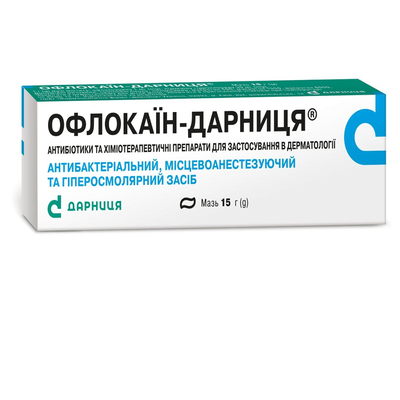
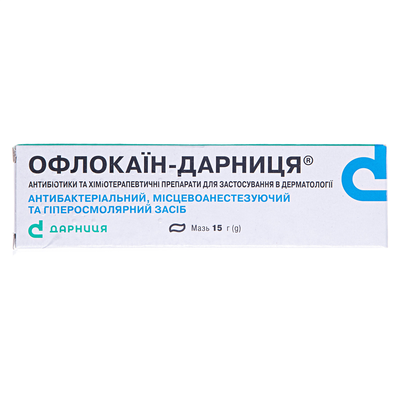
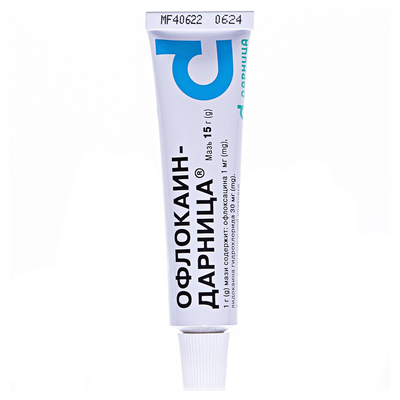
Oflokain-Darnitsa ointment, 15 g in tubes
Ingredients
Active ingredients: lidocaine hydrochloride, ofloxacin;
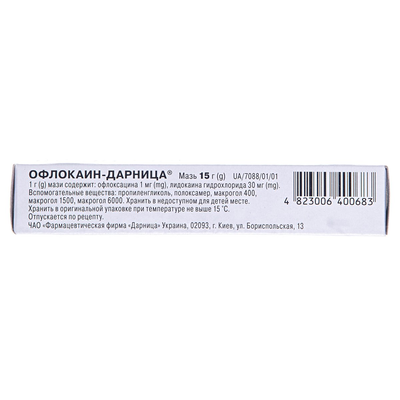
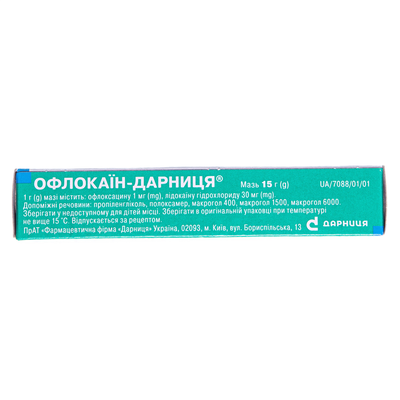
1 g of ointment contains: 1 mg of ofloxacin, 30 mg of lidocaine hydrochloride;
Excipients: propylene glycol, poloxamer, macrogol 400, macrogol 1500, macrogol 6000.
Dosage Form
Ointment.
Main physical and chemical properties: a homogeneous white ointment with a faint characteristic odor.
Pharmacotherapeutic group
Antibiotics and chemotherapeutic agents for dermatological use. Chemotherapeutic agents for topical use.
ATC code D06B X.
Pharmacological properties
Pharmacodynamics.
Oflokain-Darnitsa® is a combination of the fluoroquinolone antimicrobial agent ofloxacin and the local anesthetic lidocaine in a hydrophilic, hyperosmolar, and water-soluble base. The pharmacological effects of the ointment are due to the properties of its active ingredients.
Ofloxacin acts on the bacterial enzyme DNA gyrase and bacterial tropoisomerase IV, exerting a bactericidal effect by destabilizing bacterial DNA strands.
Ofloxacin provides the ointment’s antimicrobial properties by acting on Gram-positive and, to a greater extent, Gram-negative bacteria, as well as aerobic and anaerobic, spore-forming and non-spore-forming microflora, whether in the form of monocultures or microbial communities. Ofloxacin is also effective against hospital-acquired strains resistant to antibiotics and sulfonamides.
The hyperosmolar, polymer-based ointment base of the drug ensures the movement of water within the wound toward the ointment base. This reduces tissue edema around the wound and sorbs purulent-necrotic wound contents. The excipients in the ointment base are capable of delivering ofloxacin to the surrounding wound tissues, thereby ensuring an effect on both superficial and deep wound infections.
The mechanism of lidocaine’s local anesthetic action involves stabilizing the neuronal membrane by reducing its permeability to sodium ions, which prevents the generation of action potentials and the conduction of impulses along nerve fibers. Antagonism with calcium ions is possible. It inhibits the conduction not only of pain impulses but also of impulses of other modalities. It is rapidly hydrolyzed in the slightly alkaline environment of tissues and, after a short latent period, remains active for 60–90 minutes. The anesthetic effect of lidocaine is 2–6 times stronger than that of procaine. When applied topically, it dilates blood vessels and does not cause local irritation. In cases of tissue inflammation (tissue acidosis), its anesthetic activity is reduced. It is effective for all types of local anesthesia. It dilates blood vessels. It does not irritate tissues.
Pharmacokinetics.
Ofloxacin and lidocaine are practically not absorbed into the systemic circulation when the ointment is applied to healthy skin. When applied to a wound surface, where the skin’s barrier function is compromised, approximately 3% of the applied dose of ofloxacin enters the systemic circulation. Peak blood concentrations of the substances are observed after 3–4 hours. Six hours after application of the ointment, ofloxacin is no longer detectable in the blood.
Indications
Complicated infected wounds in Phase I of the wound healing process, of various locations and origins: amputation stumps of the extremities, wounds following surgical debridement of purulent foci. Pressure ulcers, trophic ulcers, complicated postoperative wounds and fistulas, abscesses, and phlegmons of the maxillofacial region following surgical debridement.
Prevention and treatment of suppuration in burn wounds.
Purulent-inflammatory skin diseases caused by bacterial flora sensitive to ofloxacin.
Contraindications
Hypersensitivity to ofloxacin or other quinolone derivatives; Hypersensitivity to lidocaine hydrochloride or to other amide-type local anesthetics (e.g., bupivacaine, etidocaine, mepivacaine, and prilocaine); Hypersensitivity to other components of the drug.
Drug Interactions and Other Interactions
Absorption of lidocaine through the skin is usually low; however, the drug should be used with caution in patients taking Class I antiarrhythmic drugs (tocaainide, mexiletine) or other local anesthetics, as there is a potential risk of cumulative systemic effects.
Monoamine oxidase inhibitors enhance the local anesthetic effect of lidocaine.
Special Instructions for Use
Before applying the medication to the wound surface, it is recommended to rinse the wound with an aseptic solution.
Use during pregnancy or breastfeeding.
Do not use this medication during pregnancy or while breastfeeding.
Effect on reaction time when driving or operating machinery.
This medication does not affect neuromuscular conduction; at the recommended doses, it may be used by individuals who drive or operate complex machinery.
Directions for Use and Dosage
Oflokain-Darnitsa® is for topical use.
After routine surgical debridement of wounds and burns, apply the ointment directly to the wound surface, then apply a sterile gauze dressing. The ointment may first be applied to the dressing material, which is then applied to the wound surface.
Fill the cavities of purulent wounds with ointment-soaked swabs after surgical debridement, and insert gauze tampons with ointment into fistula tracts.
When treating purulent wounds, apply the ointment once daily; when treating burns, apply it daily or 2–3 times a week, depending on the intensity of purulent discharge.
The amount of ointment used is determined by the area of the wound surface (the ointment should cover the entire affected area) and the degree of purulent exudation.
The duration of treatment is determined by the physician based on the rate at which the wound clears of purulent exudate and the time required to resolve the inflammatory process.
When treating dermatological conditions, apply a thin layer of the ointment to the affected areas of the skin 1–2 times a day or to a gauze bandage, followed by reapplication.
Children.
Do not use this medication in children.
Overdose
No cases of overdose have been reported.
Side Effects
The following reactions may occur with the use of the ointment: itching, burning sensation, rash, redness, weeping, and allergic reactions, including dermatitis, hives, and angioedema. Propylene glycol, which is a component of this medication, may cause skin irritation.
Shelf Life
2 years.
Storage Conditions
Store in the original packaging at a temperature not exceeding 15 °C.
Keep out of reach of children.
Incompatibility
It is not recommended to use other medications simultaneously at the application sites of Oflokain-Darnitsa®.
Packaging
15 g or 30 g per tube; 1 tube per pack; 500 g or 1000 g per jar.
Dispensing Category
By prescription.
Manufacturer
PJSC “Darnitsa Pharmaceutical Company.”