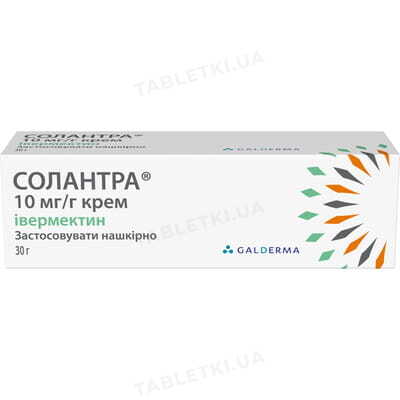
Solantra cream, 10 mg/g, 30 g in tubes
Composition
Active ingredient: ivermectin;
1 g of cream contains 10 mg of ivermectin;
excipients: glycerin; isopropyl palmitate; carbomer type B; dimethicone 20 Cst; disodium edetate; citric acid monohydrate; cetyl alcohol; stearyl alcohol; cetostearyl macrogol ether; sorbitan stearate; methyl parahydroxybenzoate (E 218); propyl parahydroxybenzoate (E 216); phenoxyethanol; propylene glycol; oleyl alcohol; sodium hydroxide; purified water.
Dosage Form
Cream.
Main physical and chemical properties: cream-colored, ranging from white to pale yellow.
Pharmacotherapeutic group
Dermatological agents. Other dermatological preparations.
ATX code D11A X22.
Pharmacological properties
Pharmacodynamics.
Mechanism of action
Ivermectin belongs to the class of avermectins. Avermectins have anti-inflammatory effects by inhibiting the production of inflammatory cytokines induced by lipopolysaccharides. The anti-inflammatory properties of ivermectin when applied to the skin have been observed in animal models of skin inflammation. Ivermectin also kills parasites, primarily by selectively binding with high affinity to glutamate-gated chloride channels found in the nerve and muscle cells of invertebrates. The exact mechanism of action of Solantra® cream in the treatment of inflammatory rosacea lesions is unknown, but it may be related to the anti-inflammatory effect of ivermectin, as well as to the killing of Demodex mites, which are reported to be one of the factors contributing to skin inflammation.
Clinical Efficacy and Safety
Two randomized, double-blind, placebo-controlled clinical trials, identical in design, evaluated the treatment of inflammatory rosacea lesions with Solantra® cream, which was applied once daily at bedtime. A total of 1,371 patients aged 18 years and older participated in the study; during the study, Solantra® cream or placebo was applied once daily every day for 12 weeks.
A total of 96% of participants were of Caucasian descent, and 67% were women. On the 5-point Investigator Global Assessment (IGA) scale at baseline, 79% of participants were rated as moderate (IGA = 3) and 21% as severe (IGA = 4).
The co-primary efficacy endpoints in both clinical trials were the rate of successful treatment based on the IGA scale (the percentage of patients rated as “clear” or “almost clear” at Week 12 of the study) and the rate of absolute change in the number of inflammatory lesions compared to baseline. The IGA scale is based on the definitions provided in Table 1.
Table 1
Investigator Global Assessment (IGA) Scale
| Grade | Label | Clinical Description |
| Clear | 0 | No inflammatory lesions, no erythema. |
| Almost clear | 1 | Very few small papules/pustules; very mild erythema. |
| Mild | 2 | Isolated small papules/pustules, mild erythema. |
| Moderate | 3 | Several small or large papules/pustules, moderate erythema. |
| Severe | 4 | Numerous small and/or large papules/pustules, marked erythema. |
The results of both clinical studies demonstrated that Solantra® cream , when applied once daily for 12 weeks, significantly outperformed placebo in terms of the frequency of successful treatment according to the IGA scale and in terms of absolute changes in the number of inflammatory lesions (p < 0.001; see Table 2).
The table below presents the efficacy metrics obtained in both studies.
Table 2
Results by Efficacy Measures
| Endpoint Parameters | Study 1 | Study 2 | ||
| Solantra® (N = 451) | Placebo
(N = 232) |
Solantra® (N = 459) | Placebo
(N = 229) |
|
| Investigator’s Global Assessment | ||||
| Number (%) of participants rated as “clean” or “almost clean” at Week 12 | 173
(38.4) |
27
(11.6) |
184
(40.1) |
43
(18.8) |
| Inflammatory lesions | ||||
| Average number of inflammatory lesions at baseline | 31.0 | 30.5 | 33.3 | 32.2 |
| Average number of inflammatory lesions at week 12 | 10.6 | 18.5 | 11.0 | 18.8 |
| Average absolute changes (percentage change) in the frequency of inflammatory lesions at week 12 compared to baseline | · 20.5
(-64.9) |
· 12.0
(-41.6) |
· 22.2
(-65.7) |
· 13.4
(-43.4) |
|
|
Solantra® cream significantly outperformed the placebo cream on the co-primary efficacy endpoints, with treatment efficacy becoming apparent after 4 weeks (p < 0.05).®
The IGA scale was used to evaluate patients during the 40-week follow-up period for both clinical trials, and the percentage of patients receiving Solantra® cream who scored 0 or 1 on the IGA scale, continued to increase through Week 52. The success rate (IGA score of 0 or 1) at Week 52 was 71% and 76% in Studies 1 and 2, respectively.
The efficacy and safety of this medication for the treatment of inflammatory lesions of rosacea were also evaluated in a randomized, blinded, active-controlled clinical trial. The study involved 962 patients aged 18 years and older who received Solantra® cream once daily or metronidazole 7.5 mg/g cream twice daily for 16 weeks. In this study, 99.7% of participants were of Caucasian descent, and 65.2% were women; at baseline, 83.3% of participants were classified as moderate (IGA = 3) and 16.7% as severe (IGA = 4).
The results of this study showed that Solantra® cream significantly outperformed metronidazole 7.5 mg/g cream in terms of the primary efficacy endpoint (mean percentage change in the frequency of inflammatory lesions): after 16 weeks of treatment, a reduction in this measure compared to baseline was observed in 83.0% and 73.7% of patients in the ivermectin and metronidazole groups, respectively (p < 0.001). The superiority of Solantra® cream after 16 weeks was also confirmed by the IGA success rate, as well as by the absolute changes in inflammatory lesions (secondary endpoints; p < 0.001).
In total, approximately 300 participants aged 65 years and older took part in all clinical trials of this drug. No significant differences in the efficacy and safety profile were observed between elderly patients and participants aged 18 to 65 years.
The safety profile described in the “Adverse Reactions” section remained consistent with long-term use and was observed during prolonged treatment courses of up to one year.
Treatment with ivermectin in combination with 40 mg modified-release doxycycline capsules.
The ANSWER clinical trial evaluated the relative efficacy of Solantra (ECo) in combination with 40 mg modified-release doxycycline capsules (MR) compared with ECo combined with placebo (PBO) in the treatment of severe rosacea. This was a 12-week randomized, double-blind, controlled study involving 273 men and women aged ≥ 18 years with 20–70 inflammatory lesions (papules and pustules) on the face and an IGA score of 4.
The primary efficacy endpoint was the change in the number of inflammatory lesions at week 12 as a percentage of baseline. A statistically significant higher mean percentage reduction in the number of inflammatory lesions was observed in patients in the ECO + DMR group compared with patients in the IVM + PBO group (mean ± standard deviation: -80.29 ± 21.65% vs. -73.56 ± 30.52%; p = 0.032).
Children
The European Medicines Agency declined to provide the results of studies of Solantra® cream in all subgroups of the pediatric population with papulopustular rosacea.
Pharmacokinetics.
Absorption
The absorption of ivermectin from Solantra® cream was evaluated in a clinical study of adult participants with severe papulopustular rosacea under conditions of maximum active use. At steady state (after 2 weeks of treatment), the highest mean plasma concentration of ivermectin (± standard deviation) was reached within 10 ± 8 hours after dosing (Cmax 2.1 ± 1.0 ng/mL, range 0.7–4.0 ng/mL), and the highest mean (± standard deviation) AUC0–24h was 36 ± 16 ng/mL (range: 14–75 ng/mL). This is observed as early as two weeks into treatment. At steady state, the level of systemic exposure to ivermectin (AUC0–24h 36 ± 16 ng·h/mL) was lower than the level of exposure following a single oral dose of 6 mg of ivermectin in healthy volunteers (AUC0–24h 134 ± 66 ng·h/mL).
Distribution
In an in vitro study, it was demonstrated that ivermectin is more than 99% bound to plasma proteins, primarily to human serum albumin. No significant binding of ivermectin to red blood cells was observed.
Metabolism
In vitro studies using human liver microsomes and recombinant CYP450 enzymes demonstrated that ivermectin is metabolized primarily by CYP3A4 enzymes.
In vitro studies have shown that ivermectin does not inhibit the cytochrome P450 isoenzymes 1A2, 2A6, 2B6, 2C8, 2C9, 2C19, 2D6, 3A4, 4A11, and 2E1. In human hepatocyte cultures, ivermectin does not induce the expression of CYP450 enzymes (1A2, 2B6, 2C9, and 3A4).
In a clinical pharmacokinetic study with maximum ivermectin exposure, two major metabolites were identified and further studied in Phase 2 clinical trials (3''-O-dimethylervermectin and 4α-hydroxyvermectin). and AUC), which was reached at steady state, was significantly lower than after oral administration of ivermectin.
Release
In a clinical pharmacokinetic study with maximum application of ivermectin in patients who applied the drug to the skin once daily for 28 days, the terminal half-life averaged 6 days (mean value—145 hours, range 92–238 hours). ®
Preclinical Safety Data
In repeat-dose animal studies lasting up to 9 months involving topical application of a 10 mg/g ivermectin cream, no toxic effects or signs of local toxicity were observed with systemic exposure at levels seen during clinical use.
In in vitro and in vivo experiments, ivermectin did not demonstrate genotoxic effects. In a two-year carcinogenicity study, no increase in tumor incidence was observed following topical application of ivermectin cream at a dose of 10 mg/g to the skin of animals.
In studies of reproductive toxicity following oral administration of ivermectin, teratogenic effects were observed in rats (cleft palate) and rabbits (wrist deformity) when administered at high doses (the exposure limit to reach the NOAEL was at least 70 times higher than in clinical use).
Neonatal toxicity in oral animal studies was attributed not to in utero exposure but to postnatal exposure via breast milk, which led to high concentrations of ivermectin in the brain tissues and plasma of the offspring. A cream containing 10 mg/g of ivermectin caused skin irritation, sensitization, and photosensitization in animals but did not cause phototoxic effects.
Environmental Risk Assessment (ERA)
Ivermectin is a highly toxic substance to invertebrates, and risks to the aquatic environment, sediment, and terrestrial environment have also been identified. Appropriate safety measures should be taken to prevent environmental contamination, particularly of the aquatic environment.
Indications
For the topical treatment of inflammatory lesions caused by rosacea (papulopustular form) in adult patients.
Contraindications
Hypersensitivity to the active ingredient or to any of the drug’s excipients.
Drug Interactions and Other Interactions
No drug interaction studies have been conducted.
The concomitant use of Solantra® cream with other medications for the topical or systemic treatment of rosacea has not been studied.
In vitro studies have shown that ivermectin is metabolized primarily by the CYP3A4 enzyme. Therefore, ivermectin should be used with caution when administered concomitantly with potent CYP3A4 inhibitors, as plasma exposure to the drug may be significantly increased.
Special Considerations
Patients may experience a temporary exacerbation of rosacea due to the death of Demodex mites, which usually resolves within 1 week with continued treatment.
If the patient’s condition worsens severely with the development of a pronounced skin reaction, treatment should be discontinued.
The effects of Solantra cream in patients with renal or hepatic impairment have not been studied.®
This medication contains:
- cetyl alcohol and stearyl alcohol, which may cause local skin reactions (e.g., contact dermatitis);
- methyl parahydroxybenzoate (E 218) and propyl parahydroxybenzoate (E 216), which may cause allergic reactions (possibly delayed);
- propylene glycol, which may cause skin irritation.
Use during pregnancy or while breastfeeding.
Pregnancy
Studies on the toxic effects of ivermectin on reproductive function following oral administration have shown that ivermectin has teratogenic effects in animals; however, due to low systemic exposure to the substance following topical application at the recommended dosage, the likelihood of harm to human embryos is low. Solantra® cream is not recommended for use during pregnancy.
Breastfeeding
Following oral administration, ivermectin is excreted in low concentrations in human breast milk. Excretion into breast milk following topical application has not been studied. Available pharmacokinetic/toxicological data in animals also indicate that ivermectin is excreted in breast milk. A risk to the infant during breastfeeding cannot be ruled out. A decision must be made whether to discontinue breastfeeding or to discontinue or suspend treatment with Solantra® cream, weighing the benefits of breastfeeding for the infant against the benefits of treatment for the woman.
Reproductive Function
There are no data on the effects of ivermectin on human reproductive function. In animals, no effects on mating or fertility have been observed during treatment with ivermectin.
Effect on reaction time when operating vehicles or other machinery.
Solantra® cream has no or negligible effect on the ability to drive vehicles or operate other machinery.
Directions for Use and Dosage
Dosage
The product should be applied once daily for the entire duration of treatment, but for no longer than 4 months. The treatment course may be repeated.
Solantra® cream can be used either as monotherapy or as part of combination therapy.
If no improvement is observed after 3 months, treatment should be discontinued.
Selected Patient Groups
Renal impairment
No dosage adjustment is necessary.
Hepatic impairment
Use with caution in patients with severe hepatic impairment.
Elderly patients
No dosage adjustment is required for the geriatric population.
Directions for Use
Solantra® cream is for use on the face only.
Apply a small amount of the product (about the size of a pea) to the skin in each of the five areas of the face: the forehead, chin, nose, and both cheeks. Spread the product in a thin layer over the entire face, avoiding the eyes, lips, and mucous membranes.
Wash your hands after applying this product.
Cosmetics may be applied only after the cream has dried.
Children.
The safety and efficacy of Solantra® cream in children (under 18 years of age) have not been studied. No data are available.
Overdose
No cases of Solantra® cream overdose have been reported.
In cases of accidental or significant human exposure to unknown amounts of veterinary ivermectin products—whether through ingestion, inhalation, injection, or contact with body surfaces—the following side effects have been most commonly reported: rash, swelling, headache, dizziness, asthenia, nausea, vomiting, and diarrhea. Other reported adverse reactions include: seizures, convulsions, shortness of breath, abdominal pain, paresthesia, urticaria, and contact dermatitis.
In case of accidental ingestion, supportive therapy should be provided, which, as indicated, may include parenteral administration of fluids and electrolytes, respiratory support (including oxygen therapy and mechanical ventilation if necessary), as well as vasopressors in the presence of clinically significant hypotension. If necessary, to prevent absorption of the ingested substance, artificial induction of vomiting and/or gastric lavage should be performed as soon as possible; laxatives should be administered, and other measures typical for poisoning should be taken.
Side Effects
The most common adverse reactions were a burning sensation on the skin, skin irritation, itching, and dry skin. The incidence of these reactions was ≤ 1% of patients who used this medication during clinical trials.
Generally, these adverse reactions are mild or moderate in severity and tend to subside with continued treatment.
No clinically significant differences in the safety profile were observed between patients aged 18–65 years and those over 65 years of age when using this medication.
Adverse reactions reported in clinical trials are classified by organ system and frequency into the following categories: very common (≥ 1/10), common (≥ 1/100 to < 1/10), uncommon (≥ 1/1,000 to < 1/100), rare (≥ 1/10,000 to < 1/1,000), very rare (< 1/10,000), frequency unknown (cannot be estimated from the available data) (see Table 3).
Table 3
Adverse Reactions
| Organ system class | Frequency | Adverse reactions |
| Skin and subcutaneous tissue disorders | Common | Burning sensation on the skin |
| Uncommon | Skin irritation, itching, dry skin, exacerbation of rosacea* | |
| Frequency unknown | Erythema, contact dermatitis (allergic or irritant), facial swelling | |
| Laboratory tests | Frequency unknown | Elevated transaminase levels* |
* Data obtained during the postmarketing period.
Reporting Suspected Adverse Reactions
Reporting adverse reactions after a drug’s approval is crucial. It allows for monitoring the benefit-risk ratio of the drug’s use. Healthcare and pharmaceutical professionals, as well as patients or their legal representatives, should report all cases of suspected adverse reactions and insufficient efficacy of the drug through the Automated Pharmacovigilance Information System at: https://aisf.dec.gov.ua.
Shelf life
2 years.
Once the tube is opened, the product is usable for 6 months.
Storage conditions
No special storage conditions are required. Keep out of reach of children.
Packaging
30 g per tube; one tube per cardboard box.
Manufacturer
GALDERMA LABORATORIES.
Manufacturer’s location and business address:
IZ Mondesir 74540 Albi-sur-Cheran, France.