
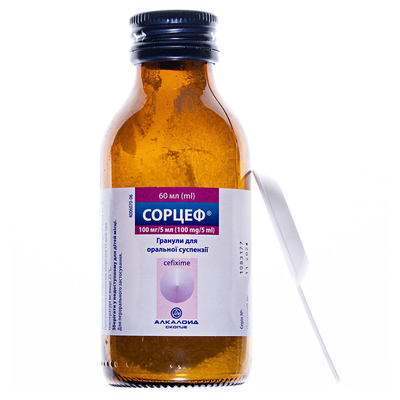

Sorcef granules for oral suspension, 100 mg/5 mL, 60 mL (32 g) per bottle.
Composition
Active ingredient: cefixime;
5 mL of suspension contains 100 mg of cefixime (as cefixime trihydrate);
Excipients: sodium benzoate (E 211), sucrose, xanthan gum, orange flavoring.
Dosage Form
Granules for oral suspension.
Main physical and chemical properties:
Granules: a mixture of yellow to almost yellow granules and colorless crystals with a pleasant orange odor;
Suspension: a viscous liquid ranging in color from white to cream with a pleasant orange odor.
Pharmacotherapeutic group
Antibacterial agents for systemic use. Beta-lactam antibiotics. Third-generation cephalosporins. ATC code J01D D08.
Pharmacological Properties
Pharmacodynamics.
Cefixime is a third-generation cephalosporin antibiotic for oral administration. In vitro, it exhibits significant bactericidal activity against a broad spectrum of Gram-positive and Gram-negative microorganisms.
It is clinically effective in treating infections caused by the most common pathogens, including Streptococcus pneumoniae, Streptococcus pyogenes, E. coli, Proteus mirabilis, Klebsiella species, Haemophilus influenzae (both beta-lactamase-positive and -negative), Branhamella catarrhalis (both beta-lactamase-positive and -negative), and Enterobacter species. It exhibits a high degree of stability in the presence of beta-lactamases.
Most strains of enterococci (Streptococcus faecalis, group D streptococci) and staphylococci (including coagulase-positive, coagulase-negative, and methicillin-resistant strains) are resistant to cefixime. In addition, most strains of Pseudomonas, Bacteroides fragilis, Listeria monocytogenes, and Clostridia are resistant to cefixime.
Pharmacokinetics.
Absorption. The absolute bioavailability following oral administration of cefixime is 22–54%. Since the presence of food does not significantly affect absorption, cefixime may be administered regardless of meals. The maximum serum concentration following administration of the recommended doses for adults or children ranges from 1.5 to 3 μg/mL. With repeated dosing, accumulation of cefixime is negligible or absent.
Distribution. Cefixime is almost completely bound to the albumin fraction, with an average free fraction of about 30%.
Metabolism. Metabolites of cefixime have not been detected in human serum or urine.
Excretion. Cefixime is excreted primarily unchanged in the urine. The predominant mechanism is glomerular filtration.
There are no data on the transfer of cefixime into breast milk.
Indications
Infectious and inflammatory diseases caused by drug-susceptible microorganisms:
- upper respiratory tract infections (including otitis media) and other upper respiratory tract infections (sinusitis, pharyngitis, and tonsillitis of bacterial etiology), in cases of known or suspected resistance of the pathogen to other commonly used antibiotics, or in cases where treatment is likely to be ineffective;
- lower respiratory tract infections (including acute bronchitis and exacerbations of chronic bronchitis);
- urinary tract infections (including cystitis, cystourethritis, and uncomplicated pyelonephritis).
Clinically effective in treating infections caused by the most common pathogens, including Streptococcus pneumoniae, Streptococcus pyogenes, E. coli, Proteus mirabilis, Klebsiella species, Haemophilus influenzae (beta-lactamase-positive and -negative), Branhamella catarrhalis (beta-lactamase-positive and -negative), and Enterobacter species. It exhibits a high degree of stability in the presence of beta-lactamases.
Most strains of enterococci (Streptococcus faecalis, Group D streptococci) and staphylococci (including coagulase-positive, coagulase-negative, and methicillin-resistant strains) are resistant to cefixime. In addition, most strains of Pseudomonas, Bacteroides fragilis, Listeria monocytogenes, and Clostridia are resistant to cefixime.
Contraindications
Confirmed hypersensitivity to cephalosporin antibiotics or to other components of the drug; hypersensitivity to penicillins; porphyria.
Drug Interactions and Other Interactions
Tubular secretion inhibitors (allopurinol, probenecid, diuretics, etc.) increase the maximum serum concentration of cefixime by slowing its renal excretion, which may lead to symptoms of overdose.
Salicylic acid increases free cefixime by 50% by displacing cefixime from its protein-binding sites; this effect is concentration-dependent.
Concomitant use with carbamazepine may cause an increase in its plasma concentration; therefore, it is advisable to monitor carbamazepine levels in plasma.
When cefixime is used concomitantly with potentially nephrotoxic agents (aminoglycosides, colistin, polymyxin, viomycin) or potent diuretics (ethacrynic acid, furosemide), there is an increased risk of developing renal failure.
Nifedipine increases bioavailability, but no clinical interactions have been identified.
Antacids containing magnesium or aluminum hydroxide delay the absorption of the drug.
As with other cephalosporins, an increase in prothrombin time has been reported in some patients; therefore, caution should be exercised in patients receiving anticoagulant therapy.
Cefixime should be used with caution in patients receiving coumarin-type anticoagulants, such as potassium warfarin. Since cefixime may potentiate the effects of anticoagulants, prothrombin time may be prolonged, with or without clinical bleeding.
During treatment with cefixime, false-positive direct Coombs’ tests and false-positive urine glucose tests may occur when using copper sulfate tablets, Benedict’s solution, or Fehling’s solution. The glucose oxidase test is recommended for determining glucose in urine.
Special Considerations
Beta-lactams, including cefixime, increase the risk of encephalopathy in patients (which may include seizures, confusion, impaired consciousness, and motor disorders), especially in cases of overdose and renal failure.
Severe cutaneous adverse reactions, such as toxic epidermal necrolysis, Stevens-Johnson syndrome, and drug rash with eosinophilia and systemic symptoms (DRESS), have been reported in some patients receiving cefixime. If severe skin reactions occur, cefixime should be discontinued and appropriate treatment initiated.
Cefixime should be used with caution in patients who have experienced hypersensitivity reactions to other medications. There have been reports of severe reactions (including anaphylactic shock) to cefixime. If an allergic reaction to cefixime develops, the drug should be discontinued and appropriate therapy initiated.
Cases of drug-induced hemolytic anemia, including severe and fatal cases, have been reported during treatment with cephalosporins. There have also been reports of hemolytic anemia following repeated use of cephalosporins (including cefixime).
Cefixime should be used with caution in patients with severe renal impairment. (“Dosage in Renal Impairment”).
Like other cephalosporins, cefixime may lead to acute renal failure, including tubulointerstitial nephritis as the primary pathological condition. If acute renal failure occurs, cefixime should be discontinued and appropriate therapy and/or measures should be taken.
Caution should be exercised when prescribing this drug in patients with a history of bleeding, gastrointestinal disorders—particularly ulcerative colitis, regional enteritis, or colitis—during treatment, as well as in patients with impaired liver function.
The safety of cefixime in premature infants or newborns has not been established.
Treatment with broad-spectrum antibiotics may disrupt the normal intestinal microflora, which can lead to excessive overgrowth of Clostridium difficile, a bacterium that produces a toxin and is the primary cause of antibiotic-associated diarrhea. Pseudomembranous colitis is associated with the use of broad-spectrum antibiotics (including macrolides, semisynthetic penicillins, lincosamides, and cephalosporins). Therefore, it is important to consider this diagnosis in patients who develop diarrhea during or after antibiotic use. Symptoms of pseudomembranous colitis may develop during or after the completion of antibiotic therapy.
Treatment of pseudomembranous colitis should include rectomanoscopy, appropriate bacteriological testing, and the administration of fluids, electrolytes, and proteins. If the condition does not improve after discontinuing the medication or if symptoms become severe, oral vancomycin should be prescribed. Vancomycin is the drug of choice for treating antibiotic-associated pseudomembranous colitis (caused by C. difficile). Other causes of colitis must be ruled out.
When cefixime is used concomitantly with aminoglycosides, polymyxin B, colistin, or loop diuretics (furosemide, ethacrynic acid) at high doses, renal function should be closely monitored. After prolonged use of cefixime, hematopoietic function should be assessed.
During treatment, a positive direct Coombs test and a false-positive urine glucose test may occur.
Cephalosporins increase the toxicity of alcohol; therefore, it is not recommended to consume alcoholic beverages during treatment with cefixime.
Important information about certain components of the medication.
5 mL of the reconstituted suspension contains 2.517 g of sucrose. This should be taken into account in patients with diabetes mellitus.
This medication should not be prescribed to patients with rare hereditary disorders such as fructose intolerance, glucose-galactose malabsorption, or sucrose-isomaltase deficiency. This medication may cause tooth damage. It is recommended to rinse your mouth with water after use, and children should drink plenty of water.
Pregnancy and lactation.
In reproductive studies in mice and rats, where animals were administered doses nearly 400 times higher than human doses, no cases of impaired fertility or fetal abnormalities due to cefixime administration were observed. In rabbits, at doses 4 times higher than human doses, no teratogenic effects were observed; A high incidence of abortions and maternal mortality was observed, which is an expected consequence of rabbits’ known susceptibility to changes in the intestinal microflora caused by antibiotics.
There are no data on the use of this drug during pregnancy. Cefixime crosses the placenta.
Do not use this medication during pregnancy or lactation, except in cases of extreme necessity as prescribed by a doctor.
Affects the ability to operate vehicles and machinery.
Patients experiencing adverse reactions involving the central nervous system (e.g., dizziness, impaired consciousness, motor disorders) should refrain from driving or operating machinery while taking this medication.®
Dosage and Administration
Food intake does not affect the absorption of cefixime. The usual course of treatment is 7 days, up to 14 days if necessary. For the treatment of uncomplicated cystitis, the course of treatment is 3 days.
For children aged 6 months to 10 years weighing up to 50 kg: the recommended dose is 8 mg/kg per day as a single dose or 4 mg/kg every 12 hours, depending on the severity of the condition.
Adults and children over 10 years of age (or weighing more than 50 kg): the recommended dose is 400 mg per day as a single dose or 200 mg every 12 hours, depending on the severity of the condition.
Elderly patients: The drug is prescribed at the recommended adult dose. In cases of severe renal impairment, renal function should be monitored and the dose adjusted (see Table 1, “Dosage in Renal Impairment”).
Dosage in Renal Impairment: Cefixime may be used in patients with impaired renal function. Patients with a creatinine clearance of 20 mL/min or higher should receive the usual dose and dosing schedule. For patients with a creatinine clearance below 20 mL/min, it is recommended to reduce the daily dose by 50%. This also applies to patients undergoing continuous ambulatory peritoneal dialysis or hemodialysis.
Instructions for preparing the suspension.
For internal use only.
For 60 mL of suspension (100 mg/5 mL): Shake the vial several times before dilution; using the measuring cup, add 40 mL of purified water in two steps and shake until a homogeneous suspension forms.
For 100 mL of suspension (100 mg/5 mL): Shake the vial several times before dilution; using a measuring cup, add 66 mL of purified water in two steps and shake until a homogeneous suspension forms.
Shake the prepared suspension well before use.
Measure the suspension with a measuring spoon.
Children.
The drug is indicated for children 6 months of age and older. The safety and efficacy of cefixime in children under 6 months of age have not been established; therefore, the use of cefixime in this patient population is not recommended.
Overdose
No cases of overdose have been reported. Adverse reactions reported at doses up to 2 g in healthy study participants did not differ from those observed in patients taking the drug at the recommended doses.
Symptoms: increased severity of adverse reactions.
Treatment: Perform gastric lavage and administer symptomatic and supportive therapy.
There is no specific antidote. Hemodialysis or peritoneal dialysis contributes only minimally to the elimination of cefixime from the body.
Side Effects
Blood and lymphatic system disorders: eosinophilia, hypereosinophilia, agranulocytosis, leukopenia, neutropenia, granulocytopenia, hemolytic anemia, thrombocytopenia, thrombocytosis, hypoprothrombinemia, thrombophlebitis, prolonged thrombin and prothrombin times (bleeding and bruising without apparent cause), purpura.
Gastrointestinal system: stomach cramps, abdominal pain, diarrhea*, dyspepsia, nausea, vomiting, flatulence, dysbiosis, oral candidiasis, stomatitis, glossitis.
Liver and biliary tract disorders: jaundice, hepatitis, cholestasis.
Infectious and parasitic diseases: pseudomembranous colitis.
Laboratory parameters: elevated aspartate aminotransferase (AST), elevated alanine aminotransferase (ALT), elevated blood bilirubin, elevated blood urea nitrogen, elevated serum creatinine.
Metabolic and nutritional disorders: anorexia (loss of appetite).
Nervous system disorders: headache, dizziness, dysphoria, hyperactivity; Cases of seizures have been reported with cephalosporins, including cefixime (frequency unknown).
Beta-lactams, including cefixime, increase the risk of encephalopathy in patients (which may include seizures, confusion, altered consciousness, and motor disorders), especially in cases of overdose and renal failure (frequency unknown).
Hearing disorders: hearing loss.
Respiratory, thoracic, and mediastinal disorders: shortness of breath.
Renal and urinary disorders: acute renal failure, including tubulointerstitial nephritis as the primary pathological condition, hematuria.
Immune system, skin, and subcutaneous tissue disorders: anaphylactic reaction, serum sickness; drug rash with eosinophilia and systemic symptoms (DRESS); fever; facial edema, hypersensitivity reactions with rash, pruritus, drug fever, and arthralgia, including rare cases of urticaria or angioedema. These reactions usually resolve after discontinuation of therapy; erythema multiforme (including Stevens-Johnson syndrome), toxic epidermal necrolysis (Lyell’s syndrome).
Reproductive system and breast disorders: genital itching, candidal vaginitis.
General disorders: weakness, fatigue, increased sweating, inflammation of the mucous membranes.
* Diarrhea is usually associated with higher doses. Cases of moderate to severe diarrhea have been reported; in such cases, discontinuation of therapy is warranted. If severe diarrhea occurs, cefixime should be discontinued.
Shelf life
3 years.
Do not use after the expiration date printed on the package.
Storage Conditions
Store the granules at a temperature not exceeding 25 °C.
Store the prepared suspension for up to 14 days at a temperature not exceeding 25 °C.
Keep out of reach of children.
Packaging
Per 60 mL of suspension:
32 g of granules in a dark glass bottle with a screw-on aluminum cap, a polyethylene liner, and a tamper-evident seal, along with a plastic measuring spoon and measuring cup in a cardboard box.
For 100 mL of suspension:
53 g of granules in a dark glass bottle with a screw-on aluminum cap, a polyethylene liner, and a tamper-evident seal, along with a plastic measuring spoon and measuring cup in a cardboard box.
Dosage category
By prescription.