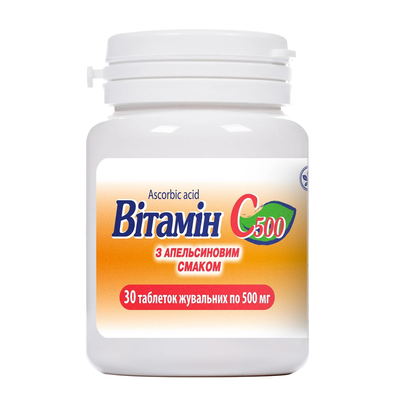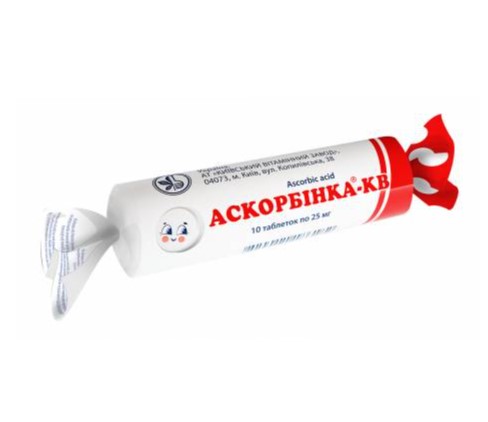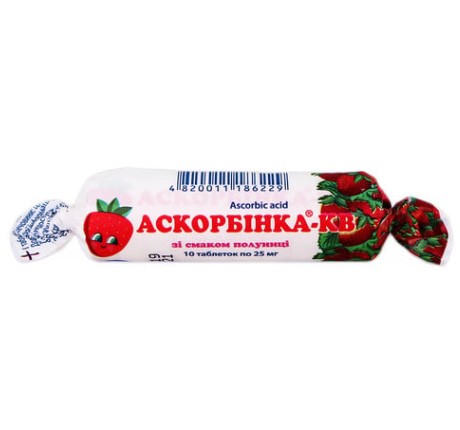

Ascorbinka-KV tablets with strawberry flavor, 25 mg each, No. 10 in a blister pack.
Ingredients
Active ingredient: ascorbic acid;
orange-flavored tablets
Each tablet contains 25 mg of ascorbic acid (vitamin C);
excipients: sugar, stearic acid, potato starch, glucose monohydrate, anhydrous citric acid, powdered “orange” food flavoring;
Mint-flavored tablets
1 tablet contains 25 mg of ascorbic acid (vitamin C);
excipients: sugar, stearic acid, potato starch, glucose monohydrate, powdered “mint” food flavoring;
Strawberry-flavored tablets
1 tablet contains 25 mg of ascorbic acid (vitamin C);
excipients: sugar, stearic acid, potato starch, glucose monohydrate, anhydrous citric acid, powdered “strawberry” food flavoring;
lemon-flavored tablets
1 tablet contains 25 mg of ascorbic acid (vitamin C);
excipients: sugar, stearic acid, potato starch, glucose monohydrate, anhydrous citric acid, powdered “lemon” food flavoring;
Tutti-Frutti-flavored tablets
1 tablet contains 25 mg of ascorbic acid (vitamin C);
excipients: sugar, stearic acid, potato starch, glucose monohydrate, anhydrous citric acid, “Tutti-Frutti” powdered food flavoring;
Melon-flavored tablets
1 tablet contains 25 mg of ascorbic acid (vitamin C);
excipients: sugar, stearic acid, potato starch, glucose monohydrate, anhydrous citric acid, “melon” powdered food flavoring;
Mango-flavored tablets
1 tablet contains 25 mg of ascorbic acid (vitamin C);
Excipients: sugar, stearic acid, potato starch, glucose monohydrate, anhydrous citric acid, “mango” powdered food flavoring;
Banana-flavored tablets
1 tablet contains 25 mg of ascorbic acid (vitamin C);
excipients: sugar, stearic acid, potato starch, glucose monohydrate, anhydrous citric acid, powdered “banana” food flavoring.
Dosage Form
Tablets.
Main physical and chemical properties:
Orange-flavored tablets:
flat-cylindrical tablets with beveled edges, white in color, with an orange taste and odor;
Peppermint-flavored tablets:
flat-cylindrical tablets with beveled edges, white in color, with a minty taste and smell;
Strawberry-flavored tablets:
flat-cylindrical tablets with beveled edges, white in color, with a strawberry taste and smell;
Lemon-flavored tablets:
flat-cylindrical tablets with beveled edges, white in color, with a lemon taste and smell;
Tutti-frutti-flavored tablets:
flat-cylindrical tablets with beveled edges, white in color, with a tutti-frutti taste and smell;
Melon-flavored tablets:
flat-cylindrical tablets with beveled edges, white in color, with a melon flavor and aroma;
Mango-flavored tablets:
flat-cylindrical tablets with beveled edges, white in color, with a mango flavor and aroma;
Banana-flavored tablets:
Flat-cylindrical tablets with beveled edges, white in color, with a banana flavor and aroma.
Pharmacotherapeutic group
Simple preparations of ascorbic acid (vitamin C). Ascorbic acid (vitamin C). ATX code A11G A01.
Pharmacological Properties
Pharmacodynamics.
Ascorbic acid (vitamin C) has pronounced general tonic properties. It belongs to the group of water-soluble vitamins. It participates in redox reactions and the regulation of carbohydrate metabolism; it influences the metabolism of aromatic amino acids, thyroxine metabolism, and the biosynthesis of catecholamines, steroid hormones, and insulin; is essential for blood clotting, the synthesis of collagen and procollagen, and the regeneration of connective and bone tissue. It improves capillary permeability. It promotes iron absorption in the intestine and participates in hemoglobin synthesis. It increases the body’s nonspecific resistance and has antidotal properties. A deficiency of vitamin C in the diet leads to the development of hypo- and beriberi C, since this vitamin is not synthesized in the body.
Pharmacokinetics.
Ascorbic acid is absorbed primarily in the small intestine. The absorption process may be impaired in cases of intestinal dyskinesia, enteritis, achilia, helminthic infestation, giardiasis, as well as when consuming alkaline beverages, fresh fruit and vegetable juices. The maximum concentration of the drug in blood plasma after oral administration is reached in 4 hours. It readily penetrates leukocytes and platelets, and subsequently all tissues; it is deposited in the posterior lobe of the pituitary gland, the adrenal cortex, the ocular epithelium, intermediate cells of the testes, ovaries, liver, brain, spleen, pancreas, lungs, kidneys, intestinal wall, heart, muscles, and thyroid gland. It is metabolized primarily in the liver to dehydroascorbic acid, and then to oxaloacetic and diketogulonic acids. Unchanged ascorbate and its metabolites are excreted in urine and feces and also pass into breast milk. At high doses, when plasma concentrations exceed 1.4 mg/dL, excretion increases sharply, and this increased excretion may persist after discontinuation of use.
Indications
Prevention and treatment of vitamin C deficiency.
Meeting increased vitamin C requirements during growth, pregnancy, or lactation; during periods of increased physical and mental stress; in cases of infectious diseases and intoxications, hemorrhagic diathesis, and as part of complex therapy for bleeding (nasal, pulmonary, uterine), in cases of radiation sickness, Addison’s disease, anticoagulant overdose, soft tissue injuries, infected wounds that heal slowly, and bone fractures.
Contraindications
Hypersensitivity to ascorbic acid or to any of the drug’s excipients. Thrombosis, tendency toward thrombosis, thrombophlebitis, diabetes mellitus, severe kidney disease. Urolithiasis—when doses exceed 1 g per day. Fructose intolerance, glucose-galactose malabsorption syndrome.
Interactions with Other Medications and Other Forms of Interaction
When taken orally, ascorbic acid increases the absorption of penicillin, tetracycline, and iron; it also promotes the absorption of aluminum in the intestine, which should be taken into account during concomitant treatment with aluminum-containing antacids.
Concomitant use of vitamin C and deferoxamine increases the tissue toxicity of iron, particularly in the heart muscle, which may lead to circulatory system decompensation. Vitamin C may be administered only 2 hours after an injection of deferoxamine.
Long-term use of high doses by individuals receiving disulfiram inhibits the disulfiram-alcohol reaction.
High doses of the drug reduce the effectiveness of tricyclic antidepressants and phenothiazine-derived neuroleptics, decrease the tubular reabsorption of amphetamine, impair the renal excretion of mexiletine, and affect the absorption of vitamin B12.
Ascorbic acid increases the total clearance of ethyl alcohol.
The drug reduces the toxicity of sulfonamide drugs and decreases the effectiveness of heparin and indirect anticoagulants.
Vitamin C increases the excretion of oxalates in the urine, thereby increasing the risk of oxalate stones in the urine, and increases the risk of crystalluria during treatment with salicylates.
Acetylsalicylic acid (aspirin) may reduce the absorption of ascorbic acid.
Concomitant use of salicylates with ascorbic acid may increase renal excretion of ascorbic acid.
Quinoline preparations, calcium chloride, salicylates, and corticosteroids, when used long-term, reduce the body’s stores of ascorbic acid.
The absorption of ascorbic acid is reduced when taken concurrently with oral contraceptives, fruit or vegetable juices, or alkaline beverages.
Special Considerations
When using high doses or during long-term use of the drug, it is necessary to monitor kidney function, blood pressure, and pancreatic function. The drug should be used with caution in patients with a history of renal insufficiency.
In cases of urolithiasis, the daily dose of ascorbic acid should not exceed 1 g.
High doses of the drug should not be prescribed to patients with increased blood clotting.
Since ascorbic acid increases iron absorption, its use in high doses may be dangerous for patients with hemochromatosis, thalassemia, polycythemia, leukemia, and sideroblastic anemia. Patients with elevated iron levels in the body should take the medication in the lowest possible doses.
Taking this medication with an alkaline beverage reduces the absorption of ascorbic acid, so it should not be taken with alkaline mineral water. Absorption of ascorbic acid may also be impaired in cases of intestinal dyskinesia, enteritis, and achilia.
Use with caution in patients with glucose-6-phosphate dehydrogenase deficiency.
As a reducing agent, ascorbic acid may affect the results of laboratory tests, such as those measuring blood glucose, bilirubin, transaminase activity, and lactate dehydrogenase levels.
Since ascorbic acid has a mild stimulating effect, it is not recommended to take the medication at the end of the day. Due to ascorbic acid’s stimulating effect on the production of corticosteroid hormones, monitoring of kidney function and blood pressure is required when the drug is used in high doses.
Ascorbic acid should be used with caution in patients with advanced cancer, as its use may complicate the course of the disease.
This medication may damage teeth.
Pregnancy and lactation.
This medication may be used during pregnancy or lactation when the potential benefit to the mother outweighs the possible risk to the fetus, in accordance with the doctor’s dosage recommendations and prescription, and under the doctor’s supervision. Recommended doses should be strictly adhered to and not exceeded.
Affects the ability to operate vehicles and machinery.
When used at therapeutic doses, the drug does not affect reaction time.
Directions for Use and Dosage
The drug should be administered orally, after meals.
Adults and children over 14 years of age should take 2–4 tablets (50–100 mg) daily for prevention; children aged 3–14 years should take 2 tablets (50 mg) daily.
Therapeutic doses for children over 14 years of age and adults are 2–4 tablets (50–100 mg) 3–5 times daily; for children aged 3–7 years—2–4 tablets (50–100 mg) 2–3 times a day; for children aged 7–10 years—4 tablets (100 mg) 2–3 times a day; for children aged 10 to 14 years—4–6 tablets (100–150 mg) 2–3 times a day.
Pregnant women and women in the postpartum period with low levels of vitamin C in breast milk should take 12 tablets (300 mg) per day for 10–15 days, followed by 4 tablets (100 mg) per day for prevention throughout the entire breastfeeding period.
The duration of treatment depends on the nature and course of the disease and is determined by the doctor on an individual basis.
Children.
This medication should be prescribed to children over 3 years of age.
Overdose
Ascorbic acid is well tolerated. It is a water-soluble vitamin; excess amounts are excreted in the urine.
Symptoms. With prolonged use of vitamin C in high doses, suppression of pancreatic islet function is possible, which requires monitoring of pancreatic function. Overdose may lead to changes in the renal excretion of ascorbic and uric acids due to urine acetylation, with a risk of oxalate stone formation.
High doses of the drug may cause vomiting, nausea, or diarrhea, which resolve after discontinuation.
Treatment: Symptomatic therapy.
Side Effects
Gastrointestinal disorders: when taken in doses exceeding 1 g per day—irritation of the digestive tract mucosa, heartburn, nausea, vomiting, and diarrhea.
Renal and urinary system: glomerular damage, crystalluria, formation of urate, cystine, and/or oxalate stones in the kidneys and urinary tract, renal failure.
Immune system: angioedema, occasionally anaphylactic shock in sensitized individuals.
Skin and subcutaneous tissue disorders: skin rashes, itching, hives, eczema.
Endocrine disorders: damage to the pancreatic islets (hyperglycemia, glucosuria) and impaired glycogen synthesis, potentially leading to the onset of diabetes mellitus.
Cardiovascular disorders: hypertension, myocardial dystrophy.
Blood and lymphatic system disorders: thrombocytosis, hyperprothrombinemia, thrombosis, erythrocytopenia, neutrophilic leukocytosis; in patients with glucose-6-phosphate dehydrogenase deficiency, it may cause erythrocyte hemolysis and hemolytic anemia (in patients with glucose-6-phosphate dehydrogenase deficiency).
Nervous system: increased excitability, sleep disturbances, headache, fever, rapid fatigue.
Metabolic disorders: impaired metabolism of zinc and copper.
Shelf life
2 years.
Storage conditions
Store in the original packaging at a temperature not exceeding 25 °C.
Keep out of reach of children.
Packaging
10 tablets per label.
Terms of Sale
Available without a prescription.
Manufacturer
OJSC “KYIV VITAMIN PLANT.”