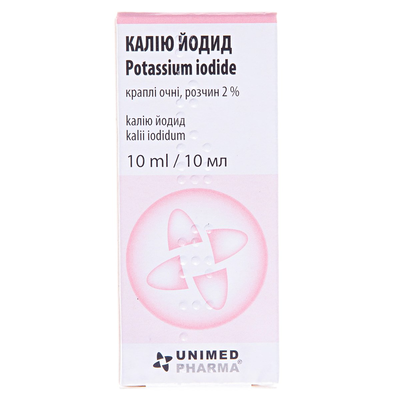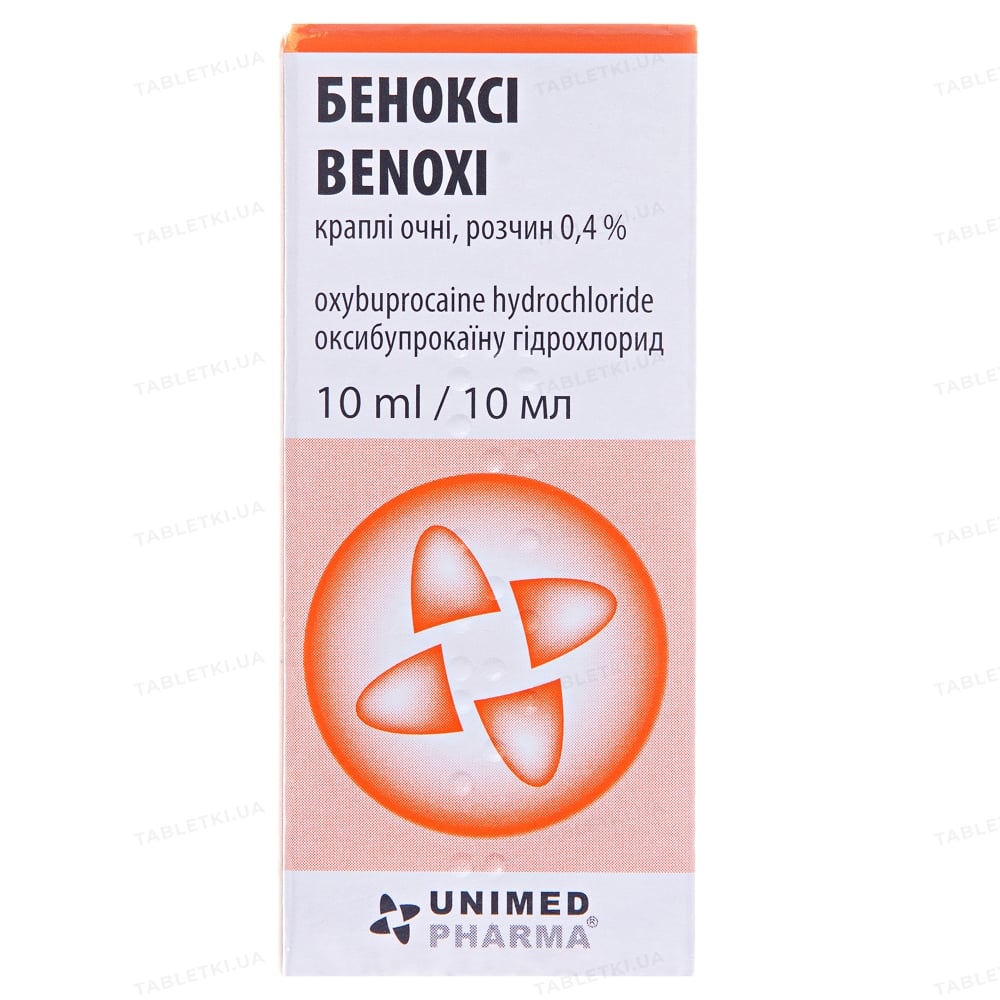


Benoxi eye drops, 0.4% solution, 10 ml in a dropper bottle
Ingredients
Active ingredient: oxybuprocaine hydrochloride;
1 mL of solution contains 4 mg of oxybuprocaine hydrochloride;
excipients: boric acid, chlorhexidine diacetate, water for injection.
Dosage Form
Eye drops, solution.
Main physical and chemical properties: a clear, colorless solution free of visible particles.
Pharmacotherapeutic group
Agents used in ophthalmology. Local anesthetics. ATC code S01H A02.
Pharmacological properties
Pharmacodynamics.
The active ingredient of the drug, oxybuprocaine hydrochloride, is a synthetic local anesthetic belonging to the group of para-aminobenzoic acid esters. It is a potent surface anesthetic that exhibits a rapidly increasing effect and exerts a short-term local anesthetic action (10–20 min). When administered in therapeutic doses to sensitive nerve endings, oxybuprocaine reversibly blocks the generation and transmission of nerve impulses, thereby causing temporary anesthesia at the site of instillation. It does not affect pupil size or the ability to accommodate. Once the local anesthetic effect wears off, pupil sensitivity returns to its initial state. In vitro, oxybuprocaine exhibits weak antibacterial activity.
Pharmacokinetics.
After instillation into the conjunctival sac, oxybuprocaine is absorbed into the bloodstream in small amounts. In the blood, oxybuprocaine is immediately metabolized by plasma esterase (via cleavage of the ether bond) to form inactive metabolites. The major metabolite is 3-butoxy-4-aminobenzoic acid, 80% of which is excreted by the kidneys in the form of a glucuronide.
Indications
Short-term local anesthesia of the cornea and conjunctiva: during the removal of foreign bodies from the cornea and conjunctiva; performance of ocular tonometry, gonioscopy, and other diagnostic examinations; preparation for subconjunctival and retrobulbar injections.
Contraindications
- Hypersensitivity to the active ingredient or other components of the drug.
- Severe heart failure.
- Thyrotoxicosis.
- Open penetrating eye wounds.
- Hypersensitivity to other local anesthetics belonging to the para-aminobenzoic acid ester group or the amide group.
- Eye infection.
- Allergic reactions.
Drug interactions and other interactions
Benoxi potentiates the effects of succinylcholine and sympathomimetics and attenuates the effects of sulfonamides and beta-blockers.
The drug contains the preservative chlorhexidine diacetate, which is incompatible with fluorescein solutions because it causes precipitation. Benoxi is also incompatible with silver nitrate, mercury salts, and alkaline substances.
Special Instructions for Use
Only a doctor should administer the drops!
Use only for instillation into the conjunctival sac. Do not use for injections. This medication should not be used at home.
Use the drops only for a short period of time. Because oxybuprocaine has a bacteriostatic effect, Benoxi should not be used prior to the collection of bacteriological swabs.
The patient should not touch the eye during anesthesia, as this may cause damage that would go unnoticed due to the anesthesia. The anesthetized eye should be protected from irritating chemicals, dust, and bacterial infections.
This medication should be used with caution in patients with pseudocholinesterase deficiency, myasthenia gravis, arterial hypotension, heart disease (heart failure, arrhythmia), and epilepsy.
This medication should be used with extreme caution in individuals with a history of bradycardia or allergic reactions, as the development of severe bradycardia or anaphylactic shock cannot be ruled out.
Uncontrolled use of any anesthetic, even at low concentrations, can lead to damage to the corneal epithelium even after brief use. Furthermore, this damage may go unnoticed due to anesthesia. Patients with chronic pain should be prescribed a systemic analgesic. Even a single use leads to the appearance of mild superficial lesions on the corneal epithelium. Repeated, long-term use exacerbates epithelial damage. Infiltration of the corneal stroma may occur, as well as toxic damage to the stroma, numerous erosions that heal very poorly (recurrent corneal erosions), leading to a condition similar to that observed in neuroparalytic keratitis.
Patients who wear contact lenses must remove them before using this medication and may put them back on once the anesthetic effect has completely worn off.
Systemic absorption of the drug can be reduced by applying pressure to the lacrimal sac located at the inner corner of the eye for one minute after instillation. This will prevent the drops from entering the nasal cavity through the nasolacrimal duct.
Use During Pregnancy or Breastfeeding.
Pregnancy.
The safety of this medication for use in pregnant women has not been established. This medication may be used during pregnancy only if, in the physician’s opinion, the potential benefit to the mother outweighs the potential risk to the fetus.
Breastfeeding
It is unknown whether oxybuprocaine hydrochloride is excreted in breast milk. Benoxi may be used by women who are breastfeeding only if, in the physician’s opinion, the potential benefit to the mother outweighs the potential risk to the infant.
Effect on the ability to drive or operate machinery.
Since oxybuprocaine is absorbed into the bloodstream—albeit in small amounts—following topical administration into the conjunctival sac, systemic effects may occur. Given the above, driving, operating machinery, or working at heights should not be done until at least 1 hour after applying the eye drops and after vision has returned to normal.
Dosage and Administration
This medication is intended for adults and children 2 years of age and older.
Instill into the conjunctival sac. Keep the eyes closed between successive instillations.
Anesthesia of the cornea and conjunctiva.
Removal of foreign particles on the surface: instill 1 drop 3 times at 5-minute intervals.
Removal of foreign particles located deep within the eye: 1 drop 5–10 times at 30–60-second intervals.
Before performing a subconjunctival or retrobulbar injection: 1 drop 3 times at 5-minute intervals.
Intraocular pressure measurement, gonioscopy, and other examinations: 1–2 drops once.
As with any eye drops, it is recommended to gently press on the lacrimal sac at the inner corner of the eye and release it after 1 minute to reduce systemic absorption. This should be done immediately after instilling each drop.
Remove contact lenses before using the eye drops; they may be reinserted once the anesthetic effect has completely worn off.
When using two or more ophthalmic medications, the interval between administrations should be at least 5 minutes.
Children.
This medication is not intended for use in children under 2 years of age.
Overdose
Systemic adverse reactions may develop with excessive doses or prolonged use. Systemic toxicity affects, in particular, the central nervous system and the cardiovascular system. Irritability, insomnia, sedation, confusion, agitation, euphoria, disorientation, hearing, vision, or speech disturbances, paresthesia, nausea, vomiting, muscle twitching, convulsions, respiratory disturbances, coma, tachycardia, arrhythmia, hypotension, shock, and cardiac arrest require symptomatic treatment. No specific antidote is known.
Side Effects
Ocular side effects.
After instillation of the medication, a temporary sensation of tingling and burning, redness, or discomfort may occur, which usually resolves quickly.
Allergic reactions of the eyelids and conjunctiva may develop. Prolonged or frequent use may lead to: stromal infiltration, edema, moderate damage to the corneal epithelium, keratitis (including toxic, superficial punctate, discoid, superinfectious candidal), iris fibrinous opacity, periorbital contact dermatitis (including allergic), suppression of the precorneal film (only in blue-eyed patients), changes in corneal thickness, decreased corneal sensitivity, keratopathies (including band keratopathy, bullous keratopathy, toxic keratopathy, necrotic ulcerative keratopathy, postoperative keratopathy), wrinkling of the Descemet’s membrane, enlargement of endothelial cells, reduced iris transparency, decreased endothelial cell density, extracellular melanosomes, subsequent reduction in normal cytokinesis and mitotic activity in ocular cells, formation of peripheral rings on the cornea, development of tolerance, damage to epithelial cells, irreversible superficial damage to corneal endothelial cells, direct cytotoxic effects on corneal cells (including a significant reduction in oxygen consumption by the corneal epithelium), chemosis, development of hypopyon or corneal perforation, necrosis of the cornea or conjunctiva. Corneal ulcers, recurrent corneal ulcers, delayed corneal healing, irreversible corneal opacification, decreased intraocular pressure, decreased spontaneous blinking rate, spontaneous eye movements, false-positive reactions, decreased tear film stability, and cataracts. Cases of fibrinous iritis have been reported.
Cardiovascular system.
Bradycardia.
Nervous system disorders.
Sedation, confusion, agitation, euphoria, disorientation, hearing, vision, or speech disturbances, paresthesia, muscle spasms, loss of consciousness, and in cases of severe overdose—seizures, respiratory arrest, and coma.
Gastrointestinal system.
Nausea, vomiting, dysphagia.
Immune system disorders.
Allergic reactions, including itching, erythema, eyelid swelling, contact allergy, hives, Quincke’s edema, angioedema, and anaphylactic shock.
Shelf life
24 months.
Store for no more than 28 days after first opening.
Storage conditions
Store in the refrigerator (2 °C – 8 °C).
Do not freeze. Store in the original packaging to protect from light.
After first opening, store at a temperature not exceeding 25 ºC for no more than 28 days.
Keep out of reach of children.
Packaging
10 mL in a dropper bottle. One dropper bottle, along with the package insert, in a cardboard box.
Manufacturer
UNIMED PHARMA Ltd.
Address
11 Orieskova St., 821 05, Bratislava, Slovak Republic/
Orieskova 11, 821 05 Bratislava, Slovak Republic.