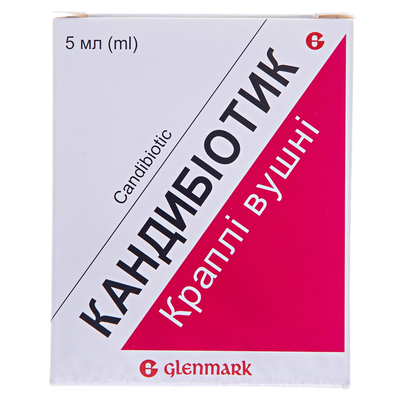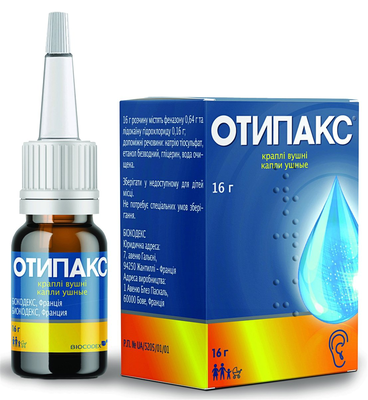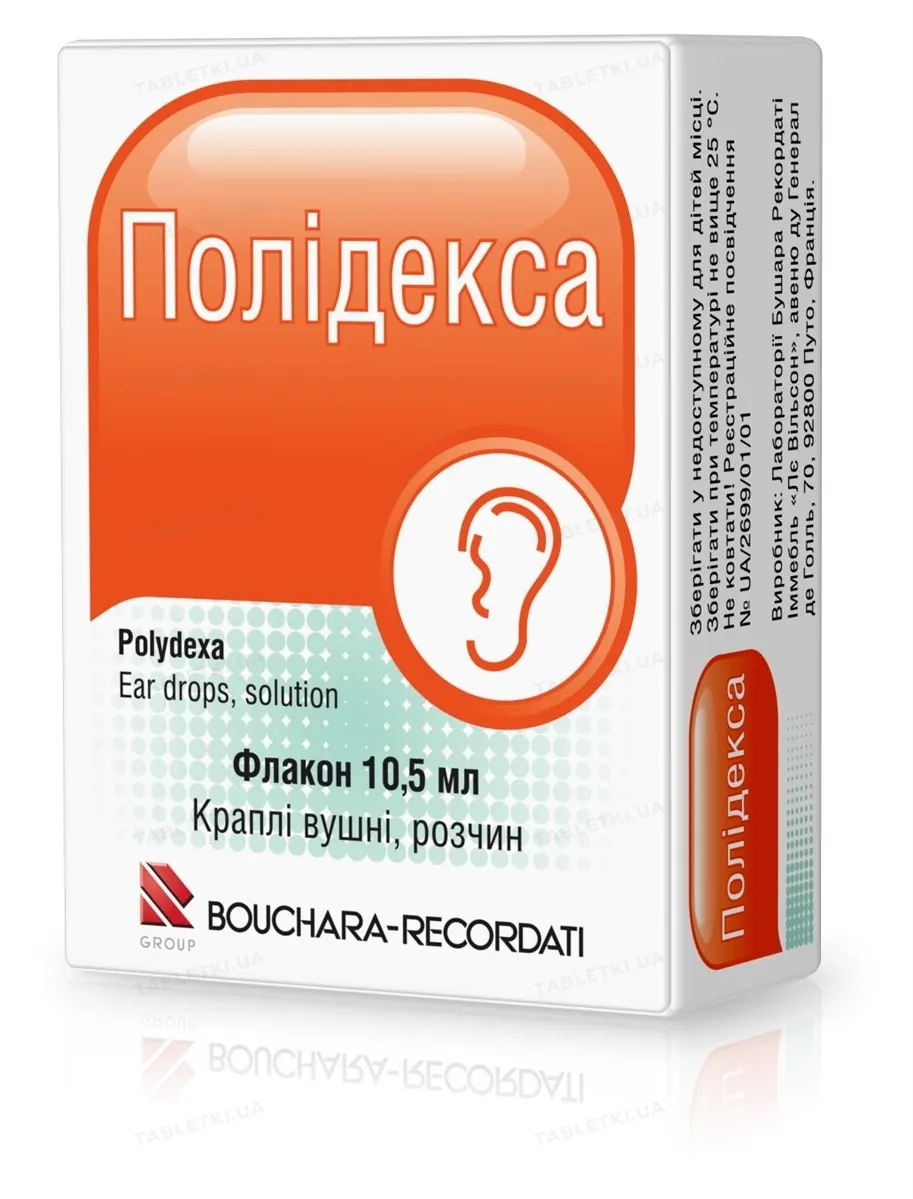
Polidexa ear drops, 10.5 ml per bottle.
Composition
Active ingredients: 1 mL of solution contains 10 mg of neomycin sulfate (6,500 IU), 10,000 IU of polymyxin B sulfate, and 1 mg of dexamethasone sodium metasulfobenzoate;
Excipients: thiomersal, citric acid monohydrate, sodium hydroxide, polyethylene glycol 400, polysorbate 80, purified water.
Dosage Form
Ear drops, solution.
Main physicochemical properties: a clear, yellow solution.
Pharmacotherapeutic group
Combination preparations containing corticosteroids and antimicrobials. Dexamethasone and antimicrobials.
ATC code S02C A06.
Pharmacological properties
Pharmacodynamics.
The therapeutic effect is due to the anti-inflammatory action of dexamethasone and the antimicrobial action of neomycin and polymyxin B. When these antibiotics are combined, the spectrum of antimicrobial activity is broadened against most Gram-positive and Gram-negative microorganisms that cause infectious and inflammatory ear diseases.
Polymyxin B is active against Acinetobacter, Aeromonas, Alcaligenes, Citrobacter, Enterobacter, E. coli, Klebsiella, Moraxella, P. aeruginosa, Salmonella, Shigella, and S. maltophilia.
The following cocci and bacilli are resistant to polymyxin B: B. catarrhalis, Brucella, B. cepacia, B. pseudomallei, Campylobacter, C. meningosepticum, Legionella, Morganella, Neisseria, Proteus, Providencia, Serratia, V. cholerae El Tor, and Mycobacteria.
Neomycin is active against Corynebacterium, Listeria monocytogenes, methicillin-sensitive Staphylococcus, Acinetobacter, B. catarrhalis, Campylobacter, Citrobacter, Enterobacter, E. coli, H. influenzae, Klebsiella, Morganella, Proteus, Providencia, Salmonella, Serratia, Shigella, Yersinia, and Pasteurella.
Enterococci, N. asteroides, Met-R Staphylococcus, Streptococcus, A. denitrificans, Burkholderia, Flavobacterium sp., P. stuartii, P. aeruginosa, S. maltophilia, Chlamydia, Mycoplasma, Rickettsiae, and resistant anaerobic bacteria
Pharmacokinetics.
In the absence of damage to the eardrum, systemic absorption does not occur.
Indications
Topical treatment of bacterial otitis externa without damage to the eardrum, including infectious eczema of the external auditory canal.
Contraindications
Hypersensitivity (allergy) to any of the drug’s components, including neomycin, other aminoglycosides, polymyxin B, or dexamethasone; Existing or suspected perforation of the eardrum; presence of signs of a viral infection in the external auditory canal, including chickenpox and infections caused by Herpes simplex.
Interactions with Other Medications and Other Types of Interactions
Concomitant use of this medication with any other topical medications is not recommended.
Concomitant treatment with CYP3A inhibitors, including medications containing cobicistat, may increase the risk of systemic adverse reactions. Such combinations should be avoided unless the benefit outweighs the increased risk of systemic side effects from corticosteroids. If such combinations are prescribed to a patient, treatment should be conducted under medical supervision, and systemic side effects of corticosteroids should be monitored.
No studies on drug interactions with other medications have been conducted.
The effect of critical concentrations of the drug’s antibacterial components was studied to identify susceptible, semi-susceptible, or resistant strains of microorganisms.
Special Considerations for Use
Warning. An examination of the eardrum is required before starting treatment. If the eardrum is perforated, use of the drug is contraindicated, as irreversible ototoxic effects (deafness, balance disorders) may occur.
Topical application of antibacterial drugs may cause sensitization to the active ingredients and lead to systemic reactions.
The presence of a corticosteroid does not affect the manifestation of cutaneous allergic reactions to antibiotics but may alter the clinical presentation of an allergic reaction.
Discontinue use of the medication immediately if a skin rash or other local or systemic manifestations of allergic reactions occur.
Athletes should be warned that this medication contains an active ingredient (dexamethasone) that may result in a positive test during doping control.
Do not swallow the solution; do not use it as an injection.
While using the product, do not touch the tip of the dropper with your fingers and avoid contact with the ear to reduce the risk of infection.
If symptoms do not resolve after a 10-day course of treatment, the patient should consult a doctor to confirm the diagnosis and review the treatment strategy.
Although this is a topical medication, keep in mind that with long-term treatment (beyond the recommended duration) or when used at doses significantly higher than recommended, the medication may have systemic effects.
When treating with this medication, official guidelines on the proper use of antibiotics must be followed.
Visual Disturbances
Visual disturbances may occur during systemic or topical corticosteroid therapy. If blurred vision or any other symptoms of visual disturbance occur during corticosteroid therapy, an ophthalmologist should examine the patient for cataracts, glaucoma, or a rarer condition such as central serous retinopathy, which can occur with systemic or topical corticosteroid use.
Thiomersal
This medication contains thiomersal, which may cause local skin reactions (e.g., contact dermatitis) and skin discoloration (see the “Adverse Reactions” section).
Use During Pregnancy or Breastfeeding
Pregnancy
There are no data on the use of this drug in animals or in clinical practice. However, systemic exposure is unlikely in the absence of a perforated eardrum.
Use of this drug during pregnancy should be considered only if necessary.
Breastfeeding
Use of this drug during breastfeeding should be considered only if necessary.
Fertility
Not applicable.
Effect on reaction time when driving or operating machinery
No effect on reaction time when driving or operating machinery has been observed.
Dosage and Administration
Apply the medication topically by instilling it into the ear.
Instill the drops into the external auditory canal of the affected ear every morning; repeat the procedure in the evening.
Dosage for adults: 1–5 drops in the affected ear twice daily.
Dosage for children (depending on the child’s age): 1–2 drops in the affected ear twice daily.
The duration of treatment depends on the nature and severity of the condition and is determined by the doctor on an individual basis. The average duration of treatment is 7 days.
Before using the drops, warm the bottle by holding it in the palm of your hand to avoid the unpleasant sensation caused by cold liquid entering the ear. Tilt your head, instill the required number of drops into the ear, and gently pull the earlobe back a few times. Keep your head tilted for about 5 minutes to help the solution reach the ear canal. If necessary, repeat the procedure for the other ear.
Do not administer the medication under pressure.
After completing treatment, discard the bottle; do not save the medication for future use.
Children
Use as directed by a doctor to treat children of any age.
Overdose
No cases of overdose have been reported.
Side Effects
Adverse reactions are classified by frequency and organ system. Frequency is determined as follows: very common (> 1/10), common (from > 1/100 to < 1/10), uncommon (from > 1/1,000 to < 1/100), rare (from > 1/10,000 to < 1/1,000), very rare (< 1/10,000), frequency unknown (cannot be estimated from the available data).
| Organ system
Class |
Adverse reactions | Frequency |
| Infections and infestations | Fungi resistant to antifungal agents | Unknown |
| Immune system disorders | Allergy to antibiotics (neomycin, polymyxin B)1 | Unknown |
| Vision problems | Blurred vision | Unknown |
| Hearing and inner ear disorders | Vestibular or cochlear ototoxicity2 | Unknown |
| Skin and subcutaneous tissue disorders | Local skin reactions (e.g., contact dermatitis)3
Skin discoloration 3 |
Unknown |
| General disorders and administration site conditions | Local reactions (irritation) | Unknown |
1 Sensitization that may preclude further systemic use of the corresponding antibiotic.
2 In case of a perforated eardrum.
3 Associated with the presence of thiomersal.
Reporting adverse reactions after the drug’s approval is of great importance. This allows for monitoring the benefit-risk ratio associated with the use of this drug. Healthcare and pharmaceutical professionals, as well as patients or their legal representatives, should report all cases of suspected adverse reactions and lack of efficacy of the drug through the Automated Pharmacovigilance Information System at the following link: https://aisf.dec.gov.ua.
Shelf life
3 years.
Storage conditions
Store at a temperature not exceeding 25 °C.
Keep out of reach of children.
Packaging
10.5 mL in a vial; 1 vial with a pipette in a cardboard box.
Manufacturer
Pharmaster.
Manufacturer’s location and business address.
Zone Industrielle de Kraft, 67150, Erstein, France.