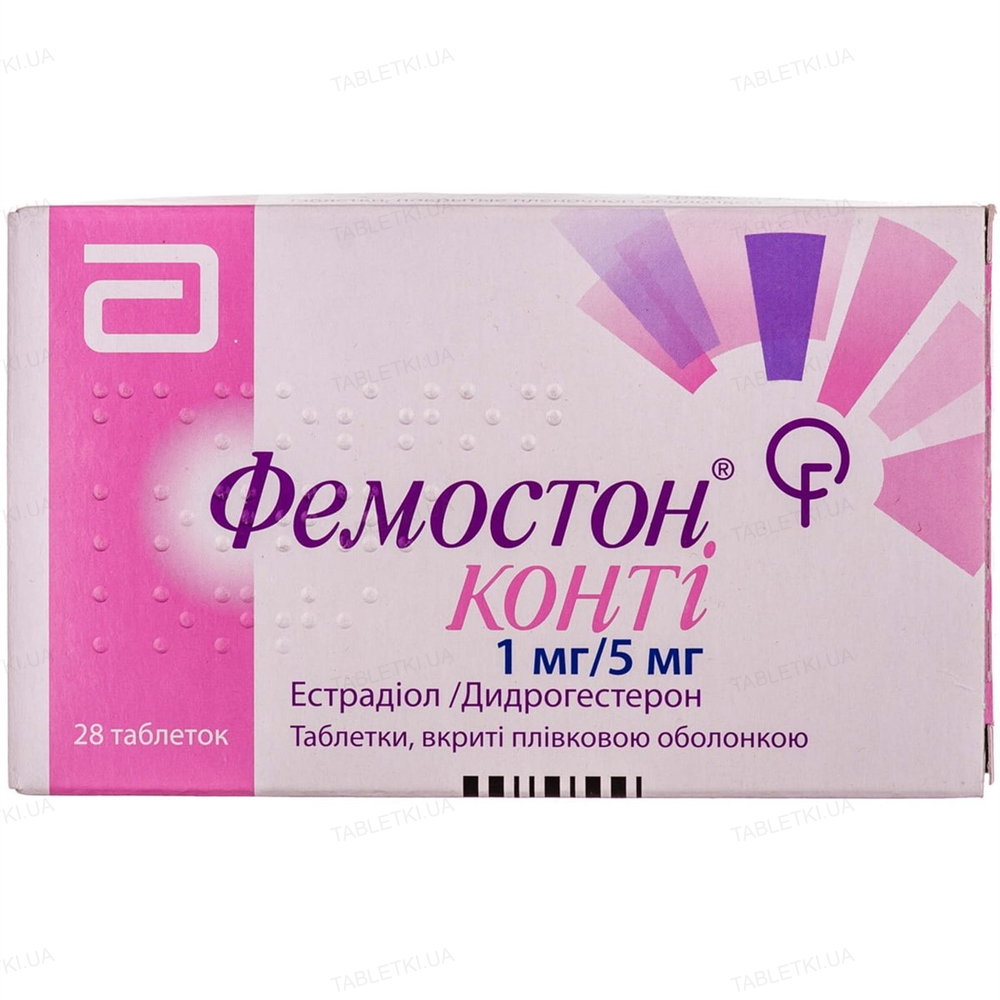
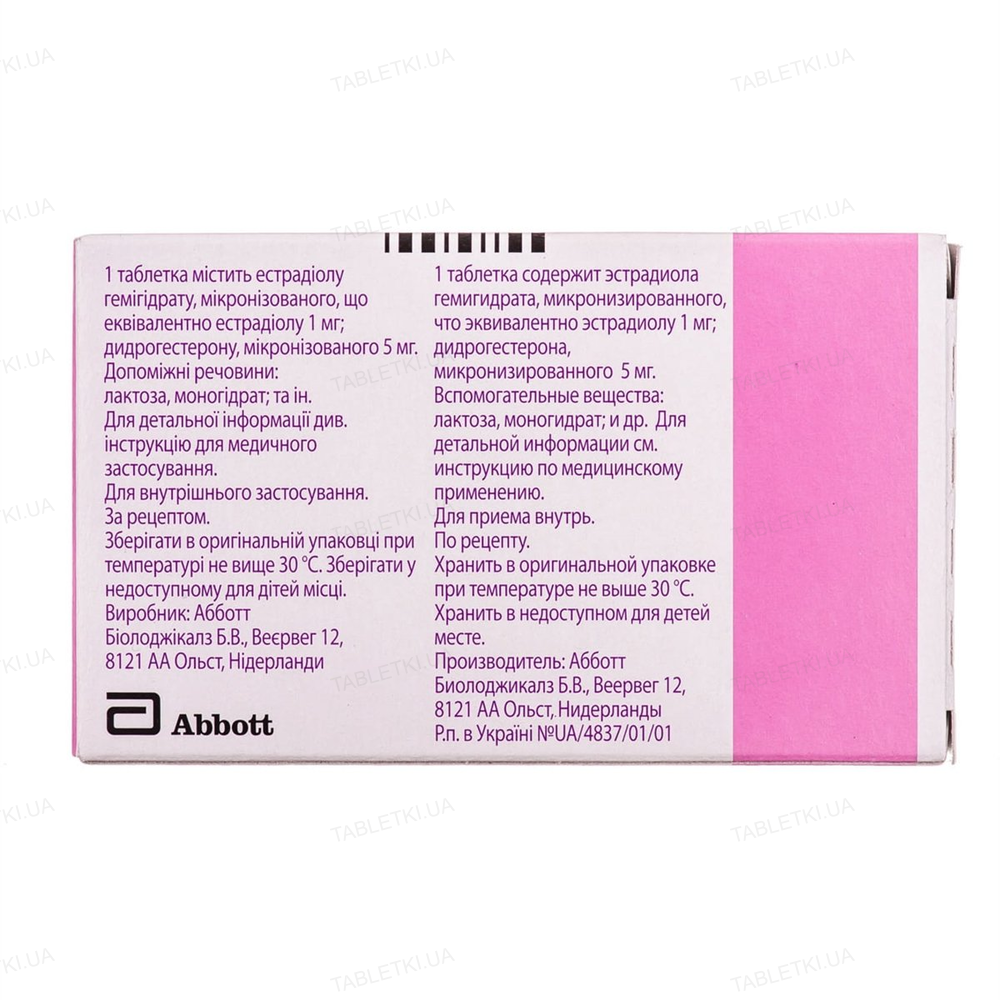
Femoston Conti tablets, film-coated, 1 mg/5 mg, No. 28
1 tablet contains micronized estradiol hemihydrate equivalent to 1 mg of estradiol; 5 mg of micronized dydrogesterone;
excipients: lactose monohydrate; hypromellose (HPMC 2910), corn starch, colloidal anhydrous silicon dioxide, magnesium stearate;
film coating: Orange I mixed film coating (polyethylene glycol 400, hypromellose (HPMC 2910), yellow iron oxide (E 172), red iron oxide (E 172), titanium dioxide (E 171)).
Dosage Form
Film-coated tablets.
Main physical and chemical properties: a round, biconvex, orange-pink film-coated tablet, marked “379” on one side. The diameter is 7 mm, and the tablet weighs approximately 144 mg.
Pharmacotherapeutic group
Drugs for the treatment of diseases of the genitourinary system and sex hormones. Progestogens in combination with estrogens. Dydrogesterone and estrogen. ATC code G03F A14.
Pharmacological Properties
Pharmacodynamics.
Estradiol
The active ingredient, 17β-estradiol, is chemically and biologically similar to the natural female sex hormone estradiol. It compensates for the loss of endogenous estrogen production in women during menopause and alleviates menopausal symptoms.
Estrogens prevent bone loss following menopause or oophorectomy.
Dydrogesterone
Dydrogesterone is an orally active progestin whose effect is comparable to that of progesterone administered parenterally.
Because estrogens stimulate endometrial growth, they increase the risk of endometrial hyperplasia and carcinoma if a progestin is not used. Adding a progestin to therapy significantly reduces the estrogen-induced risk of endometrial hyperplasia in women with an intact uterus.
Clinical trial data
Reduction in symptoms of estrogen deficiency and improvement in bleeding patterns.
A reduction in menopausal symptoms was observed within the first few weeks of treatment.
Amenorrhea (no bleeding or spotting) was observed in 88% of women during 10–12 months of treatment. Irregular bleeding and/or spotting were observed in 15% of women during the first 3 months of treatment and in 12% during the 10th–12th months of treatment.
Prevention of Osteoporosis
Estrogen deficiency after menopause is associated with increased bone resorption and a decrease in bone mass. The effect of estrogens on bone density is dose-dependent. The protective effect of estrogens is only present while they are being taken. After discontinuation of hormone replacement therapy (HRT), the rate of bone mass loss is the same as in women who did not receive this therapy.
Data from the Women’s Health Initiative (WHI) and a meta-analysis of other studies indicate that the use of HRT in predominantly healthy women—either as estrogen monotherapy or in combination with progestin—reduces the risk of hip fractures, vertebral fractures, and other types of fractures due to osteoporosis. HRT may also prevent fractures in women with low bone density and/or diagnosed osteoporosis, but data on this are limited.
After one year of treatment, bone mineral density in the lumbar spine increased by approximately 4.0% ± 3.4% [mean ± standard deviation (SD)]. In 90% of patients, bone density increased or remained unchanged during treatment.
FEMOSTON CONTI also affected femoral bone density. After one year of treatment with FEMOSTON® CONTI, bone density at the femoral neck was 1.5% ± 4.5% (mean ± SD), 3.7% ± 6.0% for the trochanter (mean ± SV), and 2.1% ± 7.2% for Ward’s triangle (mean ± SV).
The percentage of women who maintained or increased bone density in these three regions of the femur after treatment with FEMOSTON®CONTI was 71%, 66%, and 81%, respectively.
Pharmacokinetics.
Estradiol
Absorption
The absorption of estradiol depends on particle size: micronized estradiol is rapidly absorbed from the gastrointestinal tract.
The table shows the mean steady-state pharmacokinetic parameters for estradiol (E2), estrone (E1), and estrone sulfate (E1S) for each dose of micronized estradiol.
The data are presented as mean values (SD).
Estradiol 1 mg
| E2 | E1 | Parameters | E1C | |
| Cmax (pg/mL) | 71 (36) | 310 (99) | Cmax (ng/mL) | 9.3 (3.9) |
| Cmin (pg/mL) | 18.6 (9.4) | 114 (50) | Cmin (ng/mL) | 2.099 (1.340) |
| C (pg/mL) | 30.1 (11.0) | 194 (72) | Cof (ng/mL) | 4,695 (2,350) |
| AUC0-24 (pg·g/mL) | 725 (270) | 4,767 (1,857) | AUC0-24 (ng·h/mL) | 112.7 (55.1) |
Distribution
Estrogens may occur in an unbound or bound state. Approximately 98–99% of the estradiol dose is bound to plasma proteins, of which 30–52% is bound to albumin and approximately 46–69% to sex hormone-binding globulin (SHBG).
Biotransformation
After oral administration, estradiol is extensively metabolized. The major unconjugated and conjugated metabolites are estrone and estrone sulfate. These metabolites may contribute to estrogenic activity either directly or after conversion to estradiol. Estrone sulfate may undergo enterohepatic circulation.
Excretion
In urine, the major compounds are estrone and estradiol glucuronides. The half-life ranges from 10 to 16 hours. Estrogens are excreted into breast milk.
Depends on dose and duration
With daily oral administration of the drug, estradiol concentrations reach steady state in approximately 5 days. In most cases, steady-state concentrations are achieved between 8 and 11 days of administration.
Dydrogesterone
Absorption
After oral administration, dydrogesterone is rapidly absorbed, with a Tmax of 0.5 to 1.5 hours.
The following table presents the mean pharmacokinetic parameters for dydrogesterone (D) and dihydrodydrogesterone (DHD). Data are presented as mean values (SD).
Dydrogesterone 5 mg
| D | DHD | |
| Cmax (ng/mL) | 0.90 (0.59) | 24.68 (10.89) |
| AUC0-t (ng·h/mL) | 1.55 (1.08) | 98.37 (43.21) |
| AUCinf (ng·h/mL) | - | 121.36 (63.63) |
After a single meal, the peak concentration of dydrogesterone in blood plasma is delayed by approximately 1 hour, which leads to a decrease in peak plasma concentrations of dydrogesterone by approximately 20%, without affecting the extent of action of dydrogesterone and DHD.
Distribution
Following oral administration of dydrogesterone, the apparent volume of distribution is substantial and amounts to approximately 22,000 L. Dydrogesterone and DHD are bound to plasma proteins by more than 90%.
Biotransformation
After oral administration, dydrogesterone is rapidly metabolized to form DHD. Levels of the major active metabolite, 20α-dihydrodydrogesterone (DHD), reach their peak at the same time as dydrogesterone. Plasma levels of DHD are significantly higher than those of the parent compound. The AUC and Cmax ratios of DHD to dydrogesterone are approximately 25 and 20, respectively. The mean terminal half-life of dydrogesterone and DHD is approximately 15 hours. A common feature of all metabolites is the retention of the 4,6-diene-3-one configuration of the parent compound and the absence of 17α-hydroxylation. This explains the absence of the estrogenic and androgenic effects of dydrogesterone.
Excretion
After oral administration of labeled dydrogesterone, an average of 63% of the dose is excreted in the urine. The apparent total plasma clearance of dydrogesterone in the body is high, at approximately 20 L/min. Complete elimination occurs within 72 hours. DHD is present in urine primarily as a glucuronic acid conjugate.
Depends on dose and time
Single- and multiple-dose pharmacokinetics are linear over the oral dose range of 2.5 to 20 mg. A comparison of the kinetics of single and multiple doses shows that the pharmacokinetics of dydrogesterone and DHD do not change with repeated administration. Steady-state conditions are usually reached after 3 days of treatment.
Indications
Hormone replacement therapy (HRT) to alleviate symptoms caused by estrogen deficiency in menopausal women, no earlier than 12 months after the last menstrual period.
Prevention of osteoporosis in postmenopausal women at high risk for fractures. FEMOSTON® CONTI should be used in patients only if they are intolerant of or have contraindications to other medications for the prevention of osteoporosis (see the “Special Warnings and Precautions for Use” section).
Experience with treating women over 65 years of age is limited.
Contraindications
- A history of, current, or suspected breast cancer;
- Confirmed or suspected estrogen-sensitive tumors (e.g., endometrial cancer);
- confirmed or suspected progestin-sensitive tumors (e.g., meningioma);
- vaginal bleeding of unknown origin;
- untreated endometrial hyperplasia;
- active venous thromboembolism (deep vein thrombosis, pulmonary embolism);
- presence of thrombophilic disorders (e.g., protein C, protein S, or antithrombin deficiency; see the “Special Warnings and Precautions for Use” section);
- acute or recent thromboembolic arterial disease (e.g., angina pectoris, myocardial infarction);
- acute liver disease or a history of liver disease, if liver function tests have not returned to normal;
- porphyria;
- known hypersensitivity to the active ingredients or to any of the drug’s excipients.
Interactions with Other Medications and Other Types of Interactions
No drug interaction studies have been conducted.
The efficacy of estrogens and progestins may be impaired.
- The metabolism of estrogens (and progestins) may be enhanced when used concomitantly with substances capable of inducing enzymes involved in drug metabolism. This applies, in particular, to the P450 2B6, ZA4, ZA5, and ZA7 enzymes. These include anticonvulsants (phenobarbital, carbamazepine, phenytoin) and antibacterial/antiviral agents (e.g., rifampin, rifabutin, nevirapine, efavirenz).
- Although ritonavir and nelfinavir are known as potent inhibitors of CYP450 3A4, A5, and A7, they actually have an inducing effect when used concomitantly with steroid hormones.
- Herbal preparations containing St. John’s wort (Hypericum perforatum) may also increase the metabolism of estrogens (and progestins) as they pass through CYP450 3A4.
- Clinically, increased metabolism of estrogens and progestins may result in reduced efficacy and changes in the bleeding pattern.
Pharmacodynamic Interactions
In clinical studies, treatment of hepatitis C virus (HCV) with the combination of ombitasvir/paritaprevir/ritonavir, with or without dasabuvir, was significantly more than 5 times the upper limit of normal alanine aminotransferase (ALT) levels in women receiving medications containing ethinyl estradiol, such as combined hormonal contraceptives (CHCs). In women taking medications containing estrogens other than ethinyl estradiol, such as estradiol, the degree of ALT elevation was similar to that in women who did not receive any estrogens; However, due to the limited number of women taking other estrogens, caution should be exercised when this drug is used concomitantly with ombitasvir/paritaprevir/ritonavir combination therapy, with or without dasabuvir, as well as with glecaprevir/pibrentasvir therapy (see Section 4.4).
Estrogens may affect the metabolism of other drugs
Estrogens may inhibit CYP450 enzymes involved in drug metabolism through competitive inhibition. This should be taken into account particularly with regard to drugs with a narrow therapeutic index, such as:
- tacrolimus and cyclosporine A (CYP450 3A4, 3A3);
- fentanyl (CYP450 3A4);
- theophylline (CYP450 1A2).
Clinically, this may lead to an increase in the plasma levels of these substances to toxic concentrations. Therefore, careful monitoring of drug levels over an extended period may be required, as well as a reduction in the dose of tacrolimus, fentanyl, cyclosporine A, and theophylline.
Special Considerations for Use
For the treatment of estrogen deficiency symptoms in postmenopausal women, HRT should be initiated only if these symptoms significantly impair quality of life. The benefits and risks of HRT should be carefully evaluated on a regular basis, at least annually, and treatment should be continued only if the benefits outweigh the risks.
Data on the risks associated with HRT for the treatment of premature menopause are limited. However, due to the low absolute risk in younger women, the benefit-risk ratio in these women is more favorable than in older women.
Medical Examination/Follow-up
A complete medical history (including family history) should be obtained before starting HRT or, if necessary, before resuming HRT after a break. A physical examination (including a gynecological examination and breast examination) should be performed, taking into account the medical history, contraindications, and precautions for use. During treatment, regular examinations are recommended, the frequency and scope of which are determined on an individual basis. Women should be informed about what changes in their breasts they should report to their doctor or nurse (see the “Breast Cancer” section below). Examinations, including appropriate imaging methods such as mammography, should be performed in accordance with current screening practices, modified as needed to meet individual clinical needs.
Conditions Requiring Monitoring
If any of the following conditions are present in the patient’s medical history and/or worsen during pregnancy or previous hormone therapy, patients should be closely monitored. It should be noted that these conditions may recur or worsen during treatment with FEMOSTON® CONTI. These include:
- leiomyoma (uterine fibroid) or endometriosis;
- risk factors for thromboembolic disease (see below);
- risk factors for estrogen-sensitive tumors, such as a first-degree hereditary predisposition to breast cancer;
- hypertension;
- liver disease (e.g., liver adenoma);
- diabetes mellitus with or without vascular complications;
- gallstone disease;
- migraine or (severe) headache;
- systemic lupus erythematosus;
- history of endometrial hyperplasia (see below);
- epilepsy;
- bronchial asthma;
- otosclerosis;
- meningioma.
Reasons for Immediate Discontinuation of Therapy
Hormone replacement therapy should be discontinued immediately if contraindications are identified, as well as in the following situations:
- the onset of jaundice or liver dysfunction;
- a significant increase in blood pressure;
- the first occurrence of a migraine-like headache;
- pregnancy.
Endometrial hyperplasia and carcinoma
In women with an intact uterus, the risk of endometrial hyperplasia and carcinoma increases with long-term estrogen-only HRT. The observed increase in the risk of endometrial cancer in women taking estrogen-only medications ranges from 2 to 12 times that of women who do not take them, depending on the duration of treatment and the estrogen dose (see the “Adverse Effects” section). After discontinuation of treatment, the risk may remain elevated for at least 10 years.
A cyclic combination of estrogen and progestin for at least 12 days per month / a 28-day cycle, or continuous combined estrogen and progestin therapy in women with an intact uterus, prevents the excessive risk associated with estrogen alone.
Breakthrough uterine bleeding or spotting may occur during the first few months of treatment. If these occur some time after treatment begins or persist after treatment is discontinued, the cause must be determined. This may include an endometrial biopsy to rule out malignancy.
Breast Cancer
All available data indicate an increased risk of breast cancer in women taking combined estrogen-progestin HRT or estrogen-only HRT. This risk depends on the duration of use.
Combined estrogen-progestin therapy
Both the randomized, placebo--controlled Women’s Health Initiative (WHI) study and a meta-analysis of prospective epidemiological studies have consistently shown an increased risk of breast cancer in women taking combined estrogen-progestin HRT. The increased risk becomes apparent after approximately 3 (1 to 4) years (see the “Adverse Effects” section).
Estrogen-only therapy
The WHI study did not identify an increased risk of breast cancer in women who have undergone hysterectomy and are taking estrogen-only HRT. Experimental studies have reported a slight increase in the risk of breast cancer diagnosis, which is significantly lower than in patients taking estrogen-progestin combinations (see the “Adverse Effects” section).
The results of a large-scale meta-analysis showed that after discontinuation of treatment, the increased risk will decrease over time, and the time required to return to baseline depends on the duration of previous HRT use. In cases where HRT is used for more than 5 years, the risk may persist for 10 years or longer. HRT, particularly combined estrogen-progestin therapy, increases mammographic density, which may negatively affect the radiographic detection of breast cancer.
Ovarian Cancer
Ovarian cancer is significantly less common than breast cancer. Epidemiological data from a large meta-analysis showed a slightly increased risk in women receiving estrogen monotherapy or a combination of estrogen and progestin as hormone replacement therapy; This risk becomes apparent within 5 years of use and decreases over time after discontinuation of therapy. Some other studies, including the WHI study, suggest that the use of combined HRT may be associated with the same or a slightly lower risk (see the “Adverse Effects” section).
Venous Thromboembolism
HRT is associated with a 1.3-fold increased risk of venous thromboembolism (VTE), i.e., deep vein thrombosis or pulmonary embolism. This condition is more likely to occur during the first year of HRT than later (see the “Adverse Effects” section).
Patients with known thrombophilic conditions are at increased risk for VTE, and HRT may further increase this risk. Therefore, hormone replacement therapy is contraindicated in this group of patients (see the “Contraindications” section).
Well-established risk factors for VTE include: estrogen use, advanced age, major surgery, prolonged immobilization, obesity (BMI > 30 kg/m²), pregnancy/postpartum period, systemic lupus erythematosus (SLE), and cancer. There is no consensus on the role of varicose veins in the development of VTE. As with all postoperative patients, precautions should be taken to prevent VTE after surgery. If prolonged immobilization is expected following elective surgery, temporary discontinuation of HRT is recommended 4–6 weeks before surgery. Treatment may be resumed only once the woman has fully regained her mobility.
Women with no history of VTE but with first-degree relatives who experienced thrombosis at a young age may be offered screening after a thorough discussion of its limitations (screening detects only a subset of thrombophilic disorders).
If a congenital thrombophilic disorder is identified—defined as a history of thrombosis in a family member—or if the disorder is severe (e.g.,antithrombin, protein S or protein C deficiency, or a combination of disorders), GGT is contraindicated.
In women who are already on long-term anticoagulant therapy, the benefits and risks of ZGT must be carefully weighed.
If VTE develops after the start of therapy, the medication should be discontinued immediately. Patients should be advised to seek immediate medical attention if potential symptoms of thromboembolism occur (e.g., painful leg swelling, sudden chest pain, shortness of breath).
Coronary Artery Disease (CAD)
There are no randomized controlled trials demonstrating protection against myocardial infarction in women with or without ischemic heart disease who took combined estrogen-progestin HRT or estrogen-only HRT.
Combined estrogen-progestin therapy
The relative risk of developing coronary heart disease with combined estrogen-progestin HRT is slightly increased. Since the baseline absolute risk of CHD depends heavily on age, the number of additional cases of ischemic heart disease attributable to the use of estrogen and progestin is very low in healthy women approaching menopause but will increase with advancing age.
Estrogen-only therapy
Data from randomized controlled trials have not shown an increased risk of ischemic heart disease in women who have undergone hysterectomy and are receiving estrogen monotherapy.
Ischemic stroke
Combined estrogen-progestin therapy and estrogen monotherapy are associated with a 1.5-fold increase in the risk of ischemic stroke. The relative risk does not change with age or time since menopause. However, since the baseline absolute risk of stroke is highly dependent on age, the overall risk of stroke in women taking HRT will increase with age (see the “Adverse Effects” section).
Other Conditions
Estrogens may cause fluid retention; therefore, patients with impaired cardiac or renal function should be closely monitored.
Women with pre-existing hypertriglyceridemia should be closely monitored during estrogen replacement therapy or hormone replacement therapy, as in rare cases, women with this condition may experience a significant increase in plasma triglyceride levels during estrogen therapy, leading to pancreatitis.
Exogenous estrogens may cause or exacerbate the symptoms of hereditary and acquired angioedema.
- Estrogens increase thyroxine-binding globulin (TBG) levels, leading to an increase in circulating thyroid hormones, as measured by protein-bound iodine (PBI) levels, T4 levels (by column chromatography or radioimmunoassay), or TK levels (by radioimmunoassay). Triiodothyronine (TK) uptake is reduced as a result of elevated TSH levels. Concentrations of free triiodothyronine (T3) and thyroxine (T4) remain unchanged. Levels of other serum-binding proteins, corticoid-binding globulin (CRG) and sex hormone-binding globulin (SHBG), sex hormone-binding globulin (SHBG), may increase, leading to elevated concentrations of corticosteroids and sex hormones in the blood. Concentrations of free or biologically active hormones remain unchanged. Concentrations of other plasma proteins (angiotensin-renin substrate, alpha-1-antitrypsin, ceruloplasmin) may increase.
- HRT does not improve cognitive function. There have been some reports of an increased risk of developing possible dementia in women who begin long-term combined or estrogen-only HRT at age 65 or older.
- Patients with rare hereditary disorders, such as galactose intolerance, Lapp lactase deficiency, or glucose-galactose malabsorption, should not use this medication.
- FEMOSTON® CONTI is not a contraceptive.
Elevated ALT levels
In clinical studies of patients treated for hepatitis C virus (HCV) infection with a combination of ombitasvir/paritaprevir/ritonavir with or without dasabuvir, elevations in ALT levels exceeding 5 times the upper limit of normal were significantly more common in women using medications containing ethinyl estradiol, such as combined hormonal contraceptives (CHCs). In addition, among patients receiving glecaprevir/pibrentasvir, ALT elevations were also observed in women taking ethinyl estradiol-containing medications, such as CHC. In women taking medications containing estrogens other than ethinyl estradiol, such as estradiol, the degree of ALT elevation was similar to that in women who were not receiving any estrogens; however, due to the limited number of women taking other estrogens, caution should be exercised when this drug is used concomitantly with ombitasvir/paritaprevir/ritonavir combination therapy, with or without dasabuvir, as well as with glecaprevir/pibrentasvir therapy (see the “Interactions with Other Medications and Other Interactions” section).
Pregnancy and lactation.
Pregnancy
FEMOSTON CONTi is not indicated for use during pregnancy. If pregnancy occurs during treatment with FEMOSTON® CONTi, the drug should be discontinued immediately.
There are insufficient data on the use of estradiol/dydrogesterone in women during pregnancy.
It has been reported in the literature that the use of certain progestogens has been associated with an increased risk of hypospadias. However, due to confounding factors during pregnancy, it is not possible to definitively determine whether progestogens contribute to the development of hypospadias.
To date, the results of most epidemiological studies concerning incidental fetal exposure to a combination of estrogens and progestogens indicate no teratogenic or toxic risk to the fetus.
Breastfeeding
FEMOSTON® CONTi is not indicated for use during lactation.
Effect on Fertility
FEMOSTON® CONTI is not indicated for use in women of reproductive age.
Effects on the ability to drive and operate machinery.
FEMOSTON® CONTI has virtually no effect on the ability to drive or operate machinery.
Dosage and Administration
FEMOSTON® CONTI should be taken orally daily according to the continuous combined regimen described below.
Take 1 tablet daily throughout each 28-day cycle. Each blister pack is intended for a 28-day treatment period. A new cycle should be started immediately afterward. These consecutive treatment cycles are continuous.
For the treatment of estrogen deficiency in postmenopausal women, the lowest effective dose should be used as both the initial and maintenance dose, and the duration of treatment should be as short as possible (see also the “Special Warnings and Precautions for Use” section).
Continuous combined therapy may be initiated with FEMOSTON® CONTINUOUS, depending on the time elapsed since the onset of menopause and the severity of symptoms. Women who have undergone natural menopause may begin treatment with the drug 12 months after their last menstrual period. Women who have undergone surgical menopause may begin treatment immediately.
The dose should be adjusted individually based on the clinical response.
For women not currently using hormone replacement therapy, or for women switching from continuous combined hormone replacement therapy, treatment may be started on any convenient day. For women switching from cyclic or continuous sequential hormone replacement therapy, treatment should begin the very next day after the previous cycle ends.
If a dose is missed, it should be taken as soon as possible. If more than 12 hours have passed, it is recommended to continue treatment with the next tablet without taking the missed tablet. In such cases, the missed tablet may increase the likelihood of breakthrough bleeding or spotting.
FEMOSTON®CONTI can be taken with or without food.
Children.
This medication is not intended for use in children.
Overdose
Both estradiol and dydrogesterone are substances with low toxicity. In the event of an overdose, symptoms such as nausea, vomiting, breast tenderness, dizziness, abdominal pain, drowsiness/fatigue, and withdrawal bleeding may occur. It is unlikely that any specific or symptomatic treatment will be required in the event of an overdose. The information described above also applies to cases of overdose in children.
Side Effects
The most common adverse reactions in patients receiving estradiol/dydrogesterone in clinical trials were headache, abdominal pain, breast pain/tenderness, and lower back pain.
In clinical studies (n = 5,108), the following adverse reactions were observed with the following frequencies:
Table 1
| MedDRA System Organ Classes | Very common
≥ 1/10 |
Common,
≥ 1/100, < 1/10 |
Uncommon,
≥ 1/1,000, < 1/100 |
Rare
≥ 1/10,000 to < 1/1,000 |
| Infections and parasitic diseases | Vaginal candidiasis
|
Cystitis-like syndrome | ||
| Benign, malignant, and unspecified neoplasms | Enlargement of fibroids
|
|||
| Diseases of the Blood and Lymphatic System | Hemolytic anemia* | |||
| Immune system disorders | Hypersensitivity | |||
| Mental disorders
|
Depression, nervousness | Effects on libido | ||
| Central Nervous System Disorders | Headache | Migraine, dizziness | Meningioma* | |
| Eye disorders | Increased corneal curvature*, contact lens intolerance* | |||
| Heart conditions | Myocardial infarction | |||
| Vascular disorders
|
Venous thromboembolism**, hypertension, peripheral vascular disease, varicose veins | Stroke* | ||
| Gastrointestinal disorders
|
Abdominal pain | Nausea, vomiting,
flatulence |
Dyspepsia | |
| Hepatobiliary disorders
|
Liver dysfunction (in some cases accompanied by jaundice, asthenia, or malaise and abdominal pain), gallbladder disorders | |||
| Diseases of the skin and subcutaneous tissue
|
Allergic skin reactions (e.g., rash, hives, itching)
|
Quincke’s edema,
erythema nodosum*, vascular purpura; chloasma or melasma, which may persist if treatment is discontinued* |
||
| Musculoskeletal and connective tissue disorders | Back pain
|
Cramps in the lower extremities* | ||
| Disorders of the reproductive system and mammary glands
|
Chest pain / pain | Menstrual cycle disorders (including postmenopausal bleeding, metrorrhagia, menorrhagia, oligomenorrhea/amenorrhea, irregular menstruation, dysmenorrhea), pelvic pain, cervical discharge | Breast enlargement, premenstrual syndrome (PMS)
|
|
| General disorders and reactions at the injection site | Asthenic conditions (asthenia, rapid fatigue, malaise), peripheral edema | |||
| Abnormalities detected during examination | Weight | Weight loss |
* Adverse reactions reported in spontaneous reports but not observed in clinical trials have been classified as “rare.”
** See below for details.
Risk of breast cancer
A twofold increase in the risk of breast cancer diagnosis has been reported in women taking combined estrogen-progestin HRT for more than 5 years.
The increased risk in women taking estrogen-only therapy is lower than in women taking combined estrogen-progestin therapy.
The level of risk depends on the duration of use (see the “Special Warnings and Precautions for Use” section).
The absolute risk estimates below are based on the largest randomized, placebo-controlled trial conducted by the Women’s Health Initiative (WHI) and the largest meta-analysis of prospective epidemiological studies.
The Largest Meta-Analysis of Prospective Epidemiological Studies
Estimated excess risk of breast cancer after 5 years of use in women with a body mass index of 27 (kg/m²)
| Age at the start of HRT (years) | Number of cases per 1,000 women who never used HRT during a 5-year period (ages 50–54)¹ | Risk ratio | Number of additional cases per 1,000 women using HRT after 5 years |
| Estrogen-only HRT | |||
| 50 | 13.3 | 1.2 | 2.7 |
| HRT using a combination of estrogen and progestin | |||
| 50 | 13.3 | 1.6 | 8.0 |
| Note: Since breast cancer incidence varies across EU countries, the number of additional breast cancer cases will also vary proportionally.
1 Based on baseline incidence rates in England in 2015 among women with a body mass index of 27 (kg/m²). |
|||
Estimated additional risk of breast cancer after 10 years of use in women with a body mass index of 27 (kg/m²)
| Age at the start of HRT (years) | Number of cases per 1,000 women who never used HRT during a 10-year period (ages 50–59)¹ | Risk ratio | Number of additional cases per 1,000 women who used HRT after 10 years |
| Estrogen-only HRT | |||
| 50 | 26.6 | 1.3 | 7.1 |
| HRT using a combination of estrogen and progestin | |||
| 50 | 26.6 | 1.8 | 20.8 |
| 1 Based on baseline incidence rates in England in 2015 among women with a body mass index of 27 (kg/m²).
Note: Since breast cancer incidence varies across EU countries, the number of additional breast cancer cases will also vary proportionally. |
|||
The WHI Study in the U.S. — Additional Risk of Breast Cancer After 5 Years of Use
| Age range (years) | Number of cases per 1,000 women in the placebo group over 5 years | Risk ratio and 95% confidence interval (CI) | Number of additional cases per 1,000 women who used HRT for 5 years (95% CI) |
| Estrogen-only hormone replacement therapy (CEE) | |||
| 50–79 | 21 | 0.8 (0.7–1.0) |
|
| CCE + MPA combined estrogen-progestin HRT ‡ | |||
| 50–79 | 17 | 1.2 (1.0–1.5) | +4 (0–9) |
| ‡ When the analysis was limited to women who had not used HRT prior to the start of the study, there was no apparent risk during the first 5 years of treatment; after 5 years, the risk was higher than among those who did not take HRT.
2 WHI studies in women without a uterus, which have been shown not to increase the risk of breast cancer. CCE – conjugated equine estrogen, MPA – medroxyprogesterone acetate |
|||
Risk of endometrial cancer
Postmenopausal women with an intact uterus
The risk of endometrial cancer is approximately 5 cases per 1,000 women with an intact uterus who do not take HRT.
Estrogen-only HRT is not recommended for women with an intact uterus, as it increases the risk of endometrial cancer (see the “Special Warnings and Precautions for Use” section). Depending on the duration of estrogen monotherapy and the estrogen dose, the increased risk of endometrial cancer in epidemiological studies ranged from 5 to 55 additional cases diagnosed per 1,000 women aged 50 to 65.
Adding progestin to estrogen monotherapy for at least 12 days per cycle may prevent this increased risk. In the “Million Women” study, 5 years of combined (sequential or continuous) HRT did not increase the risk of endometrial cancer [risk ratio 1.0 (0.8–1.2)].
Ovarian Cancer
The use of estrogen-only HRT or combined estrogen-progestin HRT has been associated with a slightly increased risk of ovarian cancer (see Section 4.4).
A meta-analysis of 52 epidemiological studies showed an increased risk of ovarian cancer in women who used HRT compared with women who had never used HRT (risk ratio 1.43, 95% confidence interval (CI) 1.31–1.56). Among women aged 50 to 54 who used HRT for 5 years, this resulted in 1 additional case per 2,000 women. Among women aged 50 to 54 who did not use HRT, ovarian cancer is diagnosed in approximately 2 out of 2,000 women over a 5-year period.
Risk of Venous Thromboembolism
HRT is associated with a 1.3- to 3-fold increase in the relative risk of venous thromboembolism (VTE), i.e., deep vein thrombosis or pulmonary embolism. This condition occurs more frequently during the first year of HRT use (see the “Special Warnings and Precautions for Use” section). The results of the WHI studies are presented below.
WHI Study: Additional Risk of VTE After 5 Years of Use
| Age range (years) | Number of cases per 1,000 women in the placebo group over 5 years | Risk ratio and
95% CI |
Number of additional cases per
1,000 women taking HRT for 5 years (95% CI) |
| Oral estrogen-only hormone replacement therapy 3 | |||
| 50–59 | 7 | 1.2 (0.6–2.4) | 1 (–3–10) |
| Oral hormone replacement therapy with a combination of estrogen and progestin | |||
| 50–59 | 4 | 2.3 (1.2–4.3) | 5 (1–13) |
3 Studies in women without a uterus.
Risk of ischemic heart disease
The risk of developing ischemic heart disease is slightly increased in women over 60 years of age taking combined estrogen-progestin HRT (see the “Special Warnings and Precautions for Use” section).
Risk of ischemic stroke
The use of estrogen-only therapy and combined estrogen-progestin HRT is associated with a 1.5-fold increase in the relative risk of ischemic stroke. The risk of hemorrhagic stroke is not increased with HRT.
The relative risk is independent of age or duration of use; however, since the baseline risk is highly age-dependent, the overall risk of stroke in women taking HRT will increase with age (see Section 4.4).
Pooled data from the WHI studies: additional risk of ischemic stroke 4 during 5 years of use
| Age range (years) | Number of cases per 1,000 women in the placebo group over 5 years | Risk ratio and 95% CI | Number of additional cases
per 1,000 women taking HRT for 5 years (95% CI) |
| 50–59 | 8 | 1.3 (1.1–1.6) | 3 (1–5) |
4 There were no differences between ischemic stroke and hemorrhagic stroke.
Other adverse reactions reported in association with estrogen/progestin therapy (including estradiol/dydrogesterone):
- Benign, malignant, and unspecified neoplasms: estrogen-dependent neoplasms, both benign and malignant, such as endometrial cancer and ovarian cancer. Enlargement of progestin-dependent neoplasms (e.g., meningiomas);
- Immune system disorders: systemic lupus erythematosus (SLE);
- Metabolic and nutritional disorders: hypertriglyceridemia;
- Central nervous system disorders: dementia, chorea, and exacerbation of epilepsy may occur;
- Vascular disorders: arterial thromboembolism;
- Gastrointestinal disorders: pancreatitis (in women with pre-existing hypertriglyceridemia);
- Skin and subcutaneous tissue disorders: erythema multiforme;
- Renal and urinary tract disorders: urinary incontinence;
- Reproductive system and breast disorders: fibrocystic changes in the breasts, cervical erosion;
- Congenital and hereditary genetic disorders: exacerbation of porphyria;
- Abnormalities detected during examination: elevated levels of total thyroid hormones.
Shelf life
3 years.
Storage conditions
Store in the original packaging at a temperature not exceeding 30 °C. Keep out of reach of children.
Packaging
28 tablets per blister pack; 1, 2, or 3 blister packs per box.
Manufacturer
Abbott Biologicals B.V.
Address
Veerweg 12, 8121 AA Olst, Netherlands