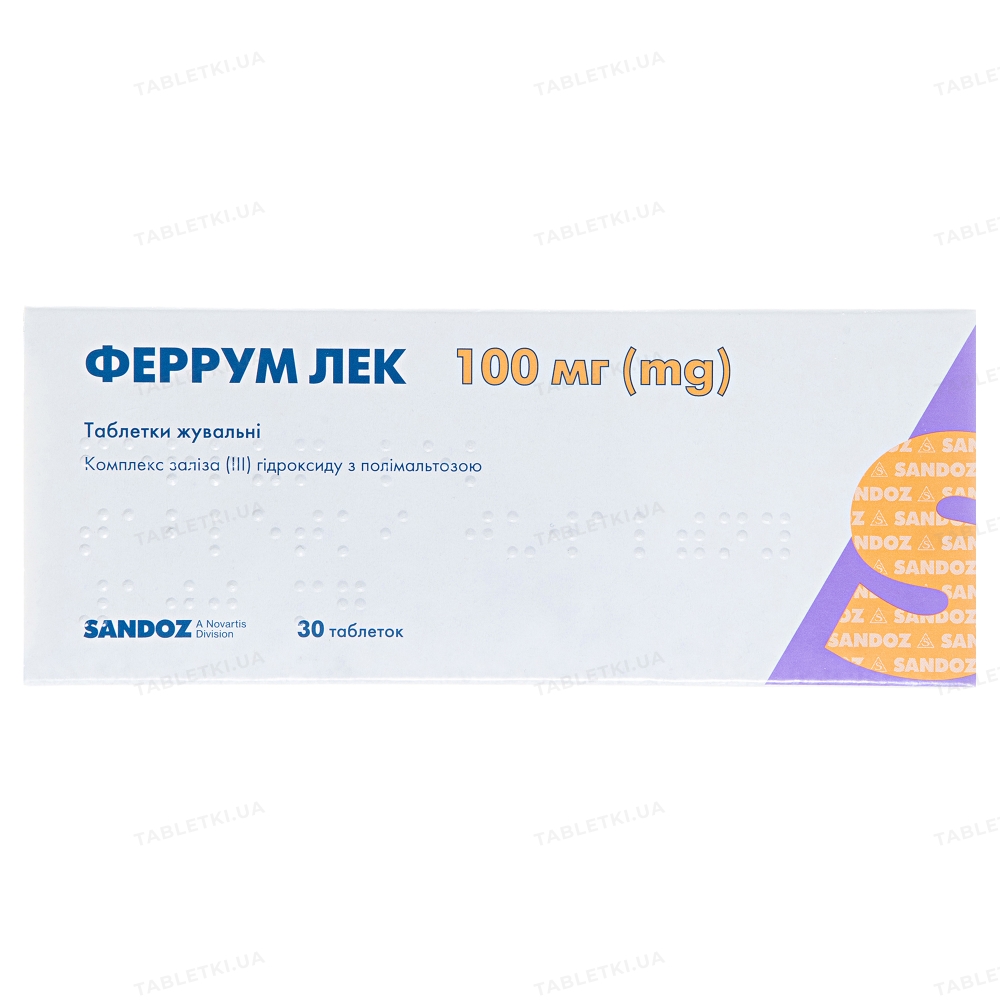
Ferrum Lek Chewable Tablets, 100 mg, No. 30 (10 x 3)
Composition
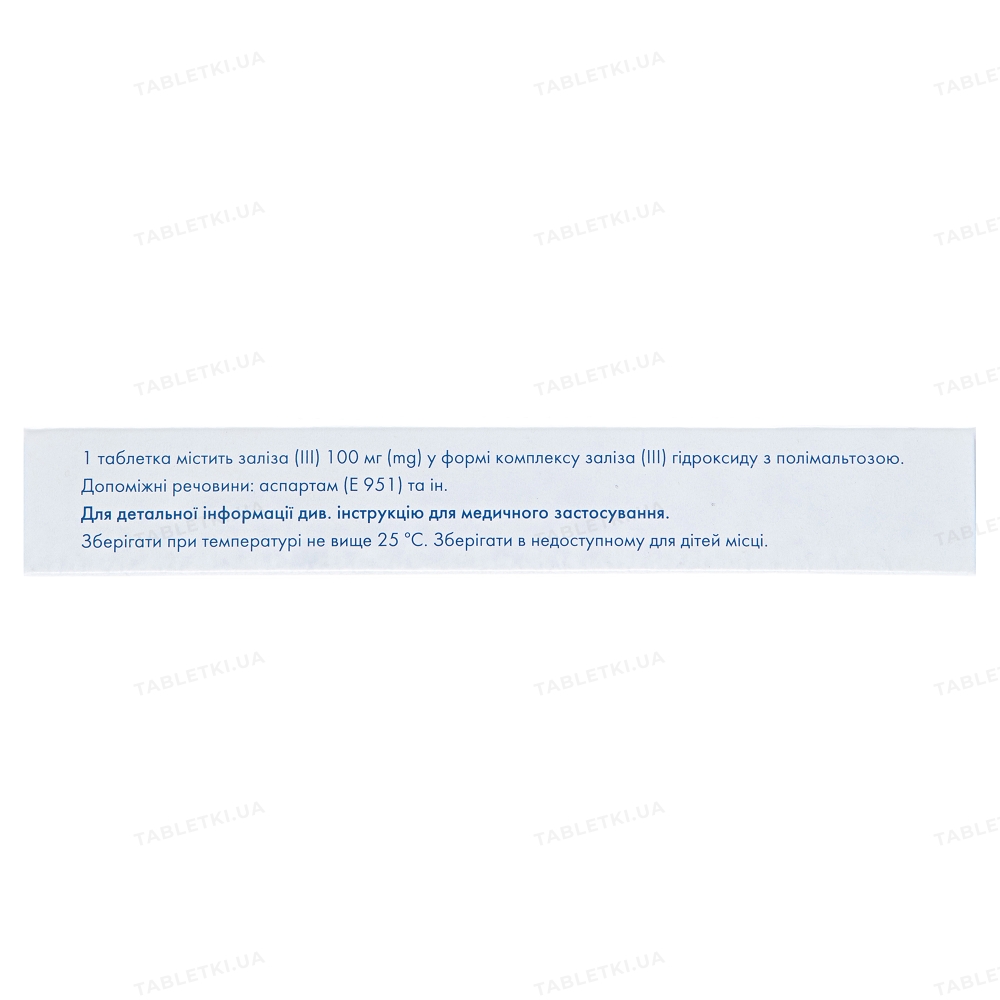
Active ingredient: Each tablet contains 100 mg of iron (III) in the form of an iron (III) hydroxide complex with polymaltose;
excipients: polyethylene glycol (macrogol 6000), aspartame (E 951), chocolate flavoring, talc, dextrates.
Dosage Form
Chewable tablets.
Main physical and chemical properties: brownish-white tablets with speckles, round, flat, with beveled edges.
Pharmacotherapeutic group
Antianemic agents. Iron (III) preparations for oral use. ATC code B03A B05.
Pharmacological properties
Pharmacodynamics.
The drug contains iron in the form of a polymaltose complex of iron(III) hydroxide. This macromolecular complex is stable and does not release iron as free ions into the gastrointestinal tract. The structure of the drug is similar to that of the natural iron compound ferritin. Due to this similarity, iron (III) is absorbed from the intestine into the bloodstream through active absorption. The absorbed iron binds to ferritin and is stored in the body, primarily in the liver. Later, in the bone marrow, it becomes part of hemoglobin. The iron preparation takes the form of a polymaltose complex of Fe³⁺ hydroxide. Externally, the multinuclear Fe³⁺ hydroxide centers are surrounded by numerous noncovalently bound polymaltose molecules, forming a complex with a molecular weight of 50 kDa, which is so large that its diffusion through the intestinal mucosal membranes is approximately 40 times lower than that of Fe²⁺ hexahydrate. The iron contained in the polymaltose complex of iron(III) hydroxide does not exhibit the pro-oxidant properties characteristic of simple iron salts. Consequently, the susceptibility of very low-density lipoproteins and low-density lipoproteins to oxidation is reduced.
Pharmacokinetics.
Studies using the double-isotope method (⁵⁵Fe and ⁵⁹Fe) showed that iron absorption, as measured by erythrocyte hemoglobin levels, is inversely proportional to the dose of the administered drug (the higher the dose, the lower the absorption). There is a correlation between the degree of iron deficiency and the amount of iron absorbed (the greater the iron deficiency, the better the absorption). The most active absorption occurs in the duodenum and small intestine. Unabsorbed iron is excreted in the stool. Iron excretion, which occurs through the shedding of the epithelium of the digestive tract and skin, as well as through sweat, bile, and urine, amounts to only 1 mg per day. In women, iron loss during menstruation must also be taken into account.
Indications
Treatment of iron deficiency without anemia (latent iron deficiency) and iron-deficiency anemia (clinically evident iron deficiency).
Iron deficiency and its severity must be confirmed by appropriate laboratory tests.
Contraindications
Known hypersensitivity or intolerance to the active ingredient or any component of the drug; excessive iron content in the body (e.g., hemochromatosis, hemosiderosis); impaired iron excretion mechanisms (lead anemia, sideroachrestic anemia, thalassemia); anemias not caused by iron deficiency (e.g., hemolytic anemia, megaloblastic anemia caused by vitamin B12 deficiency); esophageal stenosis and/or other obstructive diseases of the gastrointestinal tract; intestinal diverticula, intestinal obstruction, regular blood transfusions; concomitant use of parenteral forms of iron.
Drug Interactions and Other Interactions
Studies in rats using tetracycline, aluminum hydroxide, acetylsalicylic acid, sulfasalazine, calcium carbonate, calcium acetate, and calcium phosphate in combination with vitamin D3, bromazepam, magnesium aspartate, D-penicillamine, methyldopa, paracetamol, and auranofin revealed no interactions with the polymaltose complex of iron(III) hydroxide.
In an in vitro study, no interactions were observed between the drug and dietary components such as phytic acid, oxalic acid, tannin, sodium alginate, choline and choline salts, vitamin A, vitamin D3, and vitamin E, soybean oil, and soybean meal. The study results indicate that the polymaltose complex of iron(III) hydroxide can be taken during or immediately after a meal.
The interaction of the polymaltose complex of iron(III) hydroxide with tetracycline or aluminum hydroxide was investigated in three clinical studies (crossover studies involving 22 patients in each study). No significant reduction in tetracycline absorption was observed. Plasma tetracycline concentrations did not fall below the level required for the drug to be effective. The use of aluminum hydroxide and tetracycline did not reduce the absorption of iron from the polymaltose complex of iron(III) hydroxide. Therefore, the drug may be administered concomitantly with tetracyclines, other phenolic compounds, and aluminum hydroxide.
Concomitant use of parenteral iron preparations and Ferrum Lek is not recommended, as such use inhibits the absorption of oral iron preparations. Parenteral iron preparations may be used when treatment with oral preparations is not feasible.
Use of this medication does not affect the results of a hemoglobin-sensitive fecal occult blood test; therefore, there is no need to discontinue treatment with this medication.
Special Considerations for Use
Treatment of anemia should always be conducted under medical supervision. If no improvement in hematological parameters is observed (an increase in hemoglobin levels of approximately 20–30 g/L 3 weeks after the start of treatment), the treatment regimen should be reviewed.
Caution should be exercised in patients receiving repeated blood transfusions, as red blood cells already contain iron stores, and administration of the drug may lead to iron overload.
If anemia is caused by an infection or a neoplasm, the iron administered accumulates in the reticuloendothelial system and is not utilized. Therefore, oral iron supplements may be taken after the underlying disease has been cured, taking into account the benefit-risk ratio.
When prescribing this medication to patients with diabetes, it is important to note that 1 chewable tablet contains 0.04 bread units.
Each tablet contains 1.5 mg of aspartame (a precursor to phenylalanine), which should be taken into account when prescribing the drug to patients with phenylketonuria.
Iron supplements should be used with caution in patients with the following conditions: leukemia, chronic liver and kidney diseases, inflammatory diseases of the gastrointestinal tract, gastric and duodenal ulcers, and intestinal diseases (enteritis, ulcerative colitis, Crohn’s disease).
Dark-colored stools may occur with the use of the polymaltose iron complex; however, this has no clinical significance.
Clinical data on the use of this medication in patients with hepatic or renal insufficiency are limited. A thorough benefit-risk assessment must be conducted for these patients before prescribing the medication.
Use During Pregnancy or Breastfeeding
Data on use during the first trimester of pregnancy do not indicate any adverse effects on pregnancy or the health of the fetus or newborn. Animal studies have not shown any direct or indirect harmful effects on pregnancy, embryonic, or fetal development. However, the drug should be used with caution during pregnancy.
Human breast milk contains iron bound to lactoferrin. It is unknown how much iron from the polymaltose complex of iron(III) hydroxide passes into breast milk. It is unlikely that taking this medication will have an adverse effect on a breastfed infant.
Use of the drug during pregnancy or breastfeeding is recommended only after consulting a doctor and carefully assessing the benefit-risk ratio.
Effect on reaction time when driving or operating machinery
No relevant studies have been conducted. It is unlikely that this medication affects reaction time while driving or operating complex machinery.
Dosage and Administration
The daily dose and duration of treatment depend on the severity of iron deficiency.
Treatment of iron deficiency without anemia. The recommended dose for children 12 years of age and older and adults is 1 tablet per day (100 mg of iron).
Treatment of iron-deficiency anemia. The recommended dose for children 12 years of age and older and adults is 1–3 tablets per day (100–300 mg of iron).
The daily dose may be taken all at once or divided into several doses during or immediately after meals. Ferrum Lek chewable tablets may be chewed or swallowed whole.
The duration of treatment for clinically evident iron deficiency (iron-deficiency anemia) averages 3–5 months until hemoglobin levels return to normal. After that, treatment should be continued at the appropriate dosage to treat latent iron deficiency for the next few weeks to restore iron stores.
The duration of treatment for latent iron deficiency without anemia is 1–2 months.
Children
This medication is indicated for children 12 years of age and older. For children under 12 years of age, Ferrum Lek syrup is recommended.
Overdose
No signs of intoxication or excessive iron intake were observed in cases of overdose while taking this medication, due to the controlled release and low toxicity of the polymaltose complex of iron hydroxide (III) (LD50 > 2000 mg of iron/kg of body weight in mice and rats). No cases of accidental overdose resulting in death have been reported.
Side Effects
The frequency of adverse reactions is defined as follows: very common (≥ 1/10), common (≥ 1/100, < 1/10), uncommon (≥ 1/1,000, < 1/100), rare (≥ 1/10,000, < 1/1,000), very rare (< 1/10,000), frequency unknown (cannot be estimated from the available data). The most common adverse reaction is a change in stool color (in 23% of patients), caused by iron excretion. This has no clinical significance.
Immune system: very rare—allergic reactions.
Nervous system disorders: uncommon—headache.
Gastrointestinal system: very common—change in stool color¹; common—diarrhea, nausea, dyspepsia, heartburn; uncommon—abdominal pain², vomiting³, constipation, discoloration of tooth enamel, gastritis.
Skin and subcutaneous tissue disorders: uncommon—skin hypersensitivity reactions, such as exanthema, rash, hives, itching⁵,⁶; frequency unknown—anaphylactic reactions.
Musculoskeletal and connective tissue disorders: muscle spasms 4, myalgia.
1 According to a meta-analysis, reports of stool discoloration were rare, although this side effect is common with iron preparations.
2 including abdominal pain, dyspepsia, stomach discomfort, bloating.
3 Including vomiting and regurgitation.
4 Including muscle spasms and tremor.
5 Including rash, maculopapular rash, and vesicular rash.
6 The incidence reported after the drug’s market authorization is approximately <1/491 patients (95%).
Shelf life
5 years.
Storage Conditions
Store at a temperature not exceeding 25 °C.
Keep out of the reach of children.
Packaging
10 tablets per strip or blister pack; 3 (10 × 3) strips or blister packs per cardboard box.
Manufacturer
Lek Pharmaceutical Company d. d.
Address
Verovškova 57, Ljubljana 1526, Slovenia.