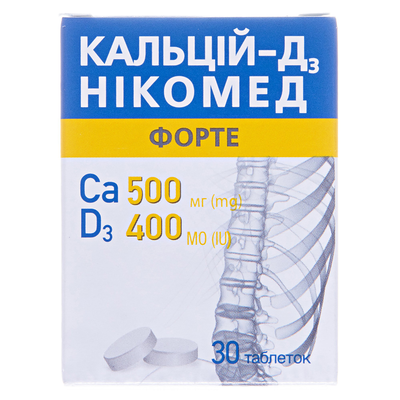
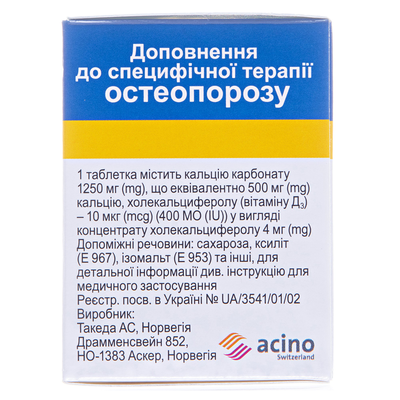
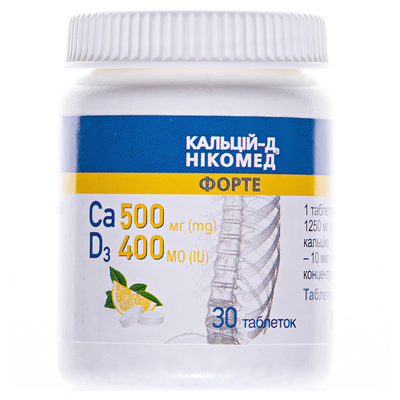
Calcium-D3 Nikomed Forte Chewable Tablets, No. 30 in a bottle
Composition
Active ingredient: Each tablet contains 1,250 mg of calcium carbonate, equivalent to 500 mg of calcium, and cholecalciferol (vitamin D3)—10 mcg (400 IU) in the form of 4 mg of cholecalciferol concentrate*;
excipients: xylitol (E 967), lemon-flavored granules (isomalt (E 953), lemon flavoring, mono- and diglycerides of fatty acids), povidone, magnesium stearate, sucralose
*Composition of cholecalciferol concentrate: cholecalciferol, DL-α-tocopherol, medium-chain triglycerides, modified corn starch, sucrose, sodium ascorbate, anhydrous colloidal silicon dioxide.
Dosage Form
Chewable tablets.
Main physical and chemical properties: round, white, biconvex, uncoated tablets; the presence of specks and slight irregularities along the edges is permissible. A small amount of powder may be present at the bottom of the bottle.
Pharmacotherapeutic group
Mineral supplements. Calcium, combinations with vitamin D and/or other drugs.
ATC code A12A X.
Pharmacological Properties
Pharmacodynamics.
Vitamin D3 increases calcium absorption in the intestine.
The use of calcium and vitamin D3 prevents an increase in parathyroid hormone (PTH) levels caused by calcium deficiency, which leads to increased bone resorption (the loss of calcium from bones).
A clinical study in hospitalized patients with vitamin D deficiency showed that daily intake of 2 tablets of 500 mg calcium and 400 IU vitamin D for 6 months normalized levels of the 25-hydroxylated metabolite of vitamin D3 and reduced the symptoms of secondary hyperparathyroidism and alkaline phosphatase levels.
Pharmacokinetics.
Calcium.
Absorption. Overall, approximately 30% of the administered dose of calcium is absorbed through the gastrointestinal tract.
Distribution and Biotransformation. 99% of calcium is concentrated in the body’s hard tissues (bones, teeth); 1% of calcium is found in the intracellular and extracellular compartments. Approximately 50% of calcium in the blood is in the physiologically active ionized form, nearly 10% is bound to citrates, phosphates, and other anions, and the remaining 40% is incorporated into proteins, primarily albumins.
Excretion. Calcium is excreted in feces, urine, and sweat. Renal excretion depends on the rate of glomerular filtration and tubular reabsorption of calcium.
Cholecalciferol.
Absorption. Vitamin D3 is readily absorbed in the small intestine.
Distribution and Biotransformation. Cholecalciferol and its metabolites circulate in the blood in a bound state with a specific globulin. In the liver, cholecalciferol is converted by hydroxylation to 25-hydroxycolecalciferol. It is then converted into the active form, 1,25-dihydroxycholecalciferol, in the kidneys. 1,25-dihydroxycholecalciferol is the metabolite responsible for enhanced calcium absorption. Unmetabolized vitamin D3 is stored in adipose and muscle tissues.
Excretion. Vitamin D3 is excreted in feces and urine.
Indications
Prevention and treatment of calcium and vitamin D deficiency in adult patients at identified risk.
Supplemental use of vitamin D and calcium as an adjunct to specific osteoporosis therapy in patients at risk of developing calcium and vitamin D deficiency.
Contraindications
- Hypersensitivity to the active ingredient or to any other components of the drug;
- severe renal insufficiency (glomerular filtration rate < 30 mL/min/1.73 m²);
- diseases and/or conditions associated with hypercalcemia and/or hypercalciuria;
- urinary stone disease (nephrolithiasis);
- hypervitaminosis D.
Interactions with Other Medications and Other Types of Interactions
Thiazide diuretics reduce urinary calcium excretion. During concomitant therapy, serum calcium levels must be monitored, as the risk of hypercalcemia increases.
Calcium carbonate may interfere with the absorption of tetracycline-class drugs; therefore, these drugs should be taken at least 2 hours before or 4–6 hours after taking Calcium-D3 Nicomed Forte.
Hypercalcemia may potentiate the toxicity of cardiac glycosides when calcium and vitamin D preparations are used. Cardiac function should be monitored via ECG, serum calcium levels, and the patient’s clinical condition.
To prevent reduced absorption of bisphosphonates, it is recommended to take Calcium-D3 Nicomed Forte no sooner than 1 hour after taking them.
When taken concurrently with calcium, the efficacy of levothyroxine may be reduced due to decreased absorption. Levothyroxine should be taken at least 4 hours after taking Calcium-D3 Nicomed Forte.
Concomitant use of calcium may affect the absorption of quinolone antibiotics. Quinolone antibiotics should be taken 2 hours before or 6 hours after taking Calcium-D3 Nicomed Forte.
Calcium salts may reduce the absorption of iron, zinc, and strontium ranelate. Therefore, iron, zinc, and strontium ranelate preparations should be taken at least 2 hours before or after taking Calcium-D3 Nicomed Forte.
Treatment with orlistat may potentially affect the absorption of fat-soluble vitamins (e.g., vitamin D3).
Special Considerations for Use
During long-term treatment with this medication, serum calcium and creatinine levels and renal function should be monitored, especially in elderly patients receiving concomitant therapy with cardiac glycosides or diuretics (see the section “Interactions with Other Medications and Other Types of Interactions”) and in patients with a high predisposition to dental calculus formation. If signs of hypercalcemia or impaired renal function appear, the dose should be reduced or the drug discontinued.
This medication should be used with caution in patients with hypercalcemia or signs of impaired renal function, and calcium and phosphate levels should be monitored. The potential risk of soft tissue calcification should be kept in mind. In patients with severe renal insufficiency, vitamin D in the form of cholecalciferol cannot be metabolized normally; therefore, other forms of vitamin D should be used. Concurrent intake of vitamin D from other sources, particularly from medications or calcium-containing foods (e.g., milk), may cause hypercalcemia and milk-alkali syndrome, leading to impaired renal function. In such patients, serum calcium levels and renal function must be monitored regularly.
Calcium-D3 Nicomed Forte should be used with caution in patients with sarcoidosis due to the risk of increased metabolism of vitamin D3 into its active form. Serum and urinary calcium levels must be monitored.
Calcium-D3 Nicomed Forte should be used with caution in immobilized patients with osteoporosis due to the risk of hypercalcemia.
To avoid overdose, the intake of calcium and vitamin D3 from other sources must be taken into account within the recommended daily intake limits for calcium and vitamin D3.
Patients with rare hereditary fructose intolerance, sucrase-isomaltase deficiency, or glucose-galactose malabsorption should not take this medication, as it contains isomalt and sucrose.
Use During Pregnancy or Breastfeeding
Pregnancy. Calcium-D3 Nicomed Forte may be used during pregnancy in cases of calcium and vitamin D deficiency. The daily dose should not exceed 2,500 mg of calcium and 4,000 IU of vitamin D. Animal studies have shown that high doses of vitamin D are toxic to reproduction. Pregnant women should avoid overdose of this medication, as prolonged hypercalcemia has adverse effects on the fetus. There is no evidence that vitamin D at recommended doses can cause teratogenic effects in humans.
Breastfeeding. Calcium-D3 Nicomed Forte may be used during breastfeeding. Calcium, vitamin D3, and its metabolites may pass into breast milk; therefore, the intake of calcium and vitamin D3 from other sources into the infant’s body must be taken into account.
Effect on reaction time when driving or operating machinery
There are no known data regarding the effect of Calcium-D3 Nicomed Forte on reaction time when driving or operating machinery.
Directions for Use and Dosage
The drug is intended for oral use. The tablet should be chewed or allowed to dissolve in the mouth.
Adults and elderly patients: 1 tablet twice daily.
Patients with hepatic insufficiency do not require a dose adjustment.
Patients with severe renal insufficiency should not use this medication (see the “Contraindications” section).
Children: This medication is not intended for use in children.
Overdose
Symptoms. Overdose with this medication may lead to hypervitaminosis D and hypercalcemia. Symptoms of hypercalcemia include: anorexia, thirst, nausea, vomiting, constipation, abdominal pain, muscle weakness, increased fatigue, mental disorders, polydipsia, polyuria, bone pain, nephrocalcinosis, nephrolithiasis, and cardiac arrhythmias in severe cases. A severe form of hypercalcemia can lead to coma and death. Persistently high calcium levels in the body can result in irreversible kidney damage and soft tissue calcification.
Patients taking large amounts of calcium and absorbable alkalis may develop milk-alkali syndrome; such patients require hospitalization.
Treatment: Symptomatic and supportive therapy. Discontinue the drug. Treatment with thiazide diuretics and cardiac glycosides should also be discontinued (see the section “Interactions with Other Medications and Other Types of Interactions”). The stomach should be emptied in patients with impaired consciousness. Administer large amounts of fluid and follow a calcium-restricted diet. Depending on the severity of the overdose, it may be necessary to administer loop diuretics, bisphosphonates, calcitonin, or corticosteroids, either alone or in combination. Serum electrolyte levels, renal function, and urine output should be monitored. In severe cases, electrocardiogram (ECG) and central venous pressure (CVP) should be monitored.
Side Effects
Adverse effects are classified by frequency of occurrence as follows:
uncommon (≥ 1/1,000, < 1/100), rare (≥ 1/10,000, < 1/1,000), very rare (< 1/10,000), unknown (frequency cannot be estimated from the available data).
Immune system disorders.
Frequency unknown: hypersensitivity reactions, including angioedema and laryngeal edema.
Metabolic disorders.
Uncommon: hypercalcemia, hypercalciuria.
Very rare: milk-alkali syndrome (frequent urge to urinate, persistent headache, persistent loss of appetite, nausea or vomiting, unusual fatigue or weakness, hypercalcemia, alkalosis, renal failure) observed only in cases of overdose (see the “Overdose” section).
Gastrointestinal disorders.
- Constipation, dyspepsia, flatulence, nausea, abdominal pain, diarrhea.
Skin and subcutaneous tissue disorders.
Very rare: itching, rash, hives.
Special Patient Populations.
Patients with renal insufficiency: there is a potential risk of hyperphosphatemia, nephrolithiasis, and nephrocalcinosis (see the “Special Considerations for Use” section).
Shelf life
30 months.
Storage conditions
Store the vial tightly closed at a temperature not exceeding 30 °C. Keep out of reach of children!
Packaging
30, 60, or 120 tablets per bottle. One bottle per cardboard box.
Dispensing Category
Over-the-counter