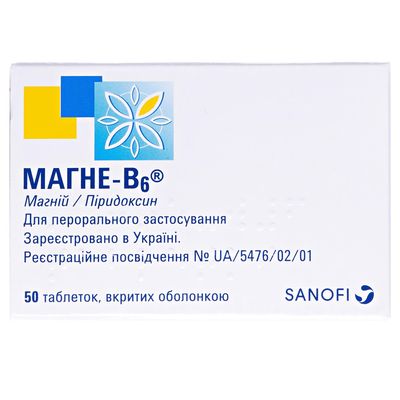
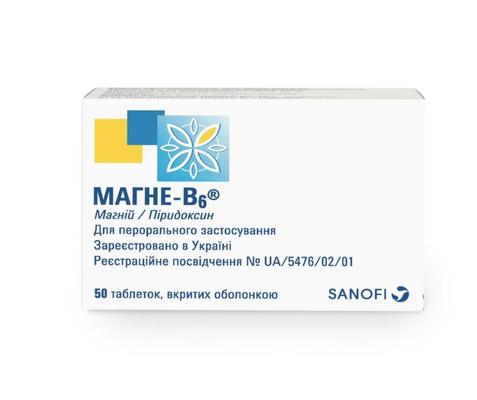
Magne-B6 Tablets, No. 60 (20 x 3)
Ingredients
Active ingredients: magnesium, pyridoxine;
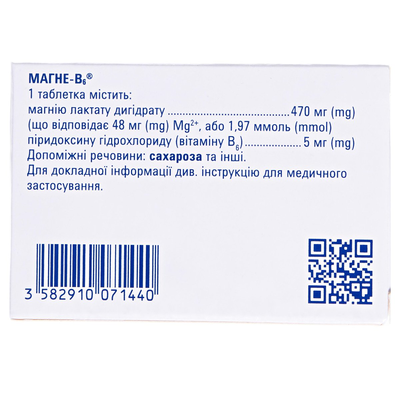
1 tablet contains 470 mg of magnesium lactate dihydrate (equivalent to 48 mg of Mg2+, or 1.97 mmol) and 5 mg of pyridoxine hydrochloride (vitamin B6);
excipients: sucrose, kaolin, acacia, carbomer, talc, magnesium stearate;
Coating: acacia, sucrose, titanium dioxide (E 171), talc, carnauba wax.
Dosage Form
Film-coated tablets.
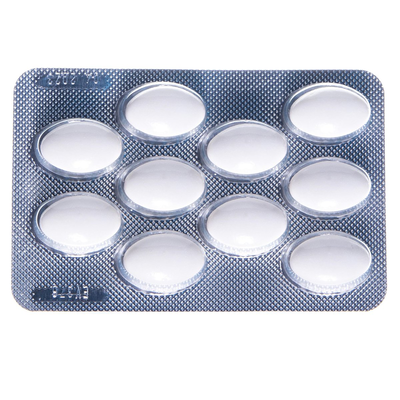
Main physical and chemical properties: white, smooth, shiny, oval film-coated tablets.
Pharmacotherapeutic group
Agents affecting the digestive system and metabolism. Vitamins. Vitamin B complex preparations, including combinations. Vitamin B complex with minerals.
ATC code A11E C.
Pharmacological properties
Pharmacodynamics.
Magnesium is an intracellular cation that reduces neuronal excitability and inhibits neuromuscular transmission, and it also participates in many enzymatic reactions. Magnesium is an important component of body tissues: the bones of the skeleton contain half of the total magnesium in the body.
A serum magnesium concentration of 12 to 17 mg/L (1–1.4 mEq/L, or 0.5–0.7 mmol/L) indicates a moderate magnesium deficiency; below 12 mg/L (1 mEq/L, or 0.5 mmol/L) indicates a severe magnesium deficiency.
Magnesium deficiency can be:
- primary, due to a metabolic disorder (chronic congenital hypomagnesemia);
- secondary, due to:
- insufficient dietary magnesium intake (poor diet, chronic alcohol abuse, exclusively parenteral nutrition);
- impaired magnesium absorption in the gastrointestinal tract (chronic diarrhea, gastrointestinal fistulas, hypoparathyroidism);
- excessive magnesium loss due to renal excretion (tubular dysfunction, severe polyuria, diuretic abuse, chronic pyelonephritis, primary hyperaldosteronism, cisplatin therapy).
Pharmacokinetics.
The absorption of magnesium salts in the gastrointestinal tract involves, among other mechanisms, a passive mechanism in which the solubility of the salt is a determining factor.
Absorption of magnesium salts in the gastrointestinal tract does not exceed 50%. Magnesium is excreted primarily in the urine.
Indications
Treatment of confirmed magnesium deficiency, whether isolated or associated with other deficiency states.
Contraindications
Hypersensitivity to any component of the drug. Severe renal insufficiency with a creatinine clearance of less than 30 mL/min. Phenylketonuria. Hypermagnesemia, vitamin B6 hypervitaminosis, myasthenia gravis. Atrioventricular block, severe arterial hypotension. Concomitant use with levodopa (see the section “Interactions with Other Medications and Other Types of Interactions”). Diarrhea. Fructose intolerance, glucose- or galactose-malabsorption syndrome, sucrase-isomaltase deficiency (due to the sucrose content in the product).
Interactions with Other Medications and Other Types of Interactions
Contraindicated combinations.
Concomitant use with levodopa should be avoided, as this inhibits the action of levodopa when its use is not accompanied by the administration of peripheral dopa-decarboxylase inhibitors. The use of pyridoxine in any amount is not indicated if levodopa is not taken in combination with dopamine decarboxylase inhibitors.
Combinations Not Recommended.
Do not use with medications containing phosphate or calcium salts, as they inhibit the absorption of magnesium from the intestine.
Combinations Requiring Caution.
Use oral tetracyclines with caution, as magnesium reduces the absorption of tetracyclines from the stomach and intestines. When taken concurrently with oral tetracyclines, administration of Magne-B6® should be delayed by at least 3 hours.
Magnesium supplements weaken the effect of oral anticoagulants and reduce iron absorption.
Diuretics increase the excretion of magnesium in the urine.
The use of hydralazine, isoniazid, penicillamine, and oral contraceptives increases the need for vitamin B6.
Special Considerations for Use
For patients with severe magnesium deficiency, treatment should begin with intravenous administration. This is also indicated for patients with malabsorption.
In patients with concomitant calcium deficiency, it is recommended in most cases to correct the magnesium deficiency before prescribing calcium.
Since this medication contains sucrose, it is contraindicated in patients with fructose intolerance, glucose-galactose malabsorption syndrome, or sucrase-isomaltase deficiency.
Information for patients with diabetes: the film-coated tablets contain sucrose as an excipient.
Excessive use of pyridoxine may lead to the development of sensory neuropathy if taken in high doses (>200 mg/day) over a prolonged period (i.e., several months or years). Symptoms include numbness, sensory disturbances, tremor, and gradually progressive sensory ataxia (coordination problems). This effect is usually reversible and resolves after discontinuation of the medication.
Precautions for Use
THIS MEDICATION IS INTENDED FOR USE ONLY BY ADULTS AND CHILDREN AGED 6 YEARS AND OLDER.
Appropriate dosage forms are available for use in children under 6 years of age.
Patients with moderate renal impairment should take precautions to prevent any risks associated with hypermagnesemia.
Use during pregnancy or breastfeeding.
Pregnancy. Limited data from animal studies have not revealed any fetotoxic or embryotoxic effects of the drug. Therefore, magnesium should be used during pregnancy only if necessary and after consulting a doctor.
Breastfeeding. Neither of the drug’s active ingredients (magnesium or vitamin B6) is contraindicated during this period. Given the limited evidence regarding the use of the maximum recommended daily dose of vitamin B6 during breastfeeding, it is recommended to administer no more than 20 mg/day of vitamin B6.
Effect on reaction time when driving or operating machinery. The drug Magne-B6®, film-coated tablets, has no or negligible effect on reaction time when operating motor vehicles or other machinery.
Directions for Use and Dosage
Swallow the tablets whole with 1 glass of water.
Adults: 6–8 tablets per day, divided into 2 or 3 doses taken with meals.
Children 6 years of age and older (weighing more than 20 kg): 10–30 mg/kg of body weight per day (i.e., 0.4–1.2 mmol/kg of body weight per day), which corresponds to 4–6 tablets per day, with the total dose divided into 2 or 3 doses taken with meals.
Treatment should be discontinued as soon as blood magnesium levels return to normal.
Children. This medication is indicated for children 6 years of age and older. Appropriate dosage forms are available for children under 6 years of age.
Overdose
Magnesium-related
Magnesium overdose following oral administration does not usually lead to toxic reactions in patients with normal renal function. However, magnesium intoxication may develop in patients with renal insufficiency.
Toxic effects in such cases depend on blood magnesium levels and manifest as follows:
- a sharp drop in blood pressure;
- nausea, vomiting;
- central nervous system depression, impaired reflexes;
- abnormal ECG changes;
- development of respiratory depression, coma, cardiac arrest, and respiratory paralysis;
- anuria.
Treatment of overdose: rehydration, forced diuresis. Patients with renal insufficiency require hemodialysis or peritoneal dialysis.
Pyridoxine-related
Sensory axonal neuropathy is the primary adverse effect that may occur during prolonged and/or long-term use of high doses of pyridoxine (several months or years).
Signs and symptoms
In particular, paresthesia, dysesthesia, hypoesthesia, sensory deficit, pain in the extremities, involuntary muscle contractions, burning sensations, balance disturbances, gait disturbances, tremors in the hands and feet, and progressive sensory ataxia (difficulty coordinating movements).
Treatment
Neurological symptoms gradually resolve after discontinuation of treatment.
Side Effects
Adverse reactions that may occur with the use of Magne-B6®, film-coated tablets, are listed below by organ system and frequency of occurrence: very common (≥ 1/10); common (≥ 1/100, < 1/10); uncommon (≥ 1/1,000, < 1/100); rare (≥ 1/10,000, < 1/1,000); very rare (< 1/10,000); frequency unknown (cannot be estimated from the available data).
Immune system disorders.
Frequency unknown: allergic reactions, hypersensitivity, angioedema.
Gastrointestinal disorders.
Frequency unknown: diarrhea*, nausea, vomiting, abdominal pain*.
Skin and subcutaneous tissue disorders.
Frequency unknown: skin reactions, including hives, itching, eczema, erythema.
* Adverse reactions associated with magnesium.
Reporting of Suspected Adverse Reactions.
Reporting suspected adverse reactions after a drug’s approval is an important procedure. It allows for continued monitoring of the drug’s benefit-risk profile. Healthcare professionals are asked to report all adverse reactions through the national pharmacovigilance system.
Shelf life
2 years.
Storage conditions
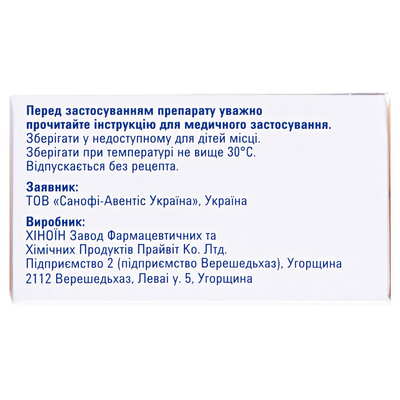
Store at a temperature not exceeding 30 °C. Keep out of the reach of children.
Packaging
No. 50 (10 × 5): 10 tablets per blister pack, 5 blister packs per cardboard box.
No. 60 (20 × 3): 20 tablets per blister pack, 3 blister packs per cardboard box.
No. 100 (20 × 5): 20 tablets per blister pack, 5 blister packs per cardboard box.
Dispensing Category
Over-the-counter.