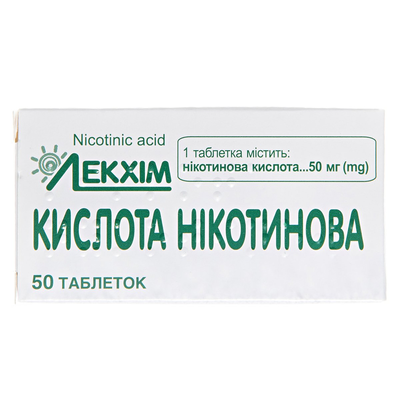
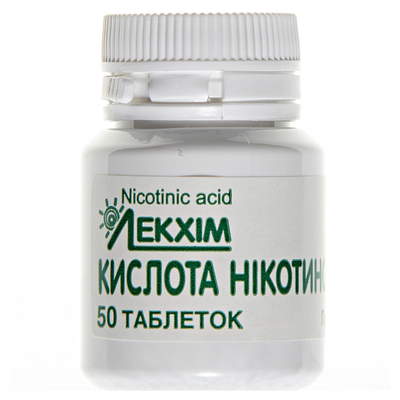
Nicotinic acid tablets, 50 mg each, No. 50, in a blister pack.
Ingredients
Active ingredient: nicotinic acid;
Each tablet contains 50 mg of nicotinic acid;
Excipients: glucose monohydrate, magnesium stearate.
Dosage Form
Tablets.
Main physical and chemical properties: single-layer, round tablets, white or almost white in color, with a score line, the upper and lower surfaces of which are convex. When broken and examined under a magnifying glass, a relatively uniform structure is visible.
Pharmacotherapeutic group
Peripheral vasodilators. Nicotinic acid and its derivatives. ATC code C04A C01.
Pharmacological Properties
Pharmacodynamics.
Nicotinic acid serves as the prosthetic group for the enzymes codehydrogenase I and codehydrogenase II—enzymes that transfer hydrogen and carry out redox reactions. Codehydrogenase II is also involved in phosphate transport. Nicotinic acid deficiency leads to the development of pellagra. Nicotinic acid improves carbohydrate metabolism and dilates blood vessels. It has lipid-lowering activity and, in cases of hypercholesterolemia, reduces the cholesterol-to-phospholipid ratio.
Pharmacokinetics.
It is absorbed over 6–8 hours, as nicotinic acid is released gradually and evenly from the tablet. Approximately 50% is absorbed within the first hour, and approximately 96% by the eighth hour. It is metabolized in the liver, kidneys, and muscles. Metabolites are excreted by the kidneys.
Indications
- Prevention and treatment of pellagra (vitamin B3 deficiency);
- atherosclerosis;
- hypoacidic gastritis;
- vascular spasms (of the brain, kidneys, and extremities);
- facial nerve neuritis;
- ulcers and wounds of various locations and origins that are slow to heal.
Contraindications
Hypersensitivity to nicotinic acid or to other components of the medication. Hypertension (severe forms), gastric and duodenal ulcers (in the acute phase), severe liver dysfunction, including cirrhosis and active hepatitis.
Decompensated diabetes mellitus, urolithiasis, hyperuricemia, gout.
Recent myocardial infarction; history of sudden decrease in peripheral vascular resistance.
Drug Interactions and Other Interactions
Oral contraceptives and isoniazid reduce the conversion of tryptophan to nicotinic acid and may therefore increase the need for nicotinic acid.
Nicotinic acid reduces the efficacy and increases the toxicity of probenecid, neomycin, barbiturates, antituberculosis drugs, and sulfonamides.
Antibiotics may exacerbate the skin flushing caused by nicotinic acid.
Acetylsalicylic acid reduces the skin flushing caused by nicotinic acid.
Lovastatin and pravastatin should not be combined with nicotinic acid due to an increased risk of adverse reactions. There have been reports of rhabdomyolysis when nicotinic acid is used with lovastatin.
Caution is advised when combining this medication with antihypertensive agents (potential potentiation of the antihypertensive effect), anticoagulants, and acetylsalicylic acid (due to the risk of hemorrhage).
This medication potentiates the effects of fibrinolytic agents, antispasmodics, and cardiac glycosides, as well as the toxic effects of alcohol on the liver.
Concomitant use with methyldopa or β-adrenergic receptor blockers leads to a significant decrease in blood pressure; when used with antidiabetic agents, it reduces the hypoglycemic effect of the latter.
Nicotinic acid is incompatible with vitamins B1, B12, and B6; euphilin; salicylates; tetracycline; sympathomimetics; and hydrocortisone.
Acute vascular insufficiency may occur if alcohol is consumed during treatment with nicotinic acid.
Special Considerations for Use
To minimize side effects and improve treatment tolerance, it is recommended to:
- monitor blood glucose levels and liver function during treatment to detect any adverse effects of nicotinic acid;
- take nicotinic acid only with food, which promotes gradual absorption of the drug and reduces side effects;
- do not take nicotinic acid with hot beverages (especially coffee) or alcohol;
- Do not take a hot shower (or bath) immediately after taking the medication.
Use with caution in patients with hemorrhages, glaucoma, renal insufficiency, moderate arterial hypotension, hyperacid gastritis, and gastric or duodenal ulcers (in remission). Nicotinic acid should be used with caution in individuals who abuse alcohol, in patients with unstable angina and acute myocardial infarction, and in those receiving nitrates, calcium channel blockers, and beta-blockers.
Long-term use of nicotinic acid in high doses may lead to the development of fatty liver, so monitoring of liver function is necessary.
Blood uric acid levels should be monitored regularly due to the possibility of elevated levels resulting from long-term therapy.
To prevent liver complications, it is recommended to include foods rich in methionine (such as cheese) in the diet or to take methionine and other lipotropic agents.
This medication contains glucose, which should be taken into account by patients with diabetes.
It is not advisable to use nicotinic acid to treat dyslipidemia in patients with diabetes.
Use during pregnancy or breastfeeding.
It is not recommended to prescribe this medication during pregnancy or while breastfeeding.
Effect on reaction time when operating motor vehicles or other machinery.
No studies have been conducted on the drug’s effect on reaction time; however, the possible occurrence of dizziness and drowsiness when using nicotinic acid should be taken into account.
Directions for Use and Dosage
Take orally after meals.
For pellagra, adults should be prescribed 100 mg 2–4 times daily for 15–20 days; children aged 12 years and older should be prescribed 50 mg twice daily. The maximum dose is 3 times daily.
For other conditions, adults should be prescribed 50 mg (up to 100 mg) twice daily; children 12 years of age and older should be prescribed 25 mg (the tablet has a score line) twice daily.
Maximum doses for adults: single dose—100 mg; daily dose—500 mg.
Maximum doses for children: single dose—50 mg; daily dose—200 mg.
In cases of atherosclerosis (in the absence of side effects), the single dose may be gradually increased to 500 mg–1 g, and the daily dose to 2–3 g.
Children.
This medication is not recommended for children under 12 years of age.
Overdose
Symptoms. High doses of nicotinic acid may cause peripheral vasodilation, skin flushing, nausea, vomiting, heartburn, diarrhea, elevated liver enzyme levels, brown skin pigmentation, rarely—hyperuricemia, itchy skin, headache, hypotension, loss of consciousness, dizziness, skin paresthesias (tingling, burning sensation, sensation of heat, pins-and-needles sensation), impaired glucose metabolism, visual disturbances, and cholestatic jaundice.
Treatment. Discontinue the drug. Treatment is symptomatic.
Side Effects
Cardiovascular system: hot flashes, which may be accompanied by shortness of breath, tachycardia, palpitations, sweating, chills, and edema.
Central and peripheral nervous system: paresthesias, dizziness, headache.
Skin: flushing of the face and upper torso with a tingling sensation and burning, dryness of the skin and the mucous membranes of the eyes, intense itching, and rash.
Liver and biliary tract disorders: with prolonged use—fatty liver, elevated blood levels of aspartate aminotransferase (AST), lactate dehydrogenase (LDH), and alkaline phosphatase.
Metabolic disorders: with prolonged use in high doses—decreased glucose tolerance, increased blood glucose levels, increased blood uric acid levels, hypophosphatemia.
Other: allergic reactions (including hives).
Very rarely, in patients with ischemic heart disease, nicotinic acid treatment may increase the frequency of atrial arrhythmias as well as acanthosis (brown patches on the skin with a velvety surface). Retinal edema may rarely occur. These symptoms are transient and resolve after discontinuation of the drug.
When taking high doses: hyperpigmentation, convulsions, diarrhea, nausea, vomiting, anorexia, exacerbation of gastric ulcers, jaundice, amblyopia, decreased platelet count, and prolonged prothrombin time. Insomnia, myalgia, hypotension, and rhinitis may occur. Blurred vision, eyelid edema, myopathy, and exfoliative dermatitis are possible. Cases of rhabdomyolysis have been reported with the use of nicotinic acid in combination with lovastatin.
Shelf life
4 years.
Storage conditions
Store in the original packaging at a temperature not exceeding 25 °C.
Packaging
50 tablets per container. 1 container per cardboard package.
Dispensing Category
Available without a prescription.
Manufacturer
PJSC “Technolog.”