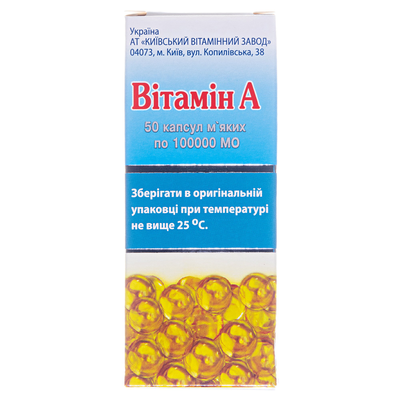
Vitamin A Softgels, 100,000 IU each, No. 50 (10 x 5)
Ingredients
Active ingredient: retinol;
for a dose of 33,000 IU
1 capsule contains 33,000 IU of vitamin A;
excipients: sunflower oil; capsule shell: gelatin, glycerin, carmoisine (E 122);
For the 100,000 IU dose
1 capsule contains 100,000 IU of vitamin A;
Excipients: sunflower oil; capsule shell: gelatin, glycerin.
Dosage Form
Soft capsules.
Main physical and chemical properties:
for the 33,000 IU dose—soft gelatin capsules of a round or spherical shape, with a seam, red in color, filled with an oily liquid ranging in color from light yellow to dark yellow;
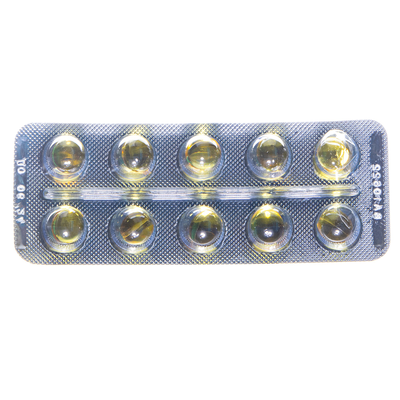
for the 100,000 IU dose—soft gelatin capsules of a globular or spherical shape, with a seam, ranging in color from light yellow to dark yellow, filled with an oily liquid ranging in color from light yellow to dark yellow.
Pharmacotherapeutic group
Simple vitamin A preparations. Retinol (vitamin A).
ATC code A11C A01.
Pharmacological properties
Pharmacodynamics.
Vitamin A has a general tonic effect and normalizes tissue metabolism: it participates in redox processes (due to the large number of unsaturated bonds), in the synthesis of mucopolysaccharides, proteins, and lipids, in mineral metabolism, and in cholesterol formation processes. It enhances the production of lipase and trypsin, stimulates myelopoiesis, and promotes cell division. It has a positive effect on the function of the lacrimal, sebaceous, and sweat glands; increases resistance to diseases of the mucous membranes of the respiratory tract and intestines; and boosts the body’s resistance to infections. It enhances the proliferation of skin epithelial cells, rejuvenates the cell population, and reduces the number of cells undergoing terminal differentiation; inhibits keratinization processes, enhances the synthesis of glycosaminoglycans, and activates the interaction of immunocompetent cells with each other and with epidermal cells. It stimulates skin regeneration. Retinol is an essential component for normal retinal function: it binds to opsin (the red pigment of the retina), forming the visual purple—rhodopsin—which is necessary for visual adaptation in the dark.
Its local action is mediated by the presence of specific retinol-binding receptors on the surface of epithelial cells.
Pharmacokinetics.
Vitamin A is almost completely absorbed in the intestine (primarily in the duodenum and rectum). After administration, the maximum concentration of the drug in blood plasma is observed after 4 hours. Retinol is distributed unevenly throughout the body. The highest concentrations are found in the liver and retina; it is also detected in the kidneys, fat depots, adrenal glands, and other endocrine glands. Retinol metabolites are excreted by the kidneys. The half-life is 9.1 hours. Retinol is not detected in the urine of a healthy person, as it is excreted in bile.
Indications
Vitamin A deficiency and vitamin A insufficiency.
Eye diseases: pigmentary retinitis, xerophthalmia, night blindness, eczematous lesions of the eyelids, superficial keratitis, corneal lesions, conjunctivitis, pyoderma.
Skin diseases and lesions: frostbite, burns, wounds, ichthyosis, follicular dyskeratosis, senile keratosis, cutaneous tuberculosis, psoriasis, certain forms of eczema.
Comprehensive treatment of rickets, collagenoses, and hypotrophy.
As part of complex therapy for acute respiratory diseases occurring against a background of exudative diathesis, chronic bronchopulmonary diseases; inflammatory, erosive-ulcerative intestinal lesions, and liver cirrhosis.
Contraindications
Hypersensitivity to the components of the drug; acute and chronic nephritis; stage II–III heart failure; gallstone disease; chronic pancreatitis; hypervitaminosis A, retinoid overdose, hyperlipidemia, obesity, chronic alcoholism, sarcoidosis (including a history thereof).
Interactions with Other Medications and Other Types of Interactions
Estrogens and oral contraceptives containing them enhance the absorption of retinol, which may lead to the development of hypervitaminosis A. Colestramine, colestipol, mineral oils, and neomycin reduce the absorption of vitamin A (an increase in the dose may be necessary). Nitrites impair the absorption of retinol.
During long-term therapy with tetracyclines, it is not recommended to prescribe high doses of vitamin A (50,000 IU or higher) due to an increased risk of intracranial hypertension. Retinol weakens the effect of Ca²⁺-containing drugs and increases the risk of hypercalcemia. Isotretinoin increases the risk of toxic effects.
Vitamin E reduces the toxicity, absorption, and storage of vitamin A in the liver; high doses of vitamin E may decrease vitamin A stores in the body. Retinol reduces (reciprocally) the risk of hypervitaminosis D. Corticosteroids and alcohol consumption reduce the therapeutic effect of the drug. Concomitant use of vitamin A and anticoagulants increases the risk of bleeding. Retinol reduces the anti-inflammatory effect of glucocorticoids.
Special Considerations for Use
This medication tends to accumulate and remain in the body for an extended period; therefore, it should not be taken concurrently with other medications containing vitamin A. Prolonged daily use of this medication, especially in high doses, may lead to the development of vitamin A toxicity.
Use with caution in patients with conditions accompanied by coagulation disorders or bleeding, calcium loss, severe liver damage, or acute and chronic hepatitis. To monitor liver function, biochemical blood tests should be performed before and during treatment.
Use of this medication is not recommended during long-term therapy with tetracyclines.
Retinol should be taken 1 hour before or 4–6 hours after taking cholestyramine.
The presence of fats in the diet is essential for the normal absorption of vitamin A.
Excessive alcohol and tobacco use impairs the absorption of the drug from the gastrointestinal tract.
Use During Pregnancy or Breastfeeding.
Given the high dose of vitamin A, this medication is contraindicated during pregnancy or breastfeeding.
Effect on reaction time when driving or operating machinery.
There is no evidence that retinol affects psychomotor reaction time while driving or operating precision machinery.
Dosage and Administration
Retinol is indicated for therapeutic use in adults with mild to moderate vitamin A deficiency. Take the medication orally 10–15 minutes after a meal.
Given vitamin A’s tendency to accumulate in the body, pay attention to the dose of retinol palmitate before taking the medication (especially when using 100,000 IU capsules).
The daily dose for adults should not exceed 100,000 IU.
For therapeutic purposes, in cases of mild to moderate vitamin deficiency, adults should be prescribed up to 33,000 IU per day; for eye diseases, 33,000–100,000 IU per day. For skin diseases, adults should be prescribed 33,000–100,000 IU per day.
The dosage and duration of treatment with Vitamin A are determined by the physician on an individual basis.
Children. This medication is contraindicated in children.
Overdose
Symptoms: severe headache, dizziness; drowsiness, confusion, visual disturbances, seizures, uncontrollable vomiting, profuse diarrhea, severe dehydration, irritability; on the second day, a widespread rash appears, followed by extensive peeling of the skin, starting from the face; bleeding gums, dryness and ulceration of the oral mucosa, peeling of the lips, palpation of long tubular bones is sharply painful due to subperiosteal hemorrhages, pain in the joints and muscles.
Treatment: symptomatic; administer thyroxine as an antidote, as well as ascorbic acid.
Side effects
Gastrointestinal system: loss of appetite, dryness of the oral mucosa, stomach pain, vomiting, nausea.
Liver and biliary system: hepatotoxic effects, portal hypertension.
Skin and subcutaneous tissue: cracks and dryness of the skin and lips; yellow-orange spots on the soles of the feet, palms, and in the nasolabial triangle; subcutaneous edema; in isolated cases, itchy maculopapular rashes may occur on the first day of use, requiring discontinuation of the medication.
Nervous system: asthenia, excessive fatigue, drowsiness, discomfort, headache, irritability, intraocular hypertension, visual disturbances, gait disturbances.
Endocrine system: oligomenorrhea.
Urinary system: pollakiuria, nocturia, polyuria.
Blood system: hemolytic anemia.
Musculoskeletal system: bone pain, changes on bone X-rays, convulsions.
Other: hyperthermia, hair loss, photosensitivity, weight loss, hypercalcemia; hypersensitivity reactions may occur with use of the drug.
Side effects resolve on their own upon dose reduction or temporary discontinuation of the drug.
In cases of skin diseases, the use of high doses of the drug after 7–10 days of treatment may be accompanied by an exacerbation of the local inflammatory reaction, which does not require additional treatment and subsequently subsides. This effect is associated with the drug’s myelostimulatory and immunostimulatory action.
Shelf life
2 years.
Storage conditions
Store in the original packaging at a temperature not exceeding 25 °C.
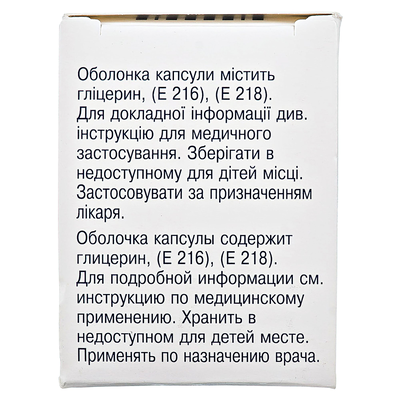
Keep out of reach of children.
Packaging
For a dose of 33,000 IU.
10 capsules per blister; 3 blisters per pack.
10 capsules per blister; 5 blisters per pack.
20 capsules per blister; 1 blister per pack.
20 capsules per blister; 3 blisters per pack.
For a dose of 100,000 IU.
10 capsules per blister; 3 blisters per pack.
10 capsules per blister; 5 blisters per pack.
20 capsules per blister; 1 blister per pack.
20 capsules per blister; 3 blisters per pack.
Dispensing category
Over-the-counter.