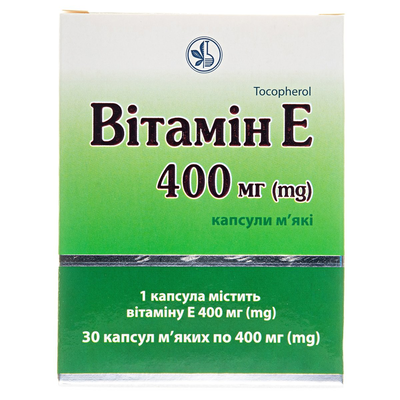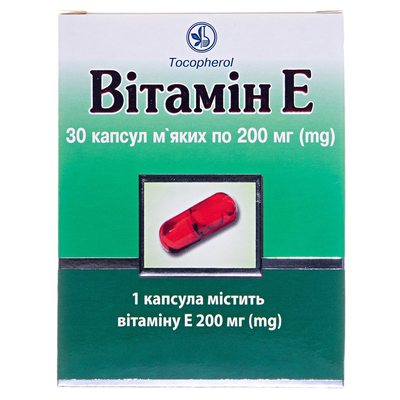
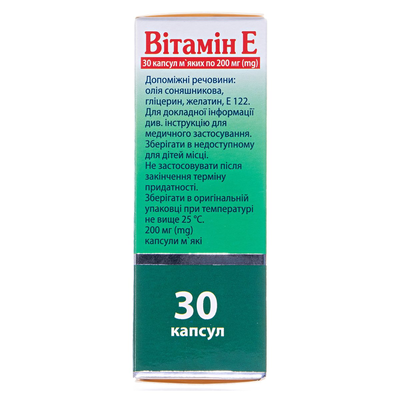
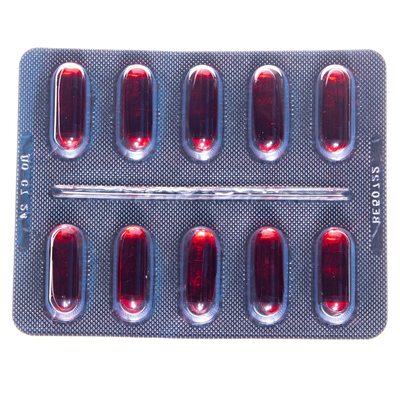
Vitamin E Softgels, 0.2 g each, No. 30 (10 x 3)
Ingredients
Active ingredient: tocopherol;
1 capsule contains 100 mg, 200 mg, or 400 mg of vitamin E;
excipients: sunflower oil;
capsule shell: gelatin, glycerin, carmoisine (E 122).
Dosage Form
Main physical and chemical properties:
- 100 mg capsules: soft gelatin capsules of a spherical or round shape, with a seam, ranging in color from light red to dark red, filled with an oily liquid ranging in color from light yellow to dark yellow;
- 200 mg capsules: soft gelatin capsules of cylindrical shape with hemispherical ends, with a seam, ranging in color from light red to dark red, filled with an oily liquid ranging in color from light yellow to dark yellow;
- 400 mg capsules: soft gelatin capsules, oval in shape, with a seam, red in color, filled with a clear, oily liquid ranging in color from colorless to slightly greenish-yellow.
Pharmacotherapeutic group
Simple vitamin preparations. Tocopherol (vitamin E).
ATC code A11H A03.
Pharmacological Properties
Pharmacodynamics.
Vitamin E is a fat-soluble vitamin that exerts significant antioxidant and radioprotective effects; it participates in the biosynthesis of heme and proteins, cell proliferation, and other vital processes of cellular metabolism.
Vitamin E improves tissue oxygen uptake. It exerts an angioprotective effect by influencing vascular tone and permeability and stimulating the formation of new capillaries.
The immunomodulatory effect of vitamin E is due to its stimulation of T-cell and humoral immunity.
Tocopherol is essential for normal reproductive processes: fertilization, fetal development, and the formation and functioning of the reproductive system.
Vitamin E deficiency leads to hypotonia and dystrophy of skeletal muscles and the myocardium; it increases capillary permeability and fragility; and it causes photoreceptor degeneration, which results in visual impairment. This leads to decreased sexual function in men and menstrual cycle irregularities and a tendency toward miscarriage in women.
Vitamin E deficiency may lead to the development of hemolytic jaundice in newborns, as well as malabsorption syndrome and steatorrhea.
Pharmacokinetics.
After absorption in the intestine, most of the tocopherol enters the lymph and blood, rapidly distributing throughout the body’s tissues with predominant accumulation in the liver, muscles, and adipose tissue. The highest concentrations are observed in the adrenal glands, pituitary gland, gonads, and myocardium. Most of the drug is excreted from the body in the urine and, to a lesser extent, in the bile.
Indications
Vitamin E deficiency and hypovitaminosis. As part of complex antioxidant therapy; during convalescence following injuries or severe somatic diseases; in cases of physical overexertion; and in cases of an unbalanced diet.
As part of complex therapy:
- to prevent pathologies of embryonic development and congenital anomalies (developmental defects) in the fetus;
- to prevent threatened miscarriage;
- menstrual cycle disorders, vulvar atrophy, and menopausal disorders;
- perceptual hearing disorders;
- atrophic processes in the mucous membrane of the respiratory tract;
- degenerative and proliferative changes in the joints and fibrous tissue of the spine and large joints; muscle weakness resulting from discogenic blockades in conditions such as intervertebral disc disease, scleroderma, systemic lupus erythematosus, rheumatoid arthritis, and other systemic connective tissue diseases;
- neurasthenia with exhaustion, primarily muscle dystrophy and atrophy, secondary muscle weakness, and myopathy associated with chronic arthritis;
- autonomic nervous system disorders;
- certain endocrine disorders;
- certain cardiovascular diseases;
- atrophic processes in the mucous membranes of the digestive system, nutritional disorders, malabsorption syndrome, nutritional anemia, and chronic hepatitis;
- certain periodontal diseases;
- eye diseases;
- skin diseases: dermatitis, trophic ulcers, psoriasis, eczema;
- in cases of penile induration, balanitis, libido disorders, gonadal dysfunction in men, impaired spermatogenesis and erectile dysfunction in men, and infertility (in combination with vitamin A).
Hypervitaminosis A and D.
Contraindications
Increased individual sensitivity to the active ingredient or to any components of the drug, severe cardiosclerosis, acute myocardial infarction, thyrotoxicosis, hypervitaminosis E, and children under 12 years of age.
Interactions with other medications and other types of interactions
Vitamin E should not be used concomitantly with iron or silver preparations, agents with an alkaline environment (sodium bicarbonate, trisamine), or indirect-acting anticoagulants (dicoumarin, neodicoumarin).
Vitamin E enhances the effects of steroidal and nonsteroidal anti-inflammatory drugs (diclofenac sodium, ibuprofen, prednisolone); and reduces the toxic effects of cardiac glycosides (digitoxin, digoxin) and vitamins A and D. High-dose vitamin E supplementation may cause vitamin A deficiency in the body.
Vitamin E and its metabolites have an antagonistic effect on vitamin K.
Vitamin E enhances the effectiveness of antiepileptic drugs in patients with epilepsy.
Cholestyramine, colestipol, and mineral oils reduce the absorption of vitamin E.
Special Considerations for Use
Use with caution in patients with atherosclerosis or an increased risk of thromboembolism.
Rarely, creatinuria, elevated creatine kinase levels, increased cholesterol levels, thrombophlebitis, pulmonary embolism, and thrombosis may occur in patients predisposed to these conditions. In cases of bullous epidermolysis, white hair may begin to grow in areas affected by alopecia.
When using this medication, it is essential to adhere to the dosage and duration of treatment prescribed by the physician to prevent overdose and the development of vitamin E toxicity.
During prolonged use of high doses of the medication, blood clotting time must be monitored.
Allergic reactions may occur due to the presence of the dye carmoisine (E 122) in the medication.
Use During Pregnancy or Breastfeeding
This medication may be used under a doctor’s supervision at the recommended doses during pregnancy or breastfeeding.
The drug partially crosses the placental barrier; vitamin E enters the fetus, where its concentration is 20–30% of the vitamin E concentration in the mother’s blood plasma.
Vitamin E also passes into breast milk.
Effect on reaction time when driving or operating machinery
If dizziness or blurred vision occurs, you should refrain from driving or operating machinery.
Dosage and Administration
Vitamin E should be taken orally after meals; the dose should be determined individually, depending on the type of condition, the course of the disease, and the patient’s condition. The capsule should be swallowed whole with a sufficient amount of water.
Dosage for adults:
- as part of complex antioxidant therapy: 200–400 mg 1–2 times daily;
- to prevent embryonic development disorders and congenital anomalies (birth defects) in the fetus: 100–200 mg once daily during the first trimester of pregnancy;
- in cases of threatened miscarriage: 100 mg 1–2 times daily for 14 days;
- for menstrual cycle disorders as part of a comprehensive treatment regimen: 300–400 mg every other day, starting on the 17th day of the cycle (repeat for 5 cycles);
- for menstrual cycle disorders when the drug is used prior to the start of hormone therapy: 100 mg 1–2 times daily for 2–3 months;
- for rheumatoid arthritis: 100–300 mg daily for several weeks;
- for muscular dystrophies and diseases of the neuromuscular and tendinous-articular systems: 100 mg 1–2 times daily for 30–60 days; repeat the course after 2–3 months;
- for neurasthenia with exhaustion, take 100 mg once daily for 30–60 days;
- for certain endocrine disorders: 300–500 mg per day;
- for certain cardiovascular diseases: 100 mg daily;
- For nutritional anemia: 300 mg daily for 10 days;
- for chronic hepatitis: 300 mg daily for an extended period;
- for certain periodontal diseases: 200–300 mg daily;
- for eye diseases: 100–200 mg 1–2 times daily for 1–3 weeks in combination with vitamin A;
- for skin diseases: 100–200 mg 1–2 times daily for 20–40 days;
- for priapism: 300–400 mg daily for several weeks, then as directed by a doctor;
- for disorders of spermatogenesis and erectile dysfunction in men: 100–300 mg daily in combination with hormone therapy for 30 days.
In other cases, the dose and duration of treatment are determined by the doctor.
For adults, the average single dose is 100 mg, and the maximum single dose is 400 mg; the average daily dose is 200 mg, and the maximum daily dose is 1,000 mg.
Vitamin E at a dose of 100 mg may be prescribed to children 12 years of age and older.
Children
This medication is contraindicated in children under 12 years of age.
Overdose
Symptoms. No adverse reactions occur when taking the recommended doses. Taking high doses of vitamin E (400–800 mg per day for an extended period) may cause visual disturbances, diarrhea, dizziness, headache, nausea, or abdominal cramps, as well as extreme fatigue or weakness.
Very high doses (more than 800 mg per day over a long period) may increase the risk of bleeding in patients with vitamin K deficiency; disruption of thyroid hormone metabolism and an increased risk of thrombophlebitis and thromboembolism in susceptible patients, elevated creatine kinase levels, increased cholesterol levels, serum triglycerides, and increased levels of estrogens and androgens in urine.
Treatment: Discontinuation of the drug; symptomatic therapy.
Side Effects
With long-term use of high doses ranging from 400 mg to 800 mg per day, the following may occur: worsening of hypoprothrombinemia, visual disturbances, dizziness, nausea, gastrointestinal bleeding, diarrhea, stomach pain, hepatomegaly, creatinuria, digestive disorders, increased fatigue, general weakness, and headache. Allergic reactions may occur, including skin rashes, itching, skin redness, and fever.
Shelf life
2 years.
Storage conditions
Store in the original packaging at a temperature not exceeding 25°C.
Keep out of reach of children.
Packaging
100 mg capsules.
- 10 capsules per blister pack.
- 10 capsules per blister; 1 blister per pack.
- 10 capsules per blister; 3 blisters per pack.
- 10 capsules per blister; 5 blisters per pack.
- 20 capsules per blister; 1 blister per pack.
- 20 capsules per blister; 2 blisters per pack.
- 20 capsules per blister; 3 blisters per pack.
- 50 capsules per blister; 1 blister per pack.
200 mg capsules.
- 10 capsules per blister.
- 10 capsules per blister; 3 blisters per pack.
400 mg capsules.
- 10 capsules per blister; 1 blister per pack.
- 10 capsules per blister; 3 blisters per pack.