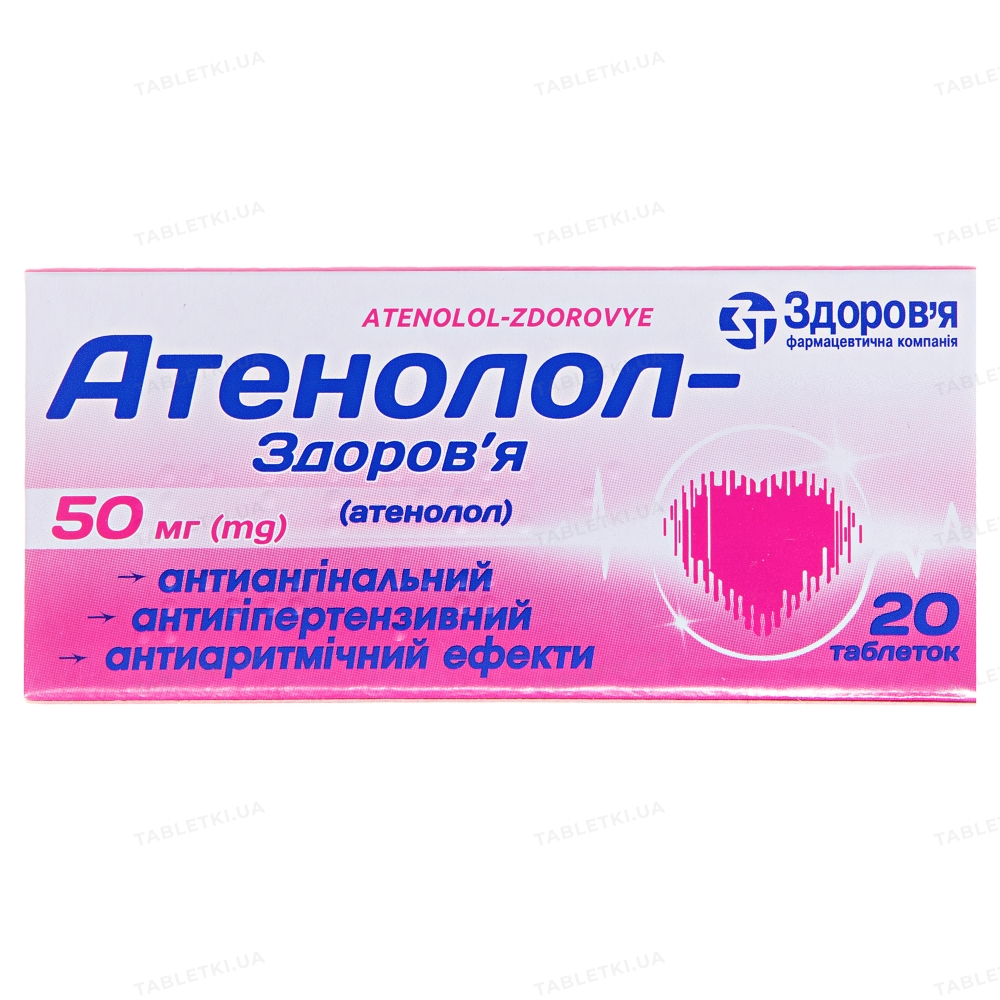
Atenolol-Zdorovye, 50 mg tablets, No. 20 (10 x 2)
Composition
Active ingredient: 1 tablet contains 50 mg of atenolol;
inactive ingredients: potato starch, light magnesium carbonate, microcrystalline cellulose, povidone, calcium stearate, talc, croscarmellose sodium.
Dosage Form
Tablets.
Main physical and chemical properties: white or white with a creamy tint, flat-cylindrical tablets with a beveled edge.
Pharmacotherapeutic group
Selective β-adrenoreceptor blockers. ATC code C07A B03.
Pharmacological properties
Pharmacodynamics. Cardioselective β-adrenergic receptor blocker. Has antianginal, antihypertensive, and antiarrhythmic effects. It has no intrinsic sympathomimetic or membrane-stabilizing activity. It reduces the automaticity of the sinoatrial node, slows atrioventricular conduction, and decreases myocardial contractility and oxygen demand. It has negative chronotropic, dromotropic, batmotropic, and isotropic effects.
Pharmacokinetics. After oral administration, 50–60% of atenolol is absorbed in the gastrointestinal tract. Maximum plasma concentration (2 μg/mL) is observed after 2–4 hours. The half-life is 6–7 hours.
Less than 5% of atenolol binds to plasma proteins. Atenolol is a hydrophilic compound that poorly crosses the blood-brain and placental barriers and is excreted into breast milk. Atenolol is metabolized to a small extent (less than 10%) in the liver. Most of the atenolol (85%) is excreted in the urine unchanged.
The half-life may be prolonged in patients with renal insufficiency.
It is removed by hemodialysis.
Indications
- Treatment of hypertension;
- treatment and prevention of angina attacks (chronic stable and unstable angina, especially when combined with tachycardia and hypertension);
- cardiac rhythm disorders (arrhythmia, sinus tachycardia, prevention of supraventricular tachycardia, paroxysmal supraventricular tachycardia, atrial fibrillation and flutter; ventricular arrhythmias, including those caused by increased physical exertion or the use of sympathomimetic agents; prevention of ventricular tachycardia and ventricular fibrillation);
- myocardial infarction (treatment and prevention to reduce mortality and lower the risk of recurrent infarction).
Contraindications
- Hypersensitivity to the drug’s components or to other β-blockers;
- acute heart failure;
- cardiogenic shock;
- second- and third-degree atrioventricular block;
- sinoatrial node dysfunction;
- sinoatrial block;
- sinus bradycardia (heart rate less than 45 beats per minute);
- hypotension (systolic blood pressure less than 90 mm Hg);
- bronchial asthma;
- metabolic acidosis;
- late stages of peripheral circulatory disorders;
- concomitant use of MAO inhibitors (except for MAO-B inhibitors);
- untreated pheochromocytoma;
- renal failure.
Interactions with Other Medications and Other Types of Interactions.
When atenolol is used concomitantly with:
- ;oral antidiabetic agents, such as insulin, their effects may be enhanced or prolonged. In this case, symptoms of hypoglycemia (especially tachycardia and tremor) may be masked or disappear. Therefore, blood glucose levels should be monitored regularly;
- ;tricyclic antidepressants, barbiturates, phenothiazides, nitroglycerin, diuretics, vasodilators, and other antihypertensive agents (e.g., prazosin), the hypotensive effect may be enhanced;
- ;calcium channel blockers (nifedipine)—in addition to an increased hypotensive effect, heart failure may develop;
- ;calcium channel blockers with a negative inotropic effect (verapamil, diltiazem) may have their effects potentiated, especially in patients with impaired ventricular function and/or atrioventricular conduction, which increases the risk of hypotension and bradycardia. If intravenous administration of verapamil is necessary, it should be administered no sooner than 48 hours after discontinuation of atenolol;
- ;when used with cardiac glycosides, reserpine, α-methyldopa, guanfacine, and clonidine, a significant slowing of the heart rate may occur;
- ;indomethacin may reduce the antihypertensive effect of atenolol;
- ;narcotics and antiseptics enhance the antihypertensive effect. In this case, an additive, negative inotropic effect of both agents is observed;
- ;peripheral muscle relaxants (e.g., succinylcholine, tubocurarine) may cause an increase in neuromuscular blockade; therefore, prior to surgery involving anesthesia, the anesthesiologist should be informed that the patient is taking atenolol;
- ;euphyllin and theophylline may mutually inhibit each other’s therapeutic effects;
- ;lidocaine: its clearance may be reduced, increasing the risk of lidocaine toxicity;
- ;sympathomimetic agents (epinephrine) may reduce the effect of β-blockers;
- ;nitrates, peripheral vasodilators, and MAO inhibitors may increase their hypotensive effects;
- ;propafenone may enhance the effect of atenolol, which is a component of the drug;
- ;potassium-containing drugs may reduce the effect of the latter;
- ;drugs that depress the central nervous system may enhance the sedative effect;
- ;narcotic analgesics lead to an increase in the narcotic effect and dangerous sedation;
- ;anticholinesterase agents and angiotensin-converting enzyme (ACE) inhibitors (captopril, enalapril, lisinopril) lead to an increase in blood potassium levels.
In patients taking both atenolol and clonidine, clonidine may be discontinued only several days after stopping atenolol treatment.
Atenolol potentiates the antihypertensive effect of prazosin; their combination results in a greater reduction in blood pressure than when either drug is taken alone.
During treatment with atenolol, intravenous calcium channel blockers such as verapamil and diltiazem, or other antiarrhythmic agents (e.g., disopyramide), should not be administered.
Special considerations for use.
An exception is made for patients undergoing treatment in intensive care units.
In all such cases, the physician must carefully weigh the benefit-risk ratio when prescribing atenolol.
If patients have experienced thrombocytopenic or non-thrombocytopenic purpura while being treated with other beta-blockers, the possibility of this side effect occurring during treatment with atenolol should be considered.
It should be noted that, in extremely rare cases, treatment with atenolol may lead to the manifestation of latent diabetes mellitus or a worsening of the condition in patients with existing diabetes mellitus. Lipid metabolism disorders are sometimes observed: while total cholesterol levels remain within the normal range, high-density lipoprotein (HDL) levels decrease and plasma triglyceride levels increase.
Do not change the dosage or discontinue treatment with atenolol without consulting a doctor. Abrupt discontinuation of the drug may lead to the development of withdrawal syndrome. Therefore, discontinuation of the drug and dose reduction should be carried out slowly and gradually.
Atenolol should be prescribed with extreme caution and only under strict medical supervision:
- in cases of first-degree atrioventricular block;
- in patients with diabetes mellitus and fluctuating blood glucose levels (due to the risk of severe hypoglycemia);
- in cases of prolonged fasting and strenuous physical exertion (severe hypoglycemia may occur);
- in pheochromocytoma (following prior administration of α1-adrenoreceptor blockers);
- in patients with impaired liver and/or kidney function (when atenolol is prescribed to this category
patients, continuous monitoring of liver and/or kidney function is required);
- in patients with active psoriasis or a personal or family history of psoriasis;
- patients with impaired peripheral circulation, including Raynaud’s syndrome;
- patients undergoing desensitization therapy or with a history of severe allergic reactions.
In cases of thyrotoxicosis, atenolol may mask the clinical signs of hyperthyroidism.
β-blockers are not recommended for use in vasospastic angina (Prinzmetal angina).
Atenolol should be prescribed with caution to patients with myasthenia gravis.
If surgery is necessary, it is recommended to discontinue atenolol therapy 24 hours prior to the procedure or to select an anesthetic with minimal negative inotropic effects.
In thyrotoxicosis, atenolol may mask the symptoms of hypoglycemia, particularly tachycardia.
Treatment with atenolol may alter the results of certain laboratory tests: increased serum potassium levels, as well as increased levels of catecholamines and their metabolites in urine and blood. Although a link between atenolol and depression has not been fully established, the drug should be used with caution in these patients.
For elderly patients, it is recommended to start treatment with reduced doses (the dose may be increased while monitoring blood pressure and heart rate). If severe bradycardia, hypotension, arrhythmias, conduction disturbances, or other complications are observed in such patients, the atenolol dose should be reduced or the drug discontinued.
Drug Interactions and Other Interactions
When atenolol is used concomitantly with:
- ;oral antidiabetic agents, such as insulin, their effects may be enhanced or prolonged. In this case, symptoms of hypoglycemia (especially tachycardia and tremor) may be masked or disappear. Therefore, blood glucose levels should be monitored regularly;
- ;tricyclic antidepressants, barbiturates, phenothiazides, nitroglycerin, diuretics, vasodilators, and other antihypertensive agents (e.g., prazosin), the hypotensive effect may be enhanced;
- ;calcium channel blockers (nifedipine)—in addition to an increased hypotensive effect, heart failure may develop;
- ;calcium channel blockers with a negative inotropic effect (verapamil, diltiazem) may have their effects potentiated, especially in patients with impaired ventricular function and/or atrioventricular conduction, which increases the risk of hypotension and bradycardia. If intravenous administration of verapamil is necessary, it should be administered no sooner than 48 hours after discontinuation of atenolol;
- ;when used with cardiac glycosides, reserpine, α-methyldopa, guanfacine, and clonidine, a significant slowing of the heart rate may occur;
- ;indomethacin may reduce the antihypertensive effect of atenolol;
- ;narcotics and antiseptics may potentiate the antihypertensive effect. In this case, an additive, negative inotropic effect of both agents is observed;
- ;peripheral muscle relaxants (e.g., succinylcholine, tubocurarine) may cause an increase in neuromuscular blockade; therefore, prior to surgery involving anesthesia, the anesthesiologist should be informed that the patient is taking atenolol;
- ;euphyllin and theophylline may mutually inhibit each other’s therapeutic effects;
- ;lidocaine: its clearance may be reduced, increasing the risk of lidocaine toxicity;
- ;sympathomimetic agents (epinephrine) may reduce the effect of β-blockers;
- ;nitrates, peripheral vasodilators, and MAO inhibitors may increase their hypotensive effects;
- ;propafenone may enhance the effect of atenolol, which is a component of the drug;
- ;potassium-containing drugs may reduce the effect of the latter;
- ;drugs that depress the central nervous system may enhance the sedative effect;
- ;narcotic analgesics lead to an increase in the narcotic effect and dangerous sedation;
- ;anticholinesterase agents and angiotensin-converting enzyme (ACE) inhibitors (captopril, enalapril, lisinopril) lead to an increase in blood potassium levels.
In patients taking both atenolol and clonidine, clonidine should be discontinued only several days after stopping atenolol.
Atenolol potentiates the antihypertensive effect of prazosin; their combination results in a greater reduction in blood pressure than when either drug is taken alone.
During treatment with atenolol, intravenous calcium channel blockers such as verapamil and diltiazem, or other antiarrhythmic agents (e.g., disopyramide), should not be administered.
Use During Pregnancy or Breastfeeding
Atenolol crosses the placental barrier and passes into breast milk. During pregnancy (especially in the first trimester), atenolol should be used only when strictly indicated, after carefully weighing the benefit-risk ratio, as there is still insufficient experience with its use in pregnant women, especially in the early stages. If a woman has been taking atenolol, treatment should be discontinued at least 24–48 hours before delivery due to the potential for the infant to develop bradycardia, hypoglycemia, and respiratory depression. If this is not possible, the infant should be kept under close observation for 24–48 hours after delivery.
Atenolol is excreted into breast milk; therefore, breastfeeding should be discontinued during treatment with this medication.
Effect on reaction time when driving or operating machinery. In some cases, at the start of treatment, when the dosage is increased, when switching medications, or when interacting with alcohol, reaction time while driving or operating machinery may be impaired.
Special considerations for use
Patients undergoing treatment in intensive care units are an exception.
In all such cases, the physician must carefully weigh the benefit-risk ratio when prescribing atenolol.
If patients have previously experienced thrombocytopenic or non-thrombocytopenic purpura while being treated with other beta-blockers, the possibility of this side effect occurring during treatment with atenolol must be considered.
It should be noted that, in extremely rare cases, treatment with atenolol may lead to the manifestation of latent diabetes mellitus or a worsening of the condition in patients with existing diabetes mellitus. Lipid metabolism disorders are sometimes observed: while total cholesterol levels remain within the normal range, high-density lipoprotein (HDL) levels decrease and plasma triglyceride levels increase.
Do not change the dosage or discontinue treatment with atenolol without consulting a doctor. Sudden discontinuation of the drug may lead to the development of withdrawal syndrome. Therefore, discontinuation of the drug and dose reduction should be carried out slowly and gradually.
Atenolol should be prescribed with extreme caution and only under strict medical supervision:
- in cases of first-degree atrioventricular block;
- in patients with diabetes mellitus and fluctuating blood glucose levels (due to the risk of severe hypoglycemia);
- in cases of prolonged fasting and strenuous physical exertion (severe hypoglycemia may occur);
- in pheochromocytoma (following prior administration of α1-adrenoreceptor blockers);
- in patients with impaired liver and/or kidney function (when atenolol is prescribed to this category
patients, continuous monitoring of liver and/or kidney function is required);
- in patients with active psoriasis or a personal or family history of psoriasis;
- patients with impaired peripheral circulation, including Raynaud’s syndrome;
- patients undergoing desensitization therapy or with a history of severe allergic reactions.
In cases of thyrotoxicosis, atenolol may mask the clinical signs of hyperthyroidism.
β-blockers are not recommended for use in vasospastic angina (Prinzmetal angina).
Atenolol should be prescribed with caution to patients with myasthenia gravis.
If surgery is necessary, it is recommended to discontinue atenolol therapy 24 hours prior to the procedure or to select an anesthetic with minimal negative inotropic effects.
In thyrotoxicosis, atenolol may mask the symptoms of hypoglycemia, particularly tachycardia.
Treatment with atenolol may alter the results of certain laboratory tests: increased serum potassium levels, as well as increased levels of catecholamines and their metabolites in urine and blood. Although a link between atenolol and depression has not been fully established, the drug should be used with caution in these patients.
For elderly patients, it is recommended to start treatment with reduced doses (the dose may be increased while monitoring blood pressure and heart rate). If severe bradycardia, hypotension, arrhythmia, conduction disturbances, or other complications are observed in such patients, the atenolol dose should be reduced or the drug discontinued.
Dosage and Administration
Swallow the tablets whole with a small amount of liquid, before meals, preferably at the same time each day.
The dosage and duration of treatment are determined by the physician on an individual basis, depending on the therapeutic effect achieved.
Myocardial infarction: Following intravenous administration, administer 50 mg orally 12 hours after the injection, followed by 100 mg another 12 hours later.
Chronic stable and unstable angina: usually, 100 mg of atenolol is prescribed once daily, or 50 mg taken in two divided doses.
Hypertension: Treatment is usually initiated with 100 mg of the drug once daily. For some patients, 50 mg daily is sufficient. The effect is observed after 2 weeks. If ineffective, use atenolol in combination with diuretics.
Supraventricular and ventricular arrhythmias: Administer the drug 1–2 times daily at a dose of 50–100 mg.
The maximum daily dose is 200 mg.
In patients with severe renal impairment, the dose depends on the creatinine clearance (CC) level: for a CC of 10–30 mL/min, reduce the dose by half (50 mg daily or every other day); for a CC of less than 10 mL/min, reduce the dose to one-fourth of the usual dose.
Patients undergoing hemodialysis should receive 50 mg of the drug after each dialysis session. This must be done in a hospital setting, as a significant drop in blood pressure may occur.
Children
Do not administer this medication to children.
Overdose
Symptoms: The clinical picture depends on the degree of intoxication and manifests primarily as disturbances in the cardiovascular and central nervous systems.
Overdose may lead to hypotension, bradycardia, heart failure, and cardiogenic shock. In severe cases, respiratory distress, bronchospasm, vomiting, and altered consciousness may occur; generalized seizures are extremely rare.
Treatment: In the event of an overdose or a condition where there is a risk of a decrease in heart rate and/or blood pressure, treatment with atenolol must be discontinued. In intensive care units, vital signs should be closely monitored and adjusted as necessary.
If necessary, administer:
- atropine (0.5–2 mg intravenously as a bolus);
- glucagon: initial dose of 1–10 mg intravenously (as a bolus), followed by 2–2.5 mg/hour as a continuous infusion;
- sympathomimetics depending on body weight and response (dopamine, dobutamine, isoprenaline, oxiprenaline, or epinephrine).
If bradycardia is refractory to treatment, temporary pacemaker support may be considered.
For bronchospasm, administer β2-sympathomimetics as an aerosol (or intravenously if the effect is insufficient) or intravenous aminophylline.
For generalized seizures, administer diazepam by slow intravenous infusion.
It is removed by hemodialysis.
Adverse reactions.
Cardiovascular system: arterial hypotension, bradycardia, atrioventricular conduction disturbances (up to cardiac arrest), orthostatic hypotension, symptoms of heart failure, a sensation of coldness, and paresthesia in the extremities. In isolated cases, an increase in the frequency of angina attacks cannot be ruled out in patients with angina.
Central nervous system: fatigue, dizziness, sleep disturbances, headache, increased sweating, depressive disorders, nightmares, insomnia, drowsiness, confusion, hallucinations, mood swings, psychosis.
Ocular: visual disturbances, decreased tear secretion, conjunctivitis, dry eyes.
Gastrointestinal system: nausea, constipation, diarrhea, dry mouth, dyspepsia, abnormal transaminase levels, intrahepatic cholestasis, hepatotoxicity.
Endocrine system: hypoglycemia (in patients with diabetes mellitus).
Genitourinary system: impaired libido and potency, impotence, gynecomastia, difficulty urinating.
Respiratory system: in susceptible patients—onset of symptoms of bronchial obstruction, bronchospasm.
Hematologic system: purpura, thrombocytopenia.
Immune system: skin flushing, itching, skin rashes (exacerbation of psoriasis), psoriasis-like skin reactions, exanthema, alopecia, urticaria, elevated antinuclear antibody levels, photosensitivity, urticarial rashes, hypersensitivity reactions (angioedema).
Other: muscle weakness, dry mouth, withdrawal syndrome.
Effect on reaction time when driving or operating machinery
In isolated cases, at the start of treatment, when the dosage is increased, when switching medications, or when interacting with alcohol, reaction time while driving or operating machinery may be impaired.
Shelf life
3 years.
Storage conditions
Store in the original packaging at a temperature not exceeding 25 °C.
Keep out of reach of children.
Packaging
50 mg tablets, No. 20 (10×2) in blister packs in a box; No. 10 in blister packs.
Side Effects
Cardiovascular system: hypotension, bradycardia, atrioventricular conduction disturbances (up to cardiac arrest), orthostatic hypotension, symptoms of heart failure, a sensation of coldness, and paresthesia in the extremities. In isolated cases, an increase in the frequency of angina attacks cannot be ruled out in patients with angina.
Central nervous system: fatigue, dizziness, sleep disturbances, headache, increased sweating, depressive disorders, nightmares, insomnia, drowsiness, confusion, hallucinations, mood swings, psychosis.
Ocular: visual disturbances, decreased tear secretion, conjunctivitis, dry eyes.
Gastrointestinal system: nausea, constipation, diarrhea, dry mouth, dyspepsia, abnormal transaminase levels, intrahepatic cholestasis, hepatotoxicity.
Endocrine system: hypoglycemia (in patients with diabetes mellitus).
Genitourinary system: impaired libido and potency, impotence, gynecomastia, difficulty urinating.
Respiratory system: in susceptible patients—onset of symptoms of bronchial obstruction, bronchospasm.
Hematologic system: purpura, thrombocytopenia.
Immune system: skin flushing, itching, skin rashes (exacerbation of psoriasis), psoriasis-like skin reactions, exanthema, alopecia, urticaria, elevated antinuclear antibody levels, photosensitivity, urticarial rashes, hypersensitivity reactions (angioedema).
Other: muscle weakness, dry mouth, withdrawal syndrome.
Manufacturer
Limited Liability Company “Pharmaceutical Company ‘Zdorov’ya’.”
Manufacturer’s location and business address: 22 Shevchenko Street, Kharkiv, Kharkiv Oblast, 61013, Ukraine.
Address
22 Shevchenko Street, Kharkiv, Kharkiv Oblast, 61013, Ukraine.