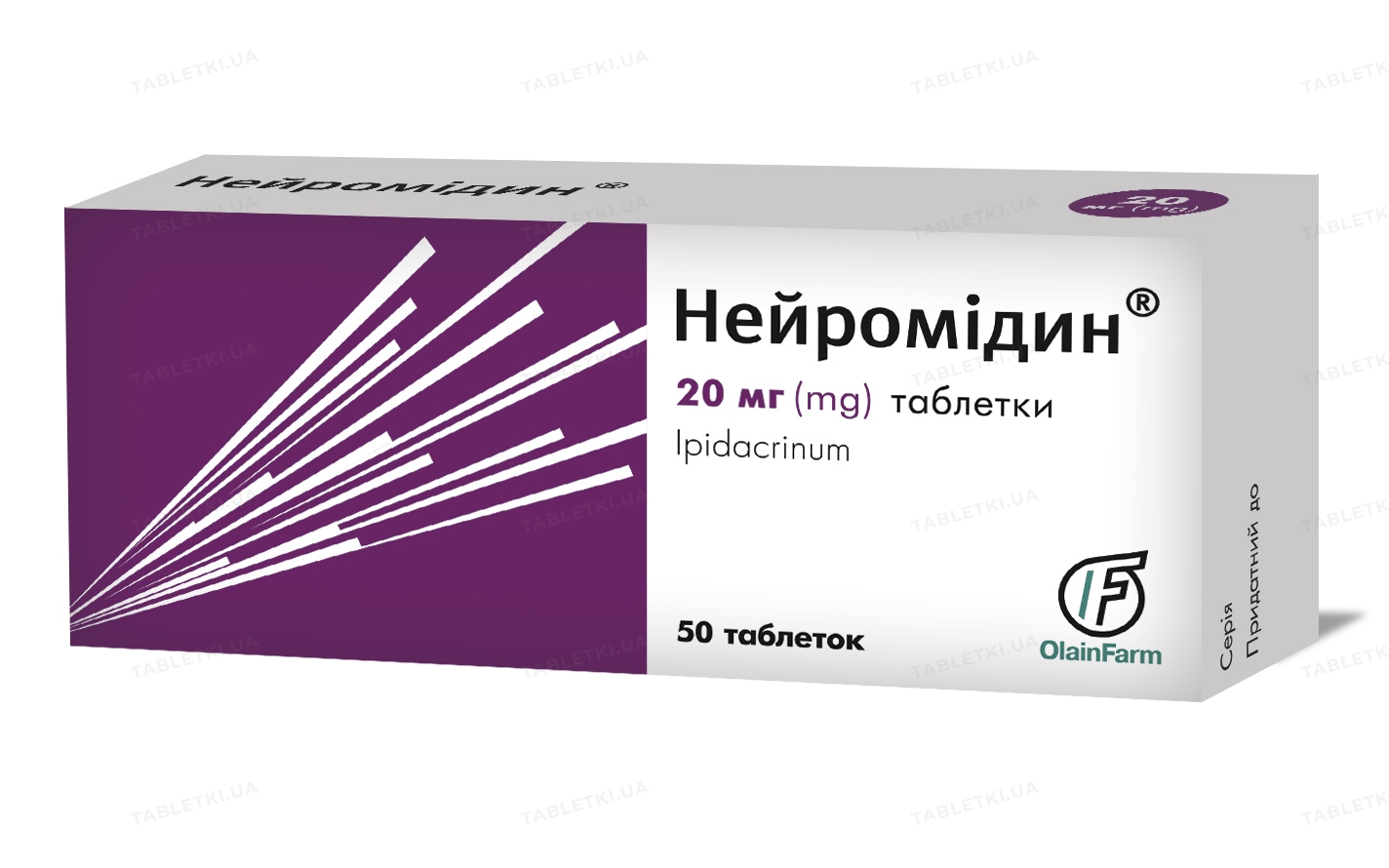
Neuromidin 20 mg tablets, No. 50 (10 x 5)
Active ingredient: ipidacrine;
1 tablet contains 20 mg of ipidacrine hydrochloride;
Excipients: lactose monohydrate; potato starch; calcium stearate.
Dosage Form
Tablets.
Main physical and chemical properties: flat-cylindrical tablets, white or almost white in color, with a beveled edge.
Pharmacotherapeutic group
Other agents acting on the nervous system. Parasympathomimetics. Anticholinesterases. ATX code N07A A.
Pharmacological properties
Pharmacodynamics.
Neuromidin® is a drug with a biologically advantageous combination of two molecular effects: blockade of membrane potassium permeability and inhibition of cholinesterase. In this case, the blockade of membrane potassium permeability plays a decisive role.
Blockade of membrane potassium permeability primarily leads to a prolongation of the repolarization phase of the action potential of the excited membrane and an increase in the activity of the presynaptic axon. This leads to an increase in the influx of calcium ions into the presynaptic terminal, which in turn leads to an increase in neurotransmitter release into the synaptic cleft at all synapses. An increase in neurotransmitter concentration in the synaptic cleft contributes to stronger stimulation of the postsynaptic cell through neurotransmitter-receptor interactions. In cholinergic synapses, inhibition of cholinesterase causes an even greater accumulation of the neurotransmitter in the synaptic cleft and an increase in the functional activity of the postsynaptic cell (contraction, conduction of excitation).
Neuromidin enhances the effects of acetylcholine, epinephrine, serotonin, histamine, and oxytocin® on smooth muscle.
Neuromidine® exhibits the following key pharmacological effects:
- stimulation and restoration of neuromuscular transmission;
- restoration of impulse conduction in the peripheral nervous system following its blockade by various agents (trauma, inflammation, the effects of local anesthetics, certain antibiotics, potassium chloride, toxins, etc.);
- increased contractile capacity of smooth muscle organs;
- moderately stimulates the central nervous system in a specific manner, with some sedative effects;
- improvement in memory and learning ability;
- analgesic effect.
The drug has no teratogenic, embryotoxic, mutagenic, or carcinogenic effects, nor does it have any allergenic or immunotoxic effects, and it does not affect the endocrine system.
Pharmacokinetics.
After oral administration, the drug is rapidly absorbed from the gastrointestinal tract. Maximum plasma concentration of the active ingredient is reached 1 hour after administration. From the blood, Neuromidin® rapidly enters the tissues; at the steady-state phase, only 2% of the drug is detected in the blood serum, and the half-life during the distribution phase is 40 minutes. 40–50% of the active ingredient binds to plasma proteins. Neuromidin® is absorbed primarily from the duodenum, to a slightly lesser extent from the small intestine and ileum, and only 3% of the dose is absorbed in the stomach. Neuromidin® is eliminated from the body through a combination of renal and non-renal mechanisms (biotransformation, secretion into bile), with urinary excretion predominating. Only 3.7% of Neuromidin is excreted unchanged in the urine, indicating rapid metabolism of the drug in the body.
Indications
- Diseases of the peripheral nervous system (neuropathies, neuritis, polyneuritis, and polyneuropathies; myelopolyradiculoneuritis), myasthenia gravis, and myasthenic syndrome of various etiologies.
- Bulbar neuritis and paresis.
- Memory impairment of various etiologies (Alzheimer’s disease and other forms of senile mental disorders); mental developmental delay in children.
- The recovery phase of organic lesions of the central nervous system accompanied by motor disorders.
- As part of complex therapy for multiple sclerosis and other forms of demyelinating diseases of the nervous system.
- Intestinal atony.
Contraindications
- Hypersensitivity to ipidacrine or any other components of the drug.
- Epilepsy.
- Extrapyramidal disorders with hyperkinesis.
- Angina pectoris.
- Severe bradycardia.
- Bronchial asthma.
- Vestibular disorders.
- Mechanical obstruction of the intestines and urinary tract.
- Peptic ulcer disease of the stomach or duodenum in the acute stage.
Interactions with Other Medications and Other Forms of Interaction
Neuromidin® enhances the sedative effect when combined with agents that depress the central nervous system. The effects and side effects are enhanced when used concomitantly with other cholinesterase inhibitors and m-cholinomimetic agents.
In patients with myasthenia gravis, the risk of a “cholinergic” crisis increases with the concurrent use of Neuromidin® and cholinergic agents. The risk of bradycardia increases if β-blockers are used prior to starting treatment with Neuromidin®.
Neuromidin® may be used in combination with nootropic agents.
Alcohol enhances the drug’s side effects.
Cerebrolysin enhances the psychotropic effects of Neuromidin®.
Special Considerations
Use with caution in patients with a history of gastric or duodenal ulcers, respiratory diseases, including acute respiratory diseases, cardiovascular diseases not associated with coronary pain, and thyrotoxicosis.
This medication contains lactose; therefore, patients with rare hereditary forms of galactose intolerance, lactase deficiency, or glucose-galactose malabsorption should not take this medication.
Pregnancy and Lactation
Neuromidin® increases uterine tone and may cause premature labor; therefore, its use is contraindicated during pregnancy.
Use of this medication is contraindicated during breastfeeding.
Effects on the Ability to Drive and Operate Machinery
Neuromidin® may have a sedative effect; therefore, caution should be exercised when driving.
Dosage and Administration
Neuromidin® tablets should be taken orally.
For neuritis: 1 tablet 2–3 times a day. The course of treatment ranges from 10–15 days for acute neuritis to 20–30 days for chronic neuritis. If necessary, the treatment course may be repeated 2–3 times at 2–4-week intervals until the maximum effect is achieved.
For myelopolyradiculoneuritis and paresis—1 tablet 2–3 times daily for 30–40 days. Treatment courses should be repeated multiple times with a 1–2-month break. Treatment courses should be repeated until a therapeutic effect is achieved.
For myasthenia gravis and myasthenic syndromes—1–2 tablets 2–3 times a day. In severe cases, the dose may be increased to 200 mg per day (2 tablets 5 times a day every 2–3 hours). Treatment is administered in courses, alternating with conventional anticholinesterase drugs.
For multiple sclerosis and other forms of demyelinating diseases of the nervous system, as well as bulbar palsy—1 tablet 3–5 times daily for 60 days, 2–3 times a year.
For Alzheimer’s disease and other forms of age-related cognitive decline, treatment begins with a dose of 1–2 tablets per day, divided into 2 doses, with a gradual increase of 2 tablets per week up to 6–10 tablets per day (2 tablets 3–5 times a day). The duration of treatment ranges from 4 months to 1 year. A course of therapy may be repeated every 4–5 months with a 1–2-month break.
For organic lesions of the central nervous system accompanied by motor disorders—1 tablet 2–3 times a day. The average course of treatment is 30 days. If necessary, the course of treatment may be repeated.
For intestinal atony—1 to 3 tablets per day, divided into 3 doses. The course of treatment is 1–3 weeks.
For children over 12 years of age with intellectual disabilities and diseases of the peripheral nervous system, Neuromidin® should be prescribed at a dose of 1 tablet (20 mg) 2–3 times daily. The course of treatment is 1–2 months, depending on the clinical presentation.
Children
The drug may be used in children over 12 years of age.
Overdose
In cases of severe intoxication, a cholinergic crisis may develop.
Symptoms: bronchospasm, tearing, increased sweating, miosis, nystagmus, increased gastrointestinal motility, involuntary defecation and urination, vomiting, jaundice, bradycardia, cardiac conduction disturbances, arrhythmias, decreased blood pressure, restlessness, agitation, excitement, anxiety, ataxia, seizures, coma, speech disturbances, drowsiness, and general weakness.
Treatment: symptomatic therapy. Use of m-cholinergic blockers (atropine, cyclodol, metacin).
Side Effects
Classification of the frequency of adverse reactions: very common (≥ 1/10); common (≥ 1/100 to < 1/10); uncommon (≥ 1/1,000 to < 1/100); rare (≥ 1/10,000 to < 1/1,000); very rare (< 1/10,000), including isolated cases; Unknown (cannot be estimated from the available data).
Neuromidin® is well tolerated. Possible side effects associated with stimulation of
M-cholinergic receptors.
Cardiac disorders: common—palpitations, bradycardia, chest pain.
Nervous system disorders: uncommon (with high doses)—dizziness, headache, drowsiness, general weakness, muscle spasms.
Respiratory, thoracic, and mediastinal disorders: uncommon—increased bronchial secretion, bronchospasm.
Gastrointestinal disorders: common—hypersalivation, nausea; rare (at high doses)—vomiting; rare—diarrhea, epigastric pain.
Hepatic and biliary disorders: jaundice (frequency unknown).
Skin and subcutaneous tissue disorders: common—increased sweating; rare—allergic reactions, including urticaria, angioedema, pruritus, and rash, may occur after taking high doses.
Reproductive system: increased uterine tone.
Salivation and bradycardia can be reduced with anticholinergic blockers (atropine, etc.). In case of adverse effects, the dose should be reduced or a short break (1–2 days) should be taken.
Shelf life
5 years.
Storage conditions
Store in a dry place, protected from light, at a temperature not exceeding 25 °C.
Keep out of the reach of children.
Packaging
10 tablets per blister pack. 5 blister packs per cardboard box.
Manufacturer
Olainfarm, JSC.
Address
5 Rupnitsu St., Olaine, LV-2114, Latvia.