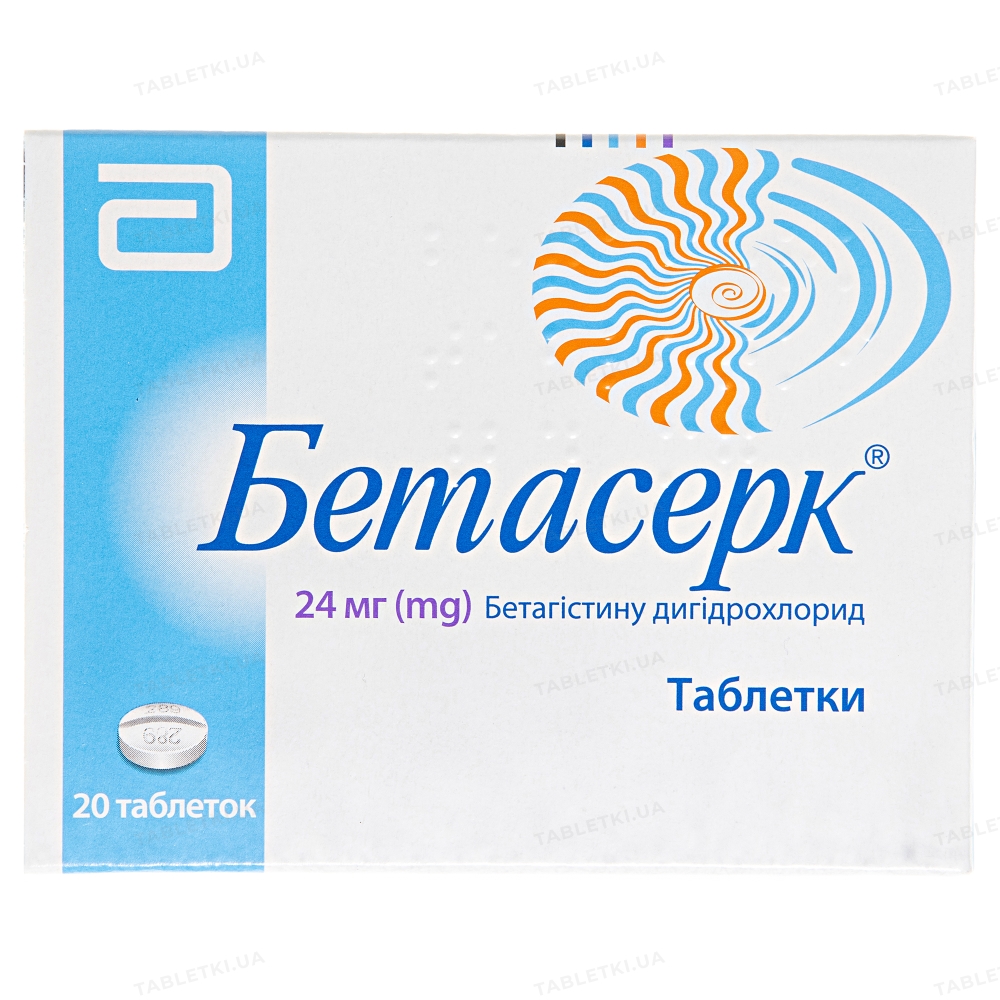
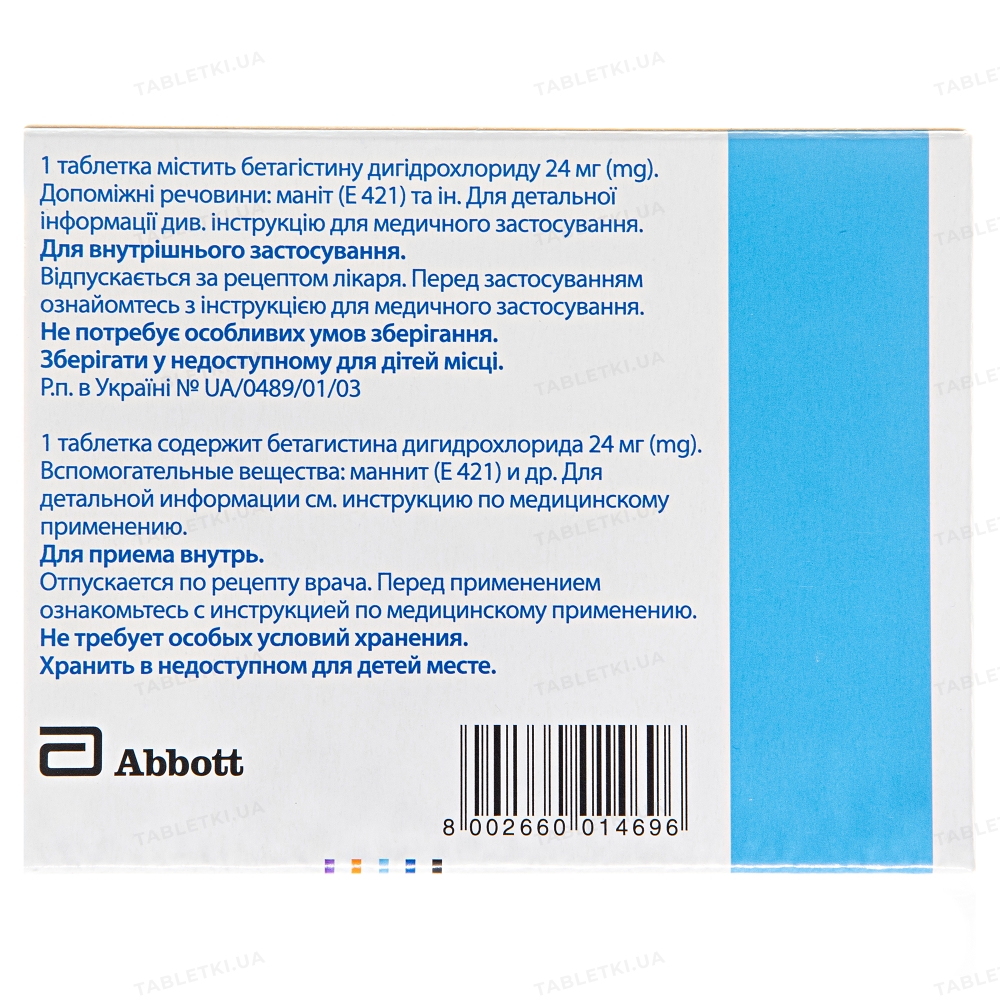
Betaserc 24 mg tablets, No. 20
Composition
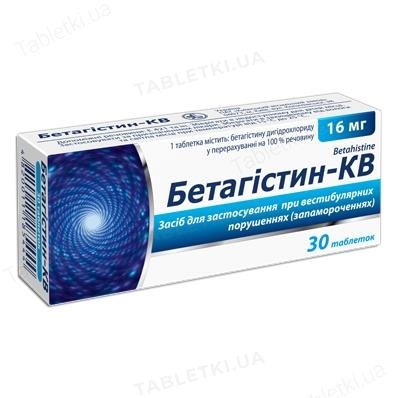
Active ingredient: betahistine dihydrochloride;
1 tablet contains 8 mg, 16 mg, or 24 mg of betahistine dihydrochloride;
Excipients: microcrystalline cellulose, mannitol (E 421), citric acid monohydrate, colloidal anhydrous silicon dioxide, talc.
Dosage Form
Tablets.
Main physical and chemical properties:
8 mg tablets: round, flat, white or almost white tablets with beveled edges, marked “256” on one side; diameter approximately 7 mm and weight approximately 125 mg.
16 mg tablets: round, biconvex, scored, white or almost white tablets with beveled edges, scored on one side and marked “267” on both sides of the score line; Diameter approximately 8.5 mm and weight approximately 250 mg; the tablet can be divided into two equal doses.
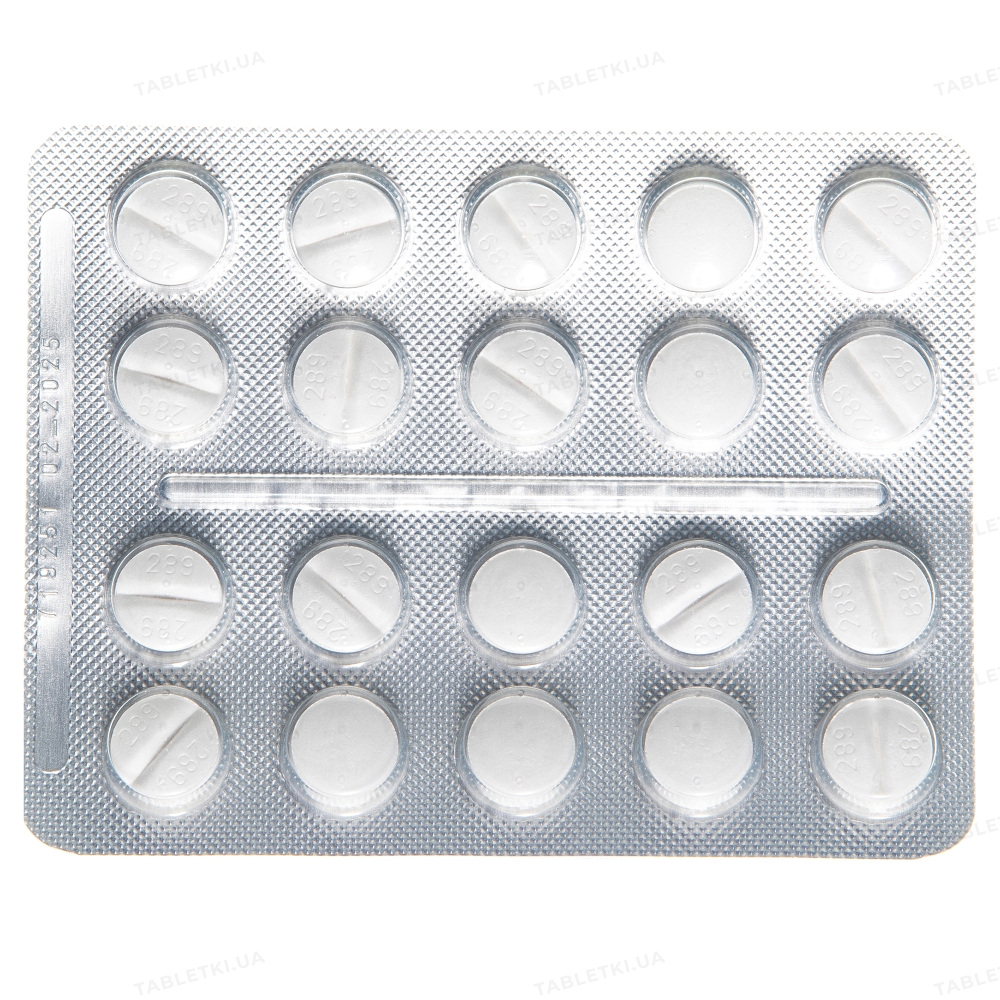
24 mg tablets: round, biconvex, scored, white or almost white tablets with beveled edges, with a score line on one side and the marking “289” on both sides of the score line; Diameter approximately 10 mm and weight approximately 375 mg; the score line is intended only to facilitate breaking the tablet to make it easier to swallow and is not intended to divide the tablet into two equal doses.
Pharmacological group
Medications for the treatment of vestibular disorders. Betahistine. ATX code N07C A01.
Pharmacological Properties
Pharmacodynamics.
The mechanism of action of betahistine has been only partially elucidated. There are several plausible hypotheses supported by data from animal and human studies.
Effect of betahistine on the histaminergic system.
It has been established that betahistine exhibits partial agonist activity at H1 receptors, as well as antagonist activity at H3 histamine receptors in nervous tissue and exhibits negligible activity against histamine H2 receptors. Betahistine increases histamine metabolism and release by blocking presynaptic H3 receptors and inducing a reduction in the number of these H3 receptors.
Betahistine may increase blood flow in the cochlear region as well as throughout the entire brain.
Pharmacological studies in animals have demonstrated improved blood flow in the striae vascularis of the inner ear, possibly due to the relaxation of precapillary sphincters in the inner ear’s microcirculatory system. Betahistine has also been shown to increase cerebral blood flow in humans.
Betahistine promotes vestibular compensation.
Betahistine accelerates the recovery of vestibular function following unilateral neurectomy in animals by stimulating and facilitating the process of central vestibular compensation. This effect is characterized by enhanced regulation of histamine metabolism and release and is mediated by H3-receptor antagonism. In humans treated with betahistine, the time required for vestibular function to recover after neurectomy was also reduced.
Betahistine alters neuronal activity in the vestibular nuclei.
It has also been established that betahistine exerts a dose-dependent inhibitory effect on the generation of spike potentials in neurons of the lateral and medial vestibular nuclei.
The pharmacodynamic properties of betahistine, as demonstrated in animal studies, may account for the drug’s positive therapeutic effect on the vestibular system.
The efficacy of betahistine has been demonstrated in studies of patients with vestibular vertigo and Meniere’s disease, as evidenced by a reduction in the severity and frequency of vertigo attacks.
Pharmacokinetics.
Absorption.
When administered orally, betahistine is rapidly and almost completely absorbed throughout the gastrointestinal tract. After absorption, the drug is rapidly and almost completely metabolized to form the metabolite 2-pyridylacetic acid. Plasma concentrations of betahistine are very low. Therefore, all pharmacokinetic analyses are conducted by measuring the concentration of the metabolite 2-pyridylacetic acid in plasma and urine.
When taken with food, the maximum concentration (Cmax) of the drug is lower than when taken on an empty stomach. However, the total absorption of betahistine is identical in both cases, indicating that food intake slows the absorption of the drug.
Distribution.
Less than 5% of betahistine is bound to plasma proteins.
Biotransformation.
After absorption, betahistine is rapidly and almost completely metabolized to 2-pyridylacetic acid (which has no pharmacological activity).
After oral administration of betahistine, the concentration of 2-pyridylacetic acid in plasma (and in urine) peaks 1 hour after administration and declines with a half-life of approximately 3.5 hours.
Elimination.
2-pyridylacetic acid is rapidly excreted in the urine. When the drug is administered at a dose of 8–48 mg, approximately 85% of the initial dose is recovered in the urine. Renal or fecal excretion of betahistine is negligible.
Linearity.
The rate of recovery remains constant when the drug is administered orally at doses of 8–48 mg, indicating the linearity of betahistine’s pharmacokinetics and suggesting that the metabolic pathway involved is unsaturated.
Indications
Ménière’s disease and syndrome, characterized by three main symptoms:
- vertigo, sometimes accompanied by nausea and vomiting;
- hearing loss (deafness);
- tinnitus.
Symptomatic treatment of vestibular vertigo of various origins.
Contraindications
Hypersensitivity to the active ingredient or any of the drug’s excipients.
Pheochromocytoma.
Interactions with Other Medications and Other Types of Interactions
No in vivo studies have been conducted to investigate interactions with other drugs. Based on in vitro data, inhibition of cytochrome P450 enzyme activity is not expected in vivo.
Data obtained in vitro indicate that the metabolism of betahistine is inhibited by drugs that inhibit monoamine oxidase (MAO) activity, including MAO subtype B (e.g., selegiline). Caution is recommended when betahistine is used concomitantly with MAO inhibitors (including B-selective MAO inhibitors).
Since betahistine is a histamine analog, the interaction of betahistine with antihistamines may theoretically affect the efficacy of one of these drugs.
Special Considerations for Use
During treatment with this medication, patients with a history of bronchial asthma and/or gastric or duodenal ulcers should be closely monitored.
Use during pregnancy or breastfeeding.
Pregnancy. There are insufficient data on the use of betahistine in pregnant women.
Animal studies have not shown any direct or indirect adverse effects regarding reproductive toxicity at doses corresponding to those used in clinical practice. Betahistine should not be used during pregnancy unless absolutely necessary.
Breastfeeding. It is unknown whether betahistine passes into human breast milk. Betahistine passes into the milk of rats. The effects observed postpartum in animal studies were limited to very high doses. The benefits of using the drug for the mother should be weighed against the benefits of breastfeeding and the potential risk to the infant.
Fertility. Studies in rats showed no effect on fertility.
Ability to affect reaction time when operating motor vehicles or other machinery.
Betahistine is indicated for the treatment of Meniere’s disease, characterized by a triad of primary symptoms: vertigo, hearing loss, and tinnitus, as well as for the symptomatic treatment of vestibular vertigo. Both conditions may negatively affect the ability to drive a car and operate other machinery. According to clinical studies investigating the drug’s effect on the ability to drive a car and operate other machinery, betahistine had no effect or only a negligible effect on this ability.
Dosage and Administration
The daily dose for adults is 24–48 mg, to be taken in evenly spaced doses throughout the day. The tablets should be swallowed whole with water.
| 8-mg tablets | 16 mg tablets | 24 mg tablets |
| 1–2 tablets
3 times a day |
½–1 tablet
3 times a day |
1 tablet
twice daily |
The dose should be adjusted individually depending on the response. Symptom relief is sometimes observed only after several weeks of treatment. The best results are sometimes achieved when the medication is taken for several months. According to some data, starting treatment early in the course of the disease prevents its progression or hearing loss in later stages.
Betaserc® can be taken with or without food. Mild gastrointestinal disturbances (listed in the “Side Effects” section) may occur while taking the medication; these can be alleviated by taking the medication with food.
Elderly Patients
Although clinical trial data in this patient group are currently limited, extensive postmarketing experience suggests that no dose adjustment is necessary for elderly patients.
Renal impairment
No specific clinical trials have been conducted in this patient group; however, based on postmarketing experience, no dose adjustment is required.
Hepatic impairment
No specific clinical trials have been conducted in this patient group; however, based on postmarketing experience, no dose adjustment is required.
Children.
Due to insufficient data on the safety and efficacy of Betaserc®, it is not recommended for use in children (under 18 years of age).
Overdose
Several cases of overdose have been reported. Some patients experienced mild to moderate symptoms (nausea, drowsiness, abdominal pain) after taking doses of up to 640 mg. More serious complications (seizures, cardiopulmonary complications) have been observed following the intentional ingestion of high doses of betahistine, especially when combined with an overdose of other medications.
Treatment of Overdose
Treatment of overdose should include standard supportive measures.
Side Effects
The following adverse reactions were observed in patients taking Betaserc® during placebo-controlled studies, with the following frequencies: very common (≥1/10), common (≥1/100 to <1/10), uncommon (≥1/1,000 to <1/100), rare (≥1/10,000 to <1/1,000), very rare (<1/10,000).
Gastrointestinal disorders
Common: nausea and dyspepsia.
Nervous system
Common: headaches.
In addition to the cases reported during clinical trials, the following adverse events have been reported spontaneously during postmarketing use and are known from the scientific literature. Based on available data, the frequency cannot be determined; therefore, it is classified as unknown.
Immune system disorders
Hypersensitivity reactions, such as anaphylaxis.
Gastrointestinal system
Complaints of minor gastrointestinal disturbances (vomiting, gastrointestinal pain, abdominal distension, and flatulence). These side effects usually resolve when the medication is taken with food or after reducing the dose.
Skin and subcutaneous tissue
Hypersensitivity reactions involving the skin and subcutaneous tissue have been observed, including angioedema, hives, rash, and itching.
Shelf life
3 years.
Storage Conditions
No special storage conditions required. Keep out of reach of children.
Packaging
8 mg tablets: 15 tablets per blister pack, 2 blister packs per cardboard box; 30 tablets per blister pack, 1 blister pack per cardboard box; 25 tablets per blister pack, 4 blister packs per carton;
16 mg tablets: 15 or 21 tablets per blister pack, 2 blister packs per carton; 20 tablets per blister pack, 3 blister packs per carton;
24 mg tablets: 10 tablets per blister pack, 1 or 5 blister packs per cardboard box; 20 tablets per blister pack, 1, 3, or 5 blister packs per cardboard box; 25 tablets per blister pack, 2 or 4 blister packs per carton.
Manufacturer
Mylan Laboratories SAS, France.
Address
Route de Belleville, Lieu dit Maillard, 01400, Chatillon-sur-Chalaronne, France.