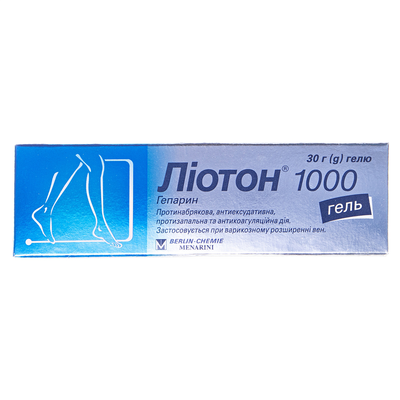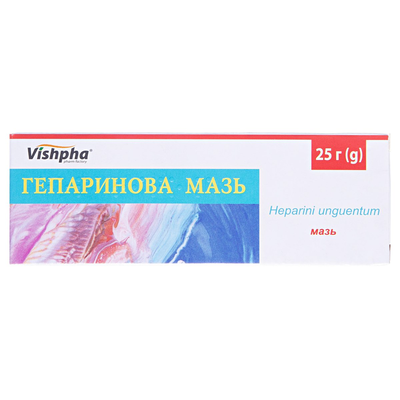
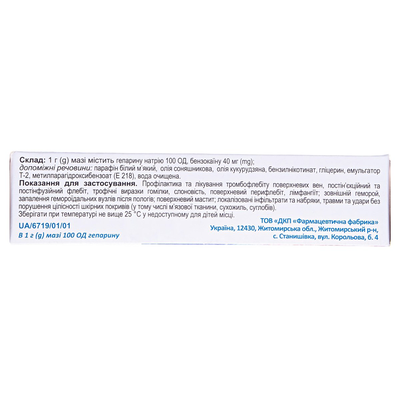
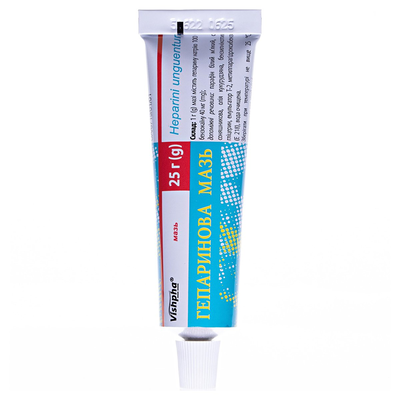
Heparin ointment, 25 g per tube
Ingredients
Active ingredients: sodium heparin, benzocaine;
1 g of ointment contains 100 IU of sodium heparin and 40 mg of benzocaine;
inactive ingredients: white soft paraffin, sunflower oil, corn oil, benzyl nicotinate, glycerin, emulsifier T-2, methyl parahydroxybenzoate (E 218), purified water.
Dosage Form
Ointment.
Main physical and chemical properties: an ointment ranging in color from white to white with a yellowish tint.
Pharmacotherapeutic group
Agents used in the treatment of varicose veins. Heparin, combinations.
ATC code C05B A53.
Pharmacological properties
Pharmacodynamics.
Heparin ointment is a direct-acting anticoagulant; it has anti-inflammatory and local analgesic effects, prevents blood clot formation, and promotes the dissolution of existing blood clots.
Pharmacokinetics.
Not determined.
Indications
Prevention and treatment of superficial vein thrombophlebitis, post-injection and post-infusion phlebitis, trophic leg ulcers, elephantiasis, superficial periphlebitis, and lymphangitis; external hemorrhoids, inflammation of hemorrhoidal nodes after childbirth; superficial mastitis; localized infiltrates and edema, injuries and contusions without disruption of the skin integrity (including muscle tissue, tendons, and joints).
Contraindications
Hypersensitivity to any of the drug’s components. Ulcerative-necrotic processes, traumatic disruption of the skin’s integrity, open infected wounds, hemorrhagic diathesis, purpura, thrombocytopenia, hemophilia, and a tendency to bleed.
Special Safety Precautions
In cases of thrombocytopenia and increased tendency to bleed, use the drug under medical supervision.
Interactions with Other Medications and Other Types of Interactions
The effect of the ointment is enhanced by anticoagulants, acetylsalicylic acid, and other nonsteroidal anti-inflammatory drugs. The effectiveness of the ointment is reduced by digitalis preparations, tetracyclines, nicotine, and antihistamines. The use of heparin may contribute to prolonged prothrombin time in patients taking oral anticoagulants. This medication should not be used in combination with other topical medications, such as those containing tetracycline, hydrocortisone, salicylic acid, or anticoagulants.
Special Considerations for Use
During prolonged use of the ointment on large areas of the skin and concurrent use of oral medications that affect blood clotting and/or hematopoiesis, clotting time and prothrombin time should be monitored. If a prolonged course of treatment is necessary and the affected areas are extensive in women aged 65 years or older, similar monitoring is recommended.
Do not apply to open wounds in the presence of purulent processes. Use of the ointment is not recommended in cases of deep vein thrombosis.
The product should not be prescribed for bleeding, applied to mucous membranes, infected skin areas, the eyes or the area around the eyes, or to ulcers and blisters. In cases of blood clotting disorders, it is not recommended to apply the ointment to large areas of skin.
Use During Pregnancy or Breastfeeding
Do not use this medication during pregnancy or while breastfeeding.
Effect on reaction time when driving or operating machinery
No effect.
Directions for Use and Dosage
This medication is for topical use in adults.
For thrombophlebitis of the superficial veins of the extremities, apply a thin layer of ointment to the affected area (at a rate of 0.5–1 g [2–4 cm of ointment] per area with a diameter of 3–5 cm) and gently rub it into the skin 2–3 times daily for 3–7 days until signs of inflammation subside. The doctor will determine whether a longer course of treatment is necessary.
For thrombosis of hemorrhoidal veins, apply the ointment to a cloth pad, which should be applied directly to the hemorrhoidal nodes and secured with a bandage (a tampon coated with the ointment may be used; it should be inserted into the anus) 2–3 times a day until signs of inflammation subside, on average 3–14 days. The possibility of longer-term use is determined by the doctor on an individual basis.
Children
Do not use.
Overdose
Due to the low absorption rate of Heparin Ointment, an overdose is not possible.
Side Effects
Redness, skin rashes, hives, angioedema, hemorrhages; occasionally, small pustules, blisters, or vesicles may develop. Local irritation may occur, manifesting as a burning sensation, itching, or slight swelling of the skin. The presence of methyl parahydroxybenzoate (E 218) in the formulation may cause allergic reactions (possibly delayed); when applied to large areas of skin, systemic allergic reactions and erythema may occur.
Shelf life
3 years.
Do not use the product after the expiration date printed on the packaging.
Storage Conditions
Store at a temperature not exceeding 25 °C, out of reach of children.
Packaging
25 g or 40 g per tube; 1 tube per pack.
Dispensing Category
Available without a prescription.
Manufacturer
DKP “Pharmaceutical Factory” LLC.