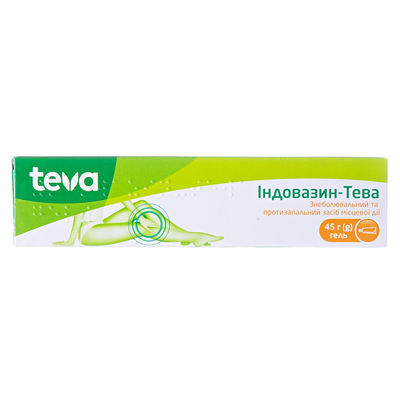
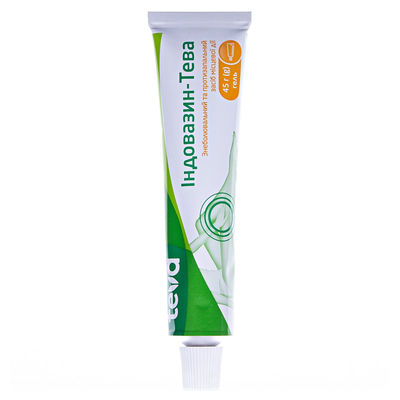
Indovazin-Teva gel, 45 g in tubes
Ingredients
Active ingredients: indomethacin, troxerutin;
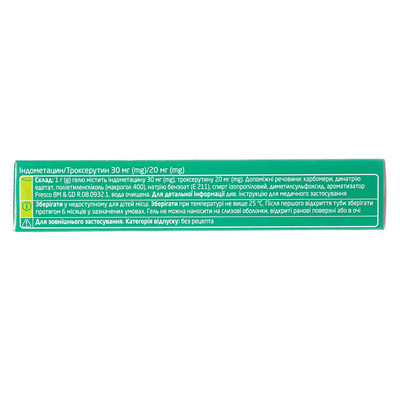
1 g of gel contains 30 mg of indomethacin and 20 mg of troxerutin;
Excipients: carbomers, disodium edetate, polyethylene glycol (macrogol 400), sodium benzoate (E 211), isopropyl alcohol, dimethyl sulfoxide, Fresco BM & GD R.08.0932.1 flavoring, purified water.
Dosage Form
Gel.
Main physicochemical properties: a slightly opalescent, homogeneous gel, ranging in color from yellow to yellowish-brown.
Pharmacotherapeutic group
Angioprotectants. Capillary-stabilizing agents. Troxerutin, combinations. ATC code C05C A54.
Pharmacological properties
Pharmacodynamics.
Indovazin-Teva is a combination drug containing indomethacin and troxerutin.
Indomethacin has pronounced anti-inflammatory, analgesic, and anti-edematous effects. This leads to pain relief, reduced swelling, and a shorter recovery time for damaged joints and tissues. The mechanism of action is associated with the inhibition of prostaglandin synthesis through reversible blockade of cyclooxygenase. Indomethacin has a more pronounced anti-inflammatory effect compared to salicylates and phenylbutazone.
Troxerutin (trihydroxyethylrutinose) is a bioflavonoid. It belongs to the class of angioprotective agents. Troxerutin reduces capillary permeability and exerts a venotonic effect. It blocks the venodilatory effects of histamine, bradykinin, and acetylcholine. It exerts an anti-inflammatory effect on perivenous tissues, reduces capillary fragility, and exhibits a certain antiplatelet effect. It reduces edema and improves tissue perfusion in pathological conditions associated with venous insufficiency. When applied to the skin, Indovazin-Teva suppresses inflammatory and edema reactions, relieves pain and reduces temperature in sites of inflammation (both superficially and in deep tissues, reaching the blood vessels located there). It has venotonic, capillary-protective, and hemostatic effects.
Pharmacokinetics.
Absorption. The ointment base of the preparation is formulated to ensure complete solubility of the active ingredients and their maximum release. The gel formulation, which contains indomethacin and troxerutin, ensures good absorption through the skin and therapeutic effects at various levels, achieving the necessary concentrations in adjacent tissues and synovial fluid.
Distribution and Biotransformation. Indomethacin binds to plasma proteins by more than 90% and undergoes extensive biotransformation in the liver via O-demethylation and N-deacetylation to inactive compounds. Troxerutin is a mixture of hydroxyethyl derivatives of the bioflavonoid rutin, in which trihydroxyethylrutoside (troxerutin) predominates.
Elimination. Indomethacin is excreted in urine (60%), bile, and feces (30%). Since indomethacin passes into breast milk, the drug is not recommended for use during breastfeeding.
Most of the absorbed tri-, di-, and monohydroxyethylrutosides are excreted in bile, with a significantly smaller portion excreted by the kidneys. Tetrahydroxyethylrutoside is excreted primarily in urine.
Indications
Indovazin-Teva gel is indicated for the symptomatic treatment of:
- symptoms of chronic venous insufficiency, including varicose veins (swelling, heaviness, and pain in the legs);
- superficial thrombophlebitis and phlebitis;
- the post-phlebitis phase;
- as part of the comprehensive treatment of hemorrhoids;
- soft tissue rheumatism: tendovaginitis, bursitis, fibrositis, periarthritis;
- edema following surgical procedures;
- contusions, dislocations, and sprains.
Contraindications
Hypersensitivity (allergy) to the active ingredient and/or to any of the drug’s components.
Hypersensitivity to nonsteroidal anti-inflammatory drugs.
Bronchial asthma.
The gel must not be applied to mucous membranes, open wounds, or in the eyes.
Interactions with Other Medications and Other Types of Interactions
This medication should not be used in combination with corticosteroids due to the potential for potentiation of their ulcerogenic effects.
Special Instructions for Use
Indovazin-Teva gel is intended for external use only.
Do not exceed the recommended dose.
Apply the gel only to intact skin.
This medication is not recommended for patients with a history of or proven hypersensitivity to foods or medications; for those with allergic rhinitis or other allergic reactions; or for those predisposed to such reactions.
If treatment lasts longer than 10 days, laboratory monitoring of white blood cell and platelet counts is necessary.
Long-term use of the drug, especially on large areas of the skin, should be limited in patients with severe liver or kidney dysfunction, as well as in patients with active peptic ulcer disease, due to the potential for high systemic absorption.
Use during pregnancy or breastfeeding.
There is no clinical experience regarding the safety of this medication during pregnancy or breastfeeding. This medication should not be used during pregnancy.
Since indomethacin passes into breast milk, the drug should not be used while breastfeeding.
Effect on reaction time when driving or operating machinery.
No effect.
Dosage and Administration
The drug is indicated for topical use in adults and children 14 years of age and older. Apply a thin layer of the gel 3–4 times daily to the affected areas using light massaging motions. A single dose is 4–5 cm of gel. The total daily dose should not exceed 20 cm.
Duration of treatment: no more than 10 days.
Children.
Indovazin-Teva is not recommended for use in children under 14 years of age due to a lack of sufficient clinical experience.
Overdose
No cases of overdose have been reported with topical application of the drug.
During long-term treatment (more than 10 days), monitoring for possible systemic effects—such as hepatotoxicity, severe headache, or hemorrhage—is necessary. White blood cell and platelet counts should be monitored.
If the gel is accidentally swallowed, a burning sensation in the mouth, increased salivation, nausea, and vomiting may occur. In such cases, rinse the mouth and stomach; if necessary, provide symptomatic treatment.
If the gel comes into contact with the eyes, mucous membranes, or open wounds, local irritation may occur—including tearing, redness, a burning sensation, and pain. Necessary measures to alleviate symptoms include rinsing the affected areas with a large amount of distilled water or a 0.9% sodium chloride solution until the symptoms are eliminated or their severity is reduced.
Side Effects
The drug is generally well tolerated.
Local reactions: Symptoms of skin hypersensitivity may occur—contact dermatitis, itching, redness, rash, and a sensation of warmth and burning at the application site.
The drug contains sodium benzoate, which has a moderate irritating effect on the skin, eyes, and mucous membranes.
The product contains dimethyl sulfoxide, which may cause skin irritation.
Systemic reactions: Very rarely, with long-term use on large areas of the body, the following side effects may occur:
gastrointestinal tract—nausea, vomiting, dyspepsia, abdominal pain, elevated liver enzyme levels;
Immune system: symptoms of hypersensitivity (anaphylaxis, asthma attack, angioedema).
If any adverse reactions occur, discontinue use of the product and consult a doctor regarding further treatment!
Shelf life
2 years.
Storage Conditions
Store at a temperature not exceeding 25 °C. Keep out of reach of children! Once the tube is opened, store for up to 6 months under the specified conditions!
Packaging
Gel in 45-g tubes, 1 tube per cardboard pack.
Dispensing Category
Available without a prescription.