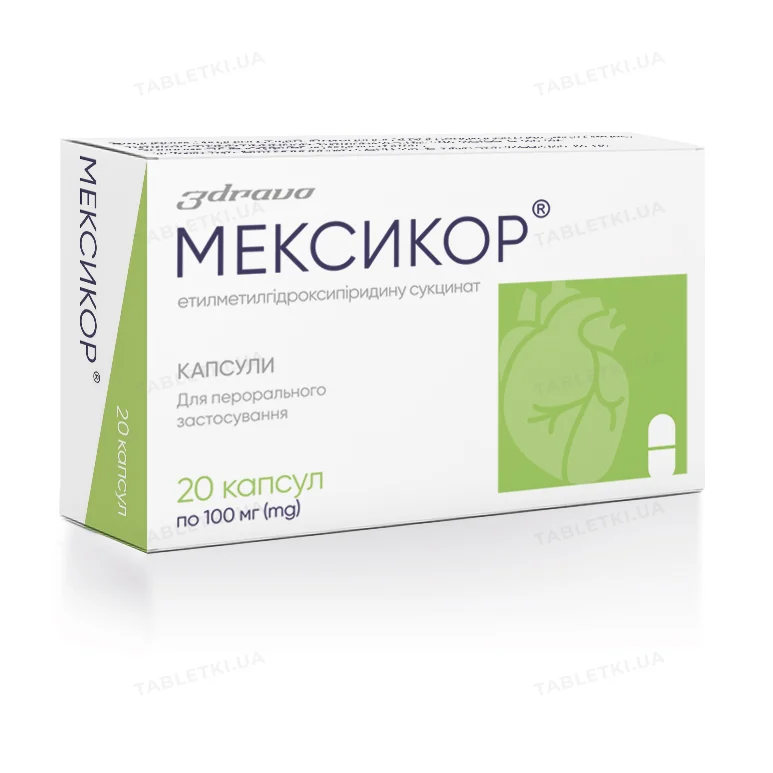
Mexicor (Mexidol) 100 mg capsules, No. 20 (10 x 2)
Ingredients
Active ingredient:
1 capsule contains 100 mg of ethylmethylhydroxypyridine succinate, calculated as 100% active ingredient;
excipients: potato starch, povidone, lactose monohydrate, magnesium stearate, microcrystalline cellulose;
capsule shell: titanium dioxide (E 171), gelatin, sunset yellow (E 110), quinoline yellow (E 104).
Dosage Form
Capsules.
Main physical and chemical properties:
Yellow No. 2 hard gelatin capsules. The capsule contents consist of granules and powder that are white or white with a yellowish tint.
Pharmacotherapeutic group
Cardiovascular drugs. Other cardiovascular drugs.
ATC code C01E B.
Pharmacological properties
Pharmacodynamics.
Mexicor® reduces oxidative stress, inhibits free-radical lipid peroxidation, and enhances the activity of the antioxidant enzyme system. Mexicor® improves cellular energy metabolism, activates the energy-producing functions of mitochondria, enhances the compensatory activation of aerobic glycolysis, and reduces the degree of inhibition of oxidative processes in the Krebs cycle. The drug’s energy-synthesizing effect is associated with increased delivery and consumption of succinate by cells, the rapid oxidation of succinic acid by succinate dehydrogenase, as well as with the activation of the mitochondrial respiratory chain.
When the drug Mexicor® dissociates within the cell into succinate and a 3-hydroxypyridine derivative, the latter exhibits an antioxidant effect that stabilizes cell membranes and restores cellular function. It exerts a modulatory effect on membrane-bound enzymes (calcium-dependent phosphodiesterase, adenylate cyclase, acetylcholinesterase), ion channels, and receptor complexes, which helps preserve the structural and functional integrity of biomembranes and improves neurotransmitter transport and synaptic transmission. It affects brain metabolism and blood supply, microcirculation, and blood rheological properties, and reduces platelet aggregation.
It promotes the restoration of the functional state of ischemic myocardium and cardiac contractility, and also reduces the manifestations of systolic and diastolic dysfunction of the left ventricle. In cases of coronary insufficiency, it increases collateral blood supply to ischemic myocardium and activates energy-synthesizing processes in the ischemic zone, thereby helping to preserve cardiomyocytes and maintain their functional activity. It restores myocardial contractility in cases of reversible cardiac dysfunction.
In patients with stable angina, it helps increase exercise tolerance and the antianginal activity of nitrates.
Mexicor® stabilizes the membrane structures of the vascular wall, inhibits red blood cell aggregation, normalizes microcirculatory disturbances in the early stages of atherogenesis, has a lipid-lowering effect, and reduces total cholesterol and low-density lipoprotein levels.
Mexicor® exerts a neuroprotective effect on the functional activity and metabolism of the ischemic brain, increases the stability of cerebral blood flow under conditions of hypoperfusion, and prevents a decrease in cerebral blood flow during the reperfusion period following ischemia. The drug promotes adaptation to ischemia by inhibiting the depletion of carbohydrate reserves, blocking the post-ischemic reduction in glucose and oxygen utilization by the brain, and preventing the progressive accumulation of lactate.
Mexicor® has nootropic properties; it prevents and reduces memory and learning impairments that occur in acute and chronic cerebrovascular diseases, as well as in cases of mild to moderate cognitive impairment of various origins; it exerts an antioxidant effect and improves concentration and cognitive performance.
In patients with acute cerebrovascular accident, it reduces the manifestation of clinical stroke symptoms and positively influences the course of the rehabilitation period.
Mexicor® has a selective action, does not cause sedation or muscle relaxation, alleviates anxiety, fear, tension, and restlessness, and improves adaptability and emotional well-being.
Pharmacokinetics.
After oral administration, Mexicor® is rapidly and completely absorbed from the gastrointestinal tract. It is rapidly distributed throughout the organs and tissues. The time to reach maximum plasma concentration (Tmax) ranges from 0.46 to 0.5 hours. The average time for the drug to distribute throughout the body is 4.9–5.2 hours. It is metabolized in the liver via glucuronidation.
Five metabolites have been identified: 3-hydroxypyridine phosphate—formed in the liver and, with the participation of alkaline phosphatase, broken down into phosphoric acid and 3-hydroxypyridine; the second metabolite—pharmacologically active—is formed in large quantities and is detected in urine 1–2 days after administration; the third is excreted by the kidneys in large quantities; the fourth and fifth are glucuronide conjugates.
The half-life (T12el) of Mexicor® is 4.7–5 hours. On average, 0.3% of the unchanged drug and 50% of the administered dose are excreted by the kidneys as glucuronide conjugates within 12 hours. Mexicor® and its glucuronide conjugates are excreted most rapidly during the first 4 hours after administration. The rates of renal excretion of the unchanged drug and its metabolites show significant individual variability.
Indications
- Comprehensive treatment of ischemic heart disease;
- Comprehensive treatment of ischemic stroke;
- circulatory encephalopathy;
- mild to moderate cognitive disorders of various etiologies.
Contraindications
Hypersensitivity to the drug, hepatic or renal insufficiency, pregnancy or breastfeeding, pediatric patients.
Drug Interactions and Other Interactions
Enhances the effects of benzodiazepine anxiolytics, anticonvulsants (carbamazepine), and antiparkinsonian agents (levodopa).
It increases the antianginal activity of nitrates and the hypotensive effect of angiotensin-converting enzyme (ACE) inhibitors and beta-blockers.
Concomitant use of Mexicor® with nibetane, propranolol, and verapamil reduces the risk of arrhythmogenic effects.
Reduces the toxic effects of ethanol.
Special Considerations for Use
Use with caution in patients with diabetic retinopathy.
Special attention is required when prescribing Mexicor® to patients with a history of severe allergic reactions.
Since this medication contains lactose, patients with rare hereditary disorders such as galactose intolerance, Lapp lactase deficiency, or glucose-galactose malabsorption should not take this medication. The medication contains the dye “Sunset Yellow” E 110, which may cause allergic reactions. In isolated cases, particularly in susceptible patients, patients with bronchial asthma, or those with hypersensitivity to sulfites, severe hypersensitivity reactions may occur.
Use During Pregnancy or Breastfeeding
Do not use during pregnancy or while breastfeeding.
Effect on reaction time when driving or operating machinery
During treatment with this medication, it is advisable to refrain from hazardous activities that require increased concentration and rapid psychomotor reactions, given the possibility of side effects that may affect reaction time and concentration.
Dosage and Administration
Mexicor® is taken orally. Therapeutic doses and the duration of treatment are determined by the physician depending on the clinical presentation of the disease and the patient’s response to the medication.
Treatment is initiated with a dose of 100 mg three times daily, gradually increasing the dose until a therapeutic effect is achieved.
The maximum daily dose should not exceed 800 mg, and the maximum single dose should not exceed 200 mg. It is recommended to divide the daily dose into 3 doses throughout the day.
The duration of Mexicor® therapy in patients with ischemic heart disease and cerebrovascular disorders is at least 1.5–2 months. Repeat courses of therapy, as recommended by a physician, should preferably be conducted in the spring and fall.
In the complex treatment of discirculatory encephalopathy and mild to moderate cognitive disorders, the drug is prescribed at a dose of 100 mg 3–4 times daily. The duration of treatment is determined by the physician depending on the course of the disease and the patient’s condition.
A course of treatment with Mexicor® should be tapered off gradually, reducing the daily dose by 100 mg each day.
Children
No controlled clinical studies on the safety of this medication in children have been conducted; therefore, this medication should not be used in this patient population.
Overdose
Due to the drug’s low toxicity, overdose is unlikely. In the event of an accidental overdose, sleep disturbances (insomnia, drowsiness) may occur.
Treatment is symptomatic.
Side Effects
The drug is generally well tolerated. In rare cases, allergic reactions, dyspeptic disorders, diarrhea, nausea, and dry mouth may occur, as well as anxiety, emotional reactivity, distal hyperhidrosis, headaches, impaired coordination, and increased or decreased blood pressure, which quickly resolve on their own or upon discontinuation of the drug.
With long-term use, flatulence and sleep disturbances (drowsiness or difficulty falling asleep) may occur.
Shelf life
3 years.
Do not use the medication after the expiration date printed on the package
Storage Conditions
Store in the original packaging at a temperature not exceeding 25 °C.
Keep out of reach of children.
Packaging
10 capsules per blister pack; 2 blister packs per cardboard box.
Manufacturer
PJSC “Technolog,” Ukraine.
Address
04114, Kyiv, 54/19 Avtozavodska St., Building A, Office
Tel. (044) 503-78-68
Applicant
“ZDRAVO” LLC, Ukraine