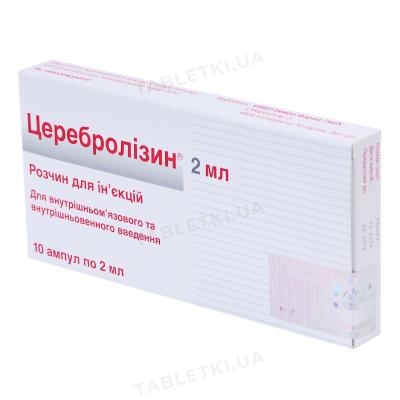
Cerebrolysin solution for injection, 215.2 mg/mL, 2 mL, No. 10 in ampoules
Ingredients
Active ingredient: Cerebrolysin® concentrate;
1 mL of solution contains 215.2 mg of Cerebrolysin® concentrate (a peptide preparation derived from pig brains);
excipients: sodium hydroxide, water for injection.
Dosage Form
Solution for injection.
Main physical and chemical properties: a clear, amber-colored solution.
Pharmacotherapeutic group
Psychostimulants and nootropics.
ATC code N06B X.
Pharmacological properties
Pharmacodynamics.
A proteolytic peptide fraction derived from pig brain stimulates cell differentiation, improves nerve cell function, and activates protective and regenerative mechanisms. Animal studies have demonstrated that Cerebrolysin® directly influences neuronal and synaptic plasticity, which contributes to improved cognitive function. This was demonstrated in young, adult, and elderly animals with impaired learning ability. In experiments using models of cerebral ischemia, Cerebrolysin® reduced infarct size, prevented edema formation, stabilized microcirculation, normalized neurological and cognitive impairments, and doubled survival rates. Positive results were also obtained in studies using models of Alzheimer’s disease. In addition to its direct effect on neurons, Cerebrolysin® significantly increases the number of molecules that facilitate glucose transport across the blood-brain barrier, thereby compensating for the critical energy deficit observed in this disease.
Quantitative analysis of electroencephalograms from healthy volunteers and patients with vascular dementia showed a significant dose-dependent increase in neuronal activity (increased frequencies of alpha and beta rhythms) after four weeks of treatment with Cerebrolysin®. Regardless of the cause of the disease—whether Alzheimer’s-type neurodegenerative dementia or vascular dementia— after treatment with Cerebrolysin®, patients show objective improvements in cognitive function and the ability to perform activities of daily living. Clinically noticeable improvements in patients’ condition are observed as early as two weeks into treatment and continue to improve with continued therapy. A positive effect from treatment with Cerebrolysin® is observed in 60–70% of patients, regardless of the type of dementia. In cases of Alzheimer’s-type senile dementia, the improvement in patients’ clinical condition persists after the end of active therapy. This is particularly true for long-term improvements in the ability to perform activities of daily living, which reduces the need for outside care and supervision of patients. Due to its neurotrophic activity (similar to that of nerve growth factor), Cerebrolysin® can significantly slow down, and in some cases halt, the progression of neurodegenerative processes.
High-molecular-weight peptides with antigenic potential are removed from the drug during the manufacturing process.
Studies have not revealed any effect of the drug on the immune system. Experiments have shown that Cerebrolysin® does not induce the formation of antibodies or anaphylactic reactions.
Cerebrolysin® does not stimulate histamine receptors and does not affect erythrocyte hemagglutination.
Pharmacokinetics.
Since the proteolytic peptide fraction derived from pig brains contains short biologically active peptides similar to or identical to those produced endogenously, it has not yet been possible to directly measure the pharmacokinetic parameters of Cerebrolysin®. Indirect pharmacokinetic data were obtained based on a study of the drug’s pharmacodynamic profile. The neurotrophic activity of Cerebrolysin® in blood plasma becomes evident within 24 hours after a single administration. The drug’s components can cross the blood-brain barrier. Preclinical in vivo experiments revealed an identical pharmacodynamic effect of the drug on the central nervous system following intracerebroventricular and peripheral administration. This is indirect evidence that the drug’s components cross the blood-brain barrier.
Indications
- Organic and metabolic disorders and neurodegenerative diseases of the brain, particularly Alzheimer’s-type senile dementia.
- Complications following a stroke.
- Traumatic brain injuries (conditions following brain surgery, closed head injuries, concussion).
Contraindications
- Hypersensitivity to any of the drug’s components.
- Epilepsy.
- Severe renal impairment.
Drug Interactions and Other Interactions
Given the pharmacological profile of Cerebrolysin®, special attention should be paid to possible additive effects when it is used in combination with antidepressants or MAO inhibitors. In such cases, it is recommended to reduce the doses of antidepressants.
Cerebrolysin® should not be mixed with balanced amino acid solutions in the same infusion vial.
Concomitant use of Cerebrolysin® with vitamins and cardiovascular medications is permitted; however, they should not be mixed in the same syringe.
Special Considerations for Use
Particular caution is required when prescribing Cerebrolysin® to patients with allergic diathesis.
Although there is no evidence that Cerebrolysin® increases the burden on the kidneys, the drug should not be administered to patients with severe renal insufficiency.
This medication contains 2.57 mg of sodium per 1 mL of solution, which is equivalent to 0.13% of the recommended maximum daily sodium intake for adults. Caution should be exercised when administering this medication to patients on a sodium-restricted diet.
Use During Pregnancy or Breastfeeding
Animal studies have not shown any reproductive toxicity of the drug. However, there are no data on the drug’s effect on human reproductive function. Cerebrolysin® may be used during pregnancy only after a careful assessment of the balance between the expected benefit to the woman and the potential risk to the fetus or infant. Breastfeeding should be discontinued during treatment.
Effect on reaction time when driving or operating machinery
Clinical studies have not shown any effect of the drug on reaction time while driving or operating machinery; however, in some patients, Cerebrolysin® may cause certain undesirable side effects affecting the nervous system and mental function, which may temporarily impair the ability to drive or operate machinery.
Dosage and Administration
The drug must be administered intravenously or intramuscularly.
Undiluted Cerebrolysin® may be administered in doses of up to 5 mL intramuscularly and up to 10 mL by intravenous injection. Doses ranging from 10 to 50 mL (maximum dose) should be administered only via slow intravenous infusion after dilution to a volume of 100 mL with one of the standard diluents listed below. The duration of infusions should be 15 to 60 minutes.
After dilution with 0.9% sodium chloride solution (9 mg NaCl/mL), Ringer’s solution (Na+ 153.98 mmol/L, Ca2+ 2.74 mmol/L, K+ 4.02 mmol/L, Cl– 163.48 mmol/L) or a 5% glucose solution, the infusion solution is physically and chemically stable for 24 hours when stored at room temperature in a place protected from light. From a microbiological standpoint, the infusion solution must be administered immediately after preparation.
The optimal recommended duration of treatment is 10–20 days with daily administration of the drug.
Single doses of up to 50 mL are possible, but course therapy is more effective.
Recommended daily doses:
- Organic and metabolic disorders and neurodegenerative diseases of the brain, especially Alzheimer’s-type senile dementia: 5–30 mL
- Post-stroke complications: 10–50 mL
- Traumatic brain injuries: 10–50 mL
- For children: 1–2 mL
The effectiveness of therapy usually increases with repeated courses of treatment. Treatment should be continued as long as the patient’s condition improves as a result of therapy. After the initial course, the frequency of administration may be reduced to 2 or 3 times per week. Breaks between treatment courses should last at least as long as the treatment course itself.
The recommended dose for children aged 6 months and older is 0.1 mL/kg of body weight (up to 2 mL per day).
Instructions for Healthcare Professionals
When administering Cerebrolysin® via a permanent intravenous catheter, the system must be flushed with a sodium chloride solution before and after the infusion.
The drug should be drawn from the ampoule or vial immediately before use.
Only a single withdrawal of the drug from the ampoule or vial is permitted.
Only a clear, amber-colored solution should be used.
Children
The drug is used in pediatric practice when there are valid indications.
Overdose
No cases of toxicity or adverse health effects resulting from an overdose of Cerebrolysin® have been reported.
Side Effects
The following adverse effects and reactions were observed during clinical trials and postmarketing surveillance, regardless of whether a causal relationship with Cerebrolysin® therapy was established (the drug is used primarily to treat elderly patients, and the symptoms listed are frequently observed in this patient population).
Immune system
Rare (<1/10,000) – hypersensitivity reactions or allergic reactions, anaphylactic shock, angioedema, fever, chills.
Metabolic disorders
Rare (>1/10,000 – <1/1,000) – loss of appetite.
Psychiatric disorders
Rare (>1/10,000 – <1/1,000) – in isolated cases, the desired therapeutic effect was accompanied by agitation (with manifestations of aggression, confusion, insomnia), depression, apathy, weakness.
Nervous system
Rare (>1/10,000 – <1/1,000) – if administered very rapidly, dizziness, tremor, headache, and drowsiness may occur.
Rare (<1/10,000) – grand mal seizures, convulsions.
Cardiovascular system
Uncommon (>1/10,000 – <1/1,000) – hypertension, hypotension.
Very rare (<1/10,000) – if administered too rapidly, palpitations, tachycardia, arrhythmia, and chest pain may occur.
Respiratory system
Uncommon (>1/10,000 – <1/1,000) – hyperventilation, shortness of breath, chest pain.
Gastrointestinal system
Very rare (<1/10,000) – dyspepsia, diarrhea, constipation, nausea, vomiting.
Skin and subcutaneous tissue disorders
Rare (>1/10,000 – <1/1,000) – if administered too rapidly, a sensation of heat, increased sweating, itching, rash (including maculopapular), hives, and skin redness.
General and local reactions
Rare (>1/10,000 – <1/1,000) – increased fatigue, flu-like symptoms (e.g., runny nose, cough, respiratory tract infections).
Very rare (<1/10,000) – reactions at the injection site, including erythema and burning at the injection site, local inflammatory reactions.
Other reactions
Rare (<1/10,000) – pain in the neck, extremities, or lower back.
Shelf life
Cerebrolysin® in ampoules: 5 years.
Cerebrolysin® in vials: 2 years.
Storage conditions
Store in the original packaging, out of reach of children, at a temperature not exceeding 25 °C. Do not freeze.
Incompatibility
Cerebrolysin® is incompatible with solutions that alter the drug’s pH (5.0–8.0), as well as with solutions containing lipids.
Cerebrolysin® should not be mixed with balanced amino acid solutions, vitamins, or cardiovascular medications in the same infusion vial.
Packaging
1 mL per brown glass ampoule; 10 ampoules per cardboard box.
2 mL per brown glass ampoule; 10 ampoules per cardboard box.
5 mL per brown glass ampoule; 5 ampoules per cardboard box.
10 mL per brown glass ampoule; 5 ampoules per cardboard box.
20 mL per brown glass ampoule; 5 ampoules per cardboard box.
30 mL or 50 mL per brown glass vial, sealed with a chlorobutyl rubber stopper with a fluoropolymer coating and an aluminum cap;
1 vial per cardboard box.
Manufacturer
EVER Neuro Pharma GmbH, Austria.
EVER Neuro Pharma GmbH, Austria.
Manufacturer’s location and address of operations/applicant’s location.
Oberburgau 3, 4866 Unterach am Attersee, Austria.
Oberburgau 3, 4866 Unterach am Attersee, Austria.