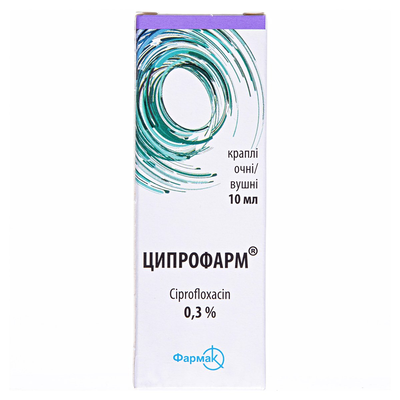

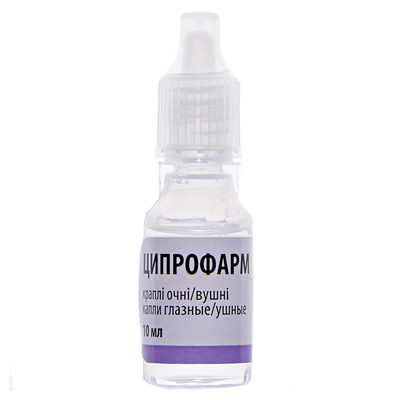
Ciprofarm Eye/Ear Drops 0.3%, 10 ml per bottle
Composition
Active ingredient: ciprofloxacin;
1 mL of the drug contains 3 mg of ciprofloxacin hydrochloride, equivalent to ciprofloxacin;
Excipients: benzalkonium chloride; sodium dihydrogen phosphate, dihydrate; sorbitol (E 420); water for injection.
Dosage Form
Eye/ear drops.
Main physicochemical properties: a clear, slightly yellowish-greenish liquid.
Pharmacotherapeutic group
Products for use in ophthalmology and otology. Antimicrobial agents.
ATC code S0ZA A07.
Pharmacological properties
Pharmacodynamics.
Mechanism of action
Ciprofloxacin
Ciprofarm® contains ciprofloxacin hydrochloride, which belongs to the quinolone class. The bactericidal action of quinolones, which primarily affects bacterial DNA synthesis, is manifested by the inhibition of DNA gyrase.
Ciprofloxacin exhibits high in vitro activity against most Gram-negative organisms, including Pseudomonas aeruginosa. It is also effective against aerobic Gram-positive microorganisms, such as staphylococci and streptococci.
Susceptibility of microorganisms
Ophthalmic use
Ciprofloxacin is active against most strains of the following microorganisms.
Aerobic Gram-positive organisms: Staphylococcus aureus (including both methicillin-susceptible and methicillin-resistant strains); Staphylococcus epidermidis; Staphylococcus spp., other coagulase-negative Staphylococcus spp., including S. haemolyticus and S. hominis; Corynebacterium spp.; Streptococcus pneumoniae; Viridans group streptococci.
Aerobic Gram-negative microorganisms: Acinetobacter spp.; Haemophilus influenzae; Pseudomonas aeruginosa; Moraxella spp. (including M. catarrhalis).
Intracanal use
Ciprofloxacin exhibits high in vitro activity against most aerobic Gram-negative organisms, including Pseudomonas aeruginosa. It is also effective against aerobic Gram-positive microorganisms, such as staphylococci and streptococci. As shown in the table below, ciprofloxacin exhibits a broad spectrum of activity in vivo (MIC90 C ≤ 2 μg/mL) against pathogens isolated from patients with acute otitis externa in recent clinical studies.
| Bacterial Type | Isolate
N= |
Min. MIC
(μg/mL) |
MIC50
(μg/mL) |
MIC90
(μg/mL) |
IPCmax.
(μg/mL) |
| Pseudomonas aeruginosa | 1089 | 0.03 | 0.13 | 0.25 | 16 |
| Staphylococcus aureus | 221 | 0.13 | 0.50 | 1.0 | 128 |
| Staphylococcus epidermidis | 257 | 0.06 | 0.25 | 0.50 | 128 |
| Staphylococcus caprae (Capra staphylococcus) | 75 | 0.13 | 0.50 | 0.50 | 2.0 |
| Enterococcus faecalis | 53 | 0.50 | 1.0 | 2.0 | 4.0 |
| Enterobacter cloacae | 45 | 0.004 | 0.016 | 0.032 | 0.25 |
Ciprofloxacin is also active against pathogens isolated from patients with acute otitis media via tympanostomy tubes.
| Bacterial type | Isolates
N= |
Min. MIC
(μg/mL) |
MIC50
(μg/mL) |
MIC90
(μg/mL) |
IPCmax.
(μg/mL) |
| Streptococcus pneumoniae | 197 | 0.25 | 1.0 | 2.0 | 8.0 |
| Staphylococcus aureus | 134 | 0.06 | 0.25 | 1.0 | >128 |
| Pseudomonas aeruginosa | 132 | 0.03 | 0.25 | 0.50 | 128 |
| Haemophilus influenzae | 122 | 0.004 | 0.008 | 0.016 | 0.25 |
| Staphylococcus epidermidis | 103 | 0.06 | 1.0 | 64 | 64 |
| Moraxella catarrhalis | 37 | 0.008 | 0.03 | 0.06 | 0.06 |
| Escherichia coli | 15 | 0.008 | 0.03 | 128 | >128 |
Threshold values for the diameters of zones of microbial growth inhibition
Ophthalmic use
Ciprofloxacin has been shown to be active in vitro against most strains of the following microorganisms; however, the clinical significance of these results in ophthalmic infections is unknown. The safety and efficacy of ciprofloxacin in the treatment of corneal ulcers or conjunctivitis caused by these microorganisms have not been established in adequate and well-controlled clinical studies.
The following bacteria are considered susceptible when evaluated using systemic cut-off values for the diameters of zones of microbial growth inhibition. However, a correlation between in vitro minimum inhibitory concentration (MIC) values and ophthalmic efficacy has not been established. In vitro, ciprofloxacin demonstrates minimum inhibitory concentrations (MICs) of 1 μg/mL or less (systemic breakpoint values for zones of bacterial growth inhibition) against the majority (90%) of strains of ocular pathogens.
Aerobic Gram-positive microorganisms: Bacillus species.
Aerobic Gram-negative microorganisms: Acinetobacter calcoaceticus; Enterobacter aerogenes; Escherichia coli; Haemophilus parainfluenzae; Klebsiella pneumoniae; Neisseria gonorrhoeae; Proteus mirabilis; Proteus vulgaris; Serratia marcescens.
Others: Peptococcus spp., Peptostreptococcus spp., Propionibacterium acnes, and Clostridium perfringens are susceptible microorganisms.
Not susceptible
Some strains of Burkholderia cepacia and Stenotrophomonas maltophilia are resistant to ciprofloxacin, as are some anaerobic bacteria, particularly Bacteroides fragilis.
Additional Information
The minimum bactericidal concentration (MBC) generally does not exceed the minimum inhibitory concentration (MIC) by more than a factor of 2.
Use in Otology
Ciprofloxacin has been shown to be active in vitro against most strains of the following microorganisms; however, the clinical significance of these results in ear infections is unknown. The safety and efficacy of ciprofloxacin in the treatment of acute otitis externa caused by these microorganisms have not been established in adequate and well-controlled clinical studies.
The following bacteria are considered susceptible when evaluated using systemic cut-off values for the diameters of microbial growth inhibition zones. However, the relationship between in vitro minimum inhibitory concentration (MIC) values and efficacy when applied to the ear has not been established. Ciprofloxacin exhibits an in vitro minimum inhibitory concentration (MIC) of 1 μg/mL or less (systemic breakpoint values for zones of microbial growth inhibition) against the majority (90%) of strains of the following pathogens.
Aerobic Gram-positive microorganisms: Bacillus species; Corynebacterium species; Enterococcus faecalis; Staphylococcus aureus; Staphylococcus epidermidis; Staphylococcus caprae; Staphylococcus capitis; Staphylococcus haemolyticus; Streptococcus pneumoniae; Viridans group streptococci.
Aerobic Gram-negative microorganisms: Achromobacter xylosoxidans subsp. hulosoxidans; Acinetobacter baumannii; Acinetobacter junii; Acinetobacter iwoffi; Radiorezistent Acinetobacter; Acinetobacter genotype 3; Citrobacter freundii; Citrobacter koseri; Enterobacter aerogenes; Enterobacter cloacae; Escherichia coli; Haemophilus influenzae; Klebsiella oxytoca; Klebsiella pneumoniae; Moraxella catarrhalis; Proteus mirabilis; Pseudomonas stutzeri; Serratia marcescens.
It has also been shown that ciprofloxacin is active in vitro against most of the following strains of microorganisms that cause otitis media:
Aerobic Gram-positive organisms: Staphylococcus aureus; Staphylococcus epidermidis; Streptococcus pneumoniae.
Aerobic Gram-negative microorganisms: Escherichia coli; Haemophilus influenzae; Moraxella catarrhalis; Pseudomonas aeruginosa.
Resistance to ciprofloxacin generally develops slowly. However, cross-resistance is observed within this group of gyrase inhibitors.
Bacterial susceptibility testing has shown that most microorganisms resistant to ciprofloxacin are also resistant to other fluoroquinolones. In clinical studies, the frequency of isolation of strains with acquired resistance to ciprofloxacin was low.
Due to its unique mechanism of action, there is no cross-resistance between ciprofloxacin and other antibacterial agents with different chemical structures, such as beta-lactam antibiotics, aminoglycosides, tetracyclines, macrolides, and peptides, as well as sulfonamides, trimethoprim derivatives, and nitrofurans. Thus, microorganisms resistant to these agents may be susceptible to ciprofloxacin.
Pharmacokinetics.
After topical application to the human eye, ciprofloxacin is well absorbed. The concentrations of ciprofloxacin detected in the tear film, cornea, and anterior chamber of the eye are ten to several hundred times higher than the MIC90 for susceptible ocular pathogens.
Systemic absorption of ciprofloxacin following topical application to the eyes is low. Plasma ciprofloxacin levels after 7 days of ocular application ranged from undetectable levels (<1.25 ng/mL) to 4.7 ng/mL. The mean maximum plasma concentration of ciprofloxacin following topical ocular administration was approximately 450 times lower than that following a single oral dose of 250 mg of ciprofloxacin.
In children with a tympanostomy tube or a perforated eardrum, topical application of ciprofloxacin to the ear resulted in non-quantifiable concentrations of ciprofloxacin in plasma, with a limit of detection of 5 ng/mL. In chinchillas, ciprofloxacin was distributed in plasma and middle ear fluid following intramuscular administration and was absorbed into the inner ear following topical application to the middle ear.
The systemic pharmacokinetic properties of ciprofloxacin are well established.
Ciprofloxacin is well distributed throughout the body’s tissues, with tissue levels generally higher than plasma levels. The volume of distribution at steady state is 1.7–2.71 L/kg. Serum protein binding is 16–43%. The half-life of ciprofloxacin in serum is 3–5 hours. After oral administration of a single dose ranging from 250 to 750 mg in adult patients with normal renal function, 15–50% of the dose is excreted in the urine as unchanged drug and 10–15% as metabolites within 24 hours. Both ciprofloxacin and its four major metabolites are excreted in the urine and feces. The renal clearance of ciprofloxacin is typically 300–479 mL/min. Approximately 20–40% of the dose is excreted unchanged in the feces and as metabolites over a period of 5 days.
Indications
Corneal ulcers and superficial infections of the eye(s) and its adnexa caused by bacterial strains susceptible to ciprofloxacin.
Acute otitis media of the external ear, as well as acute otitis media with drainage via a tympanostomy tube, caused by bacterial strains sensitive to ciprofloxacin.
Contraindications
Hypersensitivity to ciprofloxacin, other quinolones, or any of the drug’s components.
Drug Interactions and Other Interactions
Since ciprofloxacin has low systemic concentrations when used topically or in the ear, interactions with other medications are unlikely. If multiple topical medications are administered to the eye at the same time, wait at least 5 minutes between applications. Eye ointments should be applied last.
Special Considerations
Use with caution in patients with impaired liver or kidney function.
The use of Ciprofarm® in this patient population has not been studied.
General
- Patients receiving quinolones have experienced serious and sometimes fatal (anaphylactic) hypersensitivity reactions, some following the first dose. Some reactions were accompanied by cardiovascular failure, loss of consciousness, tinnitus, swelling of the throat or face, shortness of breath, hives, and itching.
- Severe cases of acute hypersensitivity to ciprofloxacin may require urgent treatment. If clinically indicated, oxygen therapy and airway management should be provided.
- Ciprofloxacin should be discontinued at the first signs of a skin rash or any other sign of a hypersensitivity reaction.
- As with all antibacterial agents, prolonged use may lead to the overgrowth of antibiotic-resistant strains of bacteria or fungi. If a superinfection develops, appropriate therapy should be initiated.
- Inflammation and rupture of tendons are possible with systemic therapy with fluoroquinolones, including ciprofloxacin, especially in elderly patients and in patients concurrently receiving corticosteroid therapy. Therefore, treatment with Ciprofarm® eye/ear drops should be discontinued at the first signs of tendon inflammation.
Eye Drops
- Clinical experience in children under 1 year of age, especially newborns, is quite limited.
- The use of Ciprofarm® eye drops in newborns with neonatal blenorrhea of gonococcal or chlamydial origin is not recommended, as such use has not been evaluated in this patient population. Newborns with neonatal blenorrhea should receive treatment appropriate for their condition.
- When using Ciprofarm® eye drops, the risk of the medication entering the nasopharynx should be considered, as this may contribute to the emergence and spread of bacterial resistance.
- Ciprofarm® eye drops contain benzalkonium chloride, which may irritate and discolor soft contact lenses.
- It is not recommended to wear contact lenses during treatment for an eye infection.
Therefore, patients should be advised not to wear contact lenses while being treated with Ciprofarm® eye drops.
Ear Drops
- The efficacy and safety of use in children under 1 year of age have not been evaluated.
- If instilled into the ear, frequent medical monitoring should be conducted to ensure that other therapeutic measures are implemented in a timely manner.
Pregnancy and lactation
Reproductive function
No studies have been conducted to evaluate the effect of topical application of Ciprofarma® on reproductive function.
Pregnancy
There are no data on the use of Ciprofarma® in pregnant women. Animal studies do not indicate any direct harmful effects due to reproductive toxicity.
It is advisable to avoid using Ciprofarma® during pregnancy.
Breastfeeding
When taken orally, ciprofloxacin is detected in breast milk. It is unknown whether ciprofloxacin passes into breast milk following topical application to the eye or ear. Ciprofarm® should be used with caution in breastfeeding women.
Effects on the Ability to Drive and Operate Machinery
This medication has no or negligible effect on the ability to drive or operate machinery. Temporary blurred vision or other visual disturbances may affect the ability to drive or operate machinery. If blurred vision occurs during instillation, the patient should wait until vision clears before driving or operating machinery.
There are no data on the effect of Ciprofarm® ear drops on the ability to drive or operate machinery.
Directions for Use and Dosage
Warning! Do not screw the cap back on the bottle before use! Before first use, screw the cap on as tightly as possible. This will cause the pin inside the cap to pierce the opening. Immediately before use, hold the bottle in the palm of your hand to warm it to body temperature. Unscrew the cap, remove it, and, while gently squeezing the bottle, instill the solution into the eye. After instilling the drops, screw the cap back on tightly and store the medication according to the instructions provided. Eye drops should be used with the utmost hygiene. Do not let the tip of the dropper touch any surface.
Ophthalmic Use
Dosage
Use in adolescents and adults, including elderly patients
Corneal ulcers:
Ciprofarm® should be administered at the following intervals, including at night:
On Day 1, instill 2 drops into the conjunctival sac(s) of the affected eye(s) every 15 minutes for the first 6 hours, then 2 drops every 30 minutes for the remainder of the first day;
On Day 2, instill 2 drops into the conjunctival sac(s) of the affected eye(s) every hour;
From the 3rd to the 14th day, instill 2 drops into the conjunctival sac of the affected eye(s) every 4 hours.
For corneal ulcers, treatment may last longer than 14 days; the dosage regimen and duration of treatment are determined by the doctor.
Bacterial superficial infections of the eye and its adnexa
The standard dose is 1–2 drops into the conjunctival sac(s) of the affected eye(s) 4 times a day.
For severe infections, the dose may be 1–2 drops every 2 hours during the day for the first 2 days.
Treatment usually lasts 7–14 days.
After instillation, it is recommended to keep the eyelids tightly closed or to use nasolacrimal occlusion. This reduces systemic absorption of the medication administered to the eye, thereby lowering the likelihood of systemic side effects.
In the case of concomitant therapy with other topical ophthalmic medications, a 10–15-minute interval should be observed between their administration.
Use in Children
The dosage for children over 1 year of age is the same as for adults.
A clinical study of newborns and infants under 1 month of age demonstrated that Ciprofarm® is clinically and microbiologically effective for the treatment of bacterial conjunctivitis in this patient population when administered 3 times daily for 4 days.
Use in Patients with Liver or Kidney Dysfunction
The use of Ciprofarm® in this patient population has not been studied.
Directions for Use
To prevent contamination of the dropper tip and the solution, take care not to touch the eyelids, surrounding areas, or other surfaces with the tip of the dropper bottle.
Use in Otology
Dosage
Use in adults, including elderly patients
For adults, the dose is 4 drops of Ciprofarma® in the ear canal twice daily.
For patients who require the use of ear swabs, the dose may be increased only twofold during the first application (i.e., 6 drops for children and 8 drops for adults).
In general, the duration of treatment should not exceed 5–10 days. In some cases, treatment may be continued, but in such cases, it is recommended to test the sensitivity of the local flora.
When using other topical medications concurrently, a 10–15-minute interval should be observed between their administration.
Use in Children
The dose is 3 drops of Ciprofarma® in the ear canal twice daily. The safety and efficacy of Ciprofarma® have been studied in children aged 1 to 12 years. Safety and efficacy in children under 1 year of age have not been established.
Use in Patients with Liver or Kidney Dysfunction
The use of Ciprofarm® in this patient population has not been studied.
Directions for Use
The external auditory canal must be thoroughly cleaned. To prevent vestibular stimulation, it is recommended to instill the solution at room temperature or body temperature.
The patient should lie on their back on the side opposite the affected ear. It is recommended to remain in this position for 5–10 minutes. Additionally, after local cleaning, a moistened gauze or absorbent cotton swab may be inserted into the ear canal for 1–2 days; however, it must be re-moistened with the solution twice daily to ensure saturation.
To prevent contamination of the dropper tip and the solution, take care not to touch the ear, the external auditory canal, adjacent areas, or other surfaces with the tip of the dropper bottle.
Children
Eye Drops
The safety and efficacy of ciprofloxacin eye drops at a dose of 3 mg/mL have been established in children aged 0 to 12 years. No serious drug-related adverse reactions have been reported in this patient population.
Ciprofarm®, eye drops, may be used in children from birth for the treatment of bacterial conjunctivitis.
Ear Drops
The safety and efficacy of ciprofloxacin 3 mg/mL ear drops have been established in children aged 1 to 12 years. No serious drug-related adverse reactions have been reported in this patient population.
Safety and efficacy in children under 1 year of age have not been established.
Ciprofarm®, ear drops, may be used in children over 1 year of age.
Overdose
Due to the nature of this medication, which is intended for external use, no toxic effects are expected when used in ophthalmology or otology at the recommended doses, nor in the event of accidental ingestion of the contents of a single vial. In case of an overdose of Ciprofarm® following topical application to the eyes, rinse the excess medication from the eye(s) with warm water.
Side Effects
Side effects observed following the use of Ciprofarma® in the eyes
Infections and infestations: stye, rhinitis.
Nervous system: dysgeusia, headache, dizziness.
Immune system disorders: hypersensitivity.
Ophthalmic disorders: corneal deposits, eye discomfort, eye redness, keratopathy, corneal infiltrates, corneal discoloration, photophobia, decreased visual acuity, eyelid swelling, blurred vision, eye pain, dry eyes, eye swelling, itchy eyes, foreign body sensation in the eye, increased tearing, eye discharge, scaling along the eyelid margins, eyelid flaking, conjunctival edema, eyelid erythema, ocular intoxication, punctate keratitis, keratitis, conjunctivitis, corneal dysfunction, corneal epithelial defect, diplopia, ocular hypoesthesia, asthenopia, eye irritation, eye inflammation, conjunctival hyperemia.
Hearing disorders: ear pain.
Respiratory system, thoracic, and mediastinal disorders: hypersecretion of the paranasal sinuses.
Gastrointestinal disorders: nausea, diarrhea, abdominal pain.
Skin and subcutaneous tissue disorders: dermatitis.
General disorders and conditions related to the injection site: intolerance to the drug.
Laboratory tests: abnormal laboratory results.
Adverse reactions reported with the use of Ciprofarma® in the ear
Nervous system disorders: tearfulness, headache.
Ear and labyrinth disorders: ear pain, ear fullness, otorrhea, itching in the ear, tinnitus.
Skin and subcutaneous tissue disorders: dermatitis.
General disorders and conditions related to the injection site: hyperthermia.
Description of the listed adverse reactions
Reactions such as generalized rash, toxic epidermal necrolysis, exfoliative dermatitis, Stevens-Johnson syndrome, and urticaria have been very rare with topical application of fluoroquinolones.
In some cases, blurred vision, decreased visual acuity, and signs of drug residue have been observed following the application of ciprofloxacin to the eye.
In rare cases, the drug’s components may cause a hypersensitivity reaction when applied to the ear. However, as with the application of any substance to the skin, there is always a possibility of an allergic reaction to any of the drug’s components (only in the case of Ciprofarm® ear drops).
Serious and, in some cases, fatal (anaphylactic) hypersensitivity reactions have been reported, sometimes after the first dose, in patients receiving systemic quinolones. Some reactions were accompanied by cardiovascular collapse, loss of consciousness, tingling, swelling of the throat or face, shortness of breath, hives, and itching.
In patients receiving systemic fluoroquinolones, ruptures of the shoulder, wrist, Achilles, or other tendons have been reported, requiring surgical repair or resulting in prolonged disability. Clinical studies and postmarketing experience with systemic fluoroquinolones indicate that the risk of such ruptures may be increased in patients receiving corticosteroids, especially in elderly patients, as well as when tendons—including the Achilles tendon—are subjected to high stress. To date, clinical and postmarketing data have not demonstrated a clear association between the use of Ciprofarm® and adverse reactions involving the musculoskeletal system and connective tissue.
In patients with corneal ulcers, frequent use of Ciprofarma® resulted in a white deposit in the eye (drug residue), which disappeared with continued use. The presence of this deposit does not require discontinuation of Ciprofarm®, nor does it have a negative effect on the clinical course of the healing process.
Systemic use of fluoroquinolone drugs has been associated with phototoxic effects. However, phototoxic effects of ciprofloxacin are not typical when applied topically to the eyes or ears.
Shelf life
3 years. The shelf life after opening the vial is 28 days.
Do not use the drug after the expiration date indicated on the packaging.
Storage Conditions
Store in a place protected from light at a temperature between 8 °C and 25 °C. Keep out of the reach of children. Do not freeze.
Packaging
5 or 10 mL per vial. 1 vial per package.
Manufacturer
Farmak JSC.